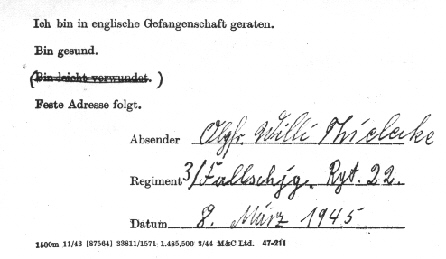
Willi Thielecke's first contact with home after his capture in Holland on March 1st 1945. It informs only of the fact that he is in English captivity.
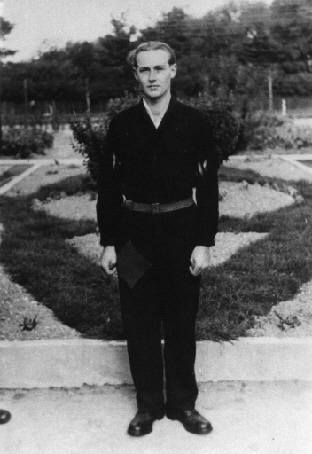
Obergefreiter Willi Thielecke
Born, 1923
Willi Thielecke was born
in 1923 and conscripted into the Luftwaffe on 15th April 1942. He was drafted
into Luftwaffe Radio Intelligence and after basic training he recieved
Radar Training and became a Radar Mechanic.
After the completion
of his final exams Willi Thielecke recieved orders to join a Radar unit
in France. He joined a Freija Radar unit in Arrus and then moved to Evreuse.
"In Evreuse I met Otto Wunder
from Hamburg. We understood each other from the first minute and became
best freinds. We were together in France as well as in captivity. We are
still joined in freindship".
"In the middle of August
1944, we blew up our Radar units and tried to march back toward Germany
when the Allies closed on our position. Near the Lorraine border we were
given new Radar units but they did not go into action".
"Why should they ? It was
sensless. So I can say that we were out of work, so we volunteered for
the Fallschirmtruppe because we were members of the Luftwaffe. It seemed
the best decision for Otto and me. We moved off to Gardelegen, a small
garrison town for Paratroops. (35km from my home town). We were gathered
in a big hall. Here we began training and exercising. There were active
paratroopers there as well. I recieved no parachute training whatsoever".
"When enough men had gathered
in Gardelegen they were sent somewhere into action under the name of Fallschirmjäger
to be used in the ground role. These were men who had been aircrew, ground
crew and other Luftwaffe personell. Only the officers and a hand full of
the men were actually Fallschirmjäger. It was soon my time to leave
Gardelegen. In November 1944, Otto and my other comrades boarded a goods
train headed for Winterswijk in Holland. In Winterswijk we recieved our
basic Infantry training. After the completion of this training we had to
march to our new position at Roermond".
"In the middle of February
1945, the front line was about to break down. The 22nd Regiment, to which
I belonged had to march fast to get to the front. We came to a bridge near
Weetze, which had been taken by British troops". (a village near the
border of Germany and Holland).
"We recieved the order to
take back the bridge. The attack was unsuccessful. I remember the words
of our platoon commander, Leutnant Schreiber; "So boys, now we go very
slowly like we go to a funeral". He also did not see the sense in it.
During this operation around 40 men from the 2nd & 3rd Battalion's
were captured on March 1st 1945. I was one of them".
Willi Thielecke's first contact with home after his capture in Holland on March 1st 1945. It informs only of the fact that he is in English captivity.
"I spent time in POW
camps 2226 and 2224 near Ostende in Belgium. This time was very bad, with
awful food and rationing. I was transferred to England at the beginning
of May 1946. I only weighed 44kg and I was 5ft 5inches tall. The POW camp
29 in Royston
(Herts),
was substantially better for me and my comrades.
I can say that we led a fairly normal life. We ate enough food and during
our spare time there was a variety of things to do, eg, cinema, sport,
magazine subscription club. Camp 29 was a work camp and most of my comrades
worked on farms. I worked at the Rubber Company in Letchworth. We went
to work by lorry every day. In Letchworth I met lots of nice English friends".
"I was discharged from captivity in February 1947 and went hom to Germany. After the reunification of both German nations I was allowed to visit England again and search for my old freinds, but unfortunately most of them had died. I came into contact with a few, who we met on our visit.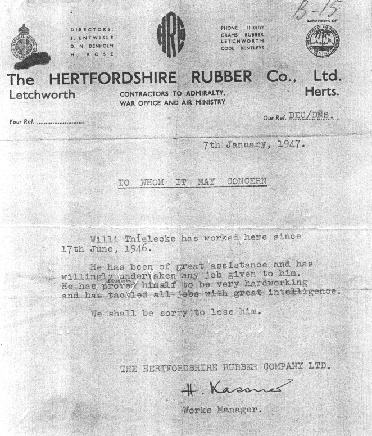
A letter of reference written by the Hertfordshire Rubber company for Willi Thielecke
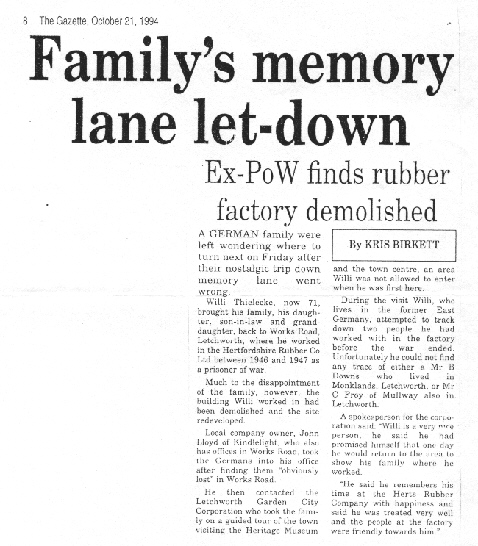
A paper clipping from a local Newspaper in Hertfordshire after Willi Thielecke's visit The factory in which he worked as a POW had been demolished.
"Here is a short anecdote
from my time as a POW in Belgium":
"One morning we woke up and could not believe our eyes. We saw a swastika flag flying from the top of a tree. It was 20th April 1945 - Hitlers birthday. The culprits could not be found anywhere. Around 100 prisoners from the camp were randomly chosen and deported immediately to England for re-education. My freind Otto Wunder was one of these soldiers and we lost sight of each other. It was not until 1982 that we met again by chance. Now we visit each other every year.
Willi Thielecke currently
lives in Beetzendorf, Germany
Return to veteran homepage