Generaloberst Kurt Arthur Benno Student
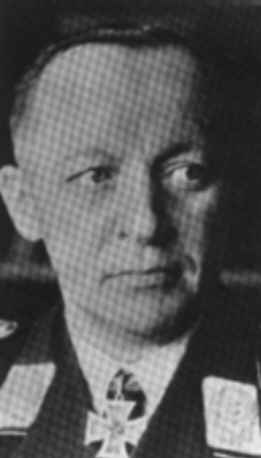
"If I only had such resources at my disposal" - Holland
1944
Generaloberst Kurt Student
Born - 12th May 1890, Birkhonz, Germany
Died - 1st July 1978, Lemgo, Germany
Kurt Arthur Benno Student was born in Birkhonz, Germany on May 12th
1890, the 3rd of 4 sons. At a young age he wanted to be a doctor but his
family could not afford the school fees. At the age of 11 he was enrolled
into a Military school where he would spend the next nine years until 1910
when he joined a Prussian Infantry Battalion at the age of 20. Later that
year he was promoted to Leutnant.
At the outbreak of the 1st World War, Student volunteered for air service
and joined a fighter squadron as a pilot, becoming a successful flyer.
In 1917 he was seriously wounded and by the time he recovered the war was
over, he returned to Germany disgruntled like so many others.
Post war he became busily involved with the planning of the new Luftwaffe
which was disguised within many of the countries Glider Clubs. He then
spent the next 5 years with an Infantry unit to gain promotion. After this
tour of duty he was appointed Director of Technical Training Schools under
the ministry of Aviation headed by Hermann Goering. In 1935 the Luftwaffe
was brought out of the dark and Student was given the job of Commander
of the Test Centre for Flying Equipment and was promoted to Oberst.
Early in 1938 he was given command of the newly raised 7th Flieger
Division. After witnessing Soviet Airborne exercises he went to work on
laying the foundations of the German Fallschirmtruppe.
It was Student who started to look into the use of Gliders in combat,
leading to the design and production of the DFS-230 Light Assault Glider.
On September 1st 1939 when German forces attacked Poland, Student’s
7th Airborne, now amalgamated with the 22nd Airlanding Division was only
partially formed. Still, it was not given its proper use in the Polish
campaign.
Hitler then turned his attention westward and Student went to work
planning the assaults that would take place in Norway, Denmark, Belgium
and Holland.
He personally commanded the 7th Flieger when they dropped into Holland,
landing with his staff on the 10th May. On the 14th whilst negotiating
a peace with Dutch forces in Rotterdam he was accidentally shot in the
head by a member of the 1st SS Panzer Division whose unit had stumbled
across the building being used for the negotiations.
He would be out of action for several months and did not return to
active service until January 1941, he returned promoted to General der
Flieger, aswell as having been awarded the Knights Cross.
Whilst in convalescence in the summer of 1940, Student drew up an outline
plan for the Airborne invasion of England, these were rejected by many
and by mid September Sealion had been called off.
The Mediterranean would next be the subject of Student’s planning.
He was ordered to look into the feasibility of air assaults on Gibraltar,
Cyprus, Malta and Crete. After long consultation with the Führer,
Student managed to persuade Hitler that Crete was a necessary objective
and it could be carried out by his 7th Flieger Division. Before the plans
for the invasion of Crete were finalised there would be another air assault,
one without the knowledge of Student. This would be the airdrop on the
Corinth Canal in southern Greece.
Student’s plans for the invasion of Crete were for a 4-prong attack
in 2 waves, one in the morning at Maleme and Chania. The second in the
afternoon at Rethymno and Heraklion. All objectives were on the north coast
of the island and all held vital airfields, which would be used for airlanding
Gebirgsjäger.
Unknown to the Germans, Crete had been reinforced by troops evacuated
from the Greek mainland and plans of the invasion had been intercepted
via Enigma.
Student set up his HQ for the operation in the Hotel Grande Bretagne
in Athens, patiently awaiting the start of the assault.
In the morning of the 20th May 1941, the aerial armada set off for
Crete, whilst Luftwaffe bombers pounded targets all along the northern
coast.
The German Airborne forces suffered heavy losses over the next couple
of days, not just to men but to irreplaceable material. On more than one
occasion, Student thought that the campaign was lost until Allied forces
evacuated positions around Maleme airfield in the west of the island. This
enabled desperately needed reinforcements to land in the shape of General
Ringel’s 5th Gebirgs Division. General Student and his staff were flown
into Crete on the 23rd May to personally recieve reports of the battle.
By the end of May the situation had changed, the British forces were
on the run, closely followed by German Paras and Mountaineers. By the beginning
of June the British had started to evacuate the island.
Crete had been successful, but costly. So much so that Hitler stated
"
the day of the Paratrooper is over".
The Fallschirmtruppe would now be used as conventional Infantry on
all fronts, especially in Russia, with the exception of several small Airborne
operations.
Student came up with the idea of an Airborne Panzer Grenadier Division
and by using 150 Gigante Gliders and 300 DFS 230’s could attack munitions
factories behind the Russian lines or cut off the British supply routes
in the Nile Valley. These ideas were promptly turned down by OKW.
Student’s planning skills were called upon again in 1942 when he put
together plans to assault Malta. This like many other of his plans never
came to light, this time due to Hitler’s reluctance to rely on the Italian
Navy.
In July/August 1943, Student again was planning an air assault. This
time it was a joint Luftwaffe/SS operation to rescue the imprisoned Mussolini.
This mission was a complete success but was publicised as an SS operation.
On 27th September 1943, Student was awarded the oakleaves to his Knights
Cross.
Student’s next command came in July 1944 when he was to command the
new 1st Parachute Army which at that time existed only on paper. When this
formation was partially raised it was moved to Holland to halt the advance
of the Allied armies streaming up from France and through Belgium.
Student was stationed in Holland in September 1944 and was witness
to the Allied airborne landings. He said of these landings "If only I had
such resources at my disposal".
By the end of 1944 he was promoted to Generaloberst and given command
of Army Group H, to which 1st Para Army was subordinated. This was short
lived and he was replaced by Generaloberst Johannes Blaskowitz whom Student
became deputy. (1944 also saw the death of his son, KIA whilst serving
as a pilot in the Luftwaffe). He bore witness to the disastrous Ardennes
offensive when Army Group H was spread along a line in Holland protecting
the northern flank.
The 1st Parachute Army was to be Student’s last command of the war.
In April 1945 he was ordered to Mecklenburg in Northern Germany. Later
that month he was taken prisoner by British forces. So ended the career
of the father of the German Airborne Forces. A man who was against Nazi
ideology, but still served his country to his best ability.
After the war he was charged with war crimes allegedly taken place
in Crete. He was sentenced to 5 years in prison but served only 2. On his
release he settled in the Federal Republic of Germany where he died in
Lemgo on July 1st 1978 aged 88.
Return
to Commanders of the Fallschirmtruppe