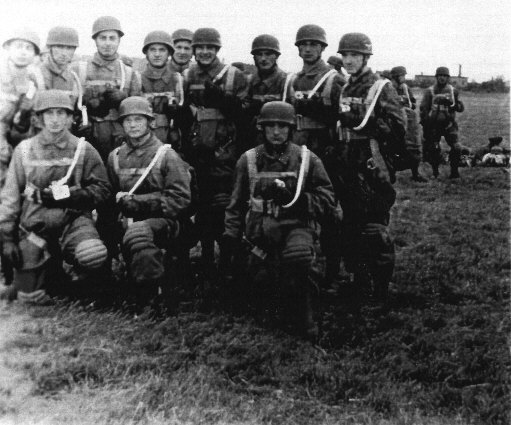
Gerhard Schneider with his 12 man training group about to board a JU52 for their last jump at Fallschirmschule III, Braunschweig.
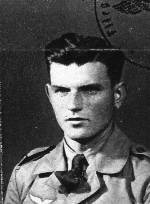
Memories of a Prisoner of War
Fortunately I am able to remember my time as a prisoner very well.
It cannot be compared with the suffering and hardships, which some other
comrades had to endure during the war.
One unusual part of my memories in connection with my prisoner of war
days is, that after all the hostilities of the war were over, I came into
contact with the former Camp Commandant.
After the Allied forces had landed in Algiers and Morocco in November
1942, I flew with Fallschirmjäger Regiment Barenthin in a JU52 from
Sicily to Tunisia and landed for active service.
(Gerhard Schneider was in 7.Kompanie, under the command of Oberleutnant
Brenneke, who was killed on 3rd March 1943 near Sedjenane. Kompanie command
given to Leutnant Meier and later Oberleutnant Wilhelm. II.Battalion was
under the command of Hauptmann Moll)
Gerhard Schneider with his 12 man training group about to board
a JU52 for their last jump at Fallschirmschule III, Braunschweig.
After the battle in the region of Mateur, we had to retreat from the
front during the night of 7th/8th May 1943. We walked towards the coast
in the direction of Tunis.
During the night we came across some Gebirgsjäger coming from
that area. They strongly advised us to turn back, since the coast was brightly
illuminated by flares, and bombers were dropping their deadly loads. We
now realized that our hopes to avoid being taken prisoner had been in vain.
The Gebirgsjäger were "mobile". An American truck carrying petrol
cans had somehow got behind the German front line and they were using this
vehicle as a taxi. We were not allowed to jump on, although it was by no
means a comfortable feeling to be sitting on such a barrel of explosives.,
considering the Tanks on the opposite side.
We spent the last night of freedom in a deserted base with our "taxi
drivers", two American soldiers.
The following day, 9th May 1943, American Tanks overtook us.
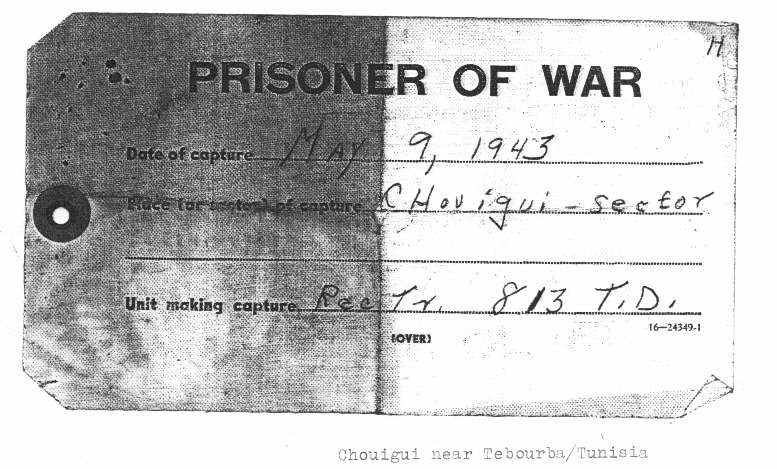
Gerhard Schneider's POW tag. He was captured at Chouigui near
Teboura in Tunisia on 9th May 1943.
My time as a POW began at an assembly point near Mateur. After a few
days, some trucks took us to the sea port of Bone in Algiers. I joined
a number of prisoners who were lining up in the road. Soon we were marching
off, the march ending when we boarded a French cargo ship in the port of
Bone. I felt happy because it could well have been a march into the desert.
These events have had a decisive influence on my way to the POW camp.
After a few days voyage through the Mediterranean, we arrived at the
port of Oran. All the prisoners were infested with lice and fleas, so after
having been deloused while still in port, we boarded an American Troop-ship,
enormous on size! During the same night we left Oran on our journey to
America, as part of a convoy of freighters, escorted by 12 destroyers.
As protection against torpedoes, steel nets had been attached all around
the ship. We had to stay below deck during our journey, but through the
portholes we could see the sea and the armada of ships. The voyage went
in a zigzag fashion without any unforeseen incidents. It was a pleasant
"cruise", although from time to time there were interruptions over the
loudspeaker to the crew about U-boats "all hands to battle-stations".
Disembarkment took place in Boston and the journey continued by train
to Camp Brekkenridge in Kentucky. After a few weeks I was one of a thousand
men who were moved to Camp Ashford General Hospital in White Sulphur Springs,
West Virginia.
"Special trains" each carrying 500 men, took us to our destination.
The camp was about 2km from the station on the outskirts of town. We sang
marching songs, guarded by American soldiers. We were wearing our uniforms,
complete with medals and decorations.
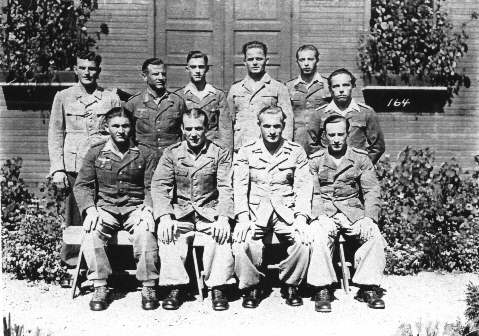
Gerhard Schneider, pictured 1st left on the back row, with his
comrades in their sunday suits at the camp.
The camp was situated in a wonderful scenic, mountainous landscape.
It was surrounded by a double fence, 3m apart.
Four watchtowers, manned with MG's and two searchlights, guarded the
camp. The huts were built, gable ends facing, on both sides of the street.
Each one accommodated 50 men. A separate "kitchen hut" with dining hall
served each kompanie of 250 men, another hut provided washing and toilet
facilities. A canteen was available for everybody. Another hut was used
for entertainment (concerts and films). Several other similar huts were
reserved for the sick, a workshop and the Camp Red Cross representatives.
Church services were held in a "special hut".
Living together was based on normal behaviour. Everyone tried to avoid
arguments and conflicts. Awkward situations were solved in a sensible and
peaceful manner. However, there were a few who found it difficult to adapt,
who couldn't get on with each other. Possibly the "camp-bug" had got to
them, but it never actually resulted in aggression or fights. On the other
hand, friendships lasting to the present day were formed and cherished.
There were many different talents and abilities among the thousand
prisoners. Soon, a camp band, a choir, sports-teams and a drama-group were
started. One of the band founders was, amongst others, Martin Ifland from
Thüringen, who had been a member of the "Stabsmusikkorp of Fallschirmjäger
Regiment 5". Our orchestra and our choir, and sometimes a combination of
both, gave us many lovely hours, especially on holidays. It certainly helped
to make our lives more bearable. The drama group had a very high standard.
Their production of very good Bavarian folklore stories could almost have
fooled you into thinking the "Bauerntheater" from Tegernsee or Berchtesgaden
were visiting the camp.
Our leisure time was spent by taking part in sports, watching films
and playing games. During the holidays we organised card games. Of special
interest to us was the offer of further education. There were language
course, shorthand, mathematics and German. Most of my comrades learned
English. Our teachers were highly qualified comrades, each in his specialised
subject. Another favourite pastime was carving (with a razor blade)
All mail from home, or sent home, was opened and censored by American
and German Authorities. Each letter was then resealed with a paper strip
and stamped by the respective officials.
We were not allowed any newspapers. Sometimes discarded papers were
smuggled into the camp, so we had some source of information about what
was happening in the outside world. Apart from that, our "radio experts"
had assembled a radio. To avoid being caught, we hid it under the floorboards
of one of the huts.
Alcohol was not one of the drinks offered by the canteen, but occasionally
one could buy a bottle of beer on Sunday's. To improve our quality of life
a little bit, the "association of wine-makers" turned fruit into wine.
The containers were hidden under one of the huts. This illegal production
was discovered when a few comrades were moved to another camp and the farewell-party
became to noisy.
There were very few tools in the workshops. Some comrades used primitive
tools to make a plane. When the camp was disbanded an American Officer
accepted it as a souvenir. To enhance the appearance of the camp, flower
beds were put in and I saw a Kolibri for the first time.
One comrade was not destined to return to his homeland, he died at
the camp and was buried on 12th March 1944, with full military honours.
Unteroffizier Hoffmann (Pastor), officiated the ceremony.
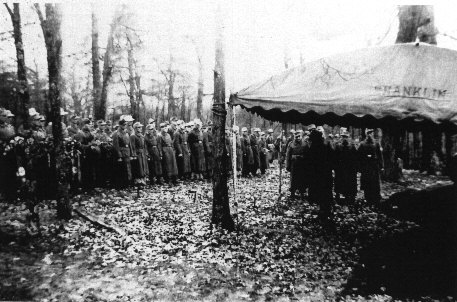
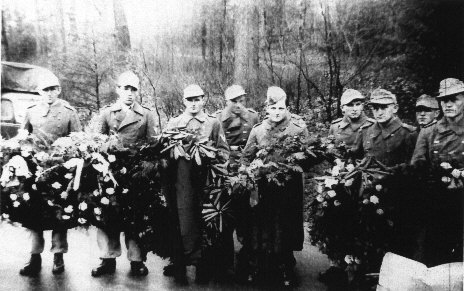
2 photographs taken at the funeral of one of the camps inmates.
He was buried with full military honours. The men in the right hand photo
mark their respect for their dead comrade with wreaths.
The sister of one of our comrades lived in America. She often visited
him at the camp.
All prisoners had to work outside the camp. Trucks belonging to the
camp took us to our places of work, or farmers would come and collect us.
We were always accompanied by guards. Our work-clothes were dyed American
uniforms. On the back of our jackets and at knee level of our trousers,
the letter P.W (abbreviation of prisoners of war) had been painted. Our
own uniforms were our "sunday suits".
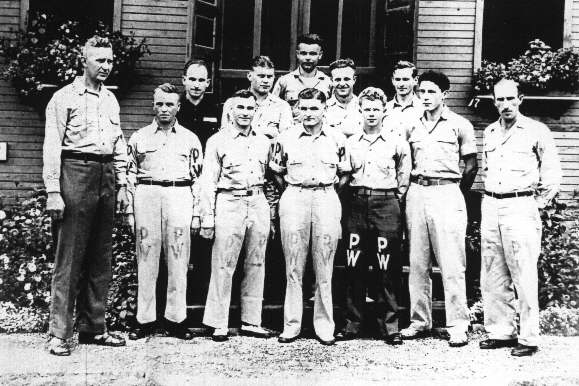
A prisoner work party with the aforementioned P.W insignia on
the trousers.
In 1942, the US Army acquired the famous "Greenbrier Hotel" and used
it as a military hospital. For the next 2½ years, this establishment
became my place of work. It would be to much to mention the many experiences
I had, but I would like to mention a few.
I was the only P.W among five Americans working in the basement catering
department of this huge building complex. Teamwork was very good and I
was treated as a colleague and immigrant. It didn't take me long to get
used to my new work environment. Since my American colleagues liked to
spend the weekends with their families; and the chef trusted me and my
acquired skills, I was left in charge of Sunday duties on my own for two
years. There were about 3000 patients in the hospital as well as personnel.
It was like a small town. Supplies of every kind had to enter the hospital
and be delivered to the kitchen. Other P.W were also working at the hospital.
Among other places, in the butchery and bakery, in lifts, laboratory and
the laundry.
On one occasion I was told to accompany a Sister (she had the rank
of an officer) back to her home. The trust, which such a request showed,
made me feel really good and proud.
At one time a number of wounded American soldiers arrived who had been
treated and cared for in Germany. They were sent home through a "Red Cross"
exchange agreement. A commission of military doctors met to assess the
wounded soldiers and word got around that the commission had been very
pleased with the skill of operations and had praised the good work of the
surgeons.
The American Army also chose the hospital as a place of rehabilitation
for some Army Chiefs of the highest rank. Apart from General Bradley and
Wainwright, General Eisenhower also came to stay. He lived in one
of the country houses in the grounds of the hospital. As an expression
of the respect, a bronze bust was unveiled, and the General in command
of the hospital gave a reception.
For this occasion, the bakery of the house made a wonderful cake, most
impressive in confectionery skills and size, (it had to be transported
by truck). Perhaps it is worth mentioning that a Gefreiter from Dortmund
(a master baker) had been very much involved with the creation of this
work of art. The officer in charge was so thrilled that he arranged previews
for groups of officers in the house. In general, the Americans held
the skilled P.W workers in very high regard.
On returning to camp from work we were body searched by guards, to
ensure that nothing illegal was being carried. As time went on, the
body searches became less intensive, trust on both sides was established.
We got on well with the guards.
At 5pm at the signal of a trumpet, all kompanies had to stand to attention
in the camp street as the American flag was lowered. The food in the camp
was good and there was plenty of it. Medical treatment was administed either
at the camp sick bay or the local hospital.
In the evenings we went for walks within the camp perimeter, but kept
our distance from the brightly lit up fence area. There was no lack of
conversation. Our thoughts were often with our loved ones at home, wondering
how things were. We had already accepted the fact that Germany's
capitulation was inevitable. When it finally happened, all went quiet,
everyone's thoughts were with their loved ones at home.
Our manner was polite and disciplined and the Americans reacted accordingly.
In short we were well respected. Because of our behaviour and manner
we somehow contributed even then to a better understanding between all
people. We experienced fair and humane treatment, according to the
Geneva Convention.
The return of the prisoners of war began towards the end of 1945 /
beginning 1946. Before leaving for Camp Shanks near New York, we
all attended a course at Fort Eustis, Virginia. It was run by American
soldiers and designed to improve and widen our knowledge and understanding
of the American way of life, the history, development and government of
the USA.
Eventually we boarded a ship to Le Havre. It was like a bolt out of
the blue when we realised that our accommodation was under canvas and that
we had to lie on bare boards. We we longing to get back to our huts.
Some of the comrades were approached to join the Foreign Legion.
There was also a search for former Legion members who had changed sides
in Afrika. Luck was on our side again, when, after a few days in Le Havre,
we were taken by goods train right across France and Germany to Bad Aiblingen,
to be discharged. The gate to freedom opened for me at the beginning of
1946, but although I had regained my freedom, I had lost my home, and I
had no place to go. The search for accommodation and work started.
At the end of my prisoner of war days I received a cheque for a few
dollars from an American bank, which I had earned during my time in the
camp as wages.
The following coincidence proves how small the world can be.
After the closing of the POW camp, the camp commandant was posted to Germany.
I was one of three former POW who attended a meeting at his flat in Munich-Harlaching.
Eventually the Colonel was promoted to military governor of Garmisch-Partenkirchen.
Here, a comrade from Grainau literally ran into him in the street. Our
former camp commandant then invited him, his wife and daughter to his residence.
In 1950 I took part in an extensive "study tour" through the USA, which
had been organised by the US department of Labour. During a stay
in Pittsburgh, I flew to Columbus and visited the Colonel. We had
kept in touch by letter since our meeting in Munich. By then he had left
the Army and was holding a high position as a lawyer.
Sometime during my study tour I was given the opportunity to
visit the place of my prisoner of war years, and to spend a few days there.
From Washington DC I took the train (Chesapake and Ohio railroad) to my
destination, a journey of about seven hours.
Fate intervened and at the reception of the Hotel where I was staying,
I met a former colleague (Mrs Bell) who had also worked at the hospital.
Once again the former POW was welcomed with open arms. and I was given
every possible assistance.
The camp was know as "POW camp Ashford General Hospital" and was situated
in White Sulphur Springs in West Virginia.
The town, founded in 1772, is a famous holiday resort, overlooking
the valley of the Green Brier river. The news of a former POW visiting
soon spread, and I met many Americans who were very pleased to see me.
I was made very welcome wherever I went and was given every possible assistance.
I also visited the place where I used to work and had a reunion with the
chef, an occasion which was marked with the opening of a bottle of whisky.
The Green Brier Hotel which had served the American army as a military
hospital had been taken over again by the owner, is know for its very high
standards. Once again I walked along the road from the station to
the site where the camp once stood. I spent quite a while reminiscing
about my time as a prisoner. For me that visit was a most moving
experience. From the place I spent a few years of my life, I travelled
to New York a 13 hour train journey, to catch my flight back to Frankfurt.
My temporary travel pass at that time is a historic document, since
it was issued by the "Allied High Commission" in Germany. Germany
did not get full sovereignty until later.
Gerhard Schneider currently resides in Viersen, Germany.