Oberst a.D. Gerhart Schirmer
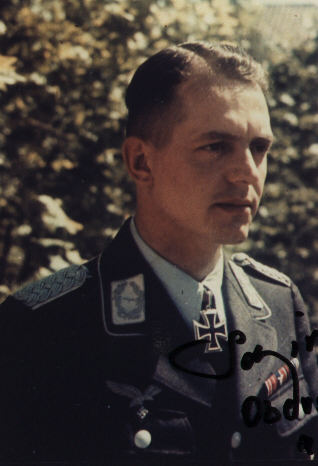
Born - 9th January 1913, Chemnitz, Germany
I have been corresponding with Gerhart Schirmer over the past couple
of years now. Although 88 years old, he has been kind enough to share with
me accounts of his service in WW2 as well as his captivity and post war
military service. I have read many biographies of Herr Schirmer, many are
incorrect and I hope to shed some light on his service in the Fallschirmtruppe
with the following Bio.
Gerhart Schirmer was born on January 9th 1913 in Chemnitz, Germany.
On April 6th 1932, he entered the Saxony State Police. On October 1st 1934
he was promoted to Leutnant. On September 1st 1935, Schirmer was accepted
into the Luftwaffe Pilot Training School at Oberschleißheim and on
March 1st 1936, was made Staffelkäpitan of 4.Kompanie at Oldenburg.
On October 1st 1937, Schirmer was promoted to Oberleutnant and on December
1st was made Chef der 5.Kompanie Flieger Ausbildungs Regiment at Quedlinburg.
He transferred to the Fallschirmtruppe on May 1st 1939 and on September
15th was given command of 6/FJR2 at Tangermünde.
With the invasion of Poland on September 1st 1939, 6/FJR was flown
in to secure the airfield at Deblin. Schirmer and his kompanie stayed in
Poland until October 15th.
On May 10th 1940, 6/FJR2 parachuted onto Holland to capture the airfields
at Wallhaven and Valkenburg. 2 hours after landing JU52's started to bring
in men of the 22nd Air landing Division. In June/July 1940 the newly promoted
Hauptmann Schirmer took part in Operations in Norway.
On April 26th 1941, 6/FJR2 parachuted into Corinth with the aim of
cutting off retreating British and Greek forces. Hauptmann Schirmer took
command of II/FJR2 when its commander Hauptmann Pietzonka was injured.
Hauptmann Schirmer successfully took the airfield near Argos on the west
side of the Peloponnese after getting there in captured trucks. For his
leadership and courage he was recommended for the Knights Cross.
On May 20th 1941, II/FJR2 was part of Group East in the Invasion of
Crete. They were due to takeoff from Greece at midday but many aircraft
from the morning wave never returned. At 1035, Schirmer's assault orders
had to be modified as only 37 out of 52 aircraft were available to carry
his battalion.
The majority of the battalion set off in the afternoon of May 20th
and were dropped on the western side of Heraklion. They met little resistance
from the British and Australian defenders but met slight partisan activity.
Schirmer led an attack on Hill 296, an important objective before Heraklion.
The town finally fell on the 28th May after British and commonwealth forces
were evacuated. Hauptmann Schirmer remained in Crete until June 15th.
On July 14th 1941, Schirmer was ordered to the Luftwffe HQ at Goldap
in Eastern Prussia. Hermann Göring hosted a reception, made a speech
and invited the attending 15 officers & 1 NCO to lunch. At 2pm Hitler
made a speech in his command post at the Wolfsschanze in East Prussia.
Hitler issued a description of the Eastern Front situation and personally
handed out the Knights Crosses. In Schirmer's own words, "this took
place without any emotions".
In November 1941, II/FJR2 was ordered to Russia after being held in
reserve in Germany. They were sent as reinforcements to Army Group South
in the Ukraine who were on the defensive due to mounting Russian pressure.
FJR2 was subordinated to a Fallschirmjäger Kampfgruupe under the command
of Generalmajor Alfred Sturm and took up positions along the River Mius
near Charzysk.
When the Soviet High Command switched their attacks to the Yuknov front
on the River Mius, Kampfgruppe Meindl was rushed from the north to help
stabilize the situation. II/FJR2 was moved northward in March 1942 to the
Volkhov front near Leningrad. They saw heavy action near Lipovka and only
with the help of Army SP guns did they plug the gaps in the Russian line
of advance. In June 1942, II/FJR2 was sent back to Germany for rest and
refitting.
In November 1942, Hauptmann Schirmer was the tactical operations officer
at the HQ of FJR5 in Italy. At 2230 on November 11th he was given orders
by the regimental commander, Oberstleutnant Koch. He was to secure the
city of Tunis in an advanced assault commanding the 8th & 9th Kompanies.
At 0230 on November 12th, 24 Ju-52 Transport Aircraft took off from Caserta.
The unit had no maps at all and the envoy, Dr.Rahn, brought maps in a shop
in Tunis after they landed.
The main part of FJR5 arrived in Tunis between 13th/15th November.
Under orders from Oberstleutnant Koch, Hauptmann Schirmer assumed command
of III/FJR5 on November 16th 1942. At the end of February 1943 he assumed
command of FJR5 when Koch was ordered back to Germany.
From February-April 1943, 3 battalions from the Fallschirm Panzer Division
"Herman Göring" arrived in Afrika and FJR5 was subordinated
to them. In the first days of May, Generalfeldmarschall Kesselring ordered
that Schirmer and Oberst Schmidt (commander Panz Div HG), fly back
to Caserta in Italy.
From Italy, Hauptmann Schirmer went to Halberstadt in Germany to rebuild
II/FJR5 from men on leave and former wounded. On June 1st 1943, Schirmer
was promoted to Major and II/FJR5 was sent to Italy with the rest of the
2nd Parachute Division. The battalion was stationed in Italy until November
when it was sent to Russia with the rest of the 2nd Division. The bulk
of FJD2 arrived between November 17th/27th and took up positions east of
Zhitomir. On December 15th, FJD2 was airlifted to Kirovgrad where they
took part in fierce fighting near Novgorodka.
On January 12th 1944, II/FJR5 were returned to Germany as they had
ceased to exist as a fighting formation.
On his return to Germany in January 1944, Major Schirmer was promoted
to Oberstleutnant and given command of FJR16, which was being built at
Halberstadt. In May 1944, FJR16 was ordered to go to Albertville on the
channel coast. At the beginning of June they were ordered back to their
HQ towns. I/FJR16 & 13/14 Kompanies to Wittstock, II/FJR16 to Stendal
and III/FJR16 to Salzwedel. The whole regiment was trained in airborne
night assaults. The regiment participated in a training airborne assault
near Wittstock. (General Student was present). It was intended to
use the regiment for an assault against English and American formations
on the channel coast during the first night of the allied invasion. This
operation never took place because Hitler refused the plans.
On July 7th 1944, FJR16(ost) was sent to Lithuania on the ever
shrinking eastern front. The regiment found themselves trapped around Vilnia
and the 21st Fallschirm Pioneer Regiment was sent to breakthrough the Russian
line.
Fallschirmjäger Regiment 16
Regiment Stab: Kommandeur - Oberstleutnant Gerhart Schirmer
Adjutant - Oberleutnant Zimmermann
Fm.Offizier - Hauptmann Mayer-Graab
Rgt.Arzt - Oberstabsarzt Dr.Nödl
Ia - Ofw Heine
IIa - Ofw Guder
IIb - Ofw Scheps
Rgt.Nachrichtenzug - Ofw Lauterbach
Rgt.Radfahrzug - Ofw Bruchmann
I.Battalion with Stab, Stabskompanie and 4.Kompanie - Major
Teusen
II.Battalion - Hauptmann Hoge
III.Battalion - Hauptmann Wangerin
13.Kompanie - Oberleutnant Amberger
14.Kompanie - Oberleutnant Richter
15.Kompanie - Oberleutnant Herzog
FJR16 managed to breakthrough to the west and saw further action in
East Prussia and the Memel Bridgehead where the regiment was added to the
Honour Roll of the German Army.
On November 18th 1944, Oberstleutnant Schirmer was informed that he
was to be the 657th recipient of the Oakleaves to the Knights Cross.
In February 1945, Schirmer was posted as 1a of Fallschirmjäger
Ausbildungs Division.1, which was just being built in an area north of
Berlin. The commanding officer was Generalmajor Paul Conrath and its HQ
was in Berlin. A supplementary division was built for the 1st Parachute
Army from 2 training divisions. The first training division contained men
from all of the Luftwaffe training schools.
In his own words, Schirmer wrote, "I ordered the commander of the
division, Generalmajor Großschnitzel to immediately move westward
with 8000, 18 year old recruits in order to cross the line Hamburg-Lübeck.
These young men knew nothing about war; they would have become easy victims
for hostile cannons! After that I built a fine combat unit and I was ordered
to fight at the Ower River near Schwedt".
On April 30th 1945, he reached Hamburg with his staff of about 50 men.
He stayed in a garden restaurant just outside the city. On May 1st, Hamburg
surrendered. Oberstleutnant Schirmer, Hauptmann Wangerin and Leutnant Halmes
drove into the city in a Kfz15 to offer their surrender to allied troops.
When they reached the city hall they came across an English tank squadron.
A German speaking officer accompanied them back to their accomodation and
from there to new accommodation at the Police barracks at the Dammtor station,
where they received new identity papers.
On May 3rd, Schirmer returned to the city hall in Hamburg with Hauptmann
Wangerin. On the way they came across an English medical unit who took
all their valuables (Schirmers German Cross in Gold and Watch).
Schirmer and his staff were handed over to the Soviets and he was kept
in captivity until January 12th 1956, nearly 11 years.
He was imprisoned at Sachsenhausen in Germany and Workuta in Eastern
Russia. (He has written a book since then called, "Sachsenhausen-Workuta,
Zehn Jahre in den Fängen der Sowjets") . It was only after the
intervention of Chancellor Ardenauer in the 50's, that Schirmer and many
other German POW's were released by the Russians. They were reluctant to
give up prisoners, even though they had been in captivity for many years.
Persistence by the German government secured the release of many POW's,
but many thousands had died whilst in captivity. Upon his release, Gerhart
Schirmer travelled with his wife from Leipzig to a new home in West Germany.
They left behind everything they owned.
On December 1st 1956, Gerhart Schirmer joined the Bundeswehr and became
commander of the 1st Fallschirm Brigade. On April 1st 1959, he was promoted
to Oberst. In 1963 he was given command of II.Korps der Heeresflieger and
retired from the Bundeswehr on April 1st 1971.
He is a member of the Bundes Deutscher Fallschirmjäger e.V. and
the association of Knights Cross winners. He currently resides in Lauf-Anbach,
Germany.
Return
to Commander page