Fallschirmjäger on the Eastern Front 1941-1945
"When Barbarossa opens,
the world will hold its breath" – Adolf Hitler
With photographs & documents courtesy of Hans
Pohlmann, Conrad Schubert, Mattias Pingittzer and Wolfram von Beck
The opening stages
June 22nd 1941, saw the opening shots of Operation Barbarossa, Hitler’s
long awaited offensive in the East. A campaign that was estimated would
take 8-10 weeks to complete.
In the early hours of 22nd June six thousand Artillery pieces signalled
the start of the conquest of the east. Three army groups poured into Russia
on a 1500 km front. The Luftwaffe destroyed the Russian airforce on the
ground within the first few hours. The Panzer divisions rolled east supported
by the Luftwaffe. Mechanized infantry followed, clearing pockets of resistance.
Army group North (General von Leeb) was to pass through East
Prussia, the Baltic States and ultimately Leningrad on the Baltic coast.
Army group centre (General von Bock) was was to strike eastwards
toward Minsk, Smolensk and eventually Moscow.
Army Group South (Field Marshall von Runstedt) was to advance
southeast to the Ukraine destroying Russian forces between the Pripet marshes
and Kiev, their main objective.
Within days the German forces had captured hundreds of thousands of
Russian troops.
The German advance seemed unstoppable, by the 26th June Army Group
North had reached the river Dvina, by the 2nd July they had crossed this
major obstacle that formed part of the Stalin line. By the 26th July, Army
Group Centre had reached Smolensk. Army Group South took Kiev on the 19th
September. There was success after success but the advance was soon to
slow down. By the end of August 1941 Army Group North had cleared the Baltic
with the exception of the city of Leningrad. The city had become partially
encircled by German and Finnish forces. Lake Ladoga, situated to the east
of the city became the lifeline for the defenders and population of Leningrad.
Hitler had decided on a siege rather than a frontal assault and all but
a few Panzers were sent to Army Group Centre for the oncoming drive to
Moscow. The pause in the advance gave the Russian forces time to pull itself
together, the cities defences were strengthened. The defenders of Leningrad
started to make probing assaults on the besieging German forces, exploiting
gaps in the line.
1941 The 7th Airborne Division goes east
After the huge losses in Crete, the 7th Flieger Division was ordered
back to its bases in Germany for rest and refitting. Operation Barbarossa
was to start without the Fallschirmtruppe. This break from battle was short
lived. At the end of September 1941 parts of the division were mobilized,
ready to be sent eastwards to fight as conventional Infantry. The 1st &
3rd Battalion's, 1st Regiment under the command of Generalmajor Bruno Bräuer
and the 2nd Battalion of the Sturm Regiment under the command of Major
Edgar Stentzler were sent to the German 18th Army (Army Group North)
on the Leningrad front.
Leningrad was situated on the eastern end of the Gulf of Finland, the
river Neva ran through it and 30 miles to the east was Lake Ladoga, a huge
expanse of water 60-70 miles wide.
The German forces backed by the Finns attacking from the North, had
partially encircled the city. The Russians held some ground on the western
side of Lake Ladoga but their foothold was being pressurized by Finnish
forces in the North.
Army Group North's battle line was only partial in the east of the
city, the Russians were only willing to exploit this weakly held line.
Facing this line were the troops of the Volkhov Front consisting of
several Russian armies. If they could break through this German line they
could hook up with forces within the city who were trying to break through
the western side of the line.
The Russians began the first of several attacks to exploit the weakly
held line to link up with Leningrad's forces with the aim of crossing the
River Neva.
It was on the River Neva that the first Fallschirmjäger units
were to see action on the Ostfront. Units of the 2nd Battalion, Assault
Regiment backed up by the 2nd Kompanie of the Fallschirm MG Battalion managed
to hold back numerous attacks by Soviet armour and massed infantry. They
took heavy casualties in the process. On the 7th October the men of the
Sturm Regiment were pulled out of the line to deal with another Russian
attack on a different sector of the River Neva.
The 2nd & 3rd Battalion's, 3rd Regiment under the command of Oberst
Richard Heidrich, reached the Leningrad front on the 1st October 1941.
They were to provide flank for the newly situated Assault Regiment on the
Neva, counterattacking small Russian bridgeheads.
The 7th Flieger Division's HQ arrived at the front in mid October and
took command of the sector held by the men of their division. Two kompanies
of the Fallschirm-Pioneer Battalion under the command of Major Liebach
arrived shortly after and went straight into action in woodland on the
west side of the Neva.
It was in its woodland area of Ssinyavino that the Russians had concentrated
huge amounts of men and material to try and break through to Leningrad.
The Engineers put up a brave defence in the woods of Ssinyavino, many
tanks being destroyed by grenades and mines. Russian troops advanced en-masse
and were cut down by heavy German MG fire. The Fallschirmjäger held
back the Russian onslaught but suffered heavy casualties. On the 16th November
the pioneer's were pulled out of the line after being relieved, they were
returned to Germany to be rested and refitted. By December the Fallschirmjäger
in the Leningrad area were pulled out and sent back to Germany.
In the meantime the 2nd Regiment had been in Germany held back as reserve.
This was short-lived as they were soon to be mobilized. In November, Army
Group South fighting in the Ukraine, was on the defensive. The harsh Russian
winter had set in and the German advance had started to slow down. The
Soviets taking advantage of the harsh weather launched attack after attack.
Army Group South found itself over stretched in the Ukraine and there
was a serious need for reinforcements. The 2nd Regiment along with the
4th Battalion of the Assault Regiment and one kompanie from the Anti-Tank
and MG Battalions were formed into a kampfgruppe and sent to the Ukraine
to bolster German forces.
This Kampfgruppe commanded by Generalmajor Alfred Sturm, were ordered
to defend a sector along the River Mius around the town of Charzysk. They
defended this sector throughout the winter of 1941 and into the early months
of 1942. The winter took its toll on Sturms men and heavy casualties were
incurred just from the weather.
(3000 fallschirmjaeger were killed, wounded or listed as missing
in that first winter in Russia)
The following photographs were taken during the winter fighting at
Smolensk, Rshew & Sobakino in the winter of 1941/42.
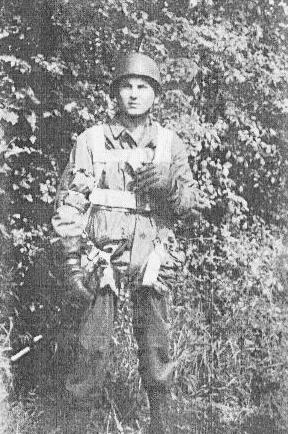
Hans Pohlmann. Veteran of Crete, Russia & Italy. Mentioned
in 14.Armee dispatches during the fighting in Anzio/Nettuno for leading
a platoon against overwleming odds and was made the hero of several Kriegsberichter
(war reporter) articles. He was reported as missing in action in Italy
and had actually been captured. The following photos were taken during
the first winter in Russia.
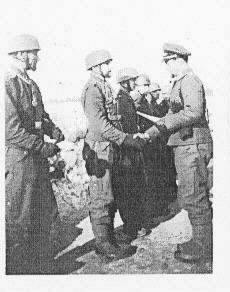
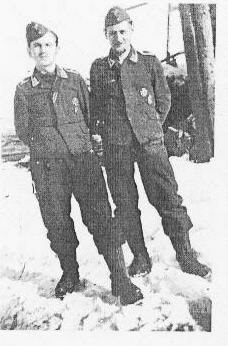
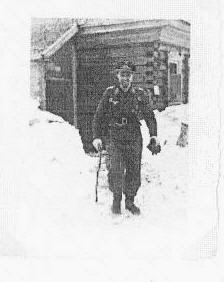
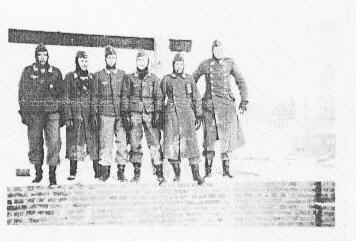
From left to right above:
-
Oberleutnant Vogel awarding the EKII to a member of his Kompanie.
-
Feldwebel Hans Pohlmann & Feldwebel Vopert
-
Oberleutnant Horst Vogel, Kompanieführer of 10./LL.St.Rgt outside
the company command post
-
On the platform of the Smolensk train station, 6 Oberjäger from
10.Kompanie - from left to right - Oberjäger Janowsky, 2 & 3 ?,
Oberjäger Pohlmann, 5 ?, Oberjäger Koch.
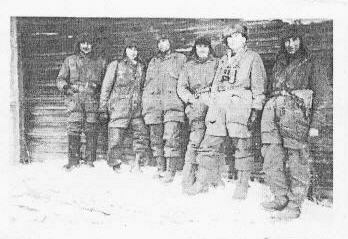
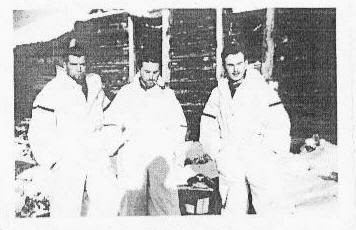
From left to right above:
-
Gruppe Pohlmann at Sobakino. Left to right - 1 ?. Oberjäger Pohlmann,
Obergefreiter Ferber, Oberjäger Jankowsky, 5 & 6 ?.
-
A minutes silence for fallen comrades. From left to right - Feldwebel
Pohlmann, Oberleutnant Vogel, Oberjäger Jankowsky.
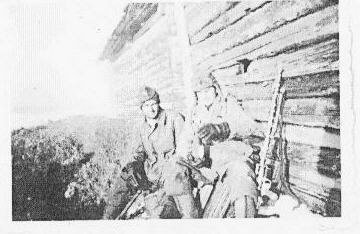
From left to right above:
-
A pause in the fighting at Sobakino. From left to right - Obergefreiter
Bergmann & Oberjäger Pohlmann with mortar shell.
-
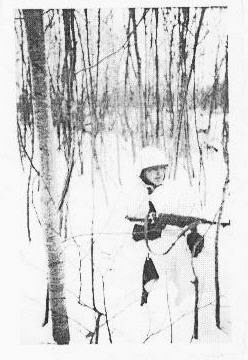
Feldwebel Pohlmann in action wearing winter camouflage
-
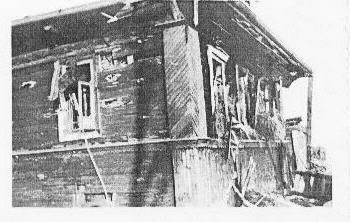
A bullet ridden house in the town of Sobakino
From left to right above:
-
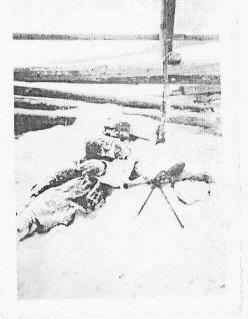
A dead Russian machine-gunner in the strong point of Sobakino.
-
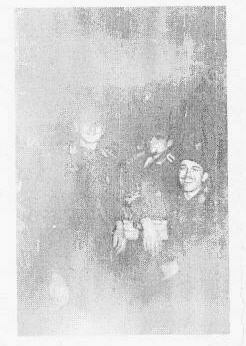
A moment to relax for the camera, (albeit a degraded photo).
1942 Moscow - so near yet so far
Kampfgruppe Sturm held their sector along the River Mius into the first
weeks of 1942, during the worst winter so far in the 20th century. They
held out against numerous Soviet assaults. Further in the North the situation
was worsening. Kampfgruppe Meindl was formed from the 1st Battalion, Assault
Regiment under the command of Major Walter Koch, parts of the Artillery
Regiment and the Regiment HQ. This small force was sent to an area near
the town of Vyasma, 95 miles east of Smolensk.
Kampfgruppe Meindl was joined by splinter groups from decimated SS
and Wehrmacht units who had taken heavy casualties in earlier fighting.
The Soviet High Command then switched their attacks to the sector held
by the 2nd Regiment on the River Mius, near Yuknov. Kampfgruppe Meindl
was rushed southwards to bolster the 2nd Regiment. They arrived in time
to hold back determined and fierce Soviet attacks. The battles of the Yuknov
sector raged on for weeks, with the paras holding back the Russians inflicting
heavy casualties on the attackers. Stavka, the Soviet High Command halted
their attacks in the Yuknov sector due to high losses. With the area now
secure, Kampfgruppe Meindl was sent North to an area around the River Volkhov
southeast of Leningrad to battle against Russian forces attempting to break
into and out of Leningrad.
In March 1942, the 2nd Regiment was moved from the south to the Volkhov
front in the north near to the area where their comrades in the 1st Regiment
had fought the previous year. When they arrived they were put under the
command of the 21st Infantry Division.
The Soviet forces of the Volkhov Front (Meretskov) and the North
West Front (Kurochkin) were regrouping their forces for a massive
offensive aimed at breaking the German ring in the east of the city of
Leningrad.
The 2nd Regiment were located in and around the small town of Lipovka.
It was on the 8th May that Russian forces attacked the town trying to break
through to cut an important road west of the town. The paras suffered heavy
casualties in the initial Artillery barrage. Masses of Russian Infantry
attempted to break the German line around the town, at some places they
penetrated the line but were contained by fierce resistance from the Fallschirmjäger.
On the morning of the 9th May Russian Jabos (ground attack aircraft)
softened up Para positions in and around Lipovka, Russian Infantry followed
up this attack, but were beaten back time and time again by the ever decreasing
numbers of determined Fallschirmjäger.
On the 13th May the Paras were reinforced by some tanks and Self Propelled
Guns, they managed to plug the gaps in the line created by the Russians
and forced them back to their start lines.
On the 14th May, the remnants of the 2nd Regiment were ordered to counterattack
Russian positions in woods east of Lipovka. (The Para commander Oberst
Sturm flew to Berlin to personally complain about this order from the commander
21st Infantry Division to whom they were subordinated, no doubt Goering
got to hear of it, but it probably fell on deaf ears).
The initial attack was fairly successful, under cover of an artillery
barrage they advanced on the enemy positions, inflicting heavy casualties
on the way. As the day wore on the Paras found that they were slowly being
outflanked by Soviet forces. They were forced to withdrawal taking their
wounded with them. By the evening of the 14th May they were back at their
start lines near Lipovka.
During the rest of May 1942, the survivors of the 2nd Regiment were
only used on Reconnaissance missions and during June were relieved and
sent westwards to rest and refit. Some fragments of the 2nd Regiment remained
behind in Russia but by July 1942 the Regiment was back in Germany.
In the summer of 1942 the majority of the 7th Airborne Division was
resting and refitting in Normandy, France. It was here that a 4th Regiment
was added to their order of battle to make up for the transfer of the 2nd
Regiment to North Afrika.
It was at the end of 1942 that plans were put together by Oberkommando
der Wehrmacht, for an airdrop in southern Russia to capture the important
oil fields in that region. This operation was cancelled in September and
several detachments from the 7th Airborne (6 Battalions from the 1st,
3rd & 4th Rgt's, a Pioneer Battalion, Artillery, AT & MG detachments)
were instead subordinated to Army Group Centre. The Soviets had been concentrating
large forces in front of the Army Group's sector with the possibility of
launching a massive winter offensive with the aim of driving German forces
from the approaches to Moscow.
The 7th took over positions near Smolensk, the scene of many attacks
by Russian forces over the past few months. They were tasked with defending
a 56 mile sector north of the Smolensk-Vitebsk highway. It was in the 7th's
sector that any Russian offensive was expected to take place.
The Division carried out many probing missions behind enemy lines to
reconnoitre the build up of Soviet forces facing them. Also during October
1942 they carried out small scale aggressive actions on Russian positions.
The actions of the 7th Airborne paid off as the Soviets chose not to attack
their sector but chose those defended by weaker German forces.
It appeared that the Paras would be spending another harsh winter on
the Eastern Front. The expected Russian offensive of late 1942 never came,
they were heavily engaged in the fighting to take Stalingrad in the south
and it was not possible to mount a second offensive west of Moscow. They
were containing the Germans, that was good enough for the time being.
As 1942 came to an end the front seemed inactive, with the Fallschirmjäger
of the 7th Fleiger Division only taking part in small scale actions. This
lull in the fighting gave the Paras an opportunity for training and building
up a good reserve for any eventuality in the future.
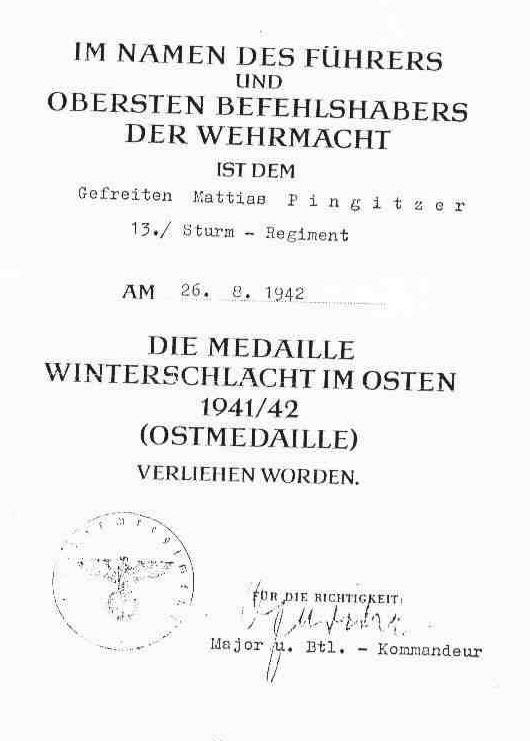
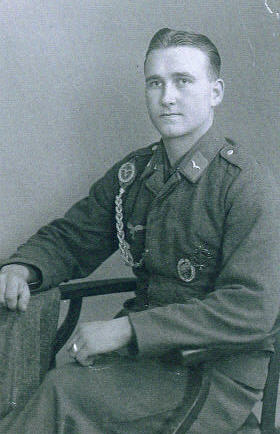
Certificate for the Ostfront medal awarded to Gefreiter Mattias
Pingitzer on 26.8.1942. He was a member of the Sturmregiment and saw action
in Crete before going to Russia. This is one example of the many Ostfront
medal certificates.
1943 7th Fleiger becomes 1st Parachute
It was at the end of March that the Russians opened their offensive
on the positions held by the 7th Flieger Division. The usual artillery
barrage was followed by massed infantry attacks. This offensive was timed
with the expected relief of the division and their transfer west.
General Richard Heidrich, commander 7th Airborne, halted all relief
attempts and the Paras stayed on to counter the Russian attacks. They held
out against superior numbers of men and armour and inflicted heavy casualties
on the Soviet forces. One battle took place at Lushki where men of the
3rd Battalion, 4th Regiment were holding positions on a hill. The Russian
onslaught was threatening to overun their defense line. The 3rd Battalion,
3rd Regiment was rushed in to help stabilise the situation. Between the
20th - 27th March 1943 these two Battalion's held back attacks by 2 Soviet
Divisions.
High losses to Soviet forces during this offensive led to a decrease
in Russian attacks.
The 7th Airborne Division now renamed the 1st Parachute Division was
relieved at the end of March 1943, once General Heidrich was sure that
his front was stable. They were transferred west, first to Germany then
to southern France where it was to join the newly raised 2nd Parachute
Division under the XI FliegerKorps.
The 1st Parachute Division had managed to contain a serious Russian
thrust. Other sectors were not so lucky. At the end of February 1943, just
before the main offensive aimed at Heidrich's positions, the 1st Regiment
was rushed to Orel some 150 miles south east of Smolensk to help contain
a Russian penetration in that area. They were subordinated to 46th Panzer
Korps and fought for three weeks alongside divisions of the the 2nd
Panzer Army until the breach had been sealed. They too left Russia at the
end of March. The only part of the 1st Division to remain in Russia at
this time was Kampfgruppe Meindl, which was subordinated to the 6th Infantry
Division.
This formation fought around Volkhov and Sobakino in the north. The
1st Battalion, Assault Regiment fought on until April when its survivors
were sent back to Germany. The 4th Battalion, Assault Regiment was the
last unit of Kampfgruppe Meindl to leave Russia. They fought in and around
Volkhov until they too were pulled out of the line in July 1943. July then
saw the German defeat at Kursk (Operation Zitadel).
The Soviet High Command then succeeded to throw back German forces
in southern and central Russia and had managed to create several bridgeheads
over the River Dnieper.
The Russian onslaught continued and all the German forces could do
was try and contain their advances. By November 6th, Kiev fell to the Russians,
by the 14th November Zhitomir was also in Russian hands.
In early November the 2nd Parachute Division was ordered to move from
their base in Italy to Russia, although they were 3 Battalions short due
to other commitments in southern Europe. The division was to take up positions
near the Russian held town of Zhitomir and contain any further enemy advances.
The bulk of the Division arrived in its sector between 17th-27th November
1943 under the command of General Gustav Wilke. It was subordinated to
42nd Korps and took up positions east of Zhitomir. The Paras were to relieve
the 1st SS Panzer Division. The Fallschirmjäger began to familiarize
themselves with the terrain by assisting the SS in an operation to clear
a wooded area near Radomsyl.
This assault started early on the 29th November, it met heavy Soviet
resistance and was hampered by bad weather of the third winter of Barbarossa.
The next day, a Kampfgruppe from the 2nd Parachute Division started
their attack on the Belka woods. The assault was successful in overcoming
the stiff Russian resistance. By the evening of the 1st December 1943,
one day ahead of schedule, the 2nd & 7th Parachute Regiments had taken
over responsibility of the sector from the 1st SS.
The small German gains in the area began to worry the Soviet High Command.
A large Russian force was assembled north east of Zhitomir with the aim
of smashing through the German defences and making for the River Dniester
further west.
Men of the 2nd Para took part in the defence of this German line. Wave
after wave of Russian Infantry were mowed down by concentrated MG and mortar
fire. Advancing Russian panzers were destroyed in their columns by tank
busting units. The Russians determined to strive for the Dniester were
undeterred by their huge losses.
The German forces managed to plug the gaps created by the Soviet advance
and even went on the offensive to drive Russian forces back to the River
Dnieper.
Further south at Kremechug, Russian forces broke through the German
line held by Army Group A. The 2nd Parachute Division was airlifted on
December 15th and flown to Kirovgrad, 80 miles south of Cherkassy (on
the River Dnieper).
They were immediately put into the line at Klinzy, several miles south
west of Kirovgrad backed by the 11th Panzer Division and the 286th SP Brigade.
The 7th Parachute Regiment was to benefit from the SP support when it would
counter attack on a 4 mile front in the Kamenka valley.
When the assault opened on the 16th December the Fallschirmjäger
managed some minor gains, knocking out several Russian tanks in the process.
The assault faltered later that day due to bad weather. The 17th was spent
regrouping forces and preparing for the renewal of the assault on the 18th
December.
The first objectives on the 18th were 2 hills heavily defended by Russian
troops. All through the day the Paras pounded the hills with artillery,
mortar and MG fire. They successfully took one hill in the evening of the
18th, the second fell early on the 19th.
Their main objective of Novgorodka could not be taken in accordance
with their schedule, the SP guns were pulled out of the line for servicing.
The 7th Regiment would have to wait until the 21st December to renew their
attack.
The Russians reinforced the town of Novgorodka and the surrounding
hills and when the attack resumed on the 21st the Russian defences were
too strong for the Fallschirmjäger to crack. The Russians were determined
to hold the town, no matter the cost in men and material. They threw in
thousands of men into the battle only to be mowed down by the Paras. The
advance started to falter and by the 23rd December the 7th Parachute Regiment
was on the defensive but firmly held on to their weakened line. The Russians
could not break through no matter what they threw at it.
It was the end of yet another year in Russia, another winter. The Wehrmacht
had suffered badly on the Eastern Front in 1943, Stalingrad, Kursk, they
were on the defensive all along the front. What would 1944 have in store
for the Fallschirmtruppe.
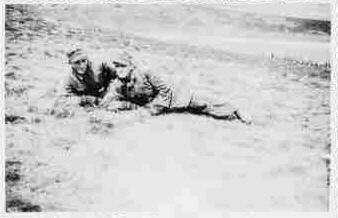
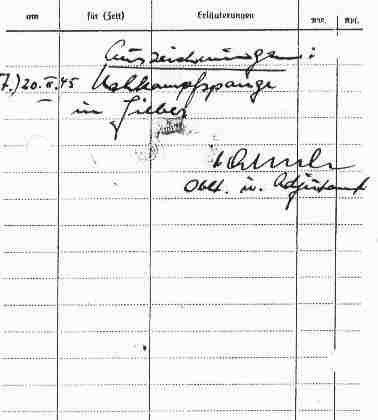
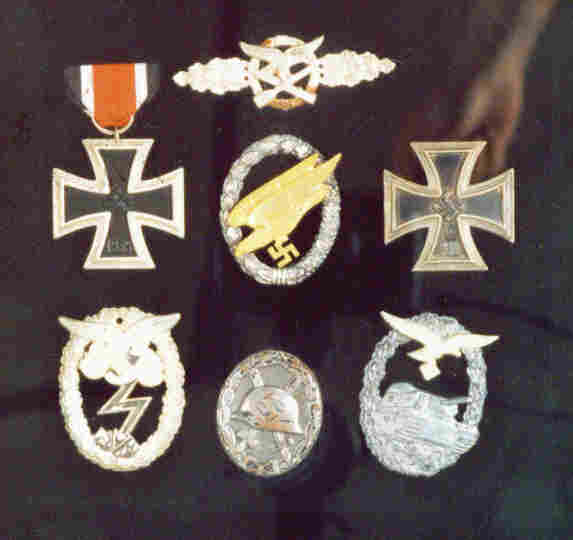
From left to right above:
-
Wolf von Beck (right) with his freind, Gefreiter Erich Kasper at the
Halberstadt training area. Kasper was later killed in Russia.
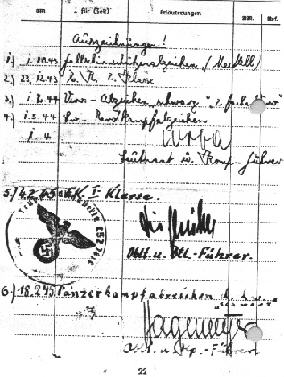
-
Wolfram von Beck spent the majority of his military service on the Russian
Front. In December 1943 alone he fought at Gahero, Wessely, Perwanensk
& Novgorodka. The two documents are copies of the awards section from
Wolf von Beck's Soldbuch. He was awarded the following:
Fallschirmschützenabzeichen - 01/10/1943 (Wittstock)
Iron Cross 2nd Class - 23/12/1943 (fighting at Novgorodka)
Wound badge in Black - 01/02/1944 (awarded whilst in hospital,
was wounded on 23/12/1943)
LW Ground assault badge - 01/05/1944 (awarded whilst at the
Halberstadt barracks)
Iron Cross 1st Class - 04/02/1945 (whilst fighting in east
prussia, promoted at the same time to FHJ-Oberjäger)
Tank destruction badge in black - 18/02/1945 (fighting in
east prussia)
LW Close combat clasp in silver - 20/02/1945 (fighting in
east prussia)
Extract from the memoirs of the Eastern Front by Wolfram von
Beck
On 9th November 1943, General Student came to see us and on a sports
field near Rome he issued orders for us to move to Russia. The next day
we boarded a train from Rome to Zitomir.
When we finally arrived in Russia, we received orders to relieve
a Waffen SS unit, which had almost been destroyed during the fighting.
I was the staff runner for Leutnant Bickel’s 1.Kompanie. He told me to
go and obtain a situation report from the Waffen SS commander. In order
to reach the SS command post quickly I decided not to use the road but
to follow the sound of guns through a wooded area. When I finally reached
the commander he reprimanded me about the absence of my unit. He then showed
me which part of the frontline we were supposed to occupy.
In front of his command post sat a Kubelwagen. It was full of men
just about ready to leave. I asked the driver if I too could jump on to
his vehicle and hitch a ride. He replied that it would not be a problem
but asked if I could lift the Unterscharfuehrer so he would not fall off
the rear of the vehicle. I was under the impression that these men were
wounded. They were not, they were all dead. The Waffen SS never left their
dead on the battlefield. Even their wounded men had to march.
I was glad to finally leave this hearse behind me and after reporting
back to Leutnant Bickel the Kompanie moved forward into the line. Our position
was near a so-called runway, a clearing in the middle of a large forest.
On the other side of the runway, Ivan was waiting.
After a day or so we made a dawn attack and drove the Russians from
in front of our positions. Suddenly, we received well aimed fire from a
thicket of trees. I quickly noticed the source of fire: the Russians had
removed the lowest branches from the trees so they not only had a good
field of fire but also a good view of any attacker.
Myself and a comrade, turned their flank and finished them off from
behind. My comrade, a machine gunner was hit. While he was dying he passed
me his wallet. All he could say was “Mama, Mama”.
I took the wallet and handed it in to Battalion. I do not know if
it ever reached “Mama”.
We were rolling up the whole Russian trench line but we stopped
in front of a soil covered bunker which had not been inspected yet. For
good measure we threw in two grenades and after the detonation, three smiling
unbruised Russians came out.
We were surprised that anyone could survive such an attack but we
naturally took them prisoner.
Our unit continued the offensive toward the direction of Kirovgrad.
Before Novgorodka we found ourselves alone, without friendly units on our
flanks. Leutnant Bickel ordered us to build a defensive perimeter on a
nearby hilltop for the night. I was now a number 2 machine gunner and the
number 1 was my friend Gefreiter Fritz. We dug an emplacement for our machine
gun at the front of the hill.
The Russians suddenly fired several shells from an anti-tank gun,
(called a Ratschbumm by the Landser, because the sound of the shot and
the hit were almost one). We joked that the Russians certainly needed some
target practice when after one detonation I found an arm and half of my
comrades chest in my lap. I lifted Gefreiter Fritz to see if I could help
him but he was already dead. I now dug faster and deeper in order to get
my machine gun in place.
During this same night, myself and Obergefreiter Zischka, who spoke
fluent Russian, crept up on the enemy positions so he could overhear the
russians talking. We noted the position of the enemy MG nests and the next
morning we attacked, driving the Russians out of Novgorodka.
I was made machine gunner one and found myself having to hump the
MG around during the assault. When Leutnant Bickel needed me again to be
staff runner, I was only glad to give the Adolf-Hitler-saw to someone else.
Whilst storming Kirovgrad I was wounded by a round from a Russian
AT gun. I was sent to the field dressing station and on 25th December 1943
I was sent to the Reserve-Lazarett at Meinigen and away from the horrors
of Russia only to return again in 1944.
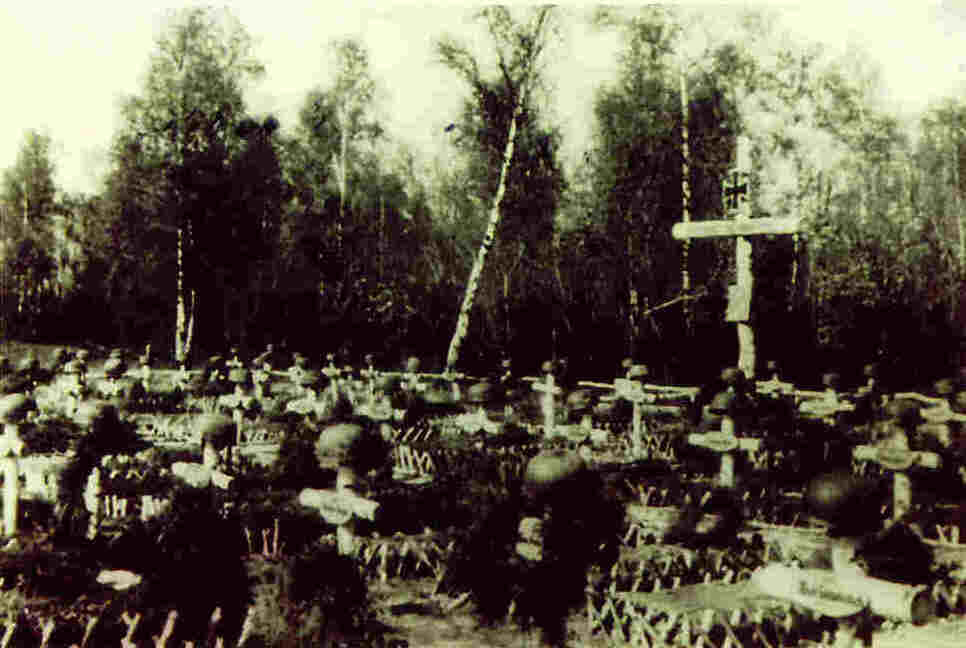
-
A wartime photo of the Soldatenfriedhof at Volkhov in Northern Russia,
where so many Fallschirmjäger perished in that first winter of the
war in the Soviet Union.
This photo was sent to me by Franz Wolf, a veteran Sanitäts-Oberjäger.
1944 A bad year all round for the Wehrmacht
Early in January 1944, the Russians renewed their operations against
the 2nd Parachute Division and 286th SP Brigade in southern Russia.
The 2nd Regiment and the 1st Battalion, 5th Parachute Regiment held
a sector around the town of Plavny near Novorodka, either side of the Kirovgrad
highway.
Early on the 5th January the Russians began their offensive against
positions held by the 1st Battalion, 5th Regiment. Within half an hour
a whole regiment of T-34's had been destroyed with minimal losses to the
SP Brigade.
The line held by the 2nd Battalion, 2nd Regiment was broken in several
locations as massed Russian armour broke through the weak line. Russian
tanks broke through east of Plavny and the remaining reserve SP artillery
pieces were rushed in to halt the advance. Many T-34's were destroyed by
individual acts of heroism using mines, satchel charges and panzerfaust's.
The 2nd Battalion, 5th Regiment was mostly destroyed as massed Russian
forces swept over their positions north of the Kirovgrad highway.
The survivors were rescued by several SP guns who broke through the
Russian forces, whereafter they successfully withdrew (although it was
several days before they turned up at the Divisions lines).
Late on the 5th, the SP Brigade was ordered to Ruptschina where the
Russians had managed to cut the Kirovgrad-Novorodka highway. As they neared
their objective they came across a Russian tank unit in the process of
being refuelled. The SP guns along with their Fallschirmjäger passengers
successfully destroyed them. By the 6th January, the 7th, 5th and 2nd Regiments
had been forced to pull out of the Novorodka area due to mounting Russian
pressure.
They managed to hold a line outside of Kirovgrad denying the Russians
this objective. On the 12th January the survivors of the 2nd Battalion.
5th Regiment were returned to Germany as they had ceased to exist as a
fighting formation.
After the intense fighting around Novorodka, the front around Kirovgrad
slipped into stalemate. The remaining guns of the 286th SP Brigade were
transferred elsewhere on the Eastern Front.
The lull in the fighting lasted until March when Russian forces around
Kiev struck southwards toward the 2nd Division's positions. The Paras took
up positions around the town of Svenigovodka. They had to withdrawal under
pressure from enemy armour. They were kept on the retreat by the ever advancing
Red Army and by the last week of March had been forced across the River
Bug where they set up defensive positions on the opposite bank. These positions
were abandoned by the Paras by the end of March.
During April 1944 the battle weary remnants of the 2nd Parachute Division
were pulled out of the line for a short spell of rest and refitting. This
was short lived, they were back in action on the 10th May when they were
to contain a Russian bridgehead on the River Dniester.
They suffered heavy casualties during this action and their ranks had
been severely depleted. At the end of May the Division was transferred
back to Germany for some serious rest and refitting. It was the last time
that the 2nd Parachute Division would see action on the Eastern Front.
Several weeks later they were thrown into Normandy.
The only other Fallschirmjäger unit to see action in Russia after
the 2nd Division left, would be a Fallschirm-Pioneer unit under the command
of Major Rudolf Witzig and a Kampfgruppe from the newly raised 16th Regiment
under the command of Oberstleutnant Gerhart Schirmer. The 16th was supposed
to be part of the 6th Para Division but was detached to the Eastern Front
to help deal with the Russian onslaught.
During the summer of 1944, Army Group Centre had been decimated in
Russia's Operation Bagration, their major successful operation in 1944
to coincide with the Normandy landings in the west.
By the middle of July, the Soviets were approaching the Baltic Sea.
It was in this area of operations that Kampfgruppe Schirmer were sent,
closely followed by the 1st Battalion, 21st Fallschirm-Pioneer Regiment.
On the 25th July 1944, Witzig's engineers took up positions on the
road between Dunaburg and Kovno in Lithuania.
This road was defended by the 1st Kompanie, the 2nd & 4th Kompanie's
defended a position south of the Dunaburg-Kovno road. Kampfgruppe Schirmer
had found themselves trapped around the Lithuanian capital and the Pioneers
were to open an escape route for the 16th Regimant back to the German lines.
They were armed with small numbers of panzerfaust's, panzerschreck's,
mines and satchel charges. They were supposed to have artillery support
but they never received it.
Throughout the night of 25th/26th July, the Fallschirm-Pioneers were
subjected to the sounds of Russian armour being brought up to the front.
By the morning of the 26th there appeared a long line of Russian tanks,
there decks awash with Russian Infantry. Behind the tanks sat row upon
row of artillery, howitzers and rocket launchers (stalin organs).
This formidable line of armour waited patiently for the opening artillery
barrage to signal the start of the attack. Inevitably it came and lasted
for just over an hour, pounding the Paras positions. When the barrage lifted
the tanks rolled forward.
The engineers held their nerve until the tanks were within 50 ft, then
they opened up with their anti-tank weapons. Russian troops were shot down
as they disembarked their rides. The pioneers carried out tank busting
raids attaching mines and satchel charges on to the advancing T-34's.
The first wave of the attack started to falter, the surviving Russian
armour turned back toward their start line leaving the fields in front
of the German positions littered with burned out tanks and dead Russian
infantry.
The 1st Kompanie had suffered heavy casualties during the attack. The
2nd & 4th Kompanie's defending south of the road were not so lucky
in holding back the Russian armour. Several T-34's managed to break through
their line. The engineers were now partially encircled, the forward units
were pulled back to the town of Dziewaltowe.
When the remnants of the Kompanie's had regrouped, there numbers had
been severely depleted. Major Witzig led the survivors of his Battalion
through woods outside the town until they reached the relative safety of
the main German lines. Small groups of survivors came in several days after
Witzig, men who had been separated and were determined to get back.
Major Witzig's Battalion stayed in Russia until October 1944 taking
part in several small scale operations. It was then disbanded, with the
survivors being sent to other Fallschirm formations.
The remainder of 1944 saw the shrinking of German occupied Russia.
German forces were on the retreat back towards the Fatherland. The Red
Army was unstoppable, surely the end would come soon.......
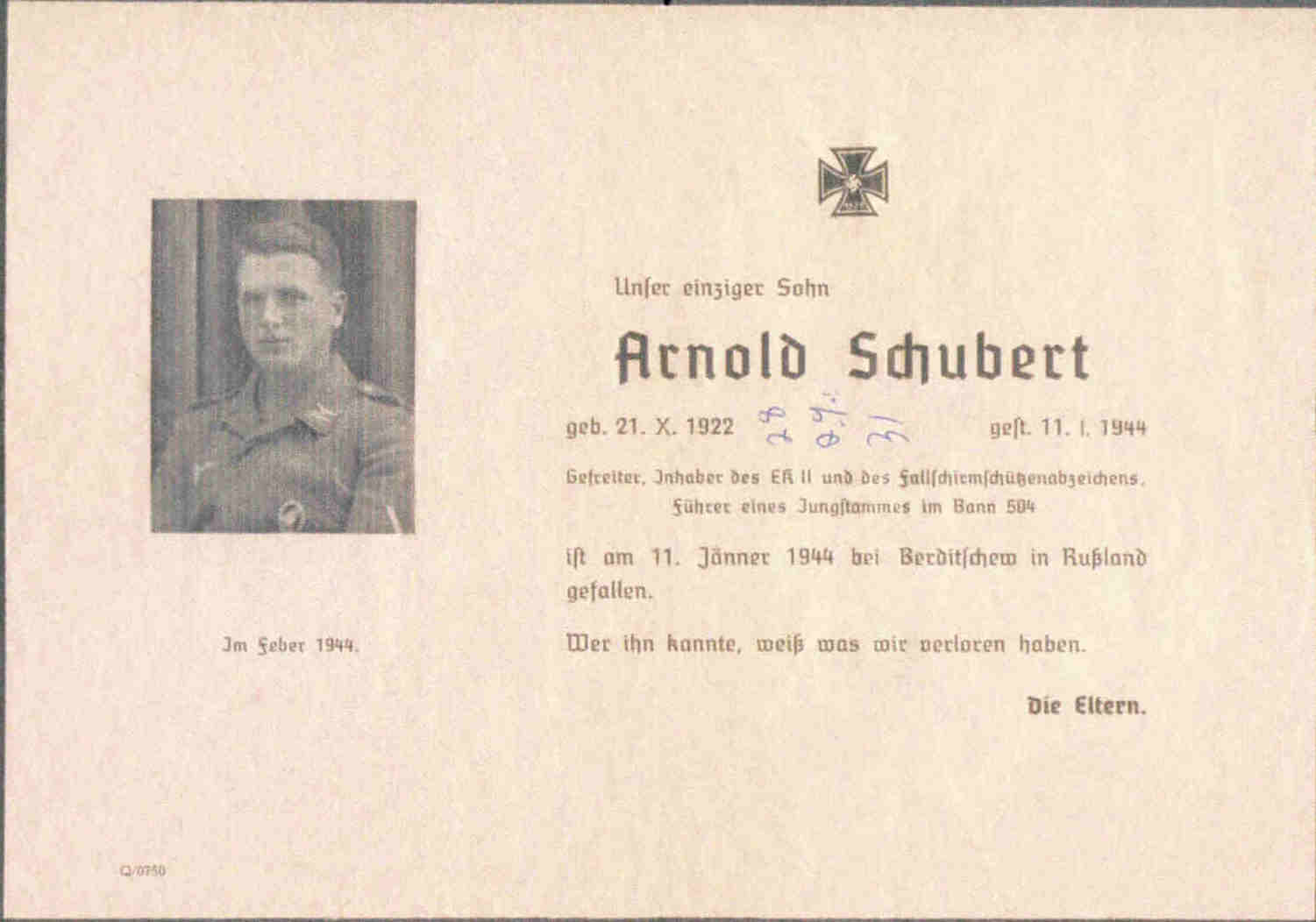
Above:
-
Death notice for Gefreiter Arnold Schubert, that appeared in a German
newspapaer in early 1944. Arnold Schubert was a member of the 2nd Division
and was killed on January 11th 1944 at Bertichev in the southern Ukraine
(south of Zitomir). He was 22 years old. He had been awarded the Iron Cross
2nd Class and the Parachute Badge and before the war had been a Hitler
Youth leader in Group 504, Bann.(southwest Germany)
1945 The end is nigh
By the beginning of 1945 the Red Army was poised to conquer Germany.
Hitler still preached victory but the situation was detteriorating and
victory was not an option.
Only two Fallschirmjäger formations were to fight on the ever
shrinking Ostfront. (a favourite saying of Berliners in the first months
of 1945 was "soon you'll be able to take a street car from one front to
the other").
The 9th and 10th Parachute Divisions were newly raised formations and
both were under strength, manpower being at an all time low.
The 9th was ordered to an area outside the town of Stettin on the Baltic
some 100 miles north east of Berlin. The division did not come together
as a whole until 8th April, as fragments of its regiments had been fighting
on the east bank of the Oder since their inception in January. The Division
was formed around splinter groups of Wehrmacht personnel, gone were the
days of accepting only the best into their ranks.
In mid April the 9th Parachute Division was used to help contain a
Russian bridgehead that had been formed on the western bank of the River
Oder. They were rushed into action from their area further north.
On the 16th April 1945 the Red Army launched their major offensive
to take Berlin. The 9th Division found itself caught up in the most intense
artillery barrage of the war so far. The Soviet war machine rolled over
the 9th's positions wiping out the 2nd Battalion, 27th Regiment and the
3rd Battalion, 26th Regiment. The remainder of the Division pulled back
only to be overpowered by Soviet armour that managed to break up the formation.
The 26th Regiment found themselves being flung back in a north westerly
direction, the 25th Regiment withdrew back towards northern Berlin, the
remainder of the Division became subordinated to the 61st Panzer Korps
and found itself in the southern outskirts of Berlin.
By late April Berlin was completely surrounded by the Russians, who
were reducing the pocket of resistance in the city day by day. The remnants
of the 9th within the city withdrew to the central district, where they
aided other splinter groups of SS, Hitler Youth and Volkssturm units to
defend the Führer Bunker and surrounding ministry buildings.
All defence was in vain, on the 2nd May 1945, General Karl Wiedling
surrendered the city to the Russians and the remnants of the 9th Parachute
Division went into Soviet captivity.
The 26th Regiment, not involved in the fighting for Berlin ended the
war fighting the Allies in Schleswig-Holstein, Northern Germany.
Breslau was a city some 200 miles south east of Berlin, it had been
turned into a fortress in accordance with the Führer's Festung Befehl
(fortress
order) and was to be defended to the last man and the last bullet like
so many before it.
The 2nd Battalion, 25th Regiment was flown into the city on the 28th
February to reinforce the garrison. The city had been surrounded since
the 12th January and the Germans knew the city could not fall into Russian
hands as it would be used as a springboard into Berlin. Within a few weeks
the 3rd Battalion, 25th Regiment was also airlifted into Breslau as the
need for reinforcements became more urgent. As Soviet forces moved in,
Breslau turned into a battle ground. The defenders managed to hold out
until the 6th May, 4 days after Berlin surrendered. The last remnants of
the 9th shared the same fate as their comrades.
The newly raised 10th Parachute Division was originally to be employed
in north west Europe but en-route to Holland they were re-directed and
sent southeast to southern Austria. Hungary had capitulated and Soviet
forces were flooding through the gap in the line defended by Germany's
former ally. Army Group South (General Freissner) could not contain
the Russian advance, reinforcements were badly needed.
On the 3rd April, the first units of the 10th Parachute Division arrived
in the city of Graz in southern Austria. The 10th like the 9th Division
was made up from Wehrmacht splinter groups, mainly Luftwaffe personel with
no aircraft to fly or maintain.
Soviet armour and massed infantry started to split the 2nd Panzer Army
and 6th Army who were defending the area. The 2nd Fallschirm-Artillery
Battalion was thrown into this split in the line, not with their Artillery
but with rifles and machine pistols, they were to be used as conventional
infantry.
They took up defensive positions around the town of Feldbach. With
the aid of Army anti-tank guns, the Fallschirm-Artillery held back wave
after wave of Russian forces. The anti-tank guns inflecting heavy losses
on the enemy armour.
Soviet ground attack aircraft tried to silence the 88 mm guns to give
the T-34's a chance. As the Jabo's ( Jagd- bombers) left the battlefield
the guns resumed their devastating fire, taking their toll on the advancing
tanks. Those tanks not destroyed by the 88's were set upon with panzerfaust's
and panzerschreck's.
The Paras shot down the accompanying infantry with MG and mortar fire.
They held back the assault, but their would be others.
The next assault came very soon, supported by aircraft and the dreaded
rocket launchers. Under this superior firepower the 2nd Fallschirm-Artillery
Battalion was decimated.
Meanwhile the 30th Regiment and a Battalion each from the 28th &
29th Regiments were based at St.Poelten in the Danube Valley, where they
were defending against vigorous Russian assaults.
They caused heavy casualties on the enemy until the 27th April when
the 10th Division was pulled out of the line, with the exception of the
30th Regiment who continued to fight in the Danube Valley.
The 10th was transported by railway to Bruenn in the Sudetenland to
join the 18th Army who were fighting for their lives. Once there, they
fought as splinter groups, not just against the Russians but also Partisans,
whose small bands of men were causing havoc behind the German lines.
The remnants of the 10th Parachute Division made their last stand to
the north of Bruenn, where they were destroyed by the sheer weight of the
unstoppable Red Army. The survivors went into Russian captivity.
The 30th Regiment who had been left in Southern Austria were ordered
to withdrawal to Bruenn in the Sudetenland. They could not travel by rail
as the Russians had cut the rail link, they started on foot to reach their
objective. En-route they changed direction, knowing that the end of the
Third Reich was near. They headed towards positions known to be occupied
by the Allies. They managed to surrender to US forces but were subsequently
handed over the the Russians to share the same fate as the rest of the
Division.
There ended the Fallschirmtruppe's long service on the Eastern Front.
Hitler was dead, the 3rd Reich had collapsed after only 12 years. Berlin
was in Russian hands, the war was now over.
The Ostfront had cost the lives of tens of thousands of Fallschirmjäger,
men who had survived the harsh Russian winters and unimaginable deprivations.
The war in the east was over, but the men of the Fallschirmtruppe had
made their mark in the bloodiest campaign of the Second World War.