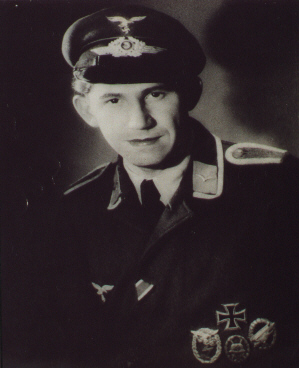
Oberjäger
Rolf Lindner
Uniform and Award Photographs
Photographs
and diary extracts are reproduced with the kind permission of John Turnbull
Various
aspects of Oberjäger Rolf Lindner's service record were taken from
entries in his diary. He joined the 14th Kompanie, 4th Fallschirmjäger
Regiment when it was based at Salzwedel and took part in subsequent training
at Villers Bocage in France.
On
9th October 1942, the 14th Kompanie was dispatched to the Eastern Front
where they saw action around Vitebsk and Smolensk.
Although
the 4th Fallschirmjäger Regiment took part in the airdrop on Sicily
in July 1943, the 14th Kompanie did not due to a lack of transport aircraft,
apparently the eight JU-52's that were to be used to ferry his Kompanie
across were shot down on the return journey to Italy.
Oberjäger
Rolf Lindner was involved in the defensive actions around Salerno in September
1943 and Taranto in November 1943. He was involved in the relief of Orsagna
before retiring to the Cassino area in time to take part in the second
battle for Cassino from March 15th - 24th 1944.
During
the third battle for Cassino (April 15th - May 18th 1944), the 14th
Kompanie defended positions within Cassino town, they took heavy casualties
and the Kompanie was reduced in size to that of a single strong platoon.
Rolf
Lindner took part in many defensive battles during the withdraw into Northern
Italy but was forced to surrender to the Allies in May 1945.
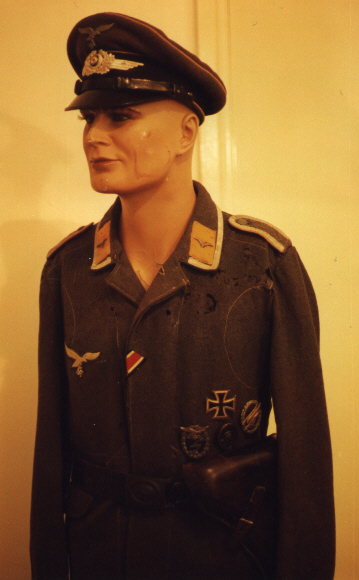
The
following photographs show Rolf Lindner's Fleigerblouse, Peaked cap and
awards now owned by John Turnbull in Australia.
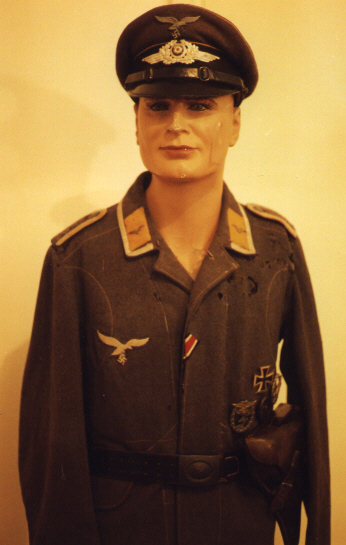
The above
photo shows the Fleigerblouse which I am told is nicely marked and is dated
1940. There is no clear indication whether the tunic was actually issued
to Rolf Lindner or was previously owned by someone before him. The tunic
buttons are marked with the numeral 1, suggesting the tunic may have been
owned by someone else before it was owned by Lindner.
Also
shown in the photograph is the Luger P08 holster issued to Rolf Lindner
which is named and dated 1938. The photo shows the enlisted mans belt and
buckle which shows extensive wear.
The
Fliegerblouse also shows extensive wear suggesting it was worn in combat
during the later stages of the war. Rolf Lindner may may have suffered
a bullet wound just below the right shoulder which would be consistent
with him being awarded the wound badge in black.
The
peaked cap is in better condition and would suggest that it was only worn
by him on formal occasions and not in combat.
The
metal wreath & cockade appear to be in mint condition with only a slight
tarnish on the metal cap eagle.
The Fliegerblouse
shows insignia for the rank of Oberjäger, featuring collar tabs with
one metal eagle and 9mm Tresse and shoulder boards with Tresse and no pips.
The collar tabs show holes from the addition and removal of 3 sets of alloy
eagles, as Rolf Lindner was promoted from Jäger through to Oberjäger.
The absense of a 4th set of holes indicates that Rolf Lindner was promoted
straight from Obergefreiter to Oberjäger. The embroidered Luftwaffe
eagle is sewn on to the right breast.
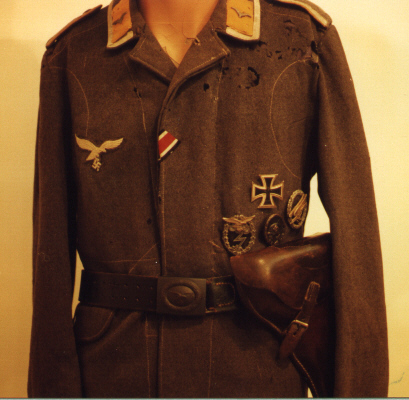
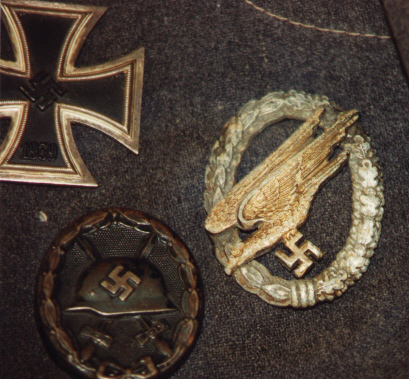
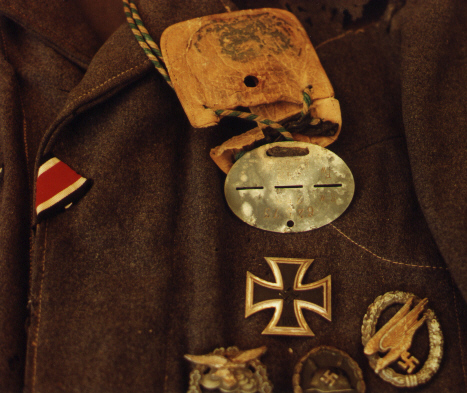
This photo
shows more clearly the awards and decorations that Rolf Lindner received
during his service in the Fallschirmtruppe. From the tunic's second button
hole he sports the ribbon for the Iron Cross 2nd Class (Eiserne Kreuz
2.Klasse). Below the left breast is worn the Iron Cross 1st Class (Eiserne
Kreuz 1.Klasse), the Parachute Qualification Badge (Fallschirmshützenabzeichen),
the Luftwaffe Ground Combat Badge (Erdkampfabzeichen der Luftwaffe)
and the Wound Badge in Black (Verwundertenabzeichen). The Para Badge
is rather battered. The pitted and much scarred surface of the Diving Eagle
(which at some stage has been torn from the wreath and subsequently
re-attached) suggests that he was proud of having been a Paratrooper
and that he must have worn the badge during combat, including possibly
during the bitter house to house fighting in the streets of Cassino town.
His Iron Cross and other awards, though in better condition, also show
signs of considerable wear and minor field repairs to clips and the like.
This
photo also shows more clearly the extensive wear to the fliegerblouse especially
around the left shoulder area, aswell as the holes in the collar tabs.
If you look closely on the left sleeve you can see where rank chevron's
and a trade proficiency badge were once sewn on.
A close
up photo of Rolf Lindners awards. The surface of the para badge is clearly
visible.
The Rolf
Lindner collection also includes his identity disc, shown here with the
leather pouch that he used to store it. Because of the harmful effects
of corrosion some of the numerals on the disc are dificult to see from
this photograph.
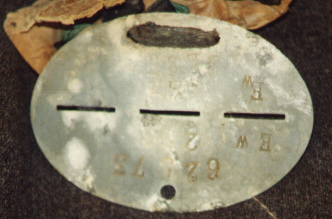
This close
up photo of Rolf Lindners identity disc shows some of the numerals. It
is marked 62 573 and underneath
EW
258. It indicates that he was previously a member of the 9th Kompanie,
Fallschirm-Ersatz Regiment 1. As Lindners
stamrollen is fairly
low it is likely that Rolf Lindner attended jump school during the early
part of 1942.


Above
is a copy of a hand painted certificate awarded to Rolf Lindner and 3 others
after winning a 4x100m relay race during a Kompanie sports day on 22nd
November 1944.
With
the assistance of a former member of the 13th Kompanie, 4th Regt, John
Turnbull traced the widow of Rolf Lindner who unfortunately knew very little
about her husband's war service. She did however pass on the name of a
former Para who was Rolf's best friend. It was revealed that Lindner was
a very useful Kompanie runner who had a reputation for successfully dodging
bullets and exploding mortar shells. Perhaps this explains why Rolf and
three of his comrades won the 4x100m relay at the Kompanie sports day.
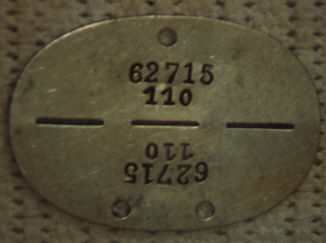
Below
is a photo of another identity disc from John Turnnbull's collection. The
code 62715 indicates that the Fallschirmjäger was a member of either
Stab. II/ Fallschirmjäger Regiment 1 or N-zg II/ Fallschirmjäger
Regiment 1.
Wanted:
Fallschirmjäger Militaria for Private Collection