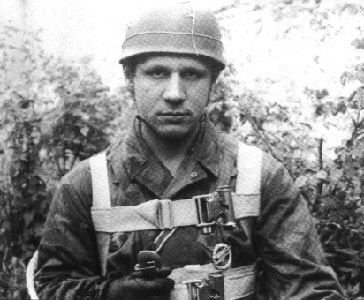
Karl-Heinz Pollmann at Yvry-la-Bataille in 1943.
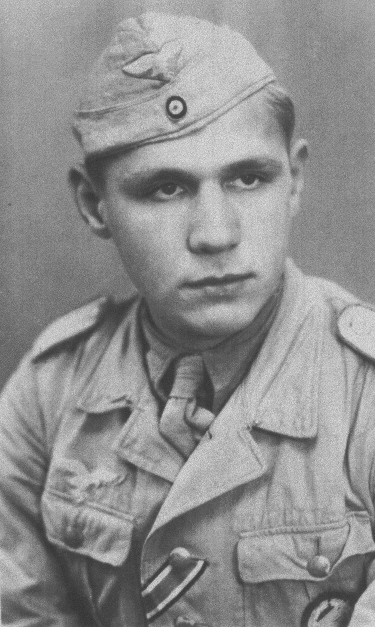
Obergefreiter Karl-Heinz Pollmann, Erkennungsmarke
62785.
Born - 26th August 1924, Lüneburg.
Excerpts from the diary of Fallschirmjäger Karl-Heinz Pollmann from February 1942 - May 1945.
"My apprenticeship as a mechanic
ended in February 1942 and I recieved my journeymans certificate. The following
day was call-up. To avoid duty in the Reichsarbeitsdienst, I volunteered
for service in the Fallschirmtruppe. The next day I travelled by rail to
Dessau-Kochstedt for a 3 day entrance examination, which consisted of writing
essays, mathematics and sport. I was lucky as I was accepted. On the next
Monday, March 8th 1942 my service began".
"On March 8th 1942, Kurt
Behr, Egon Rabe and myself, all residents of Lüneburg, were summoned
to Fsch.Pi.Btl.1 at Dessau for posting. The first thing we were taught
was that all displacement in the barracks had to be made in double step.
Later on we were shown to our rooms and given uniforms. Training could
now start.
From the outset, Leutnant
Kaths, our Kompanie Commander, put matters straight; we were to relinquish
our daily cigarette ration to the older, more experienced soldiers, who
in return would give us their sweet rations. This did not worry me as I
knew that smoking was a health hazard".
"The next 3 weeks were extremely
hard. I was posted to a heavy Kompanie, in a Mortar section. At the end
of April, our Battalion was shipped off to Normandy in France. Our 2nd
Kompanie was billetted at St.Remy sur Orne, while the 3rd Kompanie (to
which Kurt Behr & Egon Rabe belonged) was at Thury-Harcourt.
It was at St.Remy sur Orne
where we aquired the skills of our future trade. Our section leader was
Leutnant Gerd Mertins, the future commander of Fsch.Pi.Btl.5". (After
the war he made a fortune as an international arms dealer).
"Our training included shooting,
handling explosives, making sailor knots and building pontoon bridges across
the River Orne. We also had plenty of opportunities to sample the local
spirit, the famous Calvados, and cider.
One day, my feet were aching
badly after a 30km forced march. I was cared for by a nurse who lanced
one of my blisters. I swooned. With a 40 degree fever and an infection
of the lymphatic vessel, I was admitted to the Caen hospital for 2 weeks".
"In the next section served
a squad leader, who was none other than Harald Quandt, one of Dr.Goebbels'
foster children. During an important celebration, Leutnant Quandt had the
priviledge to welcome a theatrical group among whose members were such
famous actors as Albert Florath, the sisters Höpfner as well as other
well known comedians who had all been sent by the Reichspropogandaminister
himself to entertain us".
(Quandt himself was captured
by Canadian troops in Italy in 1944. After the war he became one of the
wealthiest men in Germany. He was killed when his light aircraft crashed
in Italy in the late 1950's).
"In the early summer of
1942, our Kompanie was incorporated into Korps-Fallsch-Pi.Btl and transferred
back to Dessau-Kochstedt. From there we carried out an additional course
at Dessau-Rosslau and later on the Altengrabow-Magdeburg training ground.
After this we started training at Wittstock/Dosse Fallschirmschule.
At Wittstock we were introduced
to the harsh realities of a parachute school. First came the ground exercises:
ground rolls (forwards and backwards), jumping into soft sand from
an aircraft hatch, and finally, being dragged along the rugged surface
of the exercise yard by a parachute blown by the propellor blast of 2 powerful
aircraft engines. These were the first things we were tought."
"We then learned to meticulously
fold our own parachute, which we would use on our first jump. Only 2 days
before, a motorised glider carrying 12 men had crashed on the airfield.
There were no survivors. One of the comrades in my barrack began to turn
paler each day. He might still have refused to jump, but found another
way out. During a long and arduous march, he slipped a small stone into
one of his boots. On returning to base, he suffered from a spectacular
foot inflammation and was thus declared unfit for duty".
"On the next day, as we
were returning to the barracks after one of the numerous parachute folding
sessions, we noticed that a small, agitated crowd, had gathered in front
of our building. We were told that a young man was holed up in our room.
He first fired a shot at the ceiling and then, placing the rifle barrel
into his mouth, pulled the trigger again. Because of this tragic event,
the jump was postponed until the next day".
"Our first jump was made
from 250m. The orders were:
-"Get ready"
-"Hook up"
-"Get ready to jump"
The aircraft door was wide
open. A green light was turned on and a shrill sound filled the air. The
jumpmaster gave the final order".
-"Ab!"
"Ten men, one behind the
other, rushed out through the door. On more deep breath and the show was
on!.
The world tumbled about.
Then a sharp jolt as the parachute deployed. I felt on top of the world.
Luckily everything went as planned. Otherwise, I would have reported to
the depot to get a free parachute.
During the next 45 seconds,
we were dangling from the harness as the ground rushed up to meet us. Meanwhile
our instructors kept shouting into their megaphones; "Keep your feet
together!". Then came the impact of touchdown, followed by a landing
roll. We were safely back on the ground.
During the next week, we
made another 5 jumps, with and without weapons from various types of aircraft:
Do23, Ju52 and He111".
"Proud to wear the badge
on my chest and showing off a little, I returned to my Battalion. We moved
to Wittenberg. Our 2nd Kompanie led by Oberleutnant Cord Tietjen, was assigned
to the Ramcke Brigade in July 1942, which was part of Rommel's Afrika Korps.
The Kompanie's job was to lay mines. The rest of the Battalion would soon
follow".
Now follows an excerpt from K-H Pollmann's diary from 7th Nov 1942 - 6th January 1943.
07.11.42 Saturday.
At 2am we were issued with tropical clothing. At 10pm, we entrained.
08.11.42 Sunday.
We travelled by train across Germany to Munich.
09.11.42 Monday.
We crossed the Alps. Many tunnels. We skirted Bolzano.
10.11.42 Tuesday.
Journey through the heartland of Italy, along the Appenine range and on
to Florenze.
11.11.42 Wednesday.
Through Naples and on to Lecce near Brindisi. At 6pm, we took up our quarters
in an Army barracks.
12.11.42 Thursday.
Waiting to be flown to Afrika
13.11.42 Friday.
Emplaned. Then flown out in Ju52's from Lecce to Trapani in Sicily. In
our circuit pattern, our aircraft nearly collided with a Ju88. At Trapani,
we were served an excellent meal with peas. At night, guard duty at the
airport.
14.11.42 Saturday.
Milksoup. Flight to Bizerte in Tunisia. We pitched our tents in an olive
grove. Attacked by British fighters.
15.11.42 Sunday.
In the morning we struck the tents. Italian anti-tank vehicles drove us
32km to the south, by Lake Garaet Achkel. We dug foxholes and felled the
trees which blocked the view with explosives.
16.11.42 Monday.
We slept in hay wains. On waking up, we caught a white rabbit, which we
stewed in 2 mess tins on an esbit protable cooker and ate at 3pm. Unfortunately
we had no salt.
17.11.42 Tuesday.
With individual shelter quarters, we pitched 3, four man tents.
18.11.42 Wedensday.
Everything was quiet
19.11.41 Thursday.
We slaughtered a sheep and spitted it. Later on, an Arab came along to
complain. What could we do about it? Supplies were long overdue and we
were starving.
20.11.42 Friday.
Everything was quiet.
21.11.42 Saturday.
Our positions were moved 300m back. We pitched tents for 4 and 8 men. A
black native gave us some straw.
22.11.42 Sunday.
We improved our individual tank shelter. It rained during the night. The
left hand pole collapsed and the hole was flooded.
23.11.42 Monday.
We pitched the tent again. Today, quite unusually, I have shaved.
24.11.42 Tuesday.
We moved our position 3.5km ahead, by the destroyed bridge. We pitched
our tents and this time I was on guard duty. In the North, I watched an
air attack on Bizerte......Anti-aircarft guns, searchlights, bombs.
25.11.42 Wednesday.
We brought eggs from Arabs, then we were caught in a sudden downpour.
26.11.42 Thursday.
We moved our positions to Ferryville-Mateur, 16km in the direction of Teboura.
Near a farm, we were surrounded by enemy armour. At night, we fell back
10km.
27.11.42 Friday.
In the morning we mounted armoured vehicles and drove to the farm. We came
under attack from our own Stukas, and then, were fired at by the enemy
tanks, a few of which we knocked out. A German Panzer ran over one of our
own Teller Mines. One of his tracks was shattered. Obergefreiter Dreager
was killed.
28.11.42 Saturday.
About midnight, back to the ford, 10km away, by Oued Tindja, near Mateur.
We took up position on the left side of the road. The ground was terribly
hard. In the afternoon we moved closer to the road. The 1st squad left
us.
29.11.42 Sunday.
During the night, from midnight to 3am we layed T-Mines. At 11pm, we were
exposed to enemy artillery fire for 90 minutes. We took shelter by the
Mosque and laid mines on the bridge.
30.11.42 Monday.
Our group captured a British officer and withdrew in the afternoon to Bizerte.
Unteroffizier Hartung with Pioneer's Hoersting, Haeublein and Pollmann
stayed behind, to blow up the bridge in case the enemy came. Speiss Jenal
turned up and brought some supplies he had salvaged from a freighter sunk
in the harbour. Each man recieved a sausage and a few other things.
01.12.42 Tuesday.
The 2nd Squad of the air landing Kompanie took over our quarters. We cooked
doughnuts we had made from corn flour.
02.12.42 Wednesday.
I got hold of 3 hens. Hen broth with millet.
03.12.42 Thursday.
I walked and then rode a horse to Mateur. I bought 100 francs worth of
bread, oranges, cheese, sweets and matches.
04.12.42 Friday.
With Haeublein, we dug a foxhole on the right side of the road. In the
afternoon, a Bristol-Blenheim bomber was shot down and crashed 500m away
from us. Oberst Barenthin, commanding the Pioneer troops of the Fallschirm-Korps,
arrived in his Kubelwagen and waved at me. He said "Engineer,
there are a few unexploded 250kg bombs by the wreck. Blow them up!"
I grabbed a few 100gm explosive
devices, fuses and cord and carried out the order. The most spectacular
explosion I have ever seen.
05.12.42 Saturday.
In the morning I blew up the 3rd bomb. Later, I lobbed a hand grenade into
the river: the catch was excellent, 41 fish, measuring from 12 to 30cm.
I cooked them with millet.
06.12.42 Sunday.
For todays meal I shot a chicken with a P 08. Tha Arabs were over-charging
us and besides, we were flat broke.
07.12.42 Monday.
Hoersting got hold of a small sheep: skinned, gutted and cooked.
08.12.42 Tuesday.
The wet season began. Our hole was flooded. We changed position and moved
into the farm, with the Italians.
09.12.42 Wednesday.
The supply motorcyclist brought us a 30 litre container of warm wine. Never
before have we been so drunk.
10.12.42 Thursday.
The 3 Italians departed. On guard duty at night.
11.12.42 Friday.
We switched the pieces of furniture in the sleeping room. I got kicked
in the oants by the grey horse. The pain was such that I hardly slept a
wink that night.
12.12.42 Saturday.
Today 150 slave workers were sent to mend the road. They cleared the manure
from the road.
13.12.42 Sunday.
Marching order. We removed the explosives and cleared the minefield. We
boarded trucks and on through Mateur and Bizerte to the airfield and an
olive grove. I slept beside the rucksacks on a layer of 20-30 woolen blankets.
Had some wine during the night.
14.12.42 Monday.
I put on clean underwear, then visited the Djebel Kebir fort.
15.12.42 Tuesday.
Guard duty for 2 hours. Afterwards, I gathered my belongings and back to
the 3rd Kompanie.
16.12.42 Wedensday.
In the morning, off to the medical officer at Bizerte to fetch anti-mange
powder. In the afternoon, rifle maintenance.
17.12.42 Thursday.
In the morning I washed my trousers and tunic. In the afternoon, machine
gun practice.
18.12.42 Friday.
Blast duties: Blew up French T-Mines. Cleared and defused 280 mines. In
the afternoon, swam in the sea.
19.12.42 Saturday.
Around 10.30pm, I was sitting on the barrier while on guard duty. Feldwebel
Beckmann turned up unexpectedly and berated me for misdemeanour on duty.
20.12.42 Sunday.
I reported to the Kompanie Kommandeur, Oberleutnant Friedrich. Five days
of hard detention in Germany. I recieved the balance of my pay for 1942:
1900 Francs, I felt like a rich man. Recieved a small parcel from my Mother.
Who could ask for more?.
21.12.42 Monday.
Orientation exercise with compass, to the sea, followed by a swim in 16
degree warm water. The swell was rough. On the beach, we found a French
portee, the gun of which was aimed at the sea. We operated the breech and
suddenly, the piece went off, scaring us out of our minds.
22.12.42 Tuesday.
On guard duty again.
23.12.42 Wednesday.
In the afternoon, I got hold of a Christmas tree for tonights celebrations.
24.12.42 Thursday.
Christmas Eve. On guard duty.
25.12.42 Friday.
Christmas Day. Roasted goose for lunch.
26.12.42 Saturday.
Boxing Day. Transfer to Ferryville.
27.12.42 Sunday.
Guard duty on the bridge to Ferryville.
28.12.42 Monday.
On guard duty again until 4pm. During the night two Italian airmen arrived
from the Ferryville brothel. They had to walk all the way to Caruba
(18km) as there was no transport available.
29.12.42 Tuesday.
Drill. "You want to be soldiers? Lie down, stand up, march, march!"
For lunch, noodle soup with goulash and boiled potatoes. Guard duty
at 4pm.
30.12.42 Wednesday.
Guard duty until 4pm
31.12.42 Thursday.
New Years Eve. In the morning weapon maintenance. In the evening the New
Year was cut short by an alert. Four sentries on each bridge. At midnight
loud crackling of rifle fire and machine guns as flares shot skyward. Welcome
to the New Year!.
01.01.43 Friday.
New Years Day. Air alert at 3am. The heavy flak opened up, chunks of plaster
fell from the ceiling. In the afternoon, guard duty on the bridge.
02.01.43 Saturday.
We took up positions at the Ferme Michaud, 10km away from Mateur. We pitched
tropical tents.
03.01.43 Sunday.
In the morning kit inspection. In the afternoon guard duty at the Battalion.
04.01.43 Monday.
The Kompanie set off on a forced march: 30km with all of the equipment.
05.01.43 Tuesday.
British Spitfires strafed the tents in the camp. We removed and camouflaged
them.
06.01.43 Wednesday.
During the night at 00.45am, immediate standby. We returned to the front.
At the Jefna-Pass we built shelters in the ravine. Freindly and enemy shells
were crisscrossing overhead.
Here ends my diary...........
"On 30th December 1942, at
night, the Pioneers of the 3rd Kompanie, Witzig Battalion, were delivered
by parachute and two gliders behind the French and British lines in Eastern
Algeria, to destroy 2 bridges. The operation however,
was a failure. Only two men, one of whom was the Kompanie commander, Oberleutnant
Friedrich, returned to the German lines. As they were being driven away
by their captors, Oberleutnant Friedrich and a Tunisien Scout, jumped out
of the truck and made good their escape. Several days later, they were
back in our camp in the Ferme Michaud, near Mateur."
"I was delighted, when on
my return from a mission, I found that both had come out of it in one piece!
But Friedrich did not trifle with regulations and instead of sharing my
joy at being reunited, was quick to point out my boot laces, which were
not properly secured but tied around the shaft. Friedrich had not been
away two days that discipline was beginning to slacken!"
"After the unfortunate experience
of the night jumps, we suffered more casualties in the Djebel Azag region
during an encounter with British Paratroopers led by Colonel Frost. Back
at Michaud for some rest, Feldwebel Meist decided to raid enemy lines and
carry out a few strikes at Beja and towards Algeria. I took part in two
of these missions and on 19th February 1943, I was awarded the Iron Cross
2nd Class. I was promoted to the rank of Gefreiter, while Feldwebel Meist
was recommended for the German Cross in Gold.
On 26th February, the 'Division
von Manteuffel', to which belonged the Witzig Battalion, launched an
offensive westwards in to the Sedjenane Valley. We boarded trucks and headed
for the front. I had placed my rifle behind the bunk on which I was sitting.
Suddenly, as we came across another vehicle, our truck ran into a pothole
and tilted. My rifle was knocked over and caught between the two trucks.
A sharp crack and the barrel was bent, What was I to do? Fortunately, during
a halt, I swapped my rifle for that of a wounded soldier who was about
to be evacuated."
"At dawn, the British attacked
the hill on which we were posted. Suddenly, I felt a sharp pain in the
thigh: I had been hit by a bullet. I was taken to the H.V.Pl (Hauptverbandplatz
- Dressing Station). From there I was flown out in a Feisler Storch
to the Ferryville Hospital. The bullet, however, fell to the ground as
I dropped my trousers. An operation was thus un-necessary, Four weeks of
care and rest ensued. With every meal, my liking for French food grew stronger.
We had white bread, wine and sometimes, artichokes."
"On 1st April 1943, after
convalescing, I was returned to my unit. Major Witzig then gave me my first
leave, "Call at the Speiss, he'll give you four weeks leave!". Never
before had I turned about so quickly. Later, with two comrades, both also
hailing from Northern Germany, we hitch-hiked on the road to Tunis, about
150km away.
At Tunis we could afford
a Droschke, which took us to Carthage airport, where we waited to be flown
home to Germany. A few Italian aircraft were landing and we were told that
of the eight, which had taken off, only three had made it to their destination.
As we found the venture rather risky, we chose instead to board a Ju90,
which had just arrived and in which was little room left. Mail was loaded
and the aircraft took off. During the flight, ready to fight it out with
the Tommies, we posted ourselves behind an MG15. In the evening, we arrived
at Grossetto and from there, via Rome, headed for the Motherland."
"In Munich we recieved new
tropical uniforms and then headed home to Lüneburg. I enjoyed my first
leave, but just before my time was up, I got a telegram: "After leave
you are to report to Wittenberg". Here the Battalion was being re-structured.
Veterans of the old Kompanie's, new recruits and Luftwaffe soldiers formed
the new Battalion. Now I was a veteran of Afrika."
"One day, I was called to
the Speiss:
"Pollmann, tommorow we will send you to the Helmstedt driving
school, you will gain the class A driving licence!" The course had
already started when I arrived and I had never before driven a car. Two
days later was the examination, which I missed, so I returned to my unit
and reported to the Speiss, "Pollmann, do you know, you still have to
make five days calaboose?", I really had forgotten about the incident
last December. I did my five days and reported back to the Speiss, "Pollmann,
you are a good soldier, instead of a Schirrmeister, we will make a parachute
warden out of you!"..
"My training was to start
next week at the Flugtechnische Schule IV in Bayreuth. The next 6 weeks
were spent training to fold all kinds of parachutes. After undergoing several
training courses I rejoined the Battalion and in late 1943 we moved to
Dreux, west of Paris."
"Quartered at Marcilly-sur-Eure
with my Kompanie, I was transferred with an Oberfeldwebel, two Oberjäger
and several Privates to the Battalion HQ at Yvry-la-Bataille. My group
was tasked with equipment servicing and maintenance duties. We had a small
cottage and a large shed at our disposal. The field latrines were located
by a small brook."
"In May 1944, I was promoted to the rank of Obergefreiter. The Korps.Fallsch.Pi.Btl was transferred to Moulins-sur-Allier from our HQ in the Dreux-Evreux region in France. On May 1st 1944, this Battalion was renamed 1./Fallschirm.Pi.Rgt.21, commanded by Major Rudolf Witzig.."
Karl-Heinz Pollmann at Yvry-la-Bataille in 1943.
More to come on this time........
In Brandenburg, on 1st April
1945, during my monthly check -up, Dr Wright, the Staff medical officer,
granted me a further 4-week leave as "fit for work" . On 13th April,
the men fit for duty were ordered to report to the depot and collect Panzerfaust's
to defend Berlin. The men in my situation were allowed an extra 2 weeks
furlough. Too good to refuse!. Obergefreiter Müller, who shared my
room, was a native from Hannover, a city which was already under Allied
control. He said "You've got a sister. She's my fiancee" "I have no
objections, but she is only 12. But I know, were are living through hard
times. I understand, how you feel"
"As the railway station
had been destroyed, we set off together, on foot, to Neustadt an der Dosse,
in the direction of Lüneburg, The Americans had already reached the
banks of the Elbe at Magdeburg and it was rumoured in Hamburg that Lüneburg
was to be evacuated. We decided to go there and lend a hand. We found our
way to Lüneburg. The train station had been wrecked in the bombings.
We rummaged around for some food."
"On 18th April 1945, as
we were sitting at a table, eating baked potatoes, my sister, Ilse, entered
the room and told us that the British were at Am Sande. I replied "Are
you kidding?", but at the same time I saw a British soldier riding
down the street on a motorcycle. "Müller, guess what?. The war
is over. Lets take our uniforms down to the cellar!", which is just
what we did."
Epilogue
Müller went home 2
weeks later. He was caught by the British but because of his wounding was
soon discharged in Munsterlager. He died in 1997. Kurt Behr and Egon Rabe
both returned from the POW camp in 1945. Both men died in the 60's, less
than 40 years old.
As for me... British soldiers entered my house shortly after they had taken the town. They were looking for men who had been members of the armed forces. I was asked if I had been a soldier and I replied "No". They turned and saw a portrait of me in uniform hanging on the wall. They asked me who the man was in the picture, "My brother" I replied. In the dimly lit room they could not make a comparison, so they about turned and left the house. I never became a prisoner of war.
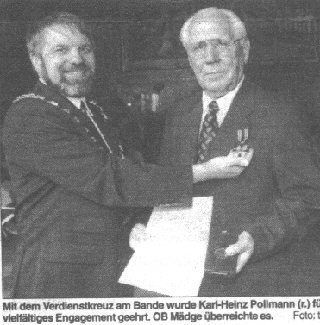
Last summer,Karl-Heinz Pollmann
was awarded the Verdienstkreuz am Bande, Germany's highest civilian award,
in a ceremony hosted by the Mayor of Lüneburg. He still resides in
Lüneburg, a beautiful town in Northern Germany.
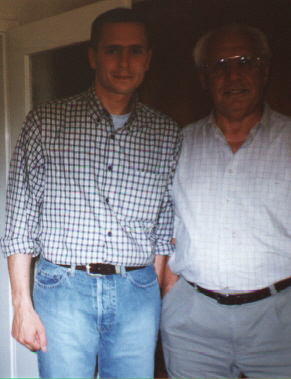
Karl-Heinz (Charlie) with the author, taken Being awarded the Verdienstkreuz in Lüneburg in the summer of
Return to Veteran Page