The Fallschirm-Pioneer-Battalion's 1940-1945
Fallschirm-Korps-Pioneer-Battalion
The Battalion began its life in mid 1942 in Dessau and was built from
2./Fallschirm.-Pi.-Batl.1 (Oberleutnant Tietjen)
Komm - Major Witzig
Adjutant - Oberleutnant Braun
N-Offizier - Leutnant Heise
Nachkommandoführer Wittenburg - Leutnant Weber
1/Pi.-Kol - Oberleutnant Conrad,
KfzOffizier - Oberleutnant Schobert
Abt.VIa - Insp. Maltan
Ärzte - Stabsarzt Dr.Bartels, Stabsarzt Dr.Holzmeister,
Stabsarzt Dr.Illig
1.Kompanie - Oberleutnant Ernst, Oberleutnant Hünichen,
Leutnant Petritzsch, Leutnant Wenzel, Hfw Matzke, Ofw Niedermeyer.
2.Kompanie - Oberleutnant Tietjen, Leutnant Tiemens, Leutnant
Treue, Leutnant Hermann, Hfw Mross, Hfw Händler, Ofw Meyer.
3.Kompanie - Oberleutnant Friedrich, Oberleutnant von Albert,
Hfw Jelinek, Ofw Schikorra, Ofw Backhaus, Fw Beckmann
4.Kompanie - Oberleutnant Hart, Hauptmann Elbert, Leutnant Fuchs,
Leutnant Klinge, Hfw Wenhardt, Fw Schürmann, Fw Boos, Fw Dieball.
In October 1942, the Battalion was attached to Fallschirmjäger
Regiment "Barenthin" in Tunisia.
In July 1942, 2.Kompanie served with the Ramcke Brigade at the El Alamein
front. In February 1943, the 2.Kompanie under the command of Leutnant Tiemens
is back with the Battalion.
In November 1942, the Battalion saw heavy fighting at Djebel Aboid.
Near Jefna the Battalion suffered heavy losses. At Sedjenane, over 100
men of the Battalion went into captivity. The allied advance pushed back
the German front line and the Battalion was involved in the fighting until
May 6th 1943, when they recieved the order to return to Germany. Only a
small part of the Battalion returned to Germany the rest went into captivity.
The collection point for the survivors of the Fallschirm-Korps-Pionier-Battalion
was the rest centre at Wittenburg.
They immediately began to re-build the Battalion and they were sent
to Moulins in France. In Moulins the Battalion was formed into Fallsch.-Pionier-Regiment.21.
I./Fallschirm-Pioneer-Regiment.21
Komm - Major Witzig
Adjutant - Leutnant Tiemens
Hptm.b.Stab - Hauptmann Kindler
N.-Offizier - Leutnant Heise
Batl.Arzt - Stabsarzt Dr.Thöne, Stabsarzt Dr.Holzmeister,
Ass-Arzt Dr.Moll
1.Kompanie - Leutnant Kubillus, Leutnant Fromme, Hfw Matzke
2.Kompanie - Oberleutnant Walter, Hfw Seifarth
3.Kompanie - Oberleutnant von Albert, Leutnant Graf Bernstorff,
Hfw Jenal, Ofw Meist
4.Kompanie - Oberleutnant Gasteyer, Leutnant Schürmann,
Hfw Wenhard
In July 1944, the 1st Battalion was moved by rail from Salzwedel to
Kovno in Lithuania. They saw heavy fighting near Riconti and on 15th July
1944 were moved to new positions between Wilna and Schauen. (II/Fj.Pi.Rgt.21
was built in Moulon, France in July 44, moved to Güstrow and renamed
Pi.E.-u.A.Btl.2).
On 23rd July 1944, the Battalion was on the front line between Dünaburg
and Kauen. On July 26th, the Russians attacked in Regiment strength and
with strong Panzer forces. It was the hardest fighting that the Battalion
would endure. The Russians lost 30 tanks and suffered heavy losses in men.
The Battalion also suffered heavy casualties and 1.Kompanie came away from
the fighting with only 26 men.
Under constant assault by Russian forces they withdrew into Eastern
Prussia and took up positions between Schaken and Schirwindt to Ebenrode.
In October 1944, the Battalion left the Eastern Front and were sent
to re-build at Bützow near Mecklenburg.
Fallschirm-Pioneer-Battalion.1
Built in June/August 1940 at Dessau-Kochstedt in the service of Flieger-Division.7.
The roots of this Battaion went back to the Heeres-Pioneer-Battalion.
Komm - Major Liebach, Hauptmann Steiner, Major Frömming,
Hauptmann Jacobeit
Adjutant - Oberleutnant Mattheus
Ärzte - Stabsarzt Dr.Marschall, Oberarzt Dr.Rüther,
Ass.-Arzt Dr.Lehmann, Stabsarzt Dr.Vock
1.Pi.-Kol - Oberleutnant Schuster
1.Kompanie - Oberleutnant Griesinger, Oberleutnant Reil, Oberleutnant
Adolf, Hauptmann Jacobeit, Hfw Lukas.
2.Kompanie - Oberleutnant Tietjen, Oberleutnant Bültemann,
Oberleutnant Frömming, Leutnant Rönnberg, Leutnant Hart, Hfw
Hildebrand, Hfw Rössler.
3.Kompanie - Leutnant Hünichen, Oberleutnant Steiner, Oberleutnant
Mattheus, Oberleutnant Lehmann, Leutnant Asselmayer, Oberleutnant Quandt,
Leutnant Haakert, Leutnant Häffner, Hfw's Krug, Baseler, Schiffers,
Lotze, Schumacher.
4.Kompanie - Oberleutnant Specht, Oberleutnant Gerstner, Leutnant
Unverzagt, Leutnant Holm, Hfw Putzka, Ofw Thomassen.
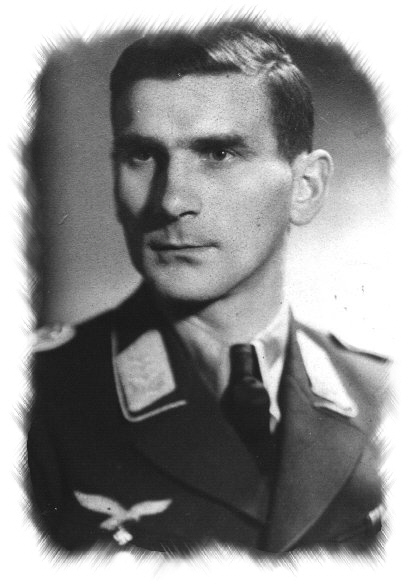
Hauptmann Arno Jacobeit.
The men for this Battalion mostly came from the Heeres-Pioneer-Battalion
as well as Pi.-Zug Witzig. Training began in earnest in the winter of 1940/1941.
The Battalion's first action was at Corinth when a platoon from 3.Kompanie
under the command of Leutnant Häffner landed near the bridge in assault
gliders. They were in action again a month later on Crete when Stab, 1,
2 and 4.Kompanie parachuted in on May 20th. 3.Kompanie were transported
by sea. In August 1941 they returned to Germany.
In October 1941, Stab, 1, 3 and 4.Kompanie were transferred to the
Leningrad front south of Schlüsselburg. 2.Kompanie under the command
of Oberleutnant Tietjen was used as the core for Korps-Pi.Btl. The Battalion
returned to Dessau from the Eastern Front in December 1941 after suffering
heavy casualties.
Rest and refitting was carried out at Dessau before they were moved
to Caen in Normandy. In mid-July 1942 they were used to lay mines in the
Cotentin Peninsula. In September 1942, they returned once again to Dessau.
A short time later they were once again transferred to the central
sector of the Russian Front until the new year of 1943 when they returned
to Normandy. They trained at Nimes in southern France.
From France it was to Italy and a combat jump on to the island of Sicily.
In May 1943, Hauptmann Steiner assumed command of the Battalion. Hauptmann
Adolf was killed in action at the Simeto Bridge. With the evacuation of
Sicily they returned to the mainland and took part in fighting at Termoli
and Monte Cassino before capitulating in May 1945.
Fallschirm-Pioneer-Battalion.2
In February/March 1943, Fallschirm-Pioneer-Battalion.2 was built from
parts of 13./Pi.Fallsch.-E.-Rgt.1(Tangermünde)and Fallsch-Pi.Btl.1(Döberitz)
It was not until May 1943 that 3. and 4.Kompanie and 1.Pi.Kol were
added to Stab, 1. and 2.Kompanie in Josselin, France.
1943
Komm - Hauptmann Gerstner,
Adjutant - Leutnant Bielstein, Hfw Liehmann
Btl.Arzt - Stabsarzt Dr.Krekel
Kfz.-Offizier - Oberleutnant Kaufer
IVa - Ob.-Insp.Götke, Insp. Kohl
1.Kompanie - Hauptmann Bültemann, Leutnant Kompmann, Leutnant
Schmidt, Hfw Detambel
2.Kompanie - Leutnant Maluche, Oberleutnant Müller, Hfw
Mroos
3.Kompanie - Leutnant Ingwersen, Hfw Brüggemann
4.Kompanie - Oberleutnant Braun, Leutnant Franke, Hfw Bartsch
In July 1943, the Battalion was moved by rail to southern France to
conduct training. Each man carried out 4 parachute jumps.
On 26th July 1943, the Battalion was transported by air to Italy. From
8th-13th September 1943, the Battalion took part in the fighting in Rome.
3.Kompanie took heavy casualties. On 8th November 1943, the Battalion,
with the exception of 3.Kompanie were moved to Russia. From Berditschew
they saw service at Shitomir and Radomsyl. On 12th December 1943, the Battalion
was airlanded into Kirovgrad and saw action in the Cherkassy pocket. On
15th February 1944, they were agin moved this time to Tischkowka. From
there they fought a rearguard into Rumania. From Rumania they were transported
back to Köln-Wahn for some serious rest and refitting. On 11th June
1944, part of the re-built Battalion was sent to Brest in Brittany. They
took part in the heavy fighting for the town between 2nd August to their
capitulation on 18th September 1944.
June 1944, rebuilding in Köln-Wahn after heavy losses in Russia.
Komm - Major Gerstner
Adjutant - Leutnant Ehlers
Stabskompanie - Hauptmann Graichen, Hfw Lichmann
Btl.Arzt - Stabsarzt Dr.Cordina, Ass.-Arzt Dr.Schöppel
IVa - Ob.-Insp.Götke
K.-Offizier - Hauptmann Kaufer
1.Kompanie - Oberleutnant Jenderzock, Hfw Detambel
2.Kompanie - Oberleutnant Müller, Hfw Seidel
3.Kompanie - Oberleutnant Roerig, Leutnant Carstens, Hfw Ludwig
4.Kompanie - Leutnant Franke, Hfw Bartsche
Fallschirm-Pioneer-Battalion.2
(neu)
The Battalion was built in October 1944 from the remainder of I/Fallsch.Pi.Btl.21
after their return from the Eastern Front and also men from Fallsch.Pi.Ers.u.Aus-Btl.2
(Güstrow).
Komm - Hauptmann Gasteyer
Adjutant - Leutnant Delorme
1.Kompanie - Leutnant Fromme
2.Kompanie - Leutnant Ackermann, Leutnant Hermann
3.Kompanie - Leutnant Kaumanus
4.Kompanie - Oberfähnrich Wenhart
1.Pi.-Kol - Leutnant Barth
Battalion strength stood at 1057 men. In December 1944, the Battalion
was sent to Newjkerk and Zuidersee in Holland. In mid-December the Battalion
was at Arnhem and then at the bridges at Issel, Hemmen and Zetten.
By February 1945 the Battalion had suffered over 500 casualties.
At the end of February 1945, 2. and 4.Kompanie were still in Holland
near Issel. Stab, 1. and 3.Kompanie had returned to Germany and were later
trapped in the Ruhr Pocket where they were captured.
Fallschirm-Pioneer-Battalion.3
In February 1944, Fj.Pi.Btl.3 was at Chalons sur Marne in France with
Stab, 4 Kompanies and 1.Pi.-Kol. The core for this Battalion came from
the Pioneer-Lehrkompanie der Erdkampfschule. (formerly 16./LL.St.Rgt)
Komm - Major Beth
Adjutant - Oberleutnant Weidmann
Arzt - Stabsarzt Dr.Lachenicht
IVa - Zahlmeister Biedermann
1.Kompanie - Oberleutnant Böhnke, Oberleutnant Gericke,
Oberleutnant Wagner
2.Kompanie - Hauptmann Riese, Hfw Klopfer
3.Kompanie - Oberleutnant Naumann, Leutnant Beck, Hfw Grissard,
Hfw Eisenach, Ofw Schmidt, Ofw Teige
4.Kompanie - Oberleutnant Duchatsch
1.Pi.-Kol - Oberleutnant Schmidt, Hfw Neuhaus
At the beginning of the Allied invasion of Normandy in June 1944, the
Battalion was in the area of St.Lo-St.Germain. It was in these areas that
they saw heavy fighting and suffered heavy casualties.
The Battalion broke out of the Falaise pocket on July 11th and made
their way to Mons in Belgium, then on to Stolberg near Aachen, where the
battalion licked its wounds. After the allied airborne drops in Holland
the Battalion was transferred to Kampfgruppe Becker.
From 16th December 1944, the unit saw action in the Ardennes offensive,
notably around St.Vith. From there the Battalion fought a rearguard action
until their capitulation on 20th April 1945 near Wipperfürth in the
Ruhr Pocket.
Fallschirm-Pioneer-Battalion.4
Built from 3./Fj.Pi.Btl.2 (Lt Ingwersen) in Italy in November
1943.
Komm - Major Friedrich
Adjutant - Leutnant Deufl, Leutnant Bittner
Offizier beim Stab - Oberleutnant Möller
Stabskompanie - Oberleutnant Schulte-Digges
Arzt - Stabsarzt Dr.Schürmann
1.Kompanie - Oberleutnant Stichnoth, Leutnant Jungbluth, Ofw
Dunkel
2.Kompanie - Leutnant Schäfer, Leutnant Meist
3.Kompanie - Oberleutnant Ingwersen, Leutnant Behr, Fw Jeromin,
Fw Meichsner
4.Kompanie - Oberleutnant Möller, Leutnant Tinsel, Leutnant
Deufl, Hfw Brüggemann, Ofw Hinrichs
Stabskompanie - Oberleutnant Schulte-Digges
Carried out coastal security duties before being transferred to the
Nettuno front in January 1944 with only 2 Kompanies. In May/June 1944,
the Battalion saw action near Rome followed by a fighting withdrawal to
Siena, Florenz, Bologna and the Futa-Pass. The Battalion capitulated in
northern Italy at the end of the war.
Fallschirm-Pioneer-Battalion.5
This Battalion was built in Melun near Paris in the new year of 1944.
The core for the Battalion was from 4./Fj.Pi.Btl.1.
Replacements came from the Ausbildingskompanie at Tangermünde.
Komm - Major Mertins
Adjutant - Leutnant Laurisch
Nachrichten-Offizier - Leutnant Sander, Leutnant Friedrich,
Hauptmann Jürgens
1.Kompanie - Oberleutnant Schulz, Leutnant Sander, Hfw Wahlen
2.Kompanie - Leutnant Greif, Hfw Oehme
3.Kompanie - Leutnant Röpnack, Leutnant Bausch, Leutnant
Tenner, Fw Löffler
4.Kompanie - Hauptmann von Gerlach, Leutnant Grosser, Leutnant
Prigge, Leutnant Richter
The Battalion was transferred to Rennes in Brittany for Pioneer training.
At the beginning of the Allied invasion in June 1944, the Battalion first
saw action south of Carentan. From Carentan they were pushed by the allied
advance in an easterly direction to St.Lo, St.Vire, Avranches, Fongeres
to Argentan. The casualties were heavy.
With Fallschirmjäger Division.5, the Battalion was moved back
to Tangermünde for rest and refitting. Shortly after they were sent
to Leyden in Holland. In December 1944, they were moved to Offenburg near
Prüm in the Eifel for the Ardennes Offensive. After the failure of
the offensive, the Battalion withdrew eastwards through Westerwald, Marburg,
Melsungen to Eichsfeld near Duderstadt. It was here that the remainder
of the Battalion wnet into captivity.
Fallschirm-Pioneer-Battalion.6
(alt)
Komm - Hauptmann Steiner
4.Kompanie - Oberfähnrich Steinmetz (June-July 1944)
Arzt - Dr.Hüffner
The Battalion was built in the area of Joigny south east of Paris. In
July 1944, it was in the area of Abbeville with Fj.Rgt Schirmer. It had
the job of cutting the 2 main advance routes open to the allies west of
the Somme. At the end of July, the beginning of August, they were transported
by rail from Abbeville to Paris. At St.Denis, near Paris, the Battalion
saw heavy fighting against the spearhead of regular French armoured forces.
They withdrew under heavy enemy pressure in a north eaterly direction,
all the time taking heavy casualties. On 2nd September 1944, they saw heavy
fighting against French Partisans and regular French troops in St.Quentin.
On 3rd September they reached the French-Belgien border. It was here that
a large part of the Battalion became trapped in a pocket and went into
captivity.
Fallschirm-Pioneer-Battalion.6
(neu)
In September-October 1944, the Battalion was built in Güstrow (Mecklenburg).
The core came from Fj.Pi.Rgt.21 (one platoon from both 2. and 3.Kompanie)
The ranks were also boosted by Luftwaffe replacements from Norway and Italy.
The Battalion took positions in Emmen/Assen and Arnhem in Holland.
Komm - Major Stipschitz (to Dec 1944), Hauptmann Meixner (from
Dec 1944)
1.Kompanie - Leutnant Huff, Leutnant Brüstle, Ofw Müller
2.Kompanie - Leutnant Ackermann, Hfw Küppers, Ofw Mahnke
3.Kompanie - Oberleutnant Tiedemann, Leutnant Agricola
4.Kompanie - Hauptmann Meixner, Oberleutnant Spangenberg, Hfw
Kück, Fw Knaatz, Fw Gummer, Fw Stengel
In November 1944, Battalion in Appeldorn-Zutphen and in December Arnhem.
They took part in the destruction of the Rhine dams, reconnaisance duties,
mine laying and other pioneer duties in the Gertraudenberg bridgehead.
In January 1945, they saw heavy fighting near the Maas River and took
heavy casualties from enemy Jabos. In February 1945 the majority of the
Battalion was captured near Hannover.
Fallschirm-Pioneer-Battalion.7
The Battlion was built in Holland in the second half of 1944 and consisted
of Btl.Stab, 4 Kompanies and 1.Pi.Kol.
Komm - Oberleutnant Hünichen
Adjutant - Leutnant Wiegand
Nachrichten-Offizier - Leutnant Gross
1.Kompanie - Leutnant Neuköther
2.Kompanie - Leutnant Rahn
3.Kompanie - Leutnant Peschke, Leutnant Pfaelzner
4.Kompanie - Leutnant Seifert
1.Pi.Kol - Hauptmann Fonfara
First saw service in the Alsace region of France. Took part in the fighting
within Hagenauer Forest, then Venlo and later Goch in Holland.
The Battalion ended its days in Schleswig Holstein in northern Germany
and capitulated to the British in May 1945.
Fallschirm-Pioneer-Battalion.9
Built in January 1945 from Pi.E.u.A.Btl.2 and under the command of Hauptmann
Kupkow. Saw serive on the Oder Front between Greifenhagen and Stettin.
Komm - Hauptmann Kupkow
Adjutant - Leutnant Ross
Nachrichten-Offizier - Oberleutnant Müller
Offizier beim Stab - Leutnant Beckmann
1.Kompanie - Oberleutnant Buhr, Leutnant Heigl, Leutnant Mantey,
Ofw Braune
2.Kompanie - Leutnant Valthäus, Leutnant Banspach, Leutnant
Aulfinger, Leutnant Heese
3.Kompanie - Leutnant Terbille, Leutnant Mettelmann, Leutnant
Schweikhardt, Ofw Schwung
1.-Pi.Kol - Leutnant Fenrich
The Battalion suffered heavy casualties on the Oder Front. 2.Kompanie
served in the area of Kladow-Fiddichow-Kehrberg. 3.Kompanie saw action
east of Schwedt and fought a rearguard action towards Berlin.
Stab, 1.Kompanie and the remnants of 1.-Pi.Kol were used in the defence
of Berlin. From 16th March - 23rd March they were moved to counter Rusian
advances near Schönefeld-Tantow and then Biesenbrow. From here they
fought another rearguard action and on 13th April saw heavy fighting against
Russian forces near Berlin. On 19th April 1945, they came under attack
by Russian tank forces near Dahmsdorf. They ended the war at Schwerin in
Mecklenburg and went into captivity on 3rd May 1945.
Fallschirm-Pioneer-Battalion.10
This Battalion was built in Graz around one kompnaie from both Fj.Pi.Btl's.1
and 3. Numbers were bolstered by men from Luftwaffe schools and flying
personel.
Komm - Leutnant Victorin
1.Kompanie - Leutnant Kabinger, Hfw Henning, Fw Hegge, Fw Migende,
Fw Kurth
2.Kompanie - Leutnant Schäfer
2.Kompanie served with FJR30 in the area of St.Poltin against Russian
tank forces and also Czech Partisans. The Kompanie was captured by the
Russians. 1.Kompanie was moved by train to Tischnowitz near Brünn.
Here they fought against Partisans. On 7th May 1945, they recieved the
order to return to the German border and arrived at 0430 on the 8th. After
hard fighting in the border regions they were captured by the Russians.
Fallschirm-Pioneer-Battalion
(von
Albert)
Battalion was built in Güstrow in February 1945 with men from E.u.A.Btl.2.
Komm - Oberleutnant von Albert
Adjutant - Oberleutnant Prehm
Arzt - Stabsarzt Dr.Köhler
1.Kompanie - Oberleutnant Krog, Hfw Bergmann, Uffz Kowalski
2.Kompanie - Leutnant Schmitz
3.Kompanie - Leutnant Austermann, Leutnant Drews, Leutnant Rütz,
Hfw Dyllong, Ofw Müller, Ofw Hufnagel, Fw Herbrich
On 22nd February the Battalion was moved by train to Berne in Oldenburg.
After service in Holland the Battalion was moved to an area north of Fürstenau.
They saw heavy fighting against British tank forces at Menslagen-Hergergen
and Löningen. When Germany capitulated the Battalion was in Rodenkirchen.
Fallschirm-Pioneer-Regiment.20
Built at the end of March 1945 from remnants of 4.Kp./Fj.Pi.E.u.A.Btl.1
to make only one Battalion of Rgt.20.
Komm - Hauptmann Dehning
Adjutant - Oberleutnant Riescher
IVa - Hauptmann Tietjen
Nachrichtenzug - Ofw Hoffmeister
1.Kompanie - Hauptmann Stegmann, Leutnant Stich, Hfw Kujath
2.Kompanie - Leutnant Flohr, Leutnant Grotha
3.Kompanie - Hauptmann Flöthe, Leutnant Grauper
4.Kompanie - Leutnant Reifgerste, Leutnant Lührs
1.-Pi.Kol - Hauptmann Kalder
At the end of April 1945, the Battalion was serving in Holland - Friesland,
Lemmer and Zuider-Damm. Just before the capitulation the battalion was
involved in mine duties on the Atlantic Coast from Bergen Op Zoom to Den
Helder.
Fallschirm-Pioneer-Battalion.21.z.b.V.HG.
The Battalion was built in November 1944 from part of Fj-Ers-Btl.1.
In December 1944 the Battalion was in Güstrow.
Komm - Hauptmann Borgis
Arzt - Unterarzt Dr.Hilb
1.Kompanie - Hauptmann Wittig, Hfw Bath
2.Kompanie - Leutnant Schürholz, Hfw Bergholz
In January 1945, the Battalion was transported by rail to Thorn. They
fought alongside E.u.A.-Brigade Hermann Göring at Strasbourg south
of Briesen. For 4 days they travelled in the direction of Graudenz, where
they saw heavy fighting at the airport and in the city. They took heavy
casualties in the house to house fighting that ensued. On 6th March, the
Battalion attempted to break out of the surrounded city but were unsuccessful.
The city fell on the same day and the Battalion went into captivity.
Fallschirm-Pioneer-Ersatz-und
Ausbildungs-Battalion.1
Battalion built from 13./Pi.Komp.Fj.Ers.Btl - Tangermünde. In the
winter of 1943/44, this Kompanie served in Italy fighting against Partisans
before being moved to Devise in France in April 1944 to build the Battalion.
Komm - Major Rosenbruch
Adjutant - Leutnant Graupner
Ia - Ofw Haak
Pi.-Schirrmeister - Ofw Brötzner
1.Kompanie - Leutnant Krause
2.Kompanie - Oberleutnant Kersten, Leutnant Brust
3.Kompanie - Leutnant Kienzlen, Oberleutnant Duchatsch
4.Kompanie - Leutnant Reifgerste, Hfw Haupt
In the summer of 1944 the Battalion was involved in anti-Partisan duties
in Moulins, Nevers and Anten in France. In August 1944, the Battalion was
in Nancy. In October 1944, one Kompanie was sent to Uetersen in Holstein.
The rest of the battalion stayed in Nancy and incorporated into 553.Volksgrenadier-Division.
At the beginning of March 1945, the Battalion was in Holland, serving in
the Rees Bridgehead, Twente-Canal line, Enter, Delden, Apeldorn, Hengelo
and Enschede. Heavy casualties were incurred on the Battalion and remnants
were used to build Pioneer-Regiment 20.
Fallschirm-Pioneer-Ersatz-und
Ausbildungs-Battalion.2
II./Fj.Pi.Rgt.21 under the command of Major Kenzian was built in Moulon,
France, in July 1944, after Witzigs 1st Battalion left for Lithuania. The
battalion moved to Güstrow and was renamed Fj.Pi.-E.u.A.Btl.2
Komm - Major Kenzian, Oberleutnant von Albert (October 1944-February
1945), Oberleutnant Weber (from February 1945)
Adjutant - Oberleutnant Weber
1.Kompanie - Hauptmann Kupkow, Oberleutnant Kroog
2.Kompanie - Leutnant von Socha-Broniatkowski, Leutnant Drews
3.Kompanie - Leutnant Austermann
4.Kompanie - Leutnant Dahlke
5.Kompanie - Leutnant Schmitz
The Battalion provided many of the Fallschirmjäger pioneer replacements
during WW2, with the exception of Pi.E.u.A.Btl.1, beginning with replacements
for Fj.Pi.Btl.2 Gasteyer. Replacements were then provided for Fj.Pi.Btl.6
Meixner. Pi.Btl.9 Kupkow, Pi.Btl.11 Von Albert. The remainder of the Battalion
saw service in Holland until the end of the war in the area of Sneek.