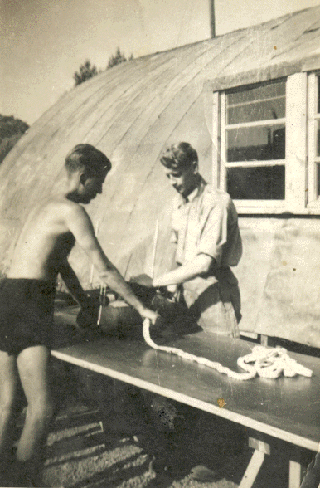
In the thirties General Student had achieved a great organisational
feat by laying the foundations of the German Fallschirmtruppe, but they
were still without their most basic piece of equipment, the parachute.
Tests were carried out in the mid thirties at the Luftwaffe test centre
at Stendal and the result was the RZ1(Rückenfallschirm Zwangsauslösung
1) parachute, which was loosely based on a civil aviation design.
This parachute was first used at the beginning of the war and was an automatically
deployed parachute by means of a static line which was attached to a wire
cable on the inside of the transport aircraft.
The RZ1 had a half globe canopy made from white silk and consisted
of 28 sections with a surface area of 56 square metres. The canopy consisted
of three parts, the apex, canopy panels and skirt. Attached to the skirt
were the shroud lines, which met at a central point where they were joined
to two carry lines, which in turn were attached to the parachute harness
by means of two snap hooks.
The canopy was packed apex first into the deployment bag, which was
then placed into the parachute outer cover with the apex nearest the top.
The static line was attached to this end of the bag. The shroud lines were
then packed vertically on top of the deployment bag. Four flaps on the
outside of the cover were then secured with a securing pin, which was also
attached to the static line.
The parachute pack cover was attached to the harness D rings with heavy
string. The two carry lines at the bottom of the pack were secured to two
larger D rings on the waist of the harness with the snap hooks. The RZ1
tended to swing badly in windy conditions and it had a high drop rate,
the wearer could not reach the shroud lines which made it difficult to
control and increased scattering on the ground.
Early tests also showed that the static line sometimes fouled the canopy
on opening. The static line problem was solved with the improved version
of the RZ1, called the RZ16, which replaced it in early 1940. The RZ16
static line was stowed side to side on top of the contents of the parachute
pack. This outer cover was also stitched to the harness instead of being
attached with string. The RZ16 canopy bag was fitted with external loops
for the stowing of the shroud lines. The harness still retained the two
slide release buckles and snap hooks on the legs.The carry lines attached
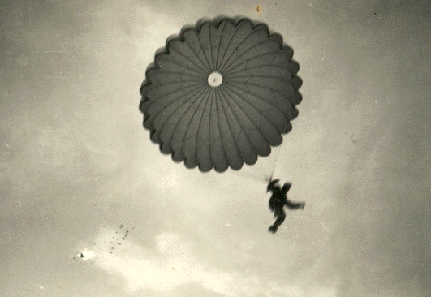
at the waist and gave the jumper no control during descent. As you can
see above, this Fj is suspended at an angle as he comes in to land.
The RZ1 & RZ16 although safe for the wearer were difficult to remove
on landing. The RZ20 was similar to the RZ16 parachute but the new harness
was fitted with 4 quick release buckles which enabled the parachutist to
clamber free of his chute quickly and more easily than before, most welcome
when landing under fire or caught in a ground wind. Men trying to struggle
free of parachute harnesses became easy targets. It was first used in the
battle for Crete in May 1941 and continued in service until the end of
the war. The number of canopy panels were reduced in this variant from
28 to 20.
Parachute colourings were also improved at this time, until now the
main colour was white, which showed up to easily on the ground and acted
as a beacon. Crete saw the use of camouflage-patterned canopy’s as well
as white. Officers were distinguished by white capped canopy’s for easy
recognition. At the time the camouflage canopies were introduced a rumour
spread amongst the men that the chemicals in the dye's used to colour the
cutes effected the smooth opening of the chute itself. (A veteran told
me a story regarding a training accident which occured whilst he was an
instructor at Salzwedel. An Italian officer died when his parachute did
not fully open. The canopy only partially deployed, it had a long crease
along its width and did not open properly. This type of phenomenon was
known as a "Brotchen" after the German bread roll served for breakfast,
which had a crease along the top)
Another variant was designed called the RZ36, which was triangular
in shape and based on a Russian design. It offered less of a shock to the
wearer upon opening, less swinging motion during the drop and a softer
landing. Its designer sought after a patent but for some reason the military
were not interested in it and it never saw service, although Oberst Baron
von der Heydte used a Russian Triangular parachute for the drop into the
Ardennes. (this may not have been the case after all and it was used
in limited numbers during the ardennes operation, information uncovered
by Willi Zahn)
1944 saw the introduction of another design of parachute of the ribbon
design, which was supposed to give better control, but saw limited service.
Special cargo parachutes were also designed to enable heavy equipment
to be dropped to the paratroops. They consisted of 5 parachutes packed
into one bag and were attached to recoilless rifles; anti-tank guns and
even motorcycle combinations.
Parachutes were also fitted to the Fallschirmjäger's most vital
piece of equipment, the air dropped weapons and supply containers. In the
early airborne operations including Crete, only a few german paratroopers
jumped with their personal weapons, (with the exception of pistols which
were carried in the built in flare pistol holsters stitched into the back
of the jump smock, as well as handgrenades).
After Crete, all paratroops were trained to jump with their weapons
to give direct fire upon landing. All weapons from rifles and smg's to
MG34/42's were dropped separately from the men in rectangular cannisters.
They would be dropped simultaneously from the transport aircraft using
the same automatically deployed parachute, which meant a mad scramble upon
landing to reach the weapons before they could become a fighting unit.
Only glider borne troops could fight straight after landing as they
were dropped with all their equipment. The problem with the containers
was the chance of them falling into enemy hands as so often happened in
Crete.
Up until operation Mercury there were 3 sizes of container, but Crete
saw the standardization of one container, used for all supplies from weapons
and ammunition to medical supplies and rations.
The containers were marked with their units designation and coloured
markings to show the contents, they could also be fitted with coloured
smoke markers for better recognition
The box itself was heavily padded on the interior to protect the contents
from the shock of hitting the ground, all contents were secured with leather
straps. Two handles were fitted externally for easy lifting and inside
was fitted a tow bar and a 2 wheel set which could be fitted to the container
and used as a tow. Containers could be towed together in groups and many
photographs taken in Crete show paratroops pulling them with makeshift
slings and even donkeys were appropriated from farms to pull the containers..
The bottom of the container was fitted with a light metal corregated
shock absorber which helped to protect the cannister on landing, this could
be replaced making the container reusable.
Tests and research revealed that safe drops could only be made below
400ft with winds of 14mph or less. This improved the accuracy of the drop
and also reduced the time in the air, therefore keeping the surprise element.
A demonstration jump by the Fallschirm-Lehr battalion showed that 13 well
trained parachutists could exit a JU-52 in 8 seconds. At an altitude of
330 feet and an aircraft speed of 120 miles per hour their dispersal distance
would only be 25 yards between each man. Any jump carried outside of these
parameters would result in the wide scattering of the stick of paratroops
and more time for ground troops to react. The lowest recorded German airdrop
was over Crete when some of the Fallschirmjäger jumped from 250ft.
(which
is a very daunting thought, a 75m jump, 9m of it static line !!)
The canopy of the parachute was packed into a cloth bag with a thin
cord attached to the apex of the canopy and the other end attached to the
mouth of the cloth bag. The 9 meter static line was also attached to the
canopy bag.
A crucifix jump position was adopted where the parachutist would launch
himself spread-eagled, horizontally out of the aircraft by means of two
handles either side of the exit. This reduced the swinging motion when
the canopy opened and thus reduced the risk of the parachutist getting
tangled up in the shroudlines. On jumping, the nine metre static line which
was attached to a cable in the aircraft, would pay out . When it became
taught it pulled the canopy bag from the chute pack. The bag would be ripped
from the folded canopy and remain attached to the end of the static line
flapping behind the aircraft. The parachutist would freefall whilst the
canopy developed and the shroud lines payed out. The canopy would fully
develop then the wearer would be exposed to the huge jerking effect as
the shroudlines finished paying out. The parachute was designed to fully
deploy after only 100ft. The crucifix jump was not the best position for
landing and called for the parachutist to land on all fours, which resulted
in a high proportion of serious ankle and wrist injuries even when wearing
padded protection.
