Fallschirmjäger in the Battles of Normandy
June/July 1944
Warning: Please be patient. Lots of photos
in this section.
"If they
attack in the West, that attack will decide the war" – Adolf
Hitler
D-Day 6th June 1944
Just before dawn on the 6th June 44, hundreds of Naval guns opened
fire on the German coastal defences along the Atlantic wall. As the German
defenders cowered in their bunkers and pillboxes, thousands of allied troops
were embarking onto landing craft ready to land ashore in Normandy for
what would be the greatest amphibious assault in history.
Earlier that morning paratroops and gliderborne troops were landed
behind the German lines to take and hold strategic points inland.
Montgomery's 21st Army Group was composed of the US 1st Army and the
British 2nd Army. Between them, they were to land on 5 beaches running
along approximately 70 km of Normandy coastline. The Americans in the west
would land at Utah and Omaha, the British and Canadians at Gold, Juno and
Sword.
Once ashore these forces were to break through the beach defences and
establish a beachead, ready for reinforcements of artillery and armour
to be bought up.
The Americans were the first to land at Utah and Omaha at 0630, followed
at 0730 by the British further east.
Facing them, the German 7th and 15th Army's, mainly second rate divisions.
Most of the veteran divisions were further inland. With the exception of
Omaha, the invaders only met slight resistance. Omaha became a bloodbath
for the US 1st Infantry Division.
As the day wore on beacheads were established inland, containing German
counterattacks aimed at throwing the invaders back into the sea................
6th Regiment 2nd Parachute Division
7 days in Normandy - June 1944.
At the beginning of 1944, the new Fallschirmjäger Regiment 6 was
built at Köln-Wahn under the command of Major Friedrich August Freiherr
von der Heydte. It consisted of 15 Kompanie's with an approximate strength
of 3000 men.
The greatest part of the regiment was made from volunteers from Luftwaffe
ground personel and men from the Luftwaffe Field Divisions. A small cadre
of experienced veterans aided in the training of the regiment.
At the Köln-Wahn training ground the men of the 6th Regiment carried
out parachute and glider training as well as weapons training with the
Panzerfaust, Panzerschreck, Rifle, MP, light and heavy MG, Mortars and
light field guns.
On D-Day, the recently raised 6th Regiment under the command of Major
Friedrich August Freiherr von der Heydte, was already stationed in the
Normandy area. Acting independently from the 2nd Parachute Division and
under the control of the LXXXIV Corps, it had been in Normandy since May
13th with the Regiment HQ at the Hotel de Ville in Periers.
OB-West - Generalfeldmarschall von Runstedt. HQ @ St.Germain
Army Group "B" - Generalfeldmarschall Rommel. HQ @ La Roche
Guyon
7th Army
Kommandeur - Generaloberst Dollmann. HQ @ Le Mans
Chief of Staff - Generalmajor Pemsel
LXXXIV Korps
Kommandeur - General der Artillerie Marcks. HQ @ St.Lo
Chief of Staff - Oberstleutnant von Criegern
Ia - Major Viebig
Ic - Major Hayn
Divisionen
709 Inf.Div - General von Schlieben. HQ @ Valognes
***91 LL.Div - Generalleutnant Falley (KIA). HQ @ Chateau
Haut, north of Picauville
716 Inf.Div - Generalleutnant Richter
243 Inf.Div - Generalleutnant Hellmich
Fallschirmjäger Regiment.6
Kommandeur - Major von der Heydte
Adjutant - Hauptmann Peiser
Regiment Arzt - Stabsarzt Dr.Roos
I./FJR6
Komm - Hauptmann Emil Priekschat (MIA 8.6.1944) Hauptmann
Zierer
Adj - Oberleutnant Reese (MIA 8.6.1944)
Arzt - Stabsarzt Dr.Ferl (MIA 8.6.1944)
1.Kompanie - Oberleutnant Billion (KIA 8.6.1944) Leutnant
Meyer (MIA 9.6.1944)
2.Kompanie - Oberleutnant Schulz (MIA 8.6.1944)
3.Kompanie - Hauptmann Bucher (KIA 8.6.1944)
4 Kompanie - Leutnant Scherer (MIA 8.6.1944)
II./FJR6
Komm - Major Rolf Mager
Adj - Hauptmann Schulte
Arzt - Stabsarzt Dr.Holtz
5.Kompanie - Hauptmann Herrmann (KIA 8.6.1944) Leutnant
Holz (WIA 4.7.1944)
6.Kompanie - Leutnant Bruunklaus (KIA 11.6.1944)
7.Kompanie - Leutnant von Socha-Borzestowski (KIA 11.6.1944)
8.Kompanie - Oberleutnant Graf Bethusy-Huc (WIA 25.6.1944)
III./FJR6
Komm - Hauptmann Horst Trebes (KIA 27.7.1944)
Adj - Leutnant Treuherz
Arzt - Stabsarzt Dr.Schadt
9.Kompanie - Oberlautnant Wagner (KIA 8.6.1944)
10.Kompanie - Oberleutnant Prive (KIA 8.6.1944)
11.Kompanie - Oberleutnant Märk (WIA 4.7.1944)
12.Kompanie - Oberleutnant Pöppel (WIA 4.7.1944)
13.Schwere GrW.Kompanie - Oberleutnant Nahde (WIA 15.6.1944)
14.Pz.Jäger.Kompanie - Leutnant Geck (MIA 7.6.1944)
Leutnant Bauer (KIA 17.6.1944)
15.Pionere.Kompanie - Hauptmann Hauch (KIA 10.7.1944) Leutnant
Degenkolbe (KIA 11.7.1944)
First into the fray.
During the evening of 5th June 1944, Major von der Heydte had planned
to travel to Rennes and attend the planned war games. He travelled to St.Lo
to accompany General Marcks to Brittany but was informed on his arrival
that they would not be leaving until early the next morning.
(VDH himself said that he wanted to discuss a possible resistance
movement with the old General. Was he unaware of the existing plot to assasinate
Hitler, did he know that his cousin, von Stauffenberg was involved? Apparently
VDH was suspected of involvment in the plot, his name was written on a
seized document. Fortunately it was mispelt and the story carries on to
say that an officer by the name of Von der Heide on the Eastern Front was
arrested and spent the rest of the war behind bars!!!)
VDH returned to his regiment HQ at Periers late on 5th June. It has
often been said that VDH had some sort of premonition that something was
going to happen that night. Regiment picked up an unusual amount of radio
traffic from the channel, his drivers from the Alsace region began to desert
their posts, there were many reports of sabotage in the area.
The regiment with its subordinated unit, 8./Artillery Regiment 191
(91.LL.Div)
were providing a security line in the south of the Cotentin Peninsula,
south west of Carentan; St.Jores - Lithaire - Lessay - Perriers - St.Georges
de Bohon, in an area 20km wide and 15km in depth.
In the very early hours of June 6th, parts of the 501st Parachute Infantry
Regiment of the US 101st Airborne Division, jumped into this area, hailing
the beginning of the invasion. The most north easterly of these airbone
invaders, assigned the area between St.Come du Mont - Baupte - Carentan
were immediately attacked and at least one Company were brought into Carentan
as prisoners. Von der Heydte travelled to Carentan to interrogate the men
of this airborne vanguard himself.
At 3am on 6th June 1944, 91 LL.Div received a Fallschirm Alarm from
FLUKO Caen (Flugwachkommando - Aviation Report Centre), but it was
too late, the Fallschirmjäger of the 6th Rgt were already in action.
500 US Paratroops had dropped in the area of III./FJR6, south west
of Carentan. Many of these men were in scattered groups, unable to make
it to their grouping areas. The firefights between airborne troops raged
on all night. Another 100-150 US Paratroops had landed in the area held
by the 1st Battalion, eastwards of St.Jores.
Meanwhile, the 6th Regiment command post was shifted to St.Come du
Mont protected by a combat team from the 1st Battalion. The rest of the
battalion was late in re-inforcing the combat team due to harrasing fire
by allied aircraft at daybreak. This force backed up a battalion from Gren.Rgt.1058
who were already in the town.
After finalising battle plans, Von der Heydte crossed the Carentan
causeway at around midday on June 6th heading to the new command post at
St.Come du Mont. The surrounding area had been secured, although US Paratroops
were already dug in less than a Km to the east at La Barquette but unable
to get close to the causeway or its bridges due to strong defensive fire
from German positions on the road and St.Come du Mont.
The orders had been given out to the battalions of Regiment.6:
1st Battalion - To advance in the direction Ste.Marie du Mont-La
Madaleine to relieve the pressure on strongpoint W5 (Resistance Nest.5,
the hub of bunker defences at Utah Beach).
2nd Battalion - Advance in the direction of Turqueville, where
795th Georgian Battalion were located.
3rd Battalion - Remain behind to provide flank security.
As the 1st & 2nd Battalions moved on to their objectives, elements
of the 3rd Battalion were still involved in mopping up operations against
isolated groups of US Paratroops, south west of Carentan. Elements of the
3rd Battalion remained behind in Carentan, including the heavy company.
The church tower was used as an artillery observation post and became a
key position in the fighting that would happen further north.
Other US airborne forces in the south of the peninsula were being attacked
from the north by Gren.Rgt 1058 & Sturm Battalion Messerschmidt. Gren.Rgt.1057
attacked from the west against airborne landings on the Merderet River
further north.
The attack by 1st & 2nd Battalions went well at first. The 1st
Battalion managed to reach to reach the outskirts of Ste.Marie du
Mont, only 6km from W5, but found that it was in the hands of 101st Airborne
Division, soon to be backed up by elements of the 4th Infantry Division
who had landed at Utah Beach earlier that morning. A battalion from AR.191
had held the town before it was taken, they had withdrawn to positions
further west. The 1st Battalion dug in amongst the fields and hedgerows
outside of the town.
The second Battalion received strong fire into its left flank from
St.Mere Eglise, where 507th PIR were holed up and constantly being strengthened.
Major Rolf Mager was unaware that the Flak unit defending the town had
abandoned their positions to the Americans. The Battalion swivelled, not
toward the east but westward to outflank the town. Still the Battalion
recieved strong flanking fire, they returned fire but their own ammunition
was beggining to reach low levels. They were forced to withdrawal back
south toward St.Come du Mont in the morning of June 7th, without having
reached the Osttruppen further to the north east.
The 1st Battalion had managed to hold their positions around St.Come
du Mont, but they were under increasing pressure from US forces heading
inland from Utah beach and constantly strengthened airborne forces operating
all over the base of the Peninsula. During the evening of June 6th approximately
150 US Gliders landed north east of Carentan in the rear of 1st Battalion.
Later that night their positions between St.Marie du Mont and Vierville
were shelled by Naval Artillery. In the early hours of June 7th, more US
Paratroops landed in the area around Angoville and at around 7am another
150 American gliders landed in an area between Angoville-St.Marie du Mont-Hiesville.
1st Battalion was slowly being surrounded and escape routes were slowly
being shut off.
Von der Heydte was unaware that the allies had landed on the beaches
east of his HQ until he witnessed the armada at sea from the church tower
in St.Come du Mont. As he lay witness tho this spectacle 11km to the east,
the town was straddled with large calibre Naval artillery shells, which
shook the church and surrounding houses. The Americans knew the value of
a church tower to Artillery observers, men who could rain death upon advancing
troops.
Infantry, artillery and Tanks were all heading inland to relieve the
airborne forces who were holding on to their early morning objectives.
Four of these objectives at the base of the Cotentin was the securing of
the western ends of Exit 1 & 2 from Utah beach, the bridges over the
Douve river just north of Carentan, the bridges over the Carentan Canal
at Le Moulins and the lock gates at La Barquette. The lock gates at La
Barquette had been easily secured by men of the 501st PIR early on D-Day.
American advances on the causeway and bridges were beaten back by dug in
positions on the causeway and in Pont du Douve backed by artillery fire
from St.Come du Mont.
In the early hours of June 7th, the first American tanks to be seen
by the 1st Battalion, appeared on the approaches to St.Marie du Mont. The
1st Battalion were not equipped for a long battle against armour, they
had already expended large amounts of ammo during probing attacks into
Ste.Marie du Mont. There were limited supplies of the Panzerfaust and Panzerschreck.
There were also other pressing matters for the 1st Battalion to take care
of. They were ordered by radio to dispatch a force to counterattack 2 bridges
over the Carentan Canal south west of Ste.Marie du Mont. These bridges
had been taken on D-Day and the americans were going to use them to bypass
Carentan and link up with forces in the Omaha Bridgehead.
The 1st Battalion sent its last radio message back to Rgt HQ late in
the morning on June 7th, "5 enemy tanks destroyed, battalion now surrounded".
Hauptmann
Priekschat now decided it was time to withdrawal, ammo was low and casualties
were high. The order went out and the remnants of the 1st Battalion from
St.Marie du Mont to Vierville began their fighting withdrawal to the south
west, only to find that US tanks had already entered Vierville and were
slowly pushing west.
Meanwhile in St.Come du Mont, Von der Heydte ordered a reconnaisance
unit from the 2nd Battalion to try and break through to its beleaguered
sister Battalion. They encountered enemy tanks in the area between Basse
Addevile-Tamerville-Les Droueries but managed to destroy 2 of them in close
combat. One Kompanie from the 3rd Battalion was also sent east from St.Come
du Mont, between Belle Eneau-Tamerville. At around 10am on June 7th, they
were engaged in bitter fighting with enemy troops. At 2200 on 7th June,
another element of the 3rd Battalion came into contact with enemy tanks
south of Angoville au Plain and managed to destroy 2 with a Panzerschreck.
After fierce fighting in the hamlet of Beaumont, just east of the N13/D913
road junction, German forces withdrew west to take up position in the fields
and hedgerows south of St.Come du Mont at dead mans corner. The war was
slowly being brought to Von der Heydte's front doorstep.
In the afternoon of June 7th, US Paratroops backed up by Grant medium
tanks, approached the road junction on a probing attack into St.Come du
Mont. The lead tank was brewed up by an AT round. Fierce fire erupted from
the hedgerows and from positions in Pont du Douve further south. The american
advance stalled and they withdrew back toward Beaumont to regroup.
At around 3am on June 8th, more US Paratroops were dropped east of
Angoville. St.Come du Mont now came under renewed artillerie attacks from
land and sea. A second attack on the N13 road junction began in the morning
of June 8th and US Paratroops were this time successful in capturing dead
mans corner.
Von der Heydte could see that he was slowly losing his grip on St.Come
du Mont, the Americans were only a few hundred meters to the south and
it would not be long before they advanced in to the town. He decided it
was time to withdrawal with what forces he had left. Many of his men evaded
to the south west, through the hamlet of La Croix and to the only other
causeway into Carentan, the railway line embankment. Small rearguards were
left behind to disable or destroy the vehicles and heavy equipment that
could not be brought back to Carentan and also to cover the withdraw from
high ground near the town. One by one, the remnants of the 2nd & 3rd
Battalions, Gren.Rgt.1058 and AR.191 were withdrawn from the line to make
their way south across the German held N13 or along the rail track to Carentan.
The withdrawal into the south of the peninsula took most of the day
as men struggled to reach the northern and eastern outskirts of Carentan.
The 300 or so men, all that was left of the first Battalion was still
making a fighting withdrawal to the southwest on the morning of June 8th.
They encountered enemy fire through the fields and villages but still they
marched on, attempting to reach the safety of Carentan. Desparate rearguard
action at Vierville, Angoville, Bse.Addeville & Beaumont allowed many
of the survivors to get in sight of their objective. However, they were
to be stopped in their tracks near the lock gates at La Barquette.
Paratroops of the 101st Airborne Division had taken this objective
and were covering the approaches with mortars and heavy machine guns. The
battle weary Fallschirmjäger came under a hail of fire in the flooded
fields north east of the lock.
They took heavy casualties and thinking the lock was held by a large
enemy force, Hauptmann Priekschat surrendered what was left of the 1st
Battalion. After the surrender, the prisoners were marched under guard
to the nearby Peneme farm, where they came under fire from their own guns
located in Carentan causing even more casualties to an already exhausted
Battalion.
Only 25 men under the command of Leutnant Stenzel (3./FJR.6)
managed to reach Carentan and inform the regimental commander of what had
happened to the 1st Battalion.
When American commanders noticed the withdraw of German troops from
St.Come du Mont, an attack on the town was ordered. As they approached
the slope north into the town they came under fire from high ground west
of the town, occupied by a rearguard of Fallschirmjäger. This height
was soon cleared of resistance and as US Paratroops entered the outskirts
of the town they witnessed the exodus of enemy troops as they headed westwards
to the relative safety of the railway causeway. An attack on German positions
at Pont du Douve was then ordered. Once these had been cleared the way
to Carentan was open. Retreating Fallschirmjäger had bolstered the
defences along the causeway and at Pont du Douve, which drove the American
forces back toward St.Come du Mont and artillery fire from the heavy company
in Carentan forced the americans to take shelter. As the US Paratroops
withdrew northward they were attacked by reaguard Fallschirmjäger
units heading south from the fields and hedgerows either side of N13 to
join their comrades on the causeway.
The rest of the 6th Regiment now formed a latch plate astride the main
road into Carentan, effectively blocking the two US bridgeheads at Utah
& Omaha. However, VDH was unaware that the attack on the bridges over
the Carentan Canal had been unsuccessful and that US forces were pouring
into the countryside north of Carentan.
Von der Heydte now set up his Regimental HQ at Ingouf Farm between
the town and the marshland, with a front line covering the approaches from
Pont du Douve. MG & mortar positions were set up in the famryard and
nearby orchards. Small islands of dry land protruding from the flood waters
housed MG's and snipers. Artillery, mortar and MG positions were set up
on a hill southwest of Carentan and ranged in to the causeway and St.Come
du Mont.
Carentan now became the most hotly contested areas on the invasion
front.
On June 9th, German regulars along with many Fallschirmjäger abandoned
positions in Pont du Douve. They had done well to hold the American advance
for so long but under heavy pressure from strong probing assaults they
were forced to move south. After destroying their heavy weapons they used
explosives to destroy the most northerly of the 4 bridges over the Douve.
They then headed south to join the new front line. It was now a waiting
game to see when the Americans would try and take the Carentan causeway.
In an old wine cellar on the outskirts of Carentan was the Regimental
dressing station. It was here that the Regimental Doctor, Dr.Roos and the
Battalion doctors of the 2nd & 3rd Battalions operated around the clock.
Along with two captured American doctors they treated more than 1000 wounded
American, German, Georgian soldiers and French civilians in a 24 hour period.
The regiment held its new front line without artillery, tank or Luftwaffe
support. Ammunition became scare, in particular Mortar and machine-gun
ammo. Artillery ammo was plentiful but they had no guns.
The thinly spread Fallschirmjäger defended their positions north
of Carentan with what ammo they had left. Mines were hastily placed to
try and slow the probing attacks by American forces who were poised to
breakthrough to Carentan, their next objective.
In early hours of June 10th, US Paratroops reconnoitered the flooded
marshland either side of the causeway to find weaknesses in the German
defences. Many casualties were caused by MG and sniper fire from the islolated
groups in the marshland, from Ingouf Farm and from Fallschirmjäger
dug into the southern end of the causeway.
In the morning of June 10th, Ingouf farm and its surrounding buildings
were subjected to a massive artillery barrage. This appeared to VDH to
be the prelude for an assault but nothing happened. Only an American offer
of surrender was forthcoming to which he replied "what would you do
in my place".
A supply column from 84 Korps brought in French mortar ammo late on
June 10th, but it was the wrong calibre. During the night of June 10th/11th,
JU52's dropped Mortar and MPi ammunition. Even re-supply could not stop
the inevitable.
In the morning of June 11th, US Paratroops who had successfully traversed
the causeway under the cover of darkness waited for the order to attack
FJR6 positions. After a massive artillery barrage, the men of 101st Division
charge the positions around Ingouf Farm. The former HQ of FJR6 was soon
in the hands of US 101st and after an unsuccessful counterattack, VDH withdrew
his men to the south west. Other elements of FJR6 attacked from the north
of Carentan but were also beaten back. The americans now set up an east-west
defensive and by midday US troops had reached the outskirts of Carentan
and had settled in the houses, gardens and hedges in front of the town.
Just as the Americans were entering Carentan, Von der Heydte ordered
the 795 Georgian Battalion to move to the south west of Carentan after
being informed of american forces attempting to surround the town from
the north. After co-ordinating one of the mornings unsuccessful counterattacks
he was unexpectedly called upon by Brigadeführer Ostendorff and his
Ia Obersturmbannführer Konrad. Ostendorff was the commander of 17th
SS Panzergrenadier Division "Götz von Berlichingen". During
this meeting Von der Heydte was informed that his Regiment was now subordinated
to the SS Division and that the combined forces will counter attack the
American foothold on the outskirts of Carentan.
The situation was growing desparate for Von der Heydte, his regiment
was understrength, the 17th SS Division was not yet ready to counterattack
and the Americans were poised to encircle and capture Carentan. Von der
Heydte decided to withdrawal his beaten Regiment from the town and at 1700
on June 11th, the men were ordered to vacate Carentan and withdrawal to
prepared positions further to the south west, even abandoning the nearby
height.
By dusk the regiment had withdrawn from the ruined town. The 6th Regiment
now set up a new defensive line: St Georges du Behon-Saintenny-La Moisentrie-Blehou.
The
battle for Carentan had come to an end. As American forces entered the
town Brigadeführer Ostendorff was informed of the Regiments withdraw
from the town. He was enraged and wanted Von der Heydte arrested and charged
for defeatism. Only signals and telephone calls from Von der Heydte's high
ranking brethren managed to cool the situation.
A counterattack was now planned for June 12th that would include the
6th Rgt and the 17th SS Panzergrenadier Division. The town would be taken
back at any cost. The orders stated the attack will take place in the direction
of the Periers-Carentan road. If good progress is made then a bridgehead
is to created at St.Come du Mont. This order was outrageous. St.Come du
Mont had fallen and it would never be taken back.
The combined German assault tried in vain to re-enter the town on June
12th. Only the 2nd Battalion managed to get into the town, taking up positions
near the train station. However, these positions had to be given up since
they could not get reinforcment due to heavy artillery and mortar fire
and the appearance of American tanks.
The route between the two beachheads at Utah & Omaha was now open.
The 6th regiment could only withdrawal to the south west and help defend
a new front line along with the remnants of 7th Army units who had managed
to escape from the Cotentin Peninsula.
The next few days went by without many incidents. American forces concentrated
on consolidating their gains around Carentan and bringing in re-inforcements.
The 6th Regiment carried out many probing attacks and recon missions to
bring in prisoners. Pioneers mined roads and fields, earthworks and bunkers
were prepared and barbed wire defences were constructed, all the time coming
under sporadic artillery and mortar fire.
In mid July the Regiment was mentioned in a Wehrmacht Communique when
the Radfahrkompanie along with a PanzerIV from the 2nd SS Panzer Division
broke through a US Infantry Battalion and took 13 officers and 600 men
prisoner. This was to be the last battlefield success for the men of the
6th Regiment in Normandy. Subsequently the Regiment was caught in the vortex
of the US breakthrough on St.Lo. By now only a few hundred men remained.
Nearly all were ill or wounded. Many had to be left in the military hospital
at Alencon.
On August 6th 1944, the Regiment along with 17th SS.Pz.Gren Div, participated
in the counterattack toward Avraches. This breakthrough to the west coast
did not succeed. Now only around 60 men remained unwounded and the regiment
had to be pulled out of the line. They were re-united with their wounded
at Lisieux. Approximately 3000 men had been killed and wounded during the
campaign in Normandy. On August 16th 1944, the remnants of Regiment.6,
around 400 in total, were collected from Nancy and transferred to Güstrow
for rebuilding. A newly built 6th Regiment would again see action in September
1944, but for many of those who survived the fighting in Normandy, Holland
would be their final battle.
**91.LL.Div:
Responsible for the defence of the southern part of the west coast
of the Cotentin Peninsula and act as a reserve in the event of an allied
landing on the east coast. Under the command of the 7th Armee.
91.LL.Div was a category 25 division, raised in early 1944 from
elements of the Replacement Armee. It consisted of 2 Grenadier Regiments,
each with 3 Battalions, a Fusilier Kompanie used as a reconnaisance unit,
an Artillery Regiment with a heavy Battalion of 12 x 155mm guns and 2 Battalions
with 12 x 105mm guns.
1057 Gren.Rgt
1058 Gren.Rgt
91.Fus.Komp
Art.Rgt.191
Pz.Jg.Btl.191
Pi.Btl.191
Nach.Btl.191
The division received special training in anti-air landing operations
and was the right unit in the right place on June 6th 1944, however co-ordination
of this unit was in dis-array after its commander, Generalleutnant Wilhelm
Falley, was ambushed in his staff car and killed during the night of June
6th, on his return from the Planspiel at Rennes in Brittany. The US Paratroopers
that took part in this ambush had no idea that they had killed the commander
of the division whose job it was to stop such an airdrop.
Later on in the campaign, the division was combined with 243rd Inf.Div
under the command of Oberst Bernhard Klosterkemper. In early July 1944,
it received a new commander in the shape of Oberst Eugen Koenig.
In July 2001, I travelled to Normany and stayed at Carentan for
3 days in a tent next to the Carentan canal. I wanted to walk the ground
where much of the above account took place. My visit began on Utah beach,
through Ste.Marie du Mont to Vierville to Angoville to Bse Addeville to
Dead Mans Corner to St.Come du Mont to La Croix to Pont du Douve to La
Barquette to Peneme Farm to Carentan and south west all the way to Periers.
I took many photos and walked for hours looking at the landscape and the
buildings, trying to imagine what it was like between 6th-12th June 1944.
Many of the roads have changed and a new expressway now covers some of
the ground covered in this battle, new buildings stand where the old of
1944 have been torn down. I cannot imagine the death & destruction
that took place on this ground but it gave me a better insight into what
happened during that time. I have omitted many photos, especially the one
I took of the Hotel de Ville in Periers, which turned out to be just a
hotel. Wasted trip. Anyway in 3 days I cracked in a lot of sightseeing,
including the Omaha sector, the Omaha cemetary, the German cemetary at
La Cambe, where my wife was sick (she was pregnant), the museums at St.Mere
Eglise, Omaha Beach, Bayeaux and St.Lo. I also visited some battle sites
near St.Lo where FJD3 fought. I recommend a visit to Normandy, just for
tranquility if nothing else. Below are some of the photos I took in July
2001. Please enjoy. It should give the reader a better feel of the geography
to accompany the account.
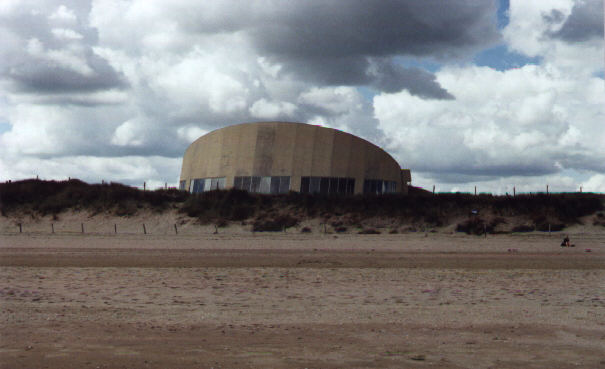
Strongpoint W5 Utah Beach.
This photograph is taken looking up the beach at Utah toward W5,
(Wiederstandsneste.5) resistance nest 5. This was the hub of defences
at Utah beach on D-Day. It was armed with 75mm and 50mm guns along with
mortars and heavy MG's. It was commanded by Leutnant Arthur Jancke of 3./IR919.
The pre-dawn attack by dozens of meduim bombers failed to destroy the bunker
complex but did manage to destroy all but a few of its weapons. With only
an handful of mortars and MG's and 1 artillery piece still in action, it
was not long before the invading US 8th Infantry Regiment silenced W5.
The bunker is now the Utah beach museum and is covered with metal and
glass. The complex has been well preserved and some sections can only be
viewed from behind glass. On some of the firing pits you can still see
the hand drawn panoramic views on the lip of the pits. These are accurate
drawings of what the men could see in their peripheral vision. At different
points of the drawing are elevation and windage settings for pre-ranged
fire.
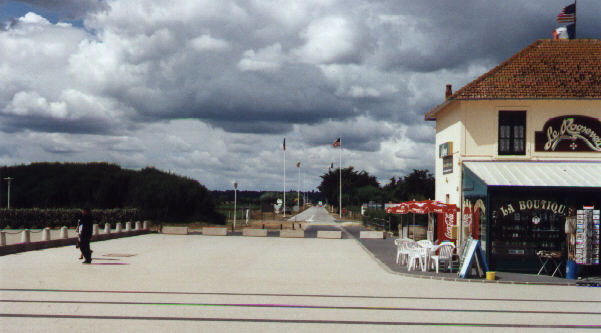
Exit 2 Utah Beach.
Right behind W5 is Exit 2, one of the four objectives of the beach
landed forces at Utah. Exit 2 leads straight to Ste.Marie du Mont and eventually
Carentan. 1st Battalion of FJR6 was ordered toward La Madaleine to relieve
the pressure on W5. If they had moved earlier in the day they may have
travelled this road to give support to the beach defenders. Nowadays behind
the dunes is a restaurant and gift shop, although you can still see a bunker
at the back of the restaurant that was camouflaged to look like a house
from the air. On getting closer you can sse that windows have been painted
on to the side.
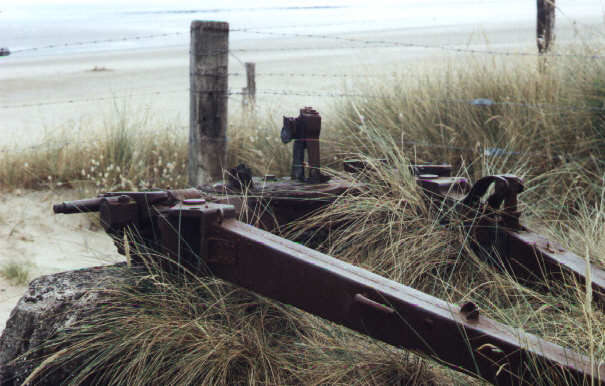
Artillery piece at Utah Beach.
One of the artillery pieces that helped to defend this section of Utah
beach. The barrel of the gun lies a few feet away in the sand. It looks
to be of French origin, or perhaps Czech. Now it is slowly rusting away
in the Normandy weather.
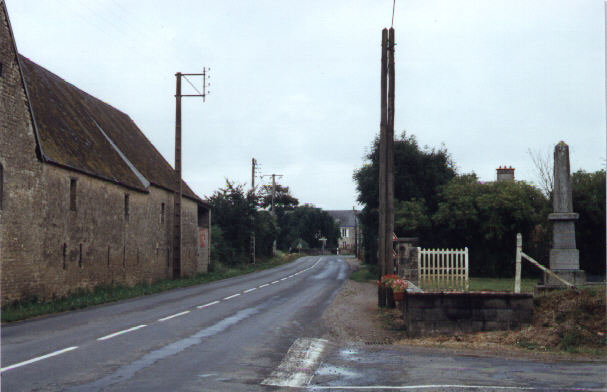
Vierville.
Looking east through Vierville toward the direction of Ste.Marie du
Mont. (I expect not much has changed in this photo since 1944)
Between Ste.Marie du Mont and Carentan lies the town of Vierville.
A quiet and peaceful village now but in those early days of June 1944 it
was a hive of activity. US Airborne forces took the village early on D-Day,
the Germans counterattacked and retook the village, later in the day it
changed hands for the third time. Between here and Ste.Marie du Mont, the
1st Battalion of FJR6 fought off attacks by US Paratroops and forces fighting
inland from the beaches further west. The Battalion also had to withdraw
through this town and its surrounding hedgerows when it retreated from
its advance positions.
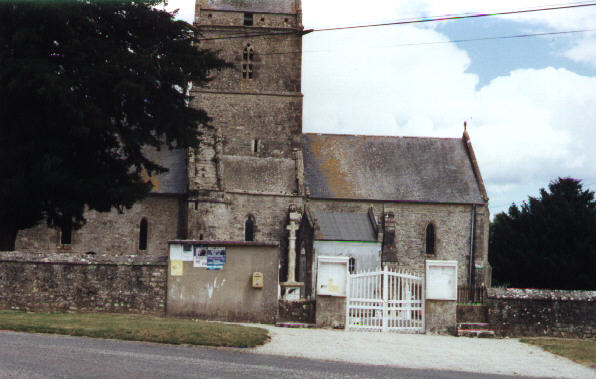
Church at Angoville au Plain.
This hamlet is only a couple of Km North East of St.Come du Mont. US
Paratroops of 501st PIR were surrounded here for the first 2 days of the
invasion. The church was turned into an aid station and medics treated
both American and German casualties. In Mark Bando's book "The 101st
Airborne at Normandy", there is a photo of one of the pews in the church,
taken in the 1990's. It still has blood stains on it from the wounded who
lay on them in June 1944.
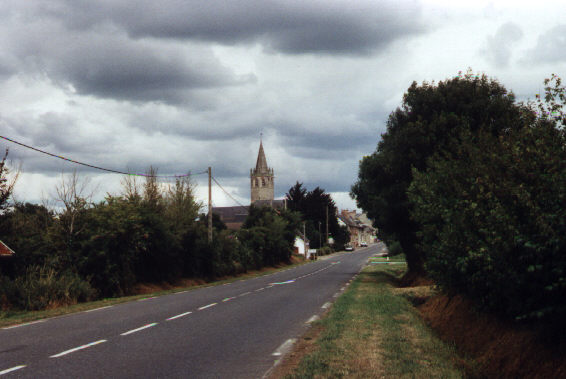
Looking north to St.Come du Mont from Dead Mans Corner.
This shot is taken about 100m north of the road junction at dead mans
corner looking toward St.Come du Mont. This road used to be the old N13
which junctured with D913 at dead mans corner. This used to be the main
road through to Carentan and was a vital objective for the allies. On 8th
June 1944, the town was abandoned by FJR6. Some men headed down this road
to attack US troops who had unsuccessfully tried to take Pont du Douve
further to the south. They then took up defensive positions in Pont du
Douve and on the slopes of the causeway, firing at US Paratroops who were
dug in less than a Km west of the causeway at La Barquette.
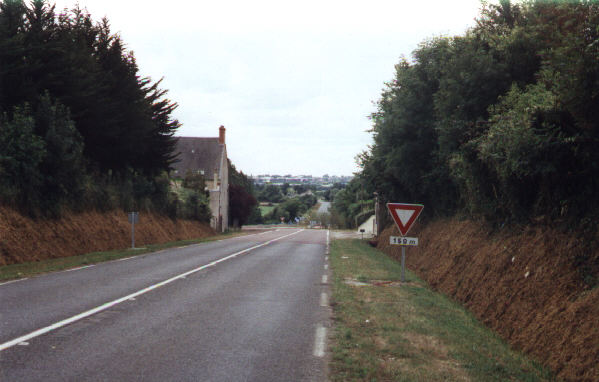
Looking south toward dead mans corner
This shot shows the house at dead mans corner and is taken about 250m
south of St.Come du Mont. In the distance on what was the old N13 highway
into Carentan can be seen the hamlet of Pont du Douve. It was German positions
here that stalled the taking of the road bridges, delaying the US troops
in their advance into Carentan.
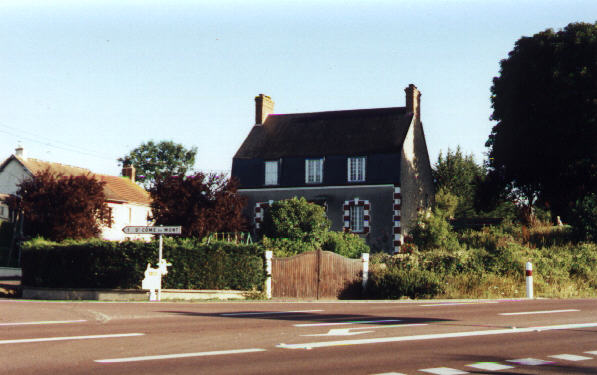
The house at Dead Mans Corner
This famous house served as a German first aid station during the fierce
fighting that took place on the road and in the fields & surrounding
hedgerows. This house stood right on the corner on the road junction that
turned right to St.Come du Mont and left to Carentan. On the afternoon
of June 7th 1944, US Paratroops along with Grant medium tanks approached
the juction from the right of the picture. The first tank was knocked out
either by a Panzerfaust or by an AT round from one of the guns in Pont
du Douve further to the south. The tank brewed up and incinerated the commander
in the turret. The tanks stood their for days and the road junction came
to be known as "Dead Mans Corner". The road layout is different
today. The D913 no longer intersects with the old N13 but corners to the
south. The house is obscured by trees as you approach it and it is easily
missed. If you are like me you will see it in your rear view mirror and
come to a screeching halt as you turn the corner. You have to indicate
early to turn right up the hill to St.Come du Mont. Well worth a visit
though if you want to stand on FJR6 ground.
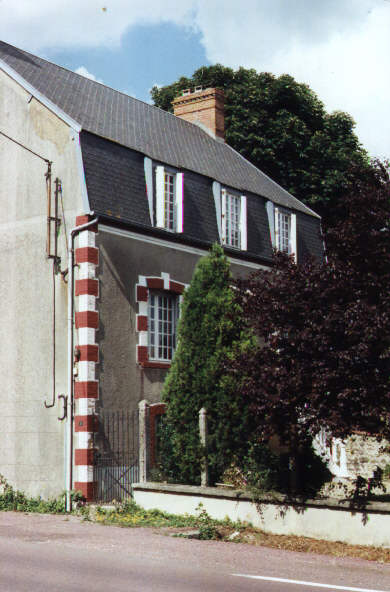
House at Dead Mans Corner
A better shot of the house, partially rebuilt since the war but still
looking very well. The owner was in his garden when I took the photo, I
wish I had asked him for a look around now.
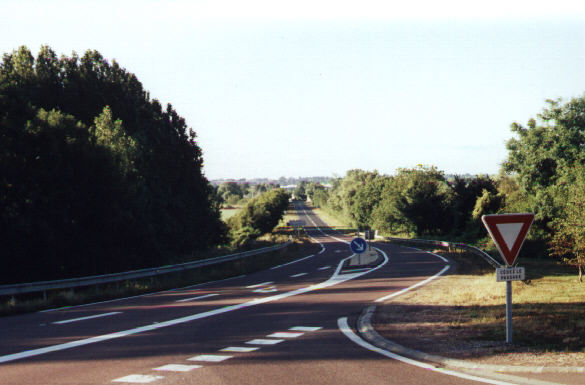
South from dead mans corner to Pont du Douve.
The hamlet of Pont du Douve can be seen right at the bottom of the
road. This road in 1944 was straight and led to St.Come du Mont several
hundred meters further to the right of the photo. This photo was taken
in front of the house at the road junction in the approximate spot where
the Gran medium tank was brewed up. It is feasible that an AT round from
Pont du Douve knocked it out, however, the hedgerows were teeming with
Fallschirmjäger, it may well have been a Panzerfaust.
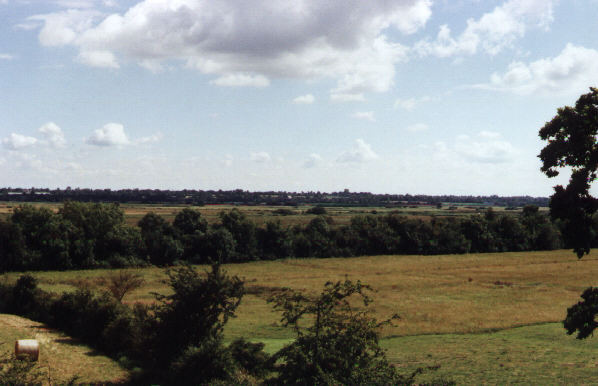
Hedgerows and fields at Dead Mans Corner
This photo is taken looking down on to the fields and hedgerows, west
of the road junction at dead mans corner. These fields and hedgerows would
have been filled with Fj and Grenadiers during the failed attack on June
7th and the successful attack on June 8th 1944.
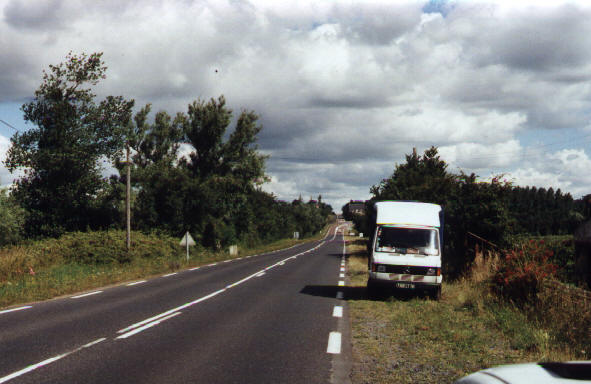
Outskirts of Pont du Douve to dead mans corner.
Please excuse the vehicle, white van man gets everywhere. This shot
is taken from Pont du Douve, several hundred meters from the old intersection
of N13 & D913. On June 8th 1944, US Paratroops of 101st Division attacked
down this road. German troops were dug in around the hamlet with MG's and
an AT gun. The German forces were protecting the 4 bridges over the Douve
river. The N13 ran across these bridges. The attack was unsuccessful. As
the americans withdrew north they were attacked by Fallschirmjäger
heading south from St.Come du Mont after that town was abandoned. German
positions in Pont du Douve were abandoned on June 9th and on their withdraw
south into Carentan they destroyed one of the bridges, hampering any American
advance to the south.
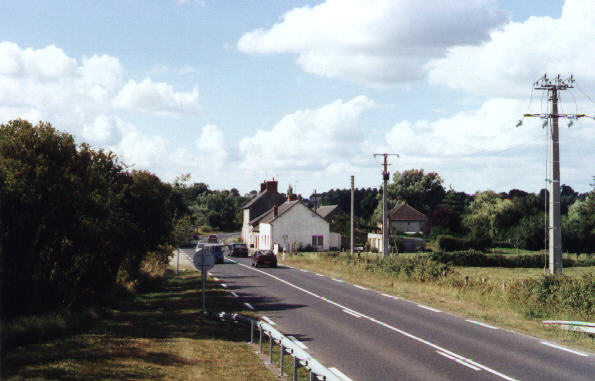
Pont du Douve to St.Come du Mont.
This is the hamlet of Pont du Douve, several hundred meters to the
south of St.Come du Mont. This hamlet was occupied by German forces who
beat back US assaults to capture the bridges on the N13 road to Carentan,
which is further south. You can just make out the steeple at St.Come du
Mont behind the white house. Pont du Douve was abandoned by German forces
on June 9th 1944. During their withdraw they destroyed the old bridge,
which would have been positioned a few meters to the left of this photo.
The other 3 bridges were obstructed and mined.
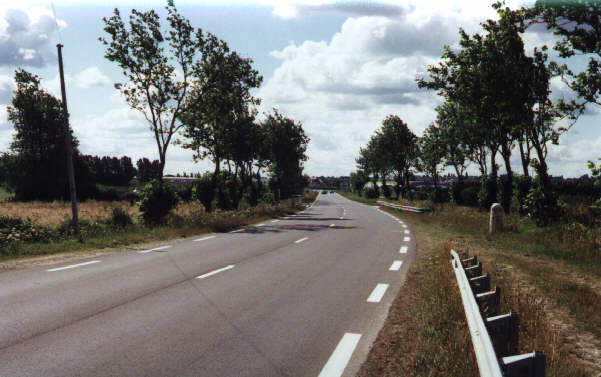
Looking south to Carentan.
This photo taken looking south towards the outskirts of Carentan shows
2 of the bridges over the Douve river. The road layout has changed since
1944 and the old N13 ran a few meters to the west of the new one. This
gives an appreciation of the distances involved to men who had to cross
the Carentan causeway to evade capture on 8th June 1944.
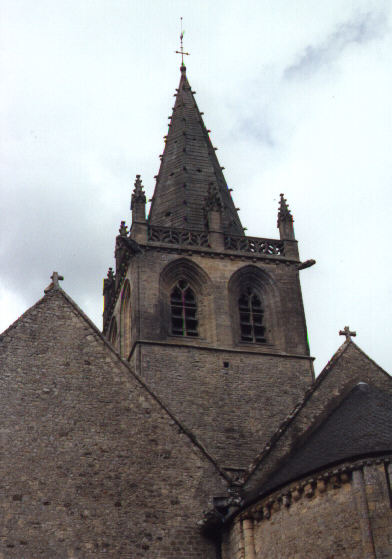
Church at St.Come du Mont.
When Von der Heydte entered the town he appropriated the keys to the
church tower. After walking on to the balcony above the church he saw the
allied fleet amassed off Utah Beach. As he watched in awe through his binoculars
the town was straddled with large calibre Naval artillery shells which
shook the church. This was confirmation that the invasion area was Normandy
and not the Pas de Calais.
When I visited the church it was empty and of course I did not appropriate
the keys and in the abscense of any verger I could not climb up to the
church tower in the footsteps of VDH. It was eerie of course, standing
in this place of worship that on 6/6/1944 was full of commotion and the
barking of orders.
The church tower has since been rebuilt. It was alledged that US forces
had destroyed it to deny the Germans a good observation point, but apparently
it was destroyed by 6 shots from 6./AR191, attached to FJR6.
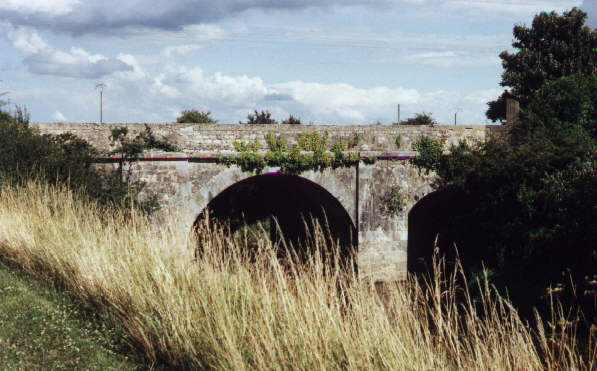
La Jourdan bridge near Carentan.
One of the 4 bridges over the Douve river near Carentan. Early objectives
for men of the 101st Airborne Division. This one at La Jourdan is the original,
a few meters to the west of the new road bridge that spans the narrow river.
To the left of this photo was a gun emplacement, probably artillery, that
still stands today. Many US Paratroops died trying to take these bridges
in their drive for Carentan.
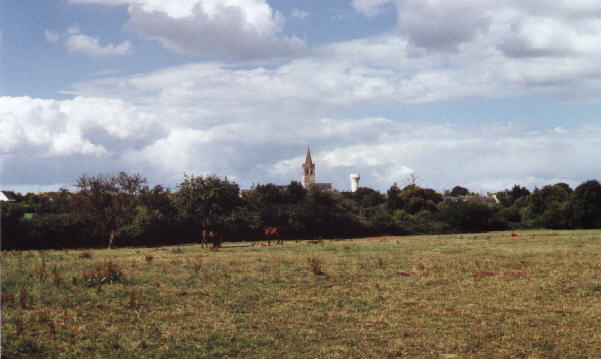
St.Come du Mont.
Looking north to St.Come du Mont. A Kilometer or so to the south west
is the small hamlet of La Croix. During the withdrawal from the town many
men under VDH's command headed through these fields and hedgerows to La
Croix to reach the rail track. This rail track led to Carentan and was
one of 2 causeways raised above the flood water filled marshland that covered
most of the low ground. This withdrawal was conducted under tank and artillery
fire. The rail embankment gave some cover to those who took that route.
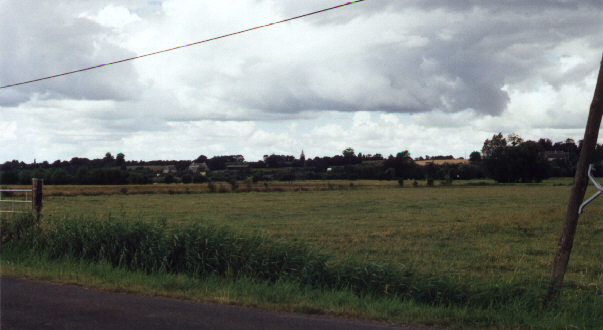
St.Come du Mont from La Barquette.
This photo is taken at the lock of La Barquette. The view is North
West and you can see the church tower of St.Come du Mont in the centre
of the photo. As you can see the ground in front of the lock is low and
was flooded in June 1944. This is the area where remnants of the 1st Battalion,
FJR6 ended its days. Many were killed and wounded in this terrain by a
force much smaller. How could they have known that just to the north west,
their commander was fighting a similar battle and trying to save his men.
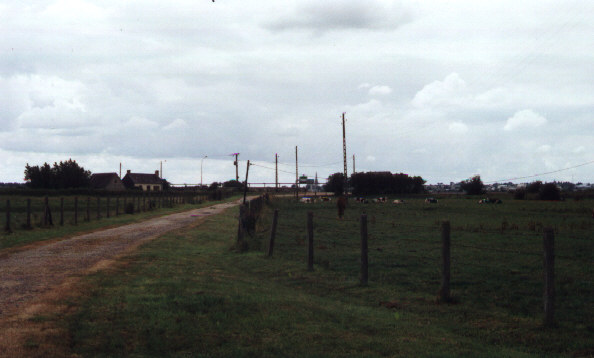
La Barquette from the North.
You can just make out the lock at the end of the dirt track. The area
was fenced off and I was unable to gain access to the lock. To the left
of the picture is where the remnants of the 1st Battalion approached the
lock, from the north east. Most of this ground around the lock was flooded.
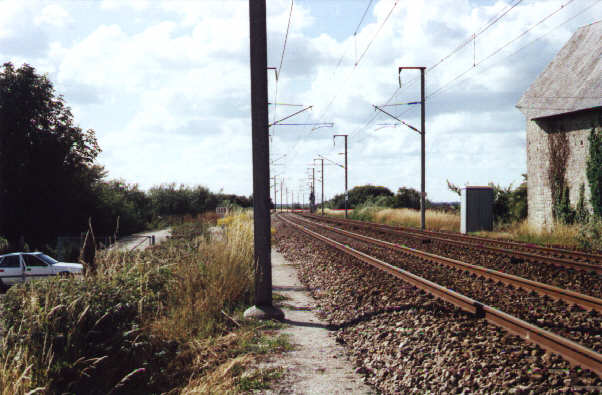
Rail line into Carentan at Ingouf Farm.
This is the rail line as it passes Ingouf Farm on the outskirts of
Carentan. The farm is still there but much of the surrounding countryside
is covered by an industrial estate. Ingouf farm was the new advance command
post for the Regiment after the withdrawal from St.Come du Mont. The area
was subjected to a huge artillery barrage on June 10th 1944 and on June
11th, US Paratroops who had secretly closed on Ingouf Farm attacked and
dislogded the Fallschirmjäger from this position.
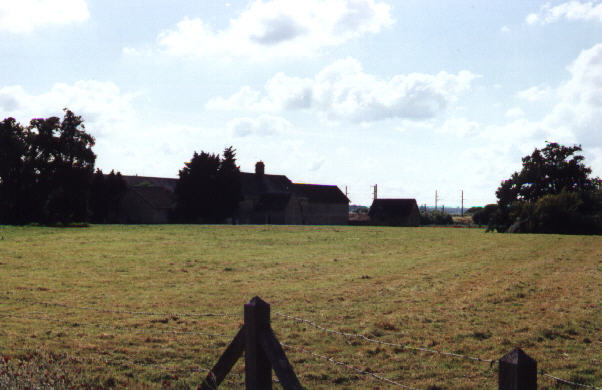
Ingouf Farm
This a better shot of Ingouf Farm, taken from the road to the south
of it. There are still a few out buildings but no orchards and fields as
there is an industrial development behind the position where I took the
photo. The rail track is to the left of the farm. This was the advance
Regiment HQ after the fall of St.Come du Mont.
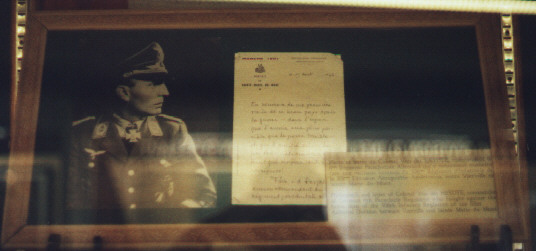
Major Friedrich August Freiherr Von der Heydte.
This framed portrait and letter hangs in the museum at Utah Beach.
It was written in August 1962 by Von der Heydte during a visit to Ste.Marie
du Mont. The accompanying caption reads "Photograph and letter of Colonel
Von der Heydte, commander of the German 6th Parachute Regiment who fought
against the brave men of 506th Infantry Regiment of the 101st Airborne
Division between Vierville and Sainte-Marie du Mont." (were the men of
the 6th regiment not brave!!!)
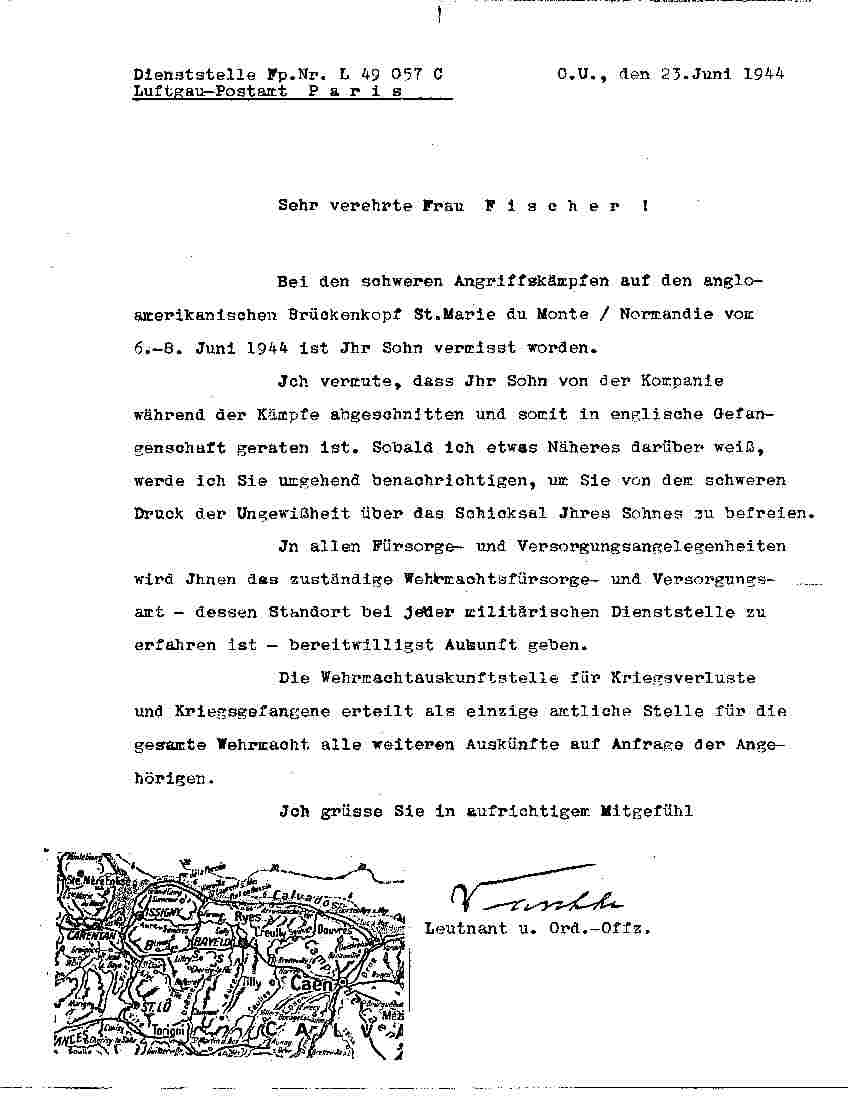
courtesy Peter Mooney
Your son is missing in action
This letter was purchased along with some award documents by Peter
Mooney. The letter was sent to a Frau Fischer whose son, Gefreiter Hans
Fischer, was reported as missing. It goes on to say:
"During the heavy fighting in the anglo-american bridgehead near
Ste.Marie du Mont in Normandy between 6-8 June 1944, your son was reported
as missing. I assume that your son became cut off from his Kompanie and
thus into English captivity. As soon as I know any details about it, I
will inform you immediately, in order to relieve you of the heavy pressure
of the uncertainty about the fate of your son"
It goes on to mention the Wehrmacht welfare service and that they can
give further information on casualties and POW's.
The Leutnant has gone to alot of trouble to produce this letter, especially
as their were hundreds of 6th Rgt dead, wounded and captured during those
first few days of the invasion. This letter was typed on June 23rd, only
15 days after Gefreiter Fischer was reported as missing. He has also taken
the trouble to photostat a large scale map of the area and attach it to
the letter, because no doubt, Frau Fischer had never heard of Ste.Marie
du Mont in Normandy, France. This certainly is a good welfare system run
by the Regiment, even at a time when the regiment was in partial ruins.
All but 25 men of the 1st Battalion were at this time MIA, hundreds more
from the 2nd & 3rd.
With the accompanying award certificates it is possible to put together
some of Gefreiter Fischer's service.
Fallschirmschützenabzeichen awarded on 20th July 1942
He was awarded the "Afrika" cuff title - no award date
Whilst a member of FJR7 he was awarded the wound badge in black
on 20th August 1943 whilst in hospital in Göppingen.
He was possibly transferred to FJR6 after recuperating in hospital
at the end of 43 or early 1944.
Peter Mooney goes on to say that 10 photos of a parachute training
exercise were also sold along with the documents. These were from the family
of Hans Fischer who knew nothing about what became of him.
Gefreiter Hans Fischer of 2./FJR.6 (Oberleutnant Helmut Schulz),
was
killed in action at some time between 6th and 8th June 1944, between Ste.Marie
du Mont and Carentan. He may have died at La Barquette or Le Moulins, who
knows.
His final resting place is the German Soldatenfriedhof at La Cambe,
block.4, grave.256.
Ariel map of N13/D913 Intersection
courtesy of Carlton Joyce
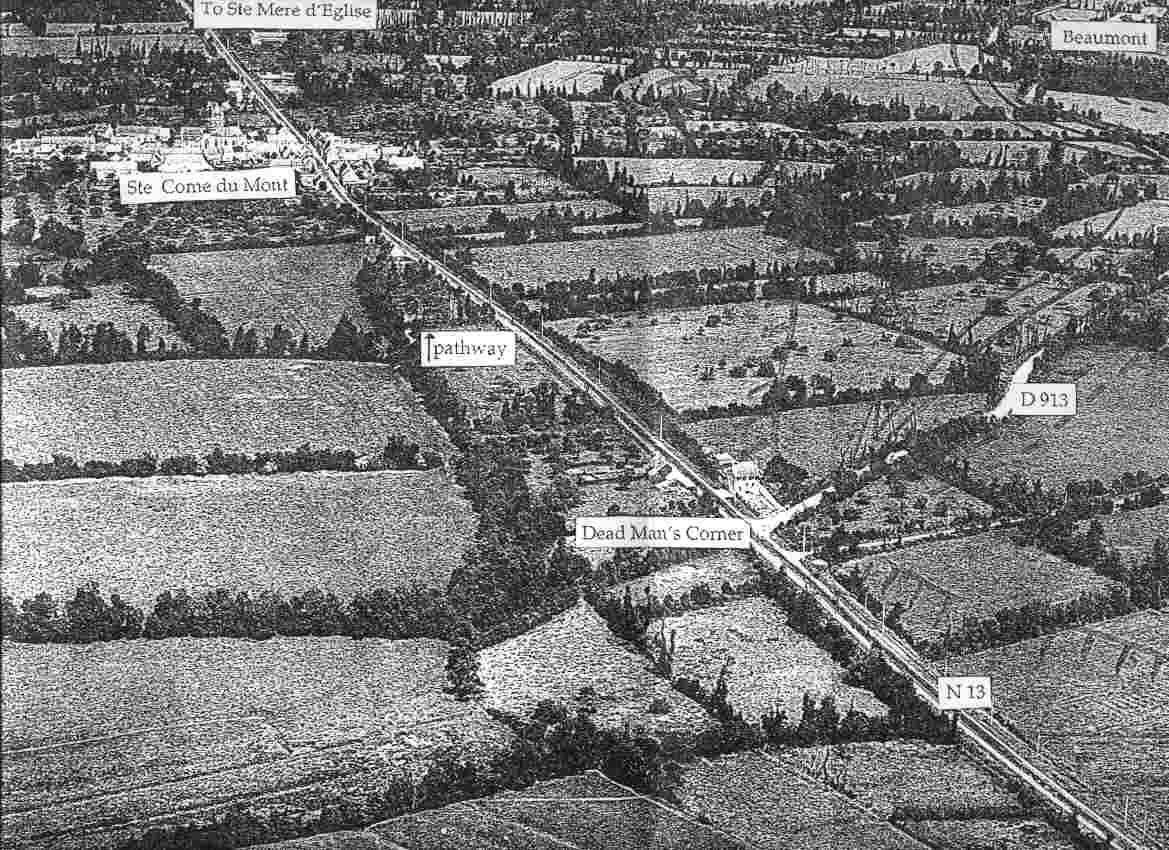
This ariel photograph was taken on 14th June 1948 and is courtesy of
Carlton Joyce. It clearly shows the N13/D913 road junction at "Dead
mans corner". The fields and hedgerows around the junction were teeming
with Fj and men of Gren.Rgt.1058 when the Americnas made their first attack
on June 7th 1944. The hamlet of Pont du Douve is just out of the picture
in the bottom right corner. This should give the reader a better appreciation
of the geography surrounding the fighting that is explained above.
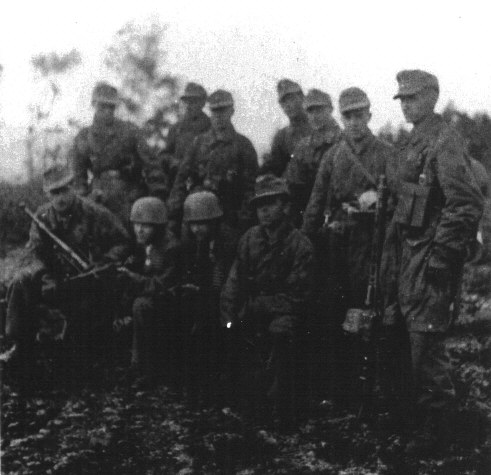
Photo courtesy of Mark Bando
This photo was taken from a captured FJR6 Fallschirmjäger during
the fighting in Normandy. This may have been taken at the training ground
at Köln Wahn or during a field exercise in Normandy itself before
the invasion. I wander how many of these men were killed in the fighting.
I have sent this photo out to some veterans but nobody recognises the men
or the place where it was taken.
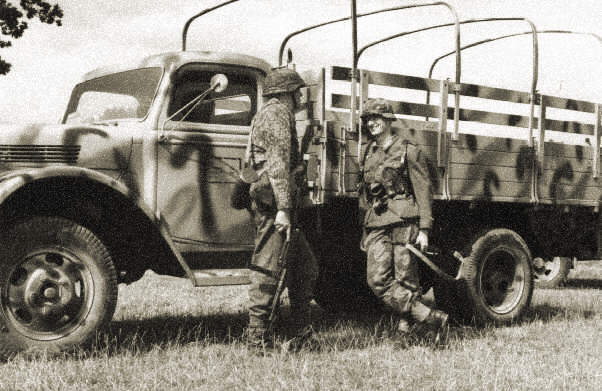
Grenadiers resting before battle.
Had to add this and the photo below, taken at Beltring 2001. Added
a bit of computer trickery.
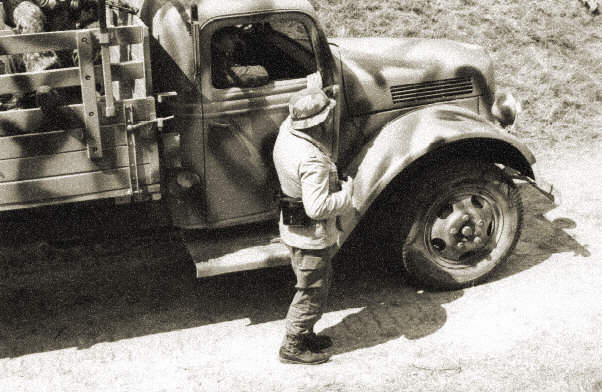
Before the battle
Another phot from Beltring 2001
For info on another casualty of I./FJR6, read about Stefan Einfalt
in the Misc articles section of this site.
More photographs from Normandy 2001...
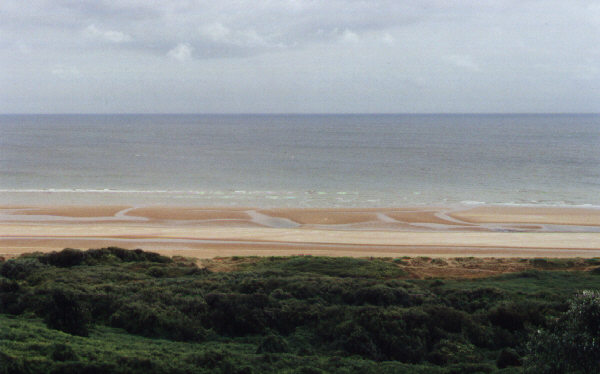
Omaha Beach.
A view of the beach looking over the bluffs from the American Cemetary.
Although the weather was terrible, the beach still looked quite inviting.
It did not look like this on June 6th 1944. More men died on this beach
than any other of the invasion beaches.
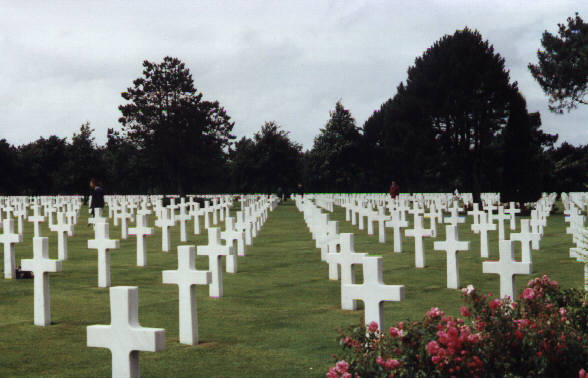
US Cemetary above Omaha Beach
It stopped raining as I stepped out of the car. This cemetary was so
inviting, coach loads of tourists were visiting, from all parts of the
world. It is an immaculate cemetary, clean white grave markers, perfectly
trimmed grass and an amazing memorial colonnade. There were hundreds of
people milling around, which made me wonder whether they were making a
pilgrimage to honour the dead or just treating it as a tourist attraction.
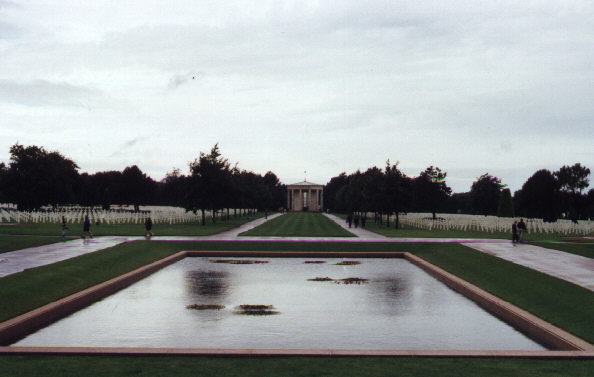
US Cemetary above Omaha Beach
Another shot of the cemetary. According to Carlton Joyce's book "Stand
where they fought", the site encompasses 172 acres and contains 9386
graves. There is also a memorial wall where you can find the names of 1557
missing.
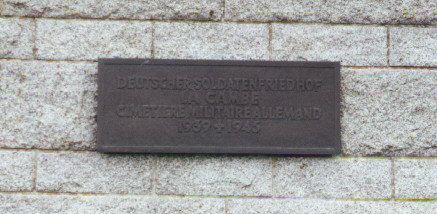
German Cemetary at La Cambe
In stark contrast to the US cemetary at Omaha, the German soldatenfriedhof
at La Cambe appeared to be what I call "solemn"
The cemetary is very well maintained and easy to find. The grey stone
entrance hall encompasses a crypt, where you can find the books containing
the names and whereabouts of the graves withing the cemetary. It is very
easy to find someone here.
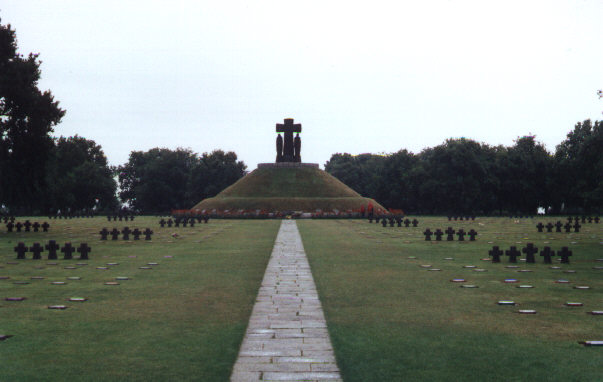
La Cambe
The main feature in this photo is the 6m high grass covered mound,
which is the focal point at La Cambe. It is a memorial to 296 unknown German
soldiers who died in the Normandy campaign. The cemetary has 21,115 grave
sites, amongst them is Hans Fischer mentioned above and SS-Hauptsturmführer
Michael Wittmann, the famous Panzer commander, who is buried along with
the crew of Tiger 007. What struck me about this cemetary was the absence
of visitors. I was there for 1 hour and only saw 2 people. Only a small
handful of graves were adorned with flowers. In fact Wittmanns grave was
the most decorated in the whole place. Well worth a visit to both cemetaries,
to see for your self the result of war, the death of thousands of young
men.
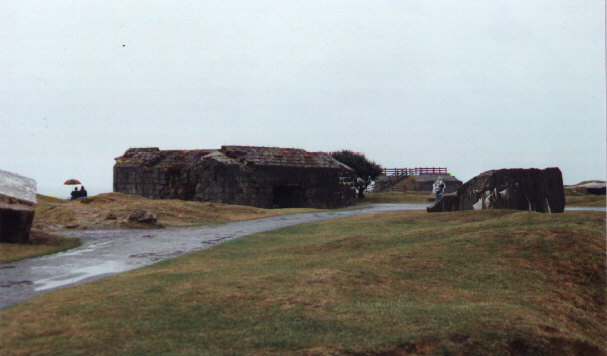
Pont du Hoc
Unfortunately I could not get down to the point. The channel weather
had taken its toll on the rocks, it had suffered from rock falls and was
not safe for the public. Another historic monument will soon be lost to
the elements. There is still much to see at Pont du Hoc. Most of the bunkers
are still there albeit damaged and the landscape is pockmarked with huge
craters from Naval artillery shells.
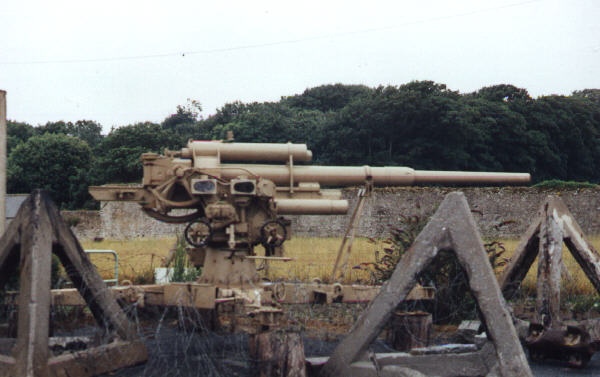
88mm gun at Vierville sur Mer
This gun is outside the museum at Vierville sur Mer near Omaha beach.
Great place to visit if you are in the area. The museum holds some great
battlefield relics, either dug up in recent times or donated by farmers
and other locals There is also a collection of beach defences, which give
it that extra touch of realism.
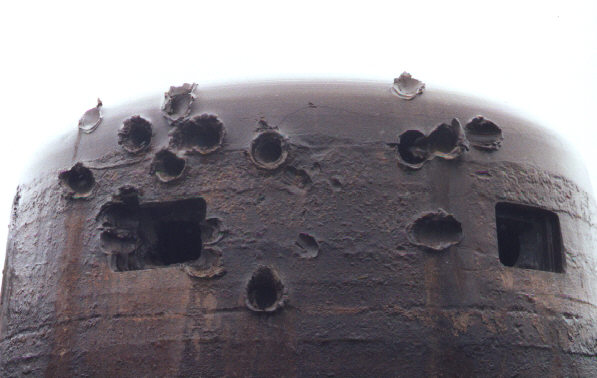
Steel casemate at Vierville sur Mer museum
This casemate is displayed outside the above museum. It has been pounded
by shells. I do not envy the occupants of this casemate when they were
under fire.
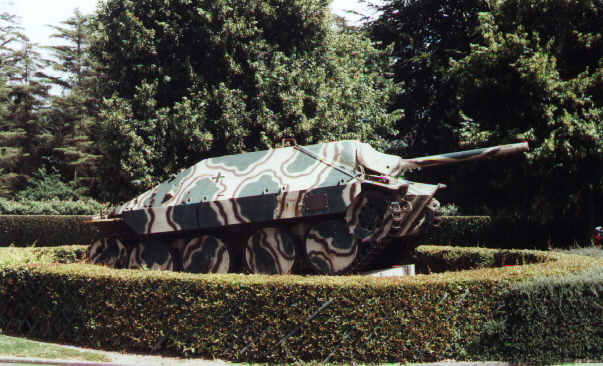
Hetzer tank killer at Bayeaux
This Hetzer has been well preserved and stands outside the D-Day museum
at Bayeaux. In my opinion this is one of the best museums in the Normandy
area. After shopping in the town I feigned surprise when we turned up outside
the museum. My wife told me I might as well go and have a look while I
was there. What a great 2 hours.
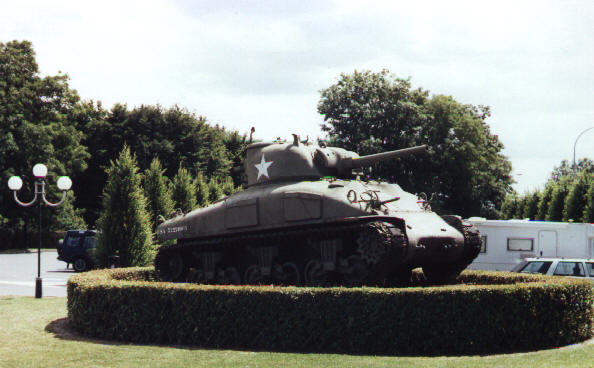
Sherman Tank at Bayeaux museum.
Another well preserved piece of military history. A veteran freind
told me a short story from the campaign in Normandy.
He was stood outside a farmhouse, which was being used as a HQ. In
the shelter of the trees outside, he witnessed a duel between a Sturmgeschütze
and a Sherman. They were firing at each other across the fields and bocage.
The German tank scored a hit on the Sherman leaving a pall of smoke rising
from its hatches. The Assault gun drove towards the farmhouse HQ and pulled
up outside. The commander opened the turret hatch and waved to the handful
of Fallschirmjäger who had witnessed the duel. The commander then
decided to tell the spectators all about his fight on the radio. As he
grabbed his mike the Paras waved and shouted to try and stop him filling
the airwaves with his exploits. It was too late, the commander had used
his radio, dropped his hatch and headed off in a cloud of dust. The Paras
quickly returned to the farmhouse to clear out their equipment. Within
minutes incoming artillery could be heard, which reduced the farmhouse
to a smoldering ruin. The tank commander had not observed the radio silence
and the americans had DF'ed the transmission.
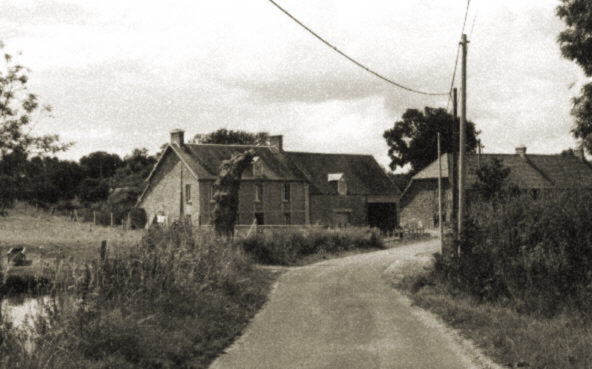
Normandy countryside view.
This photo emitamises what I call Normandy countryside. A farmhouse,
narrow road, fields and bocage. This photo was taken just west of Notre
dame d'elle. A veteran of Panzerjäger Abteilung.3 of FJD.3 saw action
near here in July 1944. I gave the photo an antique finish to make it look
more period. All that is missing is a halftrack or a jeep.
2nd Parachute Division - 2nd and 7th Parachute
regiments
The 2nd Parachute Division had been on the Eastern Front since November
1943, fighting around Zhitomir and Kirovgrad. They returned to Köln
Wahn in Germany in May 1944 for serious rest and refitting. This break
in combat was to be short lived. In less than a month the Division was
mobilized to be sent to Normandy to help repel the invasion with only the
2nd and 7th Regiments. The newly raised 6th Regiment was already there
attached to the LXXIV Corps (the old 6th Regiment had been disbanded
before deployment to Russia).
The Division's journey from Germany to France was constantly hampered
by Allied air attacks and Partisan activity. They finally arrived at their
areas on the 19th/20th June, by which time the Allied beacheads had become
firmly established and allied forces were moving into the Norman countryside.
General Bernhard Hermann Ramcke, commander 2nd Parachute Division was
ordered to concentrate his division around the Brittany port of Brest.
This was an obvious objective for the Allies because of the need for decent
harbour facilities.
The 2nd & 7th Regiments, both short of a Battalion each, took up
positions around the port, ready to repel any allied assault.
It was not until late July 44 that American forces under the command
of General Patton arrived in Brittany. After the successful and uncontested
occupation of the town of Rennes on the Brittany coast, the majority of
Pattons forces were diverted back toward Normandy to help exploit a breakthrough
inland. Only the US 8th Corps was to continue its advance on Brest.
General Ramcke's garrison was being continually drained of manpower
to support depleted units in Normandy. One such battle group heading toward
Normandy found itself surrounded by the US 8th Corps armour. After breaking
out of the encirclement they withdrew to the coastal town of St Malo where
they held out until the 5th August.
Meanwhile in Brest, the majority of the 2nd Division was mobilized
to areas facing the allied advance. Their convoy of trucks was intercepted
by American tanks and badly shot up. Both regiments took heavy casualties
and were forced to withdrawal back towards the coast fighting Americans
and Partisans on the way.
By mid August, American forces had completely surrounded Brest, part
of the division still trapped outside the town had to fight their way back
through the encirclement. The 1st Battalion, 2nd Regiment managed to escape
from the surrounding forces.
The Paras and the other German units defending the Brittany port had
to endure endless bombing and artillery attacks by the Americans, (
I have been to Brest and only a small part of the old city still stands,
you can still see pock marks in the buildings around the port area).
General Ramcke, now commander of Festung Brest finally surrendered
the town on the 20th September 1944. He was awarded the Knights Cross with
Oakleaves, Swords and Diamonds, the only Fallschirmjäger to receive
this award. He went into captivity well prepared, with a set of luxurious
leather bound suitcases and a red setter dog. (allegedly)
The 2nd Parachute Division ended its days in a Brittany port, a far
cry from the successful airborne operations the previous year or the harsh
eastern front. By the end of 1944 a new 2nd Parachute Division would be
raised in Holland around the remnants of the division.
3rd Parachute Division
The 3rd Parachute Division under the command of Generalleutnant Richard
Schimpf, along with the 5th, formed the 2nd Parachute Corps under the command
of General Eugen Meindl. The 2nd Corps was part of the 7th Army who was
entrusted with the defence of the Cotentin Peninsula.
In January 1944, the 3rd Parachute Division was moved from Reims to
Monts d' Arree, 30km east of Brest. XXV Armee Korps orders were to counter-attack
any allied invasion and complete training. The division had 70% of its
weapons but lacked Mortars and AT weapons. It had sufficient ammunition
for 3 days and only 40% of its normal quota of trucks, (these had been
commandeered for the eastern front).
On the 7th June, D-Day + 1, the division moved to Avranches, with only
a spearhead made up of Kampfgruppe Alpers, the rest of the division had
to follow on foot. Between 17th-18th June the division took up positions
to the north of St Lò. They were to advance from their positions
and drive the invading forces back into the sea. On their left flank was
the 352nd Inf.Div and on the right, 17th SS.Pz.Gren Division, G.v.B. Divisional
HQ was east of Chapelle du Fest.
The division's first encounter with enemy forces was on the 14th June
when the Para spearhead encountered armour of the US 7th Corps on the St
Lò to Bayeaux road.
(This is incorrect as I have evidence that Kampfgruppe Alpers from
FJR8 clashed with American Shermans in the Balleroy forest near Berigny
on 8th-10th June 1944. This was the spearhead of the US advance on St.Lo.)
With the aid of accurate artillery fire from the 12th Fallschirm-SP
Brigade they managed to inflict heavy casualties on the Americans.
When the division finally became whole on the 17th, they were ordered
to take up positions across a 15 mile sector from Foret de Cerisy to Caumont,
east of St Lò.
The 5th, 8th and 9th Regiments stretched along this line managed to
hold it against heavy attacks from American armour for 3 weeks, depriving
the enemy of St Lò.
St Lò had become an important strategic objective for the American
advance and on the 11th July they mounted an offensive to break the German
line around the town. The offensive opened with a devastating artillery
barrage that inflicted heavy casualties on the Para Regiments.
The 3rd Division had to withdrawal in the face of increasing pressure
and St Lò fell to the allies on the 19th July.
In June 1944, losses for the 3rd Division were, 436 dead, 1513 wounded
and 136 missing. 17% of its total strength.
On July 25th the American forces resumed their offensive to try and
encircle the 5th Panzer Army and 7th Army (to which 3rd Para was attached).
The 3rd Division along with the 12th SP Brigade tried in vain to contain
the US 7th Corps advance. General Patton's 3rd Army was diverted from Brittany
to help exploit the breakthrough at St Lò.
The Allies now dominated the Normandy countryside and German forces
were pushed back under constant pressure of the advancing armoured units.
The 7th Army and 5th Panzer soon became trapped near the town of Falaise,
the 3rd Division was now attached to the LXXXIV Corps. This pocket of German
resistance was slowly being squeezed under the might of artillery and air
attacks.
On the 20th August, the 3rd Parachute Division along with some SS units
managed to exploit a gap in the allied encirclement and escaped from the
hell of the Falaise Pocket. The Corps commander General Meindl, escaped
with a handful of Paras and 3 tanks from the 2nd SS Panzer Division. Elsewhere
in the Pocket, other German units were making good their escape, avoiding
allied held areas and slipping past patrols. The 3rd Division was responsible
for providing a rearguard for these 7th Army, 5th Panzer remnants as they
headed for the relative safety of the River Seine.
The 3rd Parachute Division had suffered heavy casualties during its
time in Normandy. At the beginning of September the division was withdrawn
to Cologne in Germany to be rebuilt, but was to see action again along
the west wall and the Ardennes at the end of 1944.
Kommandeur - Generalleutnant Richard Schimpf
FJR5 - Major Karl Heinz Becker
FJR8 - Oberst Ernst Liebach
FJR9 - Major Kurt Stephani
Pz.Jg.Abt.3 - Hauptmann Persch
Flak.Abt.3 - Major Müller
Granatwerfer.Abt.3 - unready for combat
Art.Rgt.3 - Hauptmann Fleischmann
Pionier.Btl.3 - Major Karl Heinz Beth
Luftnachricten.Abt.3 - Hauptmann Kurt Hölzner
Sani.Abt.3 - Oberarzt Wichert
Supply & Support - Oberstleutnant Diesterhöft
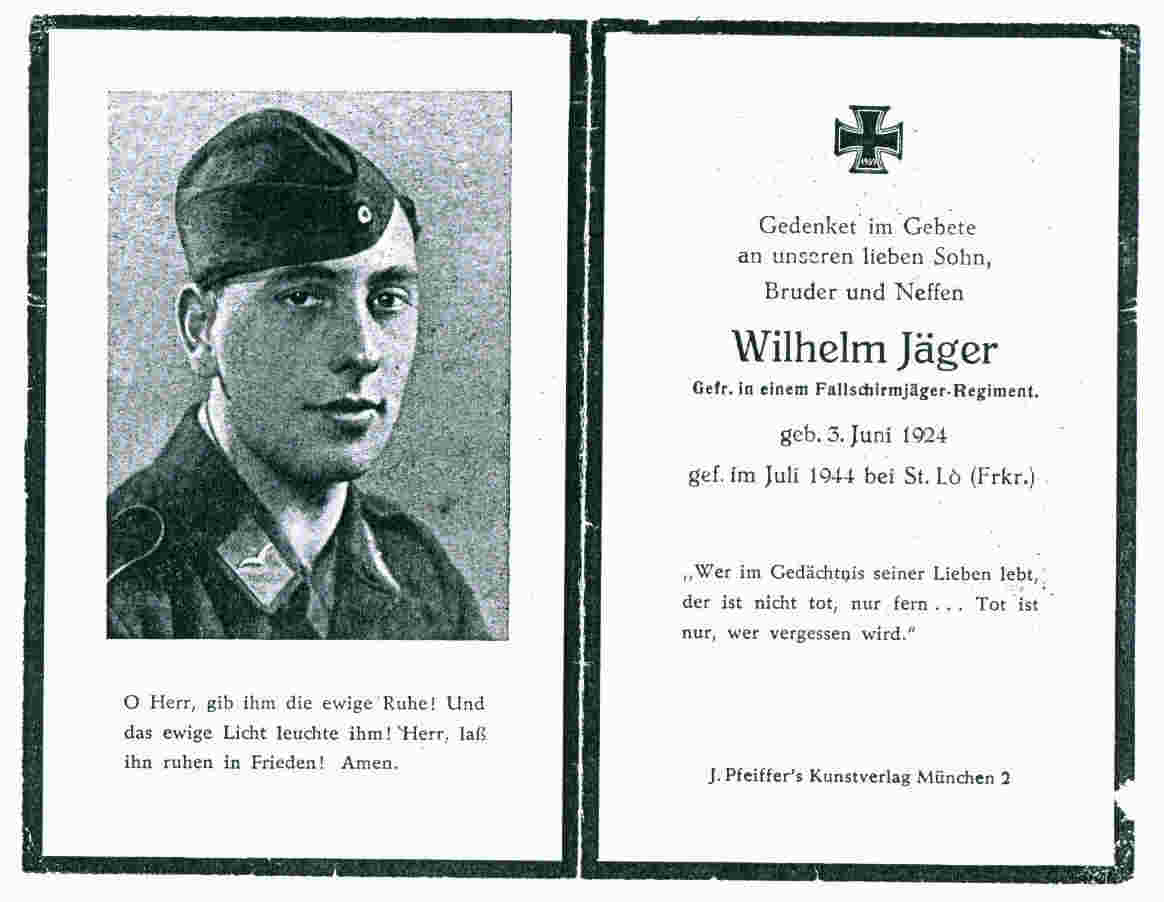
-
This death notice was sent to me by Pioneer veteran Rudolf Jackl, who
is mentioned elsewhere in this site. Jackl served in the Pioneer Platoon
of the 3rd Battalion FJR8 in Normandy. Gefreiter Wilhelm Jäger was
a good friend of Rudolf Jackl's and he was killed near St.Pierre de Semilly
on 26.7.1944, the same day that Jackl was medically evacuated. Jäger
is buried in the Soldatenfriedhof at La Cambe. Outside the cemetery is
a tree donated by Rudolf Jackl in memory of his friend and comrade.
5th Parachute Division
The 5th Parachute Division under the command of Generalleutnant Gustav
Wilke, had been in Reims since March 1944 and at the end of May, moved
to Rennes in Brittany, to defend the coast and finish its combat training.
In early June 1944, the division moved to Mont Saint Michel to prevent
any allied landings. Its neighbouring units were 17th SS Pz.Gren Div. G.v.B
on the left and the Panzer Lehr Division on the right. Divisional HQ was
4km SE of Dinan near Tressaint.
On D-Day, 95% of the divisions weapons and equipment were ready but
only 30% of its vehicles. Most of the men had not completed their jump
training. On June 6th, only the 15th Regiment was ready for combat. This
regiment had been trained by a cadre of veteran paras from FJD1 and along
with Fallschirm-Art.Rgt.5 came under the control of the 77th Inf.Div.
The 15th regiment was flung into battle west of Carentan attached to
the 353rd Division. The other two regiments of the division were hastily
put together, the 13th attached to the Panzer Lehr Division north of St
Lò and the 14th Regiment was stationed near Marigny, west of St
Lò.
Divisional losses from 15th June to 10th July were approximately 70%
of its 12,008 man strength.
The division never fought as a single formation throughout the campaign
in Normandy, but was used to bolster other units who had taken heavy casualties.
The regiments were themselves to be depleted during the US 7th Corps onslaught
on St Lò. After the final offensive on the town on 25th July the
14th Regiment had almost been decimated. In August the 3rd Division had
been drawn into the Falaise pocket along with the units they were attached
to. They barely managed to escape the encirclement and the remnants, like
the 3rd Division were withdrawn across the River Seine. Kampfgruppe's were
formed from fragments of the regiments and they saw some action in the
Arnhem corridor in September 1944. The were then rebuilt in October 1944,
in time for the Ardennes offensive in December.
Kommandeur - Generalleutnant Gustav Wilke
FJR13 - Oberstleutnant Wolf Werner Graf von der Schulenberg
FJR14 - Major Herbert Noster
FJR15 - Oberst Kurt Gröschke
Art.Rgt.5 - Oberst Winzer
Pz.Jäger.Abt.5 - Hauptmann Rolf Müller
Pionier Battalion.5 - Hauptmann Gerhard Mertins
Granatwerfer.Abt.5 - Hauptmann Maier
Flak.Abt.5 - Hauptmann Fritz Görtz
Luftnachrichten.Abt.5 - Hauptmann Herbert Fock
Fallsch.Feld Ersatz.Btl - Hauptmann Meyer
Support & Supply - Major Gröner.
II Fallschirm-Korps-Truppen
On June 6th 1944, ordered to Normandy with the 3rd Division. Saw heavy
fighting at St.Lo. Casualties during June were 65 dead, 258 wounded and
25 missing.
Auf.Abt.12 prevented the capture of the 352nd Infantry Division staff
when they attacked a column of sherman tanks at the crossroads of Le Mesnil
Herman.
Kommandeur - General Eugen Meindl
Aufklärungs Abteilung.12 - Hauptmann Bodo Göttsche
Fallsch.Luftnachrichten.Abt.12 - Oberleutnant Herbert Fleisch
Fallsch.Sturmgeschütze.Brigade.12 - Hauptmann Günther
Gerstener (3Komp, 27 Assault guns, 3 x 75mm guns, 3 x 105mm guns)
MG Battallion.12
Fallsch.Nachschubeinheiten.12
A.uE.Rgt.12
Fallsch.Art.Abt.12
The Normandy campaigns had taken its toll on the men of the Fallschirmtruppe.
It had cost them heavily in men and equipment. Many of the experienced
Fallschirmjäger had perished in the fighting to contain the allied
invasion. From now on their ranks would be filled with raw recruits and
Luftwaffe personnel. The men who survived the Normandy battles were to
fight a desperate rearguard action until they reached the relative safety
of Holland, or the borders of Western Germany. There they would stand,
ready to protect their homeland, but not before their ranks were once more
depleted in the Arnhem Corridor and then Hitler's last gamble in the west........The
Ardennes offensive.

Typical death notice card of a fallen Fallschirmjäger. This
man is Georg Schilcher, an Obergefreiter who died from his wounds on 25th
July 1944 in Normandy. He is buried at the La Cambe military cemetary.
Block 41 Grave 253.
Although featured in the book review section I feel this plug is relevant
to this section.
"Stand where they fought" by Carlton Joyce, is a must
for anyone planning to visit the American sectors of Normandy. A book covering
the British & Canadian sectors is also being planned. I planned my
visit in advance in conjunction with the book and period documents. I took
it with me and read about the places when I was standing in them. I boffed
up so much, I knew the terrain when I got there. Go and get it and stick
it in your rucksack for when your over there.
ISBN 1-57087-495-6
to find out more, visit:
www.normandybattlefields.com
Return to
Homepage