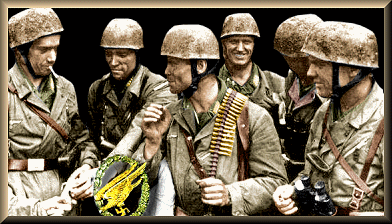
Introduction to the Ground Campaigns of the Fallschirmtrüppe
The story of the campaigns on the ground does not really start until the invasion of the Soviet Union in June 1941, before then they were used in Airborne and Glider assaults and in Poland were only used to support Infantry operations and defend captured airfields, bridges and road junctions. Crete saw the last use of Airborne Troops in large scale assaults, the losses between May 20th - June 1st 1941 had been unacceptable to Hitler and he felt that the surprise element that they had achieved in the early campaigns had gone, (although the Allies had used them effectively throughout 1944), from now on the Fallschirmjäger would be used as conventional infantry with the exception of the future small scale airborne operations. In their new role as ground troops they would come under overall command of the Army, but like the SS, when they wanted something doing they always went over the heads of army commanders and went straight to the top of the Luftwaffe hiarachy, namely Goering.
The
Fallschirmjäger were first used in the ground role when elements of
Flieger Division 7 were sent to the Leningrad Front at the end of 1941.
During the war they saw service in Russia from Leningrad and Volhov in
the north, Zhitomir and Smolensk in central Russia, to Kirovgrad in the
south, giving a good account of themselves wherever they fought.
In
the early stages of the campaign in the east, the Fallschirmtruppe underwent
some changes with the renaming of the 7th Airborne Division to the 1st
Parachute Division and the construction of several new Parachute Divisions
to be thrown into the cauldron of the Russian Front.
Divisional
rest and refitting was usually carried out in France, it was from here
that Fallschirm units like the Fallschirm- Brigade Ramcke were sent to
North Africa to fight at El-Alamein in July 1942, or men from the 2nd Parachute
Division who were sent to Italy to quell potential uprisings in Rome in
September 1943. Parts of the 1st Parachute Division were rushed over to
Sicily when the Allies invaded the island on the 10th July 1943 and were
the last German forces to cross the Straights of Messina to the Italian
mainland on the 17th August 1943.
Men
of the 1st were back in action again on 9th September 1943 when the Allies
landed at Salerno. The 4th Parachute Division was sent to Anzio to meet
the allied invasion there in January 1944.
The 1st Parachute Division, now known as the Green Devils were involved in the defence of the Gustav line in central Italy and took part in their most famous action when they held up the Allied advance from the monastery on the heights of Monte Cassino between January and May 1944. The Allies dropped thousands of tonnes of high explosives on Monte Cassino and made many assaults, but still the Paras held out.
D-Day,
6th June 1944 saw the Parachute Divisions in action again. Parts of the
2nd Parachute Division attached to the 91st Luftlande Division saw heavy
fighting around Carentan. They were later sent to the channel port of Brest
where the division was to defend the Festung to the last man and the last
bullet, surviving a long drawn out siege that ended on 20th September 1944.
The
3rd and 5th Parachute Divisions took a mauling during the Normandy campaign
in fighting around St Lo and Caen and the 3rd was almost destroyed at Falaise,
but they were reorganised and refitted and were soon back into the German
orbat ready for the Ardennes offensive in December 1944.
1944
saw the construction of the 1st & 2nd Parachute Corps in January and
May respectively, the 1st consisting of the 1st and 2nd Parachute
Divisions and the 2nd consisting of the 3rd and 5th Parachute Divisions.
Then
came the 1st Parachute Army, raised at the beginning of September 1944
under the command of General Kurt Student consisting of about twenty thousand
men who ended up with the task of defending the 60-mile front between Antwerp
and Maastricht, fighting in the Arnhem corridor and providing flank protection
in Holland during the Ardennes offensive.
The
survivors of the 2nd Parachute Division fought allied landings in the Arnhem
corridor in September 1944.
After
the disaster in the Ardennes in December 1944 the Fallschirmjäger
fought on both fronts in the defensive role, being pushed back to German
borders from the east and west.
The
recently formed 9th Parachute Division was fighting for its life on the
ever shrinking eastern front where it fought at Stargard, the River Oder,
and was involved in the attempted relief of the beleaguered defenders of
the fortress at Breslau, ending its days in the capital.
The
10th Parachute Division putting up a brave defence against overwhelming
odds in southern Austria until it too was destroyed or captured.
When
the inevitable end came, the remnants of the once mighty Parachute Divisions
were being captured by the Russian Army or trying to get to the Allied
lines in the west to ensure a better captivity.
The
Fallschirmtrüppe had fought on all fronts, from the air in large and
small-scale airborne assaults and on the ground as conventional infantry.
Wherever they fought, they proved to be tenacious fighters, loyal to their
cause and willing to lay down their lives for their beliefs. They proved
to be worthy opponents who gained the respect of every country who came
against them in combat.