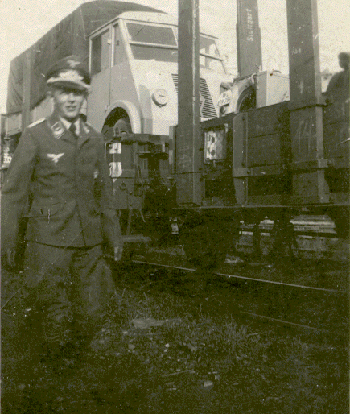
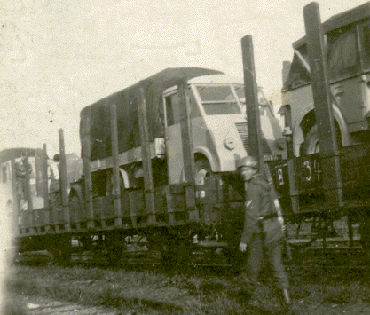
2nd May 1943. Fallschirm-Pioneers on the move to southern France
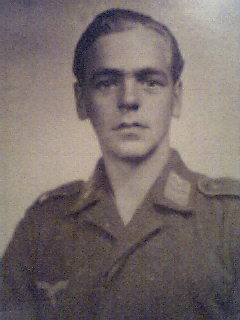
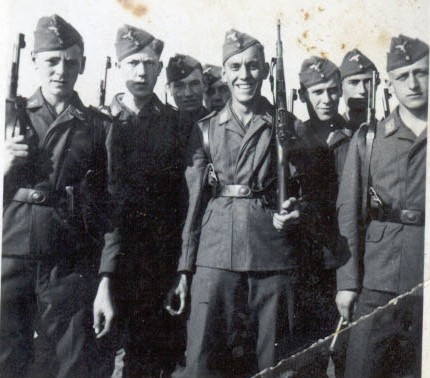
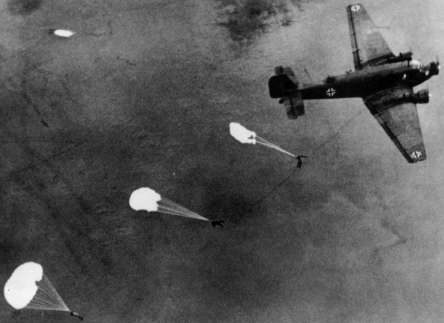
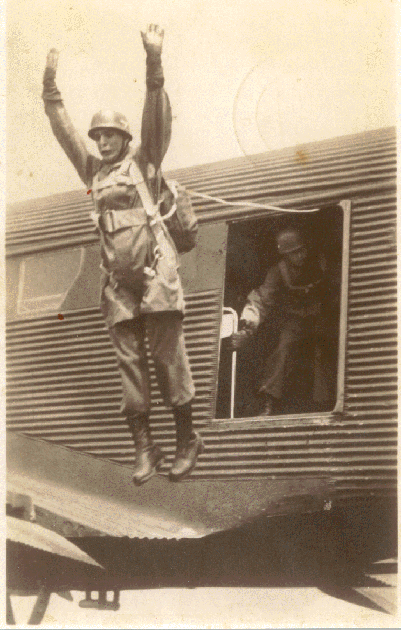
Some more dramatic views of the training at Wittstock parachute school.
After the completion of his training, Gerhard Huber and the other pioneers
joined the Ramcke Brigade and were flown to the Tatoi airfield near Athens
in Greece and from there to Tobruk in North Afrika.
His commanding officer was Oberleutnant Cord Tietjen.
Gerhard Huber took part in the fighting at Bab el Quattara from 23rd
October - 2nd November 1942, seized British Army trucks on November 5th
and also fought at El Alamein.
In the Spring of 1943, the Fallschirm-Pioneer's were back in Germany
for rest and refitting. On 2nd May, they were moved by rail to the south
of France. The Pioneers now became part of the recently raised Fallschirmjäger
Division 2.
2nd May 1943. Fallschirm-Pioneers on the move to southern France
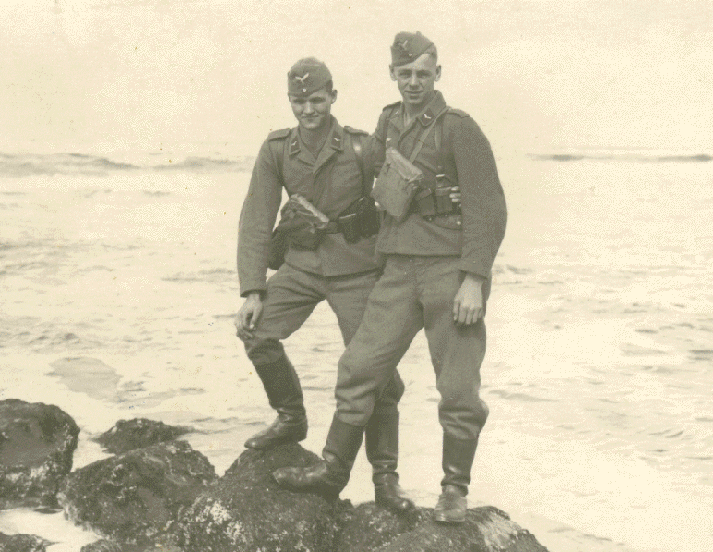
With the Atlantic behind them, Gerhard Huber poses with a comrade.
On July 26th 1943, FJD2 was sent to Italy. Within 48 hours, 20 000 men
and accompanying equipment were moved in 90 JU52's, 45 HEIII's and 80 Gliders.
Gerhard Huber was aboard a HEIII that landed at the Practica de Mare airfield.
On 10th September 1943, they moved over the Via Ostiense into Rome
to seize the Italian garrison stationed there. Gerhard Huber told his son
a story about this event;
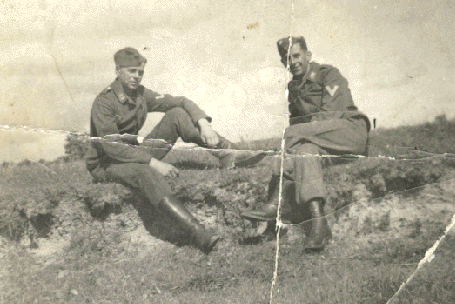
Taking a rest in Italy to pose for the camera.
"I stopped a pro-Badoglio officer and he surrendered his Berreta pistol
to me. I noticed the nice riding boots that the Tenente was wearing and
made him switch with my old Springer-Stiefel" (jumping boots).
In November 1943, the 2nd Division was sent by rail to Shitomir in
Russia. They had no idea where they were actually going. It was very cold
and they only changed their tropical uniforms for winter ones after reaching
Germany via the Alps and Austria.
On November 24th, Gerhard Huber took part in the heavy fighting at
the airfield east of Shitomir. In December, Fallschirm-Pioneer Battalion
2, was fighting alongside the 1st SS Panzer Division. Gerhard Huber's commanding
officer at this time was Hauptmann Siegfried Gerstner.
Gefreiter Huber was wounded by shrapnel in the right shoulder on December
8th 1943 and on the 10th December was flown to Germany for hospitalisation.
(Fallschirmjäger
Genesungs-Bataillon Aschersleben)
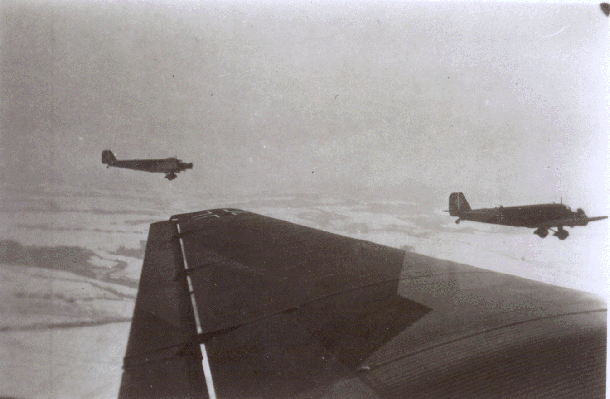
JU52 transport aircraft fly over the snows of Russia.
From the 5th-21st February 1944, Gefreiter Huber had recuperation leave
(Genesungsurlaub)
in Ittersbach, Germany.
After his leave he was transferred to the Panzer-Jäger Abteilung
of the 1st Fallschirmjäger Division, where he received new training.
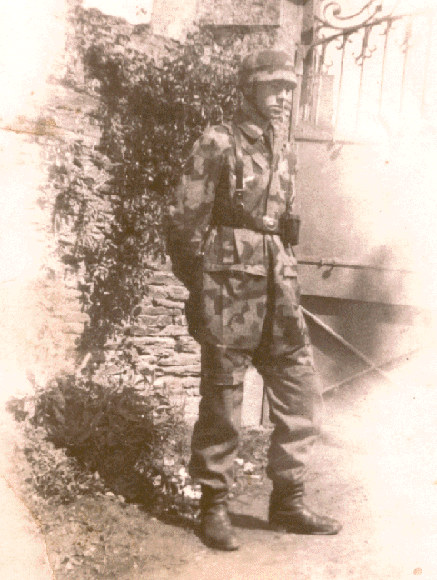
Gerhard Huber wearing his Knochensack.
In April 1944, he was sent to Konin in Poland as an instructor with
the IX SA Standarte "Feldherrenhalle" 1.Sturm.
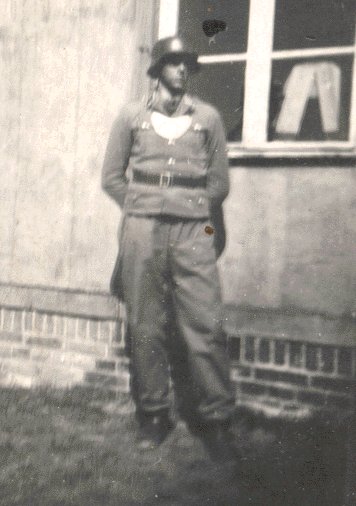
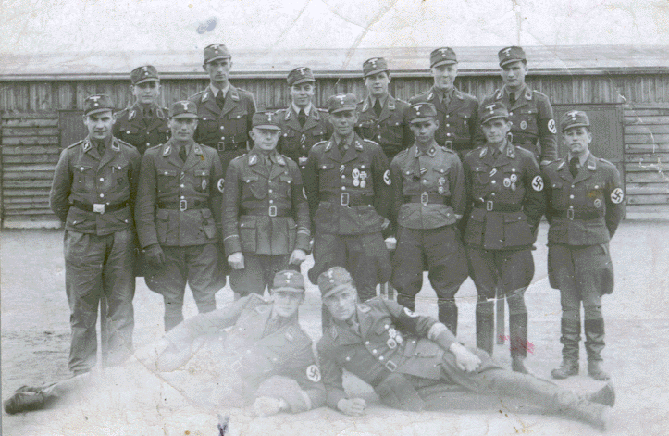
Gerhard Huber wearing the IX SAFH Gorget and with other instructors
from the unit.
In the summer of 1944, Obergefreiter Gerhard Huber was back with Fsch.Pz.Jg.Abt.1
in northern Italy.
On 1st September 1944, he was wounded for the second time during heavy
fighting against the US 5th Army in the Bologna area.
On 1st March 1945, Gerhard Huber was promoted to Oberjäger and
on 20th March was given combat leave to go home. His commanding officer,
and friend at this time was Leutnant Horst Schimpke. (Ritterkreuzträger)
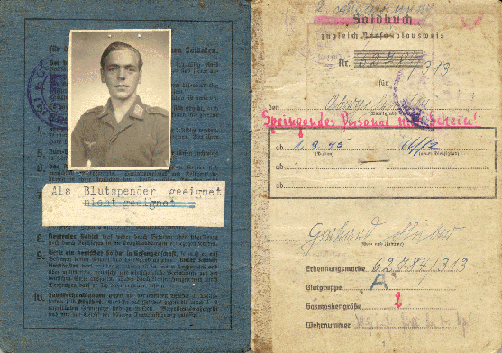
The Soldbuch of Oberjäger Gerhard Huber
When he arrived in Germany he realized that the war was nearly at an
end. Cities were devastated, the railroads had been destroyed and the Allies
were pushing into Germany from every border. The town of Pforzheim had
been completely destroyed by Allied bombing in February 1945. When he arrived
in Pforzheim he walked the 18km to his home in Ittersbach.
Ittersbach had a population of 3500 and had not been touched by the
war. He learned from his mother that his elder brother was missing and
presumed dead.
In the first days of April 1945, the French Army had crossed the Rhine
near Karlsruhe only 24km's away. Huber's mother told him "Im am not going
to loose you too. You must stay at home and wait until they get here (the
French). Then the war will be over for you".
On 8th April 1945, the French colonial Army entered the town. From
a hill in the south a Volksgrenadier unit began firing their artillery
at the French. The town came under fire and many civilians were killed
and wounded. An older man from the town was severely wounded in the leg
and lost alot of blood. Gerhard Huber placed him in the sidecar of a motorcycle
and took him to a field dressing station at Neuenbürg where he surrendered,
together with the medical staff, to the Allies.
He was handed over to the Americans and was sent to a POW camp in Heilbronn,
50km's from Ittersbach. The conditions were poor and they slept in tents.
He was released from the POW camp on the 9th September 1945 as semi-disabled.
He was 21 years old.
After the war, Gerhard Huber worked for a travel company arranging
holidays to Italy, Spain and Portugal. He married in 1949 and had 2 children.
Gerhard Huber passed away in May 1982 following a heart attack. He
was 58 years old.
During his service as a Fallschirmjäger, Gerhard Huber was awarded
the following:
Iron Cross 2nd Class
Wound Badge in Black
Ground Combat Badge
Paratroop Qualification Badge
"AFRIKA" cuff title