The first shots were fired at the Waalhaven airfield; Hauptmann Schulz’s men had to secure the airfield quickly to enable the 65th & 16th Infantry Regiments to land safely. The Luftwaffe had bombed the airfield but the Heinkels came under fire from AA guns and Dutch fighter aircraft and suffered several casualties. Waalhaven would have to be taken by paratroops. As the 3rd Battalion jumped they were met with stiff resistance, but most of them managed to land unscathed near the edge of the airfield. As the battle wore on the first of the JU-52 transports started to come into land with elements of the 22nd airlanding and the 2nd Battalion, 2nd Regiment aboard, attracting the now heavy artillery fire. Between them they eventually took the airport buildings and command of the airfield. They mopped up the remaining Dutch resistance and made the airfield safe for the rest of the 22nd Airlanding to fly in and re-inforce.
The jumps on the 3 airfields at Valkenburg, Ypenburg and Ockenburg were
planned in order to capture the Dutch Royal family and the Miltary High
Command at the Hague. At Valkenburg Airfield the jump went well but on
landing they found the runway surface unsuitable for the incoming JU-52
transports carrying the 47th Infantry Regiment. The Dutch then launched
a series of counter attacks on the airfield.
At Ypenburg the Dutch had littered the airfield with debris to damage
incoming aircraft, they also had strong AA defenses. Many JU-52's were
lost during the assault, those that were not shot down flew on to the aifield
at Ockenburg, some even landed on the main road connecting Rotterdam to
the Hague. The paras that did land at Ypenburg quickly found themselves
surrounded by Dutch forces.
The situation was the same at Ockenburg where many JU-52's had been
destroyed in the air and on the ground, the men on the ground were encountering
heavy resistance.
The attack on the Hague was finally called off and all the forces involved
were ordered to move out into the direction of Rotterdam. The Dutch forces
hassled them all the way but the German forces managed to get their on
the 12th - 13th May.
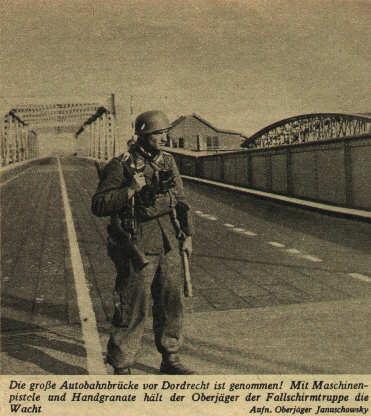
The 1st and 2nd Battalions, 1st Regiment who were assigned the bridges over the River Maas at Dordrecht and Moerdijk, were slightly more successful although during the fighting for the Dordrecht Bridge the Dutch managed to retake the rail bridge. Re-inforcements were rushed in from Waalhaven and after three more days of fighting the Dordrecht bridges were secured.
Hauptmann Pragers 2nd Battalion were dropped on either side of the River
Maas to capture the Moerdijk rail bridge. This bridge was a high priority
objective, it spanned the chief estuary of the River Maas which separates
northern and southern Holland. It also carried the main rail link between
Dordrecht and the north and Antwerp. The Luftwaffe had earlier bombed the
AA and other defensive positions around the bridge areas. The assault went
according to plan and the paras held it until units of the 9th Panzer Division
began crossing the bridge on the 14th May.
General Student and his staff flew in to a captured Waalhaven airfield
and proceeded onto Rotterdam where on the 14th May he conducted peace negotiations
before the Dutch capitulation on the same day. It was during these negotiations
that gunfire broke out in the vicinity of the building being used for the
surrender. Units of the 1st SS Division had stumbled on the talks, as Student
looked out of the window he was shot in the head by a trigger-happy SS
man unaware of the surrender.
As in Belgium the objectives had been taken quickly and successfully,
the Dutch soldiers were regarded as formidable fighters, but the surprise
attacks of Parachute units and heavy bombing of there cities took its toll
and they failed to stop the German advance like many before them.
This photograph appeared in the weekly Luftwaffe magazine "Der Adler"
in 1940 and was taken on the road bridge at Dordrecht. The caption says
"with a stick grenade and rifle, a Fallschirmjäger Oberjäger
keeps watch on the grand road bridge at Dordrecht".
I assume the para is from I/FJR1, who took the bridge.