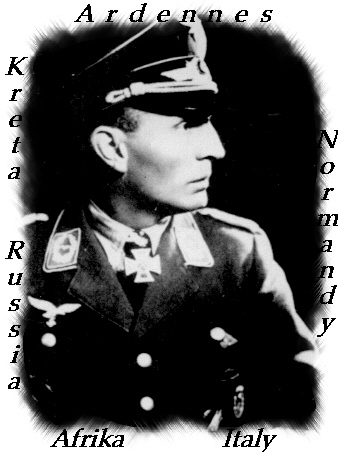
Oberstleutnant Friedrich August Freiherr Von der Heydte
Born - 30th March 1907, Munich, Germany
Died - 7th July 1994, Germany
Friedrich August Freiherr Von der Heydte was born into Bavarian nobility
in Munich on March 30th 1907. His father had made a career in the Bavarian
Army and it was hoped that the young Friedrich would follow in his footsteps.
As a teenager, Von der Heydte hoped to join a Cavalry unit but instead
joined the 19th Infantry Regiment on April 1st 1925. Life as an infantryman
was short lived when by chance a vacancy was found for him as a Cadet Officer
in the 18th Cavalry Regiment.
Released from the Army to study law at Innsbruck university he was
forced to become a private tutor due to family financial difficulties.
With the money he managed to save he travelled to Berlin to carry on with
his Law studies.
In late 1927 he went to Vienna to take up Diplomatic training.
In 1934 he was involved in a fight with a Nazi student. He evaded arrest
by the Gestapo after re-joining the 18th Cavalry Regiment. He then found
himself transferred to the 15th Cavalry Regiment and promoted to Leutnant.
He was then released again to carry on with his law studies, this time
at the Hague. In late 1935, his Cavalry unit was formed into an Anti-Tank
kompanie
In the winter of 1938/39 he attended a General Staff Officers course
and only returned to his A-T kompanie at the outbreak of WW2 in September
1939.
In early 1940 he became the 1a of the 246th Division and in the campaign
in the west was awarded both the Iron Cross 2nd & 1st Class.
Von der Heydte applied for the Fallschirmtruppe in early 1940 and after
being accepted transferred over to the Luftwaffe on 1st August 1940. He
took command of 14/FJR3, the newly raised regiments anti-tank kompanie.
After successful parachute training at Wittstock he assumed command of
I/FJR3 at Wolfenbüttel on December 10th, now promoted to Hauptmann
(October 25th).
His first action as a Fallschirmjäger commander came on May 20th
1941 when I/FJR3 parachuted onto Crete. The battalion drop zone straddled
the main road running southwards from Chania, the islands capital and primary
objective of the Operation. His troops were dispersed on landing and came
under heavy fire from New Zealand troops defending the area, who occupied
the village of Galatas and the Agya prison.
After an un-successful outflanking attack on Galatas his men were reinforced
on May 23rd. His battalion was further bolstered by Gebirgsjäger who
had been successfully air landed at Maleme. With these reinforcements Galatas
was taken on May 25th.
On May 27th, I/FJR3 continued the assault on Chania, leading an attack
from the south. Under constant pressure the town fell. Von der Heydte personally
negotiated the surrender of Chania.
For his part in Operation Mercury, Von der Heydte was awarded the Knights
Cross on July 9th 1941. He and other victors of Crete were presented to
Hitler at the Wolfschanze in East Prussia.
On August 1st 1941 he was promoted to Major.
At the end of September 1941, I/FJR3 & II/Sturm Rgt were sent to
the German 18th Army on the Leningrad front. After the II/Sturm Rgt suffered
heavy casualties, the I/FJR3 were rushed in to carry on the momentum of
the attack on Russian positions. It was on the Neva front that Von der
Heydte was wounded by a shell splinter. I/FJR3 were withdrawn from Russia
in December 1941 and renamed Lehr Battalion 2. In July 1942 Von der Heydte's
renamed battalion arrived in Africa as part of the Ramcke Brigade, which
was under the command of Generalmajor Hermann Bernhard Ramcke.
Lehr Battalion 2 became subordinated to the Italian Division Bologna
and was placed in the line near El Alamein. After a bout of dysentery Von
der Heydte returned to his battalion just after the battle of El Alamein.
The battalion had suffered heavy casualties in his absence. He did not
see the battalion withdrawal into Tunisia. He was once again taken ill
with dysentery and flown back to Germany.
On February 1st 1943, he was posted as 1a to the newly raised Fallschirmjäger
Division 2 in Brittany. Due to the escalating political crisis in Italy
the 2nd Division was ordered to make preparations to move to Italy. Von
der Heydte led an advance party to make preparations for the Division's
arrival at Viterbo.
When the political crisis reached a peak in September 1943, Von der
Heydte took part in the disarming of Italian forces in and around Rome.
Assuming the next objective was the island of Elba he carried out an aerial
reconnaissance. The plane crashed on its return and VDH was seriously injured.
He was hospitalized for 4 months and on February 1st 1944 was given command
of the newly re-raised FJR6, to replace the one destroyed on the Ost Front.
VDH intensely trained his new regiment in close quarters combat and
Parachute training at the Dreux para school near Paris. He wanted his men
to be ready for any eventuality.
On June 6th 1944, war games had been planned for the German 7th Army
in Rennes, Brittany. This Planspiel was to involve Divisional commanders
and one regimental commander from each division. These unit representatives
were to arrive at Rennes on the evening of June 5th.
VDH arrived at LXXXIV Korps HQ to accompany General Marcks to Rennes.
(it is reputed that the reason for this was that VDH wanted to discuss
with the General, an anti Hitler resistance movement. It is not known whether
he actually knew of the one already in existence that carried out the July
20th plot, several weeks after this incident). General Marcks persuaded
VDH to leave early in the morning of the 6th. He spent the night with his
regiment at Periers.
After midnight on 5th/6th, reports started to come into FJR6 HQ of
paratroop landings north of Carentan. The already mobilized regiment was
sent northwards to counter these drops. (VDH had some sort of premonition
that something was going to happen, unusually high radio traffic to resistance
groups, French volunteers in his Rgt deserted, news of aircraft build up
in southern England. He put his regiment on alert when he left for LXXXIV
Korps HQ).
VDH carried out his own reconnaissance in the early morning of June
6th. He entered the town of St Comb du Mont and from the steeple of the
town church, witnessed for himself the allied ships offshore at Utah beach
pouring ashore men and material.
US paratroops and forces from Utah beach forced FJR6 from their positions
in the Cotentin Peninsula until they withdrew to Carentan, which fell on
June 12th. After FJR6 evacuated Carentan, the commander of the 17th SS
Panzergrenadier Division insisted on having VDH court martialled for desertion
as the SS troops were to pass through Carentan to reach the Invasion beaches.
Only the intervention of the corps commander stopped the ludicrous accusations
of desertion. In fact VDH and FJR6 were praised for holding the town unsupported
in the face of superior numbers.
FJR6 then withdrew to St.Lo and just managed to escape from there when
the town fell on July 18th. At Falaise, the regiment again found themselves
surrounded and only a small amount of men managed to escape to cross the
River Sein near Paris. After being in action since June 6th FJR6 was withdrawn
to Germany for some much needed rest and major refitting. VDH was promoted
to Oberstleutnant on August 1st 1944.
The regiment' R&R was to be short lived as the newly rebuilt regiment
was back in action in September 1944.
FJR6 saw action at Neerpelt on the Belgium/Holland border, subordinated
to the newly raised 1st Parachute Army. They took up positions along Hells
Highway to Eindhoven and took part in the battle for the road bridge at
Veghel.
On October 23rd, VDH was informed that he was the 617th recipient of
the Oakleaves to the Knights Cross. He also received a new posting to the
Parachute Army weapons school at Aalten (some sources say it was the
jump school at Bergen op Zoom in Holland).
On December 8th 1944, General Student informed VDH of new orders from
Hitler. He was to form a battle group from men of the 1st Parachute Army
for a new offensive. He was allowed to pick his Officers, NCO's and planning
staff. He formed 5 kompanies, one of them heavy, a signals and pioneer
platoon. Things did not go well with the planned operation, equipment for
his men never turned up, the pilots had no experience, he was only given
a basic outline of the part he and his men were to play in the forthcoming
offensive. His orders were to hold open a main crossroad's north of Malmedy
to allow the 6th Panzer Army to pass through. The airdrop was planned for
the early hours of December 16th.
The majority of his Kampfgruppe were not trained for airdrops, he had
no intelligence on enemy forces, no aerial photos of the drop zone. Realizing
the mountainous terrain would interfere with radio reception, he asked
the command of 6th Panzer Army for carrier pigeons, which he never received.
He was however supplied with several dozen straw filled dummies that would
be dropped on 2 dummy landing zones to confuse the enemy.
On December 16th, the Kampfgruppe was hampered by transport problems
which delayed the start of Operation Stösser. They finally took off
at midnight on 16th/17th December in 100 JU52 transport aircraft. VDH had
received reports that American reinforcements were being rushed to the
front through the crossroad's he was to hold. He now had to take the crossroad's
and defend them until relieved by spearheads of the 6th Panzer Army.
Heavy flak dispersed the aircraft, the inexperienced pilots never took
into account the strong head winds. On the ground there were 36mph blizzards.
When the time came to jump many of the Fallschirmjäger were a long
way from their drop zones. VDH jumped with a Russian triangular parachute.
He already had one arm in a sling from a previous injury. On landing he
injured his other arm.
By the morning of December 17th, VDH only managed to find 125 of his
men. By late afternoon he found another 150. Many were wounded and all
were suffering from the cold. Hardly any of the weapons containers had
been found and food was running low. They could not take and hold the crossroad's
without heavy weapons. Scouts were sent out to try and gain contact with
the 6th Panzer Army. Many never returned. As predicted, none of the radios
worked, there was no contact at all with the supposedly advancing German
forces. Realizing the operation was futile VDH decided to send his wounded
in the direction of distant gunfire.
By now the Americans were aware of an airdrop and the hunt for Kampfgruppe
VDH was underway. After an unsuccessful breakthrough of the American lines
VDH decided to break up his men into groups of 3 giving them more of a
chance of reaching safety. On the 21st December he set of towards Monshau
with his adjutant and an orderly. He parted company with his comrades outside
of the town. He was now injured, tired and hungry and suffering from exposure.
Unaware that Monshau was occupied by US troops he rested up in a local
house. When he became seriously ill he sent the son of the house with a
surrender note for the nearest American troops.
He was captured on December 24th and later found himself charged with
unfounded charges of war crimes. These were however dropped but he was
not released until July 12th 1947.
After his release he went to teach law at University and rose to the
rank of General in the post was Bundeswehr.
Friedrich August Freiherr Von der Heydte died on July 7th 1994.