Uniforms,
weapons & equipment of the Fallschirmtruppe
This is by no means an extensive
list.
Helmets
The equipment of the Fallschirmjäger
was suitably designed for their role. The most distinctive feature of their
equipment was the specially designed Parachutists helmet. The earlier helmets
worn by the Army Fallschirm- Battalions were cut down versions of the regular
armies model 1935. The large neck covering and projecting peak were removed
leaving what looked like a rimless helmet. This model was also adopted
when the Luftwaffe took over control of all Paratroop forces in July 1938
and became the model 1938 pattern paratroopers’ helmet.
The model 1935 helmet worn by all
other branches of the Wehrmacht was not suitable for the role intended.
The neck covering was removed because of the risk of the risk of serious
neck injury on landing and the projecting peak became liable to get embedded
during a bad landing. The final design had only a short neck covering and
a slight peak.
The helmet strap was also redesigned,
securing the helmet more firmly making it less likely to be shaken off
or lost. It had an adjustable fork shaped chin and neck strap made from
kid leather lined with chamois skin.
The helmet was fitted with a kid
leather liner with 12 ventilation holes and attached to an aluminium ring
which in turn was attached to the helmet by means of four bolts which also
acted as vent holes and securing points for the chin strap. Between the
liner and helmet were seven rubber pads to aid in absorbing shock.
The helmet shell was made from 1.15mm
sheet steel and weighed just under a kilogram.
The early army- fallschim helmet
was painted in a dark green colour; helmets under Luftwaffe production
were painted dark green/grey, although later in the war they were also
painted field grey. For tropical operations the helmet was painted in a
dark sandy yellow and for service on the eastern front it was often whitewashed,
although in the field many Jäger adapted their helmet colour schemes
to whatever was available to camouflage them. The early helmets were adorned
with the national tri-colour on the right side and the Luftwaffe eagle
(facing inwards) on the left. Later helmets did away with the tri-colour
as it stood out and made a good target, leaving just the eagle, which itself
was removed later in the war.
Cloth coverings were also used on
helmets, from plain light olive to splinter pattern and tan water to match
the colour schemes of the 3 patterns of smock. In the field however, many
Fallschirmjäger utilised many other patterns of cloth camouflage to
cover their helmets. Elasticated bands and chicken wire were also fitted
to enable foliage to be attached.
 Another photograph from a 1940 copy
of the Luftwaffe weekly "Der Adler", which shows a Jäger putting on
his helmet. This could be taken in Holland as this particular issue was
dedicated to the operations in the low countries in 1940. (Note the
inward facing Adler decal).
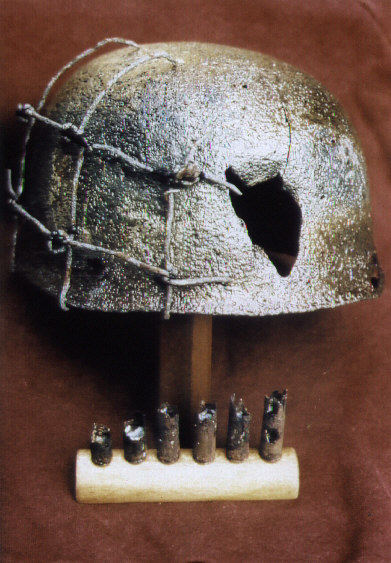
 Above left: Photograph of a Fallschirmjäger
helmet found in June 1981 by veteran Rudolf Jackl. It was found near St.Pierre
de Semilly in Normandy, in positions held by a section from III./FJR8 in
July 1944. The helmet has suffered a head shot, or shrapnel hit so the
fate of the former owner is quite obvious. The helmet was found alongside
hundreds of SMG cartidge cases, highlighting the heavy fighting that took
place there.
Rudolf Jackl was a member of the
Pioneer Platoon from FJR8 and in the above mentioned fighting tackled 2
shermans with Faustpatronen but missed in the heat of the battle.
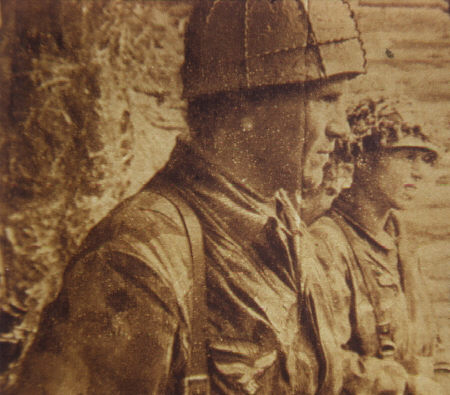
Above right: This photograph
was also provided by Rudolf Jackl and features Oberfeldwebel Fritz Heinemann,
Pioneer Platoon Leader of FJR8. Heinemann was an Alte Adler and had taken
part in the assault of Eben Emael, Crete, Russia and Normandy. This photograph
was taken at a briefing held by Major Friedrich Alpers in early July 1944.
Fritz Heinemann took part in the fighting at St.Pierre de Semilly and managed
to get Rudolf Jackl medically evacuated after the battle. Heinemann was
captured by the Americans at the end of July 1944. (Note the chicken
wire on the helmet, designed to hold foliage)
Jump Boots
German airborne troops were the
only formation to be issued with rubber soled boots. The first pattern
were side laced but proved to cause too many ankle injuries. A thick rubber
soled boot with a chevron pattern made from quality leather with front
laces replaced them. They were of such good design that the British copied
them and captured German stocks were even issued to British Para units.
Jump Smock
Another distinctive piece of clothing
issued to the Fallschirmjäger was the smock; affectionately referred
to as the Knochensack (bonesack), a waterproof garment designed to be worn
underneath the parachute harness. It was thigh length and made from cotton.
Different versions of the smock were manufactured throughout the war. The
early army Fallschirmjager unit smocks were made in a reed green colour,
the 1st pattern luftwaffe versions were light olive green in colour, the
2nd version to be produced was in a splinter pattern, which consisted of
brown and green symmetrical brick patches on a pale green background. A
tan water patterned version was produced in 1943. There were many variations
of each pattern smock. All were very similar in that the pockets were either
press stud or zip fastening. The early smock called for the wearer to step
into the garment where as later versions could be worn open at the thigh
and done up by use of press studs. They were fitted with pockets which
were accessible by flap covered zips. The rear of the smock was fitted
with a built in pistol holster (originally intended to hold a flare
pistol) as weapons in early campaigns were dropped by canister and
not carried by the parachutists.
On landing and removal of the harness
and smock, the mans webbing could then be worn external to the smock as
it proved to be a good all weather coverall.
The only insignia worn on the smock
after March 1940 was the Luftwaffe eagle, made of threaded white cotton
on the right breast, although during ceremonial occasions decorations and
awards were displayed on the jump smock.
The standard issue Luftwaffe belt
was usually worn around the waist of the jump smock. It was made from aluminium
and finished in a matt grey colour, it featured a Luftwaffe eagle within
an oval laurel wreath and was attached to a dark brown leather belt.
I have spoken a veteran freind at
length about the uniform that he wore when he was in Normandie in 1944.
The only item which stuck in his mind was his jump smock. He told me that
he had hacked off the leg sections of the smock as it had been a hinderance
and was an impractical item for the fighting in Normandie. He also mentioned
that many of the young boys in his section had copied him. As an Feldwebel
they looked up to him and whatever he did they followed suite.
Tunics and Trousers
Two tunic types were in service
with the Fallschirmjäger, the most practical and most photographed
was the Fliegerblouse, which was a cloth jacket in field blue colour. It
had only two flap pockets on the hips which were only introduced in November
1940, as before then only officers had pockets in their Fliegerblouse.
It had a fly front, which covered
five painted buttons and was usually worn open necked except on ceremonial
duties when it was worn with a shirt and tie.
The Luftwaffe eagle was sewn on
to the right breast in white cotton and the collar tabs and shoulder boards
displayed the rank of the wearer.
The second tunic style was the standard
four pocket Tuchrock in field blue colour and had the same insignia as
the Fliegerblouse.
The
Fallschirmjäger trousers were made from Field Grey wool. They were
field grey in colour and had ankle tapes, which were used to gather the
trouser leg into the jump boot, and could be worn with or without braces.
They had stud fastened slits in the legs, which were originally designed
to allow the Paratrooper to remove the early knee pads. The right leg opening
was also fitted with a pocket to carry the Luftwaffe issue gravity knife,
which was designed to be used one handed to cut the wearer free of rigging
if he got tangled up upon landing. The trousers were also fitted with hip
and rear pockets and also a small pocket on the front to accomodate a fob
watch.
Fallschirmjägergewehr-
FG42
This weapon is worth mentioning
as it was specially designed for use by the Fallschirmjäger.
It
was an advanced weapon for its time and could either be used in the semi
automatic or fully automatic modes. It was manufactured by Rheinmettel-Borsig
AG and came into service in September 1943 and was first used in the Gran
Sasso raid to rescue Mussolini. Its final production number was only around
7000 as production had started on the new MP44 assault rifle, which took
manufacturing precedence.
It fired the old style 7.92x57 Mauser
round at a muzzle velocity of 760 meters per second and had a range of
up to 1100 meters. It was made from pressed metal and weighed just under
10lbs, length was 94cm. It was fitted with a short bipod and a spike bayonet
for close quarter fighting which folded back underneath the barrel. It
used a 20 round box magazine, which was inserted horizontally into the
left side of the weapon. Spare magazines were carried by the gunner in
specially made ammunition bandoleers which were worn around the neck and
attached to the mans belt. Its small size and light weight made it an ideal
weapon to be used as an LMG or automatic rifle and was not as cumbersome
to man handle as the MG-34/42.
If you work out the mathematics
of the issue of this weapon against how many were manufactured, it would
appear that they were quite rare in Fallschirmjäger units. However,
the same veteran mentioned above was issued with an FG42 in Normandy and
was captured by Polish soldiers with it, in Normandy in early September
1944.( yes, september 1944, he and his comrade were fugitives for nearly
2 weeks when they became separated from their unit. They survived by paying
farmers for food and milk with french francs taken from a post office in
St.Lo in July 44).
Other weapons used by the
German airborne forces
The following is a breif overview
of the other weapons used by German airborne forces. The list is not extensive
as better discriptions can be found on many other WWII associated sites.
The small arms used by the Fallschirmjäger
were mostly the same as the ones used by their comrades in the other branches
of the Wehrmacht, such as the MP 38/40, Kar98K, MP44, MG34/42. Pistols
such as the Luger, Walther P38 & PP/PPK and Sauer model 38H were all
used by paratroops.
The folding stock and shortened
version of the Gewehr 43 automatic rifle was also used, a ten shot rifle
generally used as a sniper rifle.
Stick and egg grenades were also
carried on jumps to give the parachutist some added firepower on landing.
The stick-grenade contained 212 grammes of TNT within a cylindrical metal
head, which was attached to a wooden handle. It was 40cm long and contained
a 4.5 second fuse. The firing mechanism was actuated by removing a metal
screw cap on the base, which revealed a ceramic toggle or ring attached
to a cord. The cord was pulled and the grenade was thrown. It had the advantage
of being able to be thrown up to 30m overarm. Mines of all types were also
used by Fallschirm Pioneers, the most infamous being the Teller 43 anti-tank
mine, S-mines and schu mines.
Apart from personal weapons the
Fallschirmtruppe had quite an array of heavy calibre firepower at their
disposal.
Anti tank rifles were used in the
early campaigns, such as the PanzerBusche 38/39 which were 7.92mm in calibre.
They were followed by the 20mm Panzerbusche 41 which became obsolete during
Barbarossa when they were unable to penetrate the russian armour.
The PzB41 was then altered to 28mm
calibre and fitted to a small wheeled carriage with the aim of being dropped
during airborne ops. It fired a tungsten cored round, the most effective
against armour, but production stopped when there became a serious lack
of Tungsten.
There was also the extensive use
of the Panzerfaust variants and the Panzerschreck, an 88mm anti-tank rocket
launcher which differed to the Panzerfaust as it could be used again and
again. It was based on the American bazooka but proved to be more effective
as the projectile was more powerful than its american counterpart.
(NB, I was recently told an interesting
story by a veteran. After the fighting for St.Lo this particular Fj unit
headed south and were soon engaged by enemy tanks near the town of le Mesnil-Herman.
They succeeded in knocking out some of the tanks but ran out of Panzerfausten.
Soon, new ones were brought up and one of the Paras who fetched them asked
if he could have a go at a tank. He was told to get in a firing position
above the hedgerow aiming down on the road. His number 2 took cover at
the base of the hedge. As he fired the number 2 felt a burning sensation
down his left side. The Para with the panzerfaust had panicked at the last
minute and fired harmlessly into the air, the back blast had burnt the
numbers 2's helmet cover, some hair and the left side of his jump smock.
I was also told that the incompetent para, a Gefreiter, was never seen
again after this incident.)
Wheeled recoiless guns were developed
for airborne use and came in many calibres such as the 75mm, 105mm and
150mm. They were widely used and made their first appearance in Crete in
1941.
The only dis-advantage of the recoilless
gun was the huge muzzle flash and smoke plume during firing.
Mortars were also widely used, the
50mm light mortar could be packed into a weapons container and dropped
with personal weapons. The 81mm mortar also gave the paratroopers on the
ground some added firepower.
The 37mm Pak36/37 was dropped separately
on multiple chutes, and gave men on the ground limited anti-tank capabilities.
These were ofted hooked up to motorcycle combinations to give them mobility.
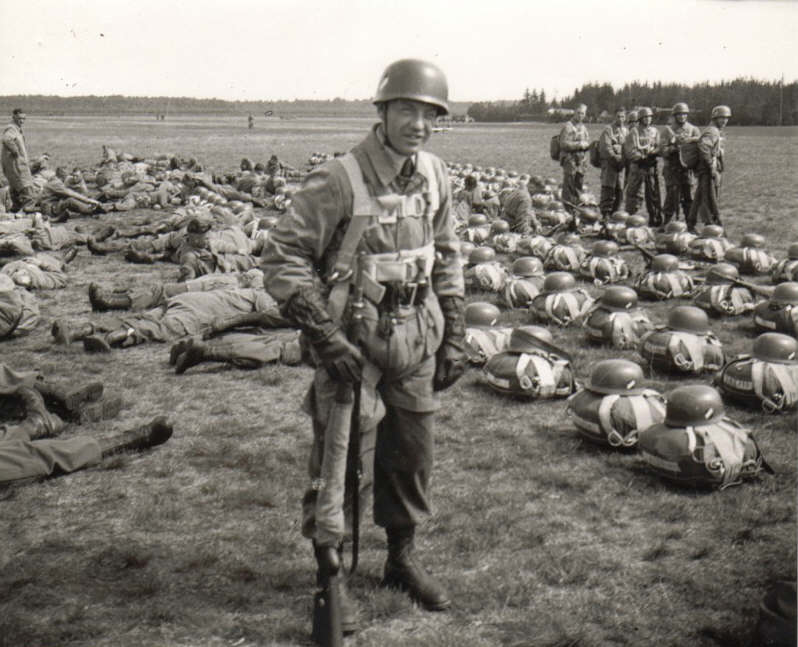
This photograph has been reproduced
with the kind permission of Robert Willsie.
This great photo was taken at Fallschirmschule
II - Wittstock in 1941. It is assumed that it was taken after the invasion
of Crete as the men look as though they are going to jump with their K98
rifles. The un-named Oberjäger in the photo wears the RZ20 parachute
and has a rifle cover on his K98. The canvas breech cover was produced
to protect the working parts of the rifle from dirt and dust etc, but also
proved useful when jumping with the K98 so equipment and rigging lines
could not get caught up in the working parts.
The men to the right of the picture
look as though they could be next to jump, whilst the men on the left are
resting before their turn.
Return
to Homepage