The Battles
for Monte Cassino and the Defence of the Gustav Line
January – May 1944
"Whoever is master of
the hill is master of the valley"
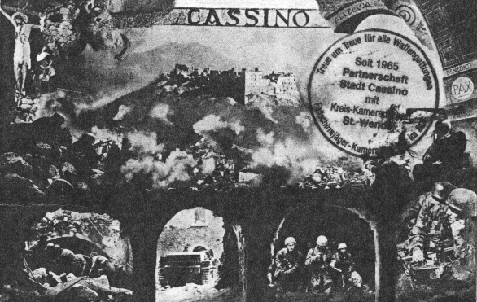
With an account by Fallschirmjäger-Pioniere
veteran Bob Frettlöhr & anecdote by Pioneer veteran Carl Bayerlein.
The soft underbelly of
Europe
After the Axis retreat and allied
victory on the island of Sicily, it was only a matter of time before the
Allies carried out a landing on the mainland of Italy, the "soft underbelly
of Europe". This they did on the toe of Italy, when the British 8th
Army landed at Reggio on the 3rd September and Taranto on the 9th. Both
of these landings were uncontested by the Germans as they had pulled out
of the area some time before.
The US 5th Army then landed on the
west coast further north at Salerno on September 9th 1943 to coincide with
the Italian armistice. This move was predicted by the commander of
German forces in Italy, Field Marshall Kesselring. In expectation of a
landing at Salerno the 16th Panzer Division was moved to the area to meet
the invasion. The German 10th Army was then mobilized behind the 16th Panzer
to help drive the Allied invasion force back into the sea.
The Gustav Line
If the unexpected happened and the
German 10th Army could not contain the Allies, they could withdrawal to
prepared positions which ran across the width of central Italy, from the
mouth of the Sangro river in the east, through the Abruzzi mountain region
to the mouths of the Rapido/Garigliano rivers on the west coast. This defensive
position was to be known as the Gustav line and within its defensive line
stood the town of Cassino.
Less than a kilometre west
of Cassino town stood Monte Cassino towering 1700 ft above the town below.
On top of Monte Cassino stood the
centuries old Benedictine Monastery, the scene of many battles over the
centuries. Monte Cassino became the hub of the German Gustav line, situated
100 miles south east of Rome. It dominated the surrounding countryside,
including the Liri valley that ran through the mountains to the north and
Route 6, the main highway linking the south to Rome which snaked around
Monastery Hill. It also had a perfect view of the town below. Monte Cassino
was surrounded by other peaks and hills, directly behind the town stood
Castle Hill, crowned by a crumbling fort known to the Allies as point 192.
Point 435 or Hangman's Hill was another hill that sprouted from the slopes
of Monte Cassino. Just over 1 km to the northwest stood point 593, or Calvary
Hill. Just to the north of Calvary stood point 445, or Snakeshead Hill.
All of these hills were to be the scene of much bloodshed.
Back at Salerno the unexpected did
happen, the allied forces pushed back the defending Germans, the allies
gained air superiority and were being supported by warships stationed offshore
and by the 15th had the upper hand at Salerno. The order was given for
the German forces to withdrawal northwards toward the Gustav line.
The 2 allied armies meanwhile, linked up on the 16th, southeast of Salerno.
Cassino town was first bombed on
the 10th September when targets all along the Garigliano river were hit.
It caused heavy casualties amongst the civilian population, many took refuge
in the monastery at Monte Cassino. Soon after the bombing, the first units
of the 14th Panzer Corps that had withdrawn from the south started to arrive
at Cassino. They immediately started to dig themselves in around Monte
Cassino and fortifying the town below. The approaches to the town were
mined and they flooded the countryside in front of the Rapido east of Cassino
town and awaited the allied advance.
The 14th Panzer Corps couldn't live
up to their title, they were desperately short of tanks and had to rely
mainly on infantry, amongst their ranks men of the 1st Parachute Division
who had been moved from the Adriatic sector held by LI Gebirgs Korps.
The allied forces now started their
advance into central Italy, the US 5th Army in the west and the British
8th Army in the east, on their way northwards they took Foggia, with
its important airfields on 27th September, the port of Naples on 5th October
and the island of Corsica taken on 11th September by French forces.
The winter weather caused General
Alexander, commander of the Allied 5th Army Group, to call a halt to the
advance on 15th November.
By the time the 5th Army Group had
resumed their advance, the Germans had firmly dug themselves in on the
Gustav defensive line in expectation of the allied offensive.
The British 8th Army on the eastern
flank met determined and fierce resistance from forces of the LI Gebirgs
Corps and became bogged down in the bad weather. In the west, the US 5th
Army faced divisions of the XIV Panzer Corps. It appeared to the allies
that the Gustav line was not going to be easily cracked. The whole front
slipped into stalemate.
Facing the Cassino front the allies
now had seven Commonwealth divisions, containing men from India, New Zealand,
South Africa (who had an armoured division in reserve) & Brazil,
also five American, five British, four French and three Polish Divisions.
A formidable force.
The Allied governments accused the
Germans of using the Monastery as a strong point, which they strongly denied,
although they were dug in on the slopes of the monastery. German positions
had been blasted into the rock and well camouflaged. An artillery observation
post was constructed below the monastery that was able to signal German
batteries and direct fire onto any of the surrounding allied positions.
This post was also home to observers from the German 71st Mortar Regiment,
whose well concealed mortar batteries could rain deadly shells down on
any of the surrounding countryside. A cave beneath the monastery had been
turned into an ammunition storage area.
The Germans had encompassed Monte
Cassino into their defence line so the allies, although reluctant to do
so, agreed that in the near future it would probably have to be bombed.
It was Oberst Schlegel of the Hermann
Goering Panzer Division who was responsible for getting all the treasures
and works of art within the Monastery, out of harms way before they could
be destroyed. They were removed in October to a safer location in the north
before being handed over to the Italian government.
The First Battle
The first allied assault on the
Gustav line came on the 17th January 1944 to coincide with the landings
at Anzio, planned for the 22nd. The British 10th Corps was to cross the
Garigliano river west of Cassino and try to outflank German positions around
the Liri Valley. The French Expeditionary Corps was to move through the
mountains in the east and complete the flanking manoeuvre. In the centre
the US 2nd Corps would cross the Rapido river a few miles south of Cassino
town and enter the Liri Valley from the front. Both the British and the
French had limited success, they never managed to complete the flanking
manoeuvre. They met heavy resistance and all they could do was dig in around
the hills and mountains behind Monte Cassino.
The American 36th Division spent
a couple of days preparing for their assault. Boats were bought up to the
front to carry the men across the Rapido. On the 20th they started their
assault. The going was tough, the Rapido was not as easy to cross as they
thought, many boats and their occupants were lost in the crossing. They
were supported by artillery who bought shells down on the German defenders
dug in on the opposite bank. As the 36th approached the opposite side their
artillery stopped and the murderous German fire started. Some elements
of the 36th reached the other side of the river and attacked German positions.
During the night, engineers constructed
bridges to reinforce the men on the other side, but as daylight came artillery
was brought down on them from Monte Cassino. The Americans on the German
side found themselves surrounded.
Through the next night, more bridges
were built across the Rapido to reinforce the small bridgehead, but still
they were held at bay. The order to pull back was given on the 22nd , not
before the 36th had suffered heavy casualties. On the 24th January, the
US 34th Division crossed the Rapido east of Cassino to try and outflank
German positions. Over the next few days they moved around the hills and
mountains until they came within a few hundred yards of Monastery Hill.
They took heavy casualties in the process and were unable to get close
to Monte Cassino. They started to dig in.
This first assault on the Cassino
front of the Gustav line had not been very successful, with only pockets
of allied resistance dotted around the slopes of surrounding hills and
mountains. They had been unable to penetrate the excellent German defences,
whose positions dominated the surrounding area.
Anzio
On the 22nd January, British and
Americans of the US 6th Corps carried out a successful landing on beaches
at Anzio, 60 miles north of Cassino. This landing behind the German lines
was designed to draw German forces away from the Cassino front, making
the penetration of the Gustav line a bit easier. Then the forces on the
Cassino front could head north and link up with the US 6th Corps, before
advancing on their goal, Rome. Instead of this, parts of the German 14th
Army were rushed to Anzio. The 6th Corps soon consolidated a beachead but
made the mistake of not breaking out to engage German forces. Instead,
the German 14th Army contained the beachead. Stalemate set in at Anzio.
The Second Battle
The next assault on the Cassino
front was planned for the 15th February. On the 14th, leaflets were dropped
onto the monastery telling the occupants and refugees that the allies had
decided to bomb Monte Cassino and surrounding German positions from the
air. The refugees left to avoid the bombing. The German troops on the slopes
prepared themselves for what was to come.
On the 15th the bombing began in
earnest. It was the first time that heavy bombers had been used in the
support of infantry and the first time that bombers from England had attacked
an Italian target. The monastery was pulverized, its architecture destroyed
and left in ruins; there was uproar from all round the world at the destruction
of this holy bastion.
What the allies had not expected
was that the bombing had turned the monastery into a fortress. The walls
had been up to 15 ft thick and the ruins made an excellent strong point.
After the bombing ceased, the infantry
attack began. Men of the 2nd New Zealand Division attacked south of Cassino
town to try and take the railway station, which had become an important
part of the towns defences. Positions around the monastery and surrounding
hills were defended by men of the 90th Panzer Grenadier Division under
the command of Generalleutnant Ernst-Gunther Baade. Baade's division had
been part of the German 14th Army's reserve but had been sent south to
the Cassino front. The 90th had been recently reinforced by men of Kampfgruppe
Schulz, made up of men from the 1st Parachute Division's 1st Regiment,
the Machine Gun Battalion and the 3rd Battalion, 3rd Regiment. They took
up positions north west of monastery hill. The 1st Parachute Division's
machine gun Battalion took up positions on the hill itself.
The New Zealanders assault was met
with fierce tank and artillery fire, which forced the Kiwis back across
the Rapido River, suffering heavy casualties in the process.
Men of the American 34th and 36th
Infantry Divisions had managed to secure Snakeshead Hill a few days before
the bombardment, a kilometre or so behind Monte Cassino, which gave good
observation of the monastery. This success was planned to be exploited
by a flanking manoeuvre.
The Americans on Snakeshead Hill
were relieved by men of the 4th Indian Division on the 13th, who found
that US troops had been badly mauled during the assaults they had made
on Calvary Hill over the past few days. This particular feature had changed
hands four times since the 6th February.
When the bombing started the Indian
troops were dug in around Calvary hill and suffered many casualties from
mis-dropped bombs. They attempted to assault Calvary Hill, which was being
held by the 3rd Battalion, 3rd Parachute Regiment, but were almost decimated
in the process. Men from the Ghurka Regiment also tried to get close to
the rear of the monastery but were cut down in heavy cross fire from German
positions in the monastery above. The assault was called off on the 19th
February. The surviving Indians and Ghurkas dug in around Monte Cassino
and kept observation on German positions, some only yards from German dug-outs.
On 20th February, the 1st Parachute
Division relieved the men of the 90th Panzer Grenadier Division, (who
along with 15th Panzer Grenadier's & 71st Infantry Division took turns
in defending the Cassino front). On the 26th February, General Richard
Heidrich, commander of the 1st Parachute Division, took command of the
8 mile long sector that had been entrusted to his division. The Fallschirmjäger
fortified their positions in Cassino town, the task being given to the
1st Fallschirm-Pioneer kompanie under the command of Lieutenant Heinz Austermann.
They began strengthening the cellars and strong points of the towns buildings,
they laid mines in the debris covered streets, turning places such as the
Fishmarket and the Hotel Continental into fortresses.
Kiwi troops were visible from some
of the buildings in Cassino, trucks were observed bringing up reinforcements
but kept out of range of German artillery, a sure sign of another attack.
The defence of the town was given
to men of the 2nd Battalion (Hauptmann Ferdinand Foltin) of the
3rd Regiment, commanded by Colonel Ludwig Heilmann. The 1st Battalion,
3rd Regiment, under the command of Major Rudolf Boehmler took up positions
within the ruins of the Monastery and surrounding hills.
The Third Battle
Then on the morning of 15th March
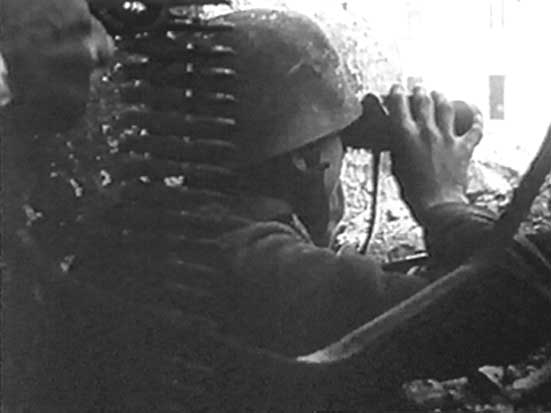
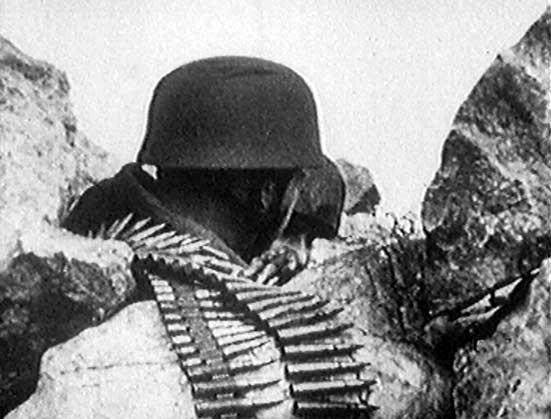
in fine weather, another bombardment began. The Fallschirmjäger took
shelter below ground ready to emerge and take up defensive positions when
it ceased. The 3rd Regiment HQ was situated in a cave on the lower slopes
of Monastery Hill and was refuge to 80-90 paras sheltering from the bombing.
The paras suffered heavy casualties during the bombardment, with some of
the Fallschirmjäger Battalion's down to 200 men, but as the men of
the 2nd New Zealand Division advanced they were met with fierce resistance
from the survivors who emerged from the ruins to meet the attack. Tanks
were sent in but got bogged down in shell craters and mud and could only
be used as static artillery.
Men from the Ghurka regiment made
a dash for Hangmans Hill, which looked toward Monte Cassino but were partly
destroyed in the process, the survivors dug themselves in on the slopes
of the hill. British troops managed to get a toehold on Castle Hill above
the town.
Smoke was laid on the slopes of
Monte Cassino to blind artillery observers who were directing fire onto
the Kiwi’s who were in the process of building a Bailey bridge across the
Rapido in Cassino Town.
The Kiwis managed to capture large
parts of the town but some isolated pockets still remained in German hands.(noteably
the continental hotel) These were turned into fortresses. House to
house fighting took place over the next few days, which slowed down the
advance.
General Heidrich was at 3rd Regiment
HQ when the bombardment began. He concentrated his own artillery and mortar
fire on Kiwi positions in the town, which also helped to stall the New
Zealanders.
On the 16th, reinforcements got
into the town to bolster the Paras hold on their small pockets of resistance.
The 2nd Battalion, 3rd Regiment had consisted of 300 men, 160 had been
killed, wounded or buried in the bombardment. The towns defences were now
under the command of Hauptmann Rudolf Rennecke.
The monastery was again bombed but
the defenders remained un-scathed in their underground bunkers.
The Ghurkas stranded on Hangmans
Hill could not be relieved due to heavy German resistance from the surrounding
high ground, so supplies were air dropped. Some of these supplies were
dropped on the monastery, some containing blood supplies, which were
welcomed by the medical teams in the monastery.
On the 19th March the Allied high
command ordered another push to take German strong points in the town and
a frontal assault on Monte Cassino from Hangmans Hill by the Ghurkas who
would be reinforced by men from Castle Hill, who in turn were to be relieved
by Indian troops. It was hoped tanks, which were being brought in on a
newly carved track north of Cassino, would back up this assault.
The advance on the town was kept
at bay by determined German resistance who were using tanks which they
had half buried in the house ruins.
The Indian troops were late relieving
the defenders of Castle Hill and the frontal assault on Monte Cassino was
delayed. In the morning of March 19th, the 1st Battalion, 4th Regiment
(Major
Reinhard
Karl Egger), who were dug in at the base of Castle Hill, counterattacked
the defenders in the castleabove en masse, which was now being held by
British & Indian troops; a fierce hand to hand battle ensued, causing
heavy casualties on both sides. The attack was unsuccessful and the Para's
had to withdrawal.
When the tanks appeared from the
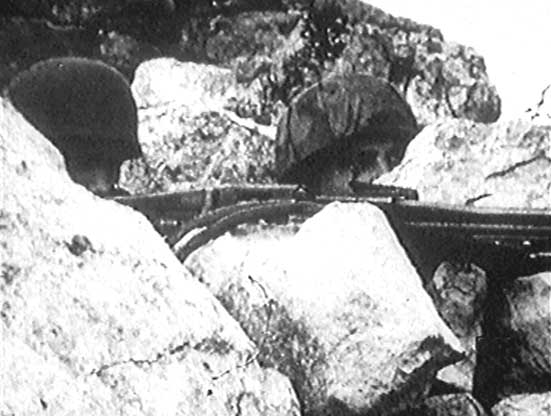
north behind Monte Cassino, the dug in Paras started to knock them out
with Panzerfaust’s and Panzerschreck’s. The knocked out tanks at the head
of the column held up all those behind who became easy targets for nearby
entrenched Para's who used grenades and mines to disable them.
"There were two attacks on
Castle Hill, the first succeeded in blowing a large hole in the castle
wall but this failed to take the objective and the Fallschirmjäger
were beaten off. The second attack was in the early morning of March 19th.
It was carried out by men of FJR4 and men of the Pioneer Battalion. The
Pioneers brought a Flameflower with them. Whilst preparing for the assault
in the ruins of the Monastery, the operator of the Flamethrower, reported
that the Oxygen had leaked out of the tank, rendering the Flamethrower
useless. This was very good news for the operator as he was always an early
target for enemy guns and also good news for my British friend, Bill Hawkins
who was defending Castle Hill".
"When the NZ tanks tried to
break through over the Albenetta Farm, we were detailed off with anti-tank
equipment to attack and disable them. Out of approximately 16 tanks, 5
got out, one of which was occupied by my dear friend Jim Moody from Christchurch,
New Zealand, who calls me Bazooka Bob!"
By the afternoon of the 19th the
frontal assault was called off. The allied troops once again dug themselves
in around Monte Cassino.
Most of Cassino town was now in
the hands of the Kiwi’s, reinforcements had managed to get through to the
beleaguered defenders of Castle Hill overlooking the town.
General Heidrich started to become
concerned over whether his men could continue to hold their small pockets
of resistance in Cassino town. In the meantime German artillery kept up
their relentless barrage on allied positions.
On the 23rd March the allied attack
was called off. Nearly 3000 men had been lost since the 15th March.
On the 25th the allies again bombarded
the monastery with artillery to cover the withdrawal of their forces on
Hangman’s Hill.
The next day the Fallschirmjäger
raised the Swastika on Hangmans Hill when it was realized that the Allies
had withdrawn.
The next allied assault was already
being planned to take place in May. Parts of the British 8th Army on the
Adriatic front of the Gustav line were secretly moved westward to the Cassino
front. Enigma intercepted coded messages, which included details of the
under strength German formations facing them. It was decided that the Cassino
front had to be broken before the Normandy invasion, planned for June,
could take place. The Allies had to try and smash as many German Divisions
as they could, men that could be used in France.
The attack had to be soon.
A four prong attack was planned
with the US 2nd Corps attempting a breakthrough along the west coast following
route 7 and heading north to try and link up with the US 5th Corps who
were attempting to break out of the Anzio beachhead.
The French Expeditionary Force of
4 divisions was to advance north through the Liri Valley attacking German
positions in the areas behind Monte Cassino. The British 8th Corps was
to cross the Rapido River, clear the town and advance across the Gustav
line, cutting off the road west of Cassino. The Polish 2nd Corps which
composed of 2 infantry divisions and 1 armoured, had Monte Cassino as its
objective. They were to encircle the objective and attack from the north.
Firstly they had to take German positions on Calvary Hill behind Monte
Cassino, still in the hands of the 3rd Battalion, 3rd Regiment, part of
Kampfgruppe Schulz, under the command of Major Kurt Veth.
The 1st Parachute Division now took
time to reassemble its Regiments and make some changes. The 4th Regiment
now took up positions in their strongholds in the town and within the monastery.
The 3rd Regiment moved to positions north west of Cassino. The 1st Regiment
formed the reserve. The relief's were carried out at night where they would
silently slip past allied positions.
The Fourth Battle
Late in the evening of the 11th
May 1944 the opening barrage of 2000 allied artillery pieces caught the
German Paras totally by surprise.
Within an hour the Polish forces
were on Calvary Hill, just over 1 km north west of Cassino, (they had
relieved the British 78th Division in the mountains behind Cassino a few
days before). They took heavy casualties as the Fallschirmjäger
put up fierce resistance. Several times the men of the Polish 3rd Carpathians
attempted to take Calvary Hill. By the 13th the order came for Polish forces
to withdrawal.
During the 12th, 4 Bailey bridges
had been constructed across the Rapido River and the British 8th Corps
had advanced 4 miles. The French Expeditionary Force had successfully advanced
up the Liri Valley, battling with German defenders on the way.
The US 2nd Corps advancing northwards
up the coast towards Anzio were supported by allied warships, which pounded
German positions.
The Germans were barely holding
on to the Gustav line, it had been penetrated and the German positions
were being bypassed.
Tanks backed up another assault
on the 16th May by Polish forces. They once again tried to take Calvary
Hill behind Monte Cassino with the hope of cutting off retreating German
forces. The Paras answered this new assault with artillery and mortar fire
but the Poles overwhelmed the defenders on Calvary Hill.
As allied forces were penetrating
the Gustav line backed up by a Canadian Army Corps, (a unit unknown
to the Germans), the order came from Field Marshall Kesselring, commander
Army Group C, to withdrawal from positions in Cassino town, the monastery
and surrounding hills and mountains. The allies had made the mistake of
not cutting Route 6, the main highway linking the south to Rome, allowing
thousands of German troops to escape northwards. Amongst these the men
of the 1st Parachute Division, who quietly slipped away from their positions
on Monte Cassino on the night of 17th.
The town of Cassino finally fell
on the 17th May.
"I was wounded at Cassino
when we recieved the order to retreat on the night of May 17th. We had
to climb over Monastery Hill from Rocca Janula to the other side of the
valley. When I reached the top a grenade exploded nearby. I saw a bright
flash and the next thing I knew, I woke up with a badly swollen and injured
left leg. I crawled into the first aid post, situated in the crypt of the
Monastery ruins. My leg was cleaned up and bandaged during the night of
May 17th. Early in the morning of May 18th, the rest of the men evacuated
and left only the wounded. At approximately 9.30am, a Polish platoon under
the command on Kazimeriz Gubriel came into the monastery and took us as
prisoners. Three of us stayed there and all of the walking wounded were
taken away. At lunchtime we were joined by many officers and among them
was an American reporter.
The reporter was called Mr.Tetlow.
He was dressed immaculately in a white trench coat and he spoke with me
briefly in German. You must remember, I was in pain, hungry, exhausted,
dirty and lousy and I was very angry with the 'nerve' of this clean, well
fed reporter, who had no idea of what we endured. I was well treated by
the men who captured me and I indeed met up with Kazimeriz many years later
and we remained in contact until his death on January 27th 1992".
Only the wounded remained at Monte
Cassino under Hauptmann Herbert Karl Beyer (commander I/FJR4), himself
seriously wounded. The Poles entered the monastery early on the 18th May,
where they proudly raised their flag over the ruins where so many of their
men had sacrificed their lives. Nearly 1000 Poles were killed and 3000
wounded in the assaults on Monte Cassino.
Altogether the Germans had lost
20 000 men in the defence of the Gustav line. The men of the 1st Parachute
Division who had survived the battles in and around Cassino lived to fight
another day.
The German 10th Army defending the
Gustav line made an orderly retreat back toward the next defensive
line, the Hitler/Dora line, 6 miles behind Gustav. This defensive line
had been built to contain any forces that managed to break through the
Gustav line. It was half a mile deep, laid with minefields, anti-tank traps,
barbed wire and pillboxes. Behind this line a third defensive position
was under construction called the Caesar Line, situated in the Alban Hills
20 miles south of Rome, but this was never finished. The Hitler/Dora line
could not stop the Allied advance and was breached within a couple of days
of the Gustav Line.
This breach in backup defences forced
the German 10th Army northwards even further and the German 14th Army eastwards
to avoid the advancing Allies from Anzio. The next German defensive line
was the Gothic Line which ran from La Spezia in the west through the Appennes
to Pesaro on the east coast, some 200 miles in length.
During the German retreat they destroyed
bridges, laid mines on roads and prepared ambushes, all designed to delay
the advancing Allied forces.
On the 23rd May, the US 6th Corps
broke out of the beachead at Anzio and on the 25th May linked up with the
US 2nd Corps. The German 14th Army at Anzio and the 10th Army withdrawing
from their defensive positions were partially encircled by this joint
US force as they moved north, but avoided encirclement when it was decided
that the Americans would head for Rome, which they then entered on the
4th June 1944. The German forces slipped past the outskirts of Rome the
same time the Allies entered.
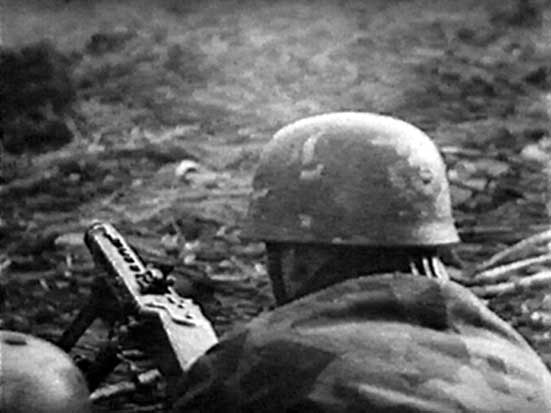
The stubborn defence of Monte Cassino
by the men of the 1st Parachute Division had delayed the allied advance
in Italy and showed their esprit de corps and tenacity in battle, earning
them the name "The Green Devils of Cassino" and gaining the respect
of all who came up against them.
A letter from Pioneer veteran Carl Bayerlein to Chemical warfare
expert, Dr.H.G.Brauch, dated January 1991.
Gas shells used at Cassino.
"During the fighting for Cassino in
Italy, during April and May 1944, we were fired at with shells, which contained
a Reizgaz (irritating stimulant), and also Tränengaz (teargas). Our
gasmasks did not offer sufficient protection against this gas. The result
was a stimulated cough and tears to the eyes. The gas penetrated through
the filters of our gasmasks and forced us to remove them. The bombardment
with these weapons began in the middle of April and continued until I left
the area of battle on May 4th 1944.
In the actual mortar shell were 3
cans filled with this gas. They were discharged in the air over our positions
before going to ground.
Our own spies informed us that the
allies were unloading these poisonous gas shells in the port of Naples.
An appeal for gasmasks took place
at the beggining of April but the filters did not offer enough protection
against this kind of gas. The gas mixed with the urid smoke of other detonating
shells and formed a dense smog, that provoked the mucous membranes and
forced us to fight for air. These shells were only fired during darkness
so they would additionally obstruct our vision. I can provide witnesses
for these events at any time.
Since you are considered as a recognised
chemical weapons expert, could you tell me what kind of gas was actually
used and how many of these shells were fired against us. Since this Reizgaz
was a chemical weapon, it falls into your sphere of interest.
This gas was used to try and drive
us out from the ruins of Cassino and break our resistance. It would appear
that this use of chemical weapons during WW2 has been concealed in the
past. I would be interested to know if you have heard about the use of
this weapon at Cassino."
C.B
"The use of poison in
combat marks the difference between treachery and war"
Winston Churchill
German Forces - Gustav
defensive line
Jan - May 1944
German 10th Army - Generaloberst
von Vietinghoff
LI Gebirgs Corps -General
der Gebirgs Truppen Fuerstein
5th Gebirgs Division - Generalleutnant
Schrank
44th Infantry Division -
Generalleutnant Ortner
1st Parachute Division -
Generalleutnant Heidrich (releived 90th PanzGren Div-14th Army Res.
Moved from Adriatic front to Cassino Front)
XIV Panzer Corps - Generalleutnant
von Senger und Etterlin
71st Infantry Division -
Generalmajor Raapke
94th Infantry Division -
Generalmajor Steinmetz
15th Panzergrenadier Division
- Generalmajor Rodt
Kampf-(Korps) Gruppe Bode
Armee Reserve - 90th Panzergrenadier
Division - Generalleutnant Baade
Allied forces facing
the Gustav line
Allied 5th Army Group - General
Alexander
US 5th Army - General Clark
US 2nd Corps - General Keyes
French Expeditionary Corps
- General Juin
British 8th Army - General
Leese
British 5th Corps - General
Keightley
British 10th Corps - General
Mc Creery
Polish 2nd Corps - General
Anders
British 8th Corps - General
Kirkman
Canadian 1st Corps - Reserve
Corps - Lt General Burns
"Das Geheimnis des Erfolges der Fallschirmtruppe
kann in drei Begriffen dargestellt werden: Kameradschaft, Korpsgeist und
Einsatzbereitschaft."
"The secret of the Paratrooper's
success can be summed up in three words, comradeship, esprit de corps and
efficiency"
Major Rudolf Boehmler - 1/FJR3,
Cassino.
Return
to Homepage