
Fallschirmjäger
Awards and Decorations
There are many sites on the web
that cover German military awards and decorations in the period of 1939-1945.
I am only going to cover a few of the awards and decorations that were
associated with the Fallschirmtruppe. I intend to add images to the articles
as soon as they become available.
Parachute qualification
badge
The most distinctive award associated
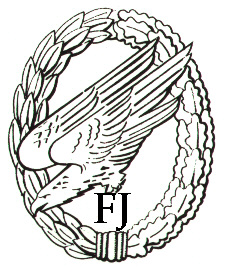
with the fallschirmjager was the Fallschirmshützenabzeichen, also
known as the Parachute Riflemans Badge. It was instituted on November 5th
1936 by the Commander in Chief of the Luftwaffe and was awarded after the
recipient had qualified as a parachutist by completing six training jumps;
one of which was a night jump.(British paratroops had to complete 8
jumps to qualify).
It is a very attractive award displaying
a Diving Eagle with a swastika clutched in its talons, set in an oval wreath,
one side made up of oak leaves, the other side laurel leaves. The eagle
is gold in colour and made of brass and the wreath a silver colour later
blackened, made from a nickel copper alloy. The wreath and eagle were separate
pieces and were riveted together. It was fitted with a vertical type needle
pin.
The army had their own parachutists
badge which was instituted on September 1st 1937 and was awarded to men
of the Army Fallschirm-Kompanie and was worn instead of the luftwaffe version
if they qualified between the inception date in 1937 and January 1st 1939
when the badge was dis-continued. It was however re-instituted in 1943
when it was awarded to men of two new Fallschirmjäger units introduced
in that year. The SS and the Brandenburg Regiment created their own Fallschirm
units in the summer of 1943, but some photos show a mixture of Army and
Luftwaffe Parachute Badges.
The Army badge also featured the
diving eagle, in a gold coloured oval wreath of oak leaves but had a closed
winged Wehrmacht eagle with a swastika in its talons at the top of the
wreath.
Cloth versions were designed for
use on combat clothing, silver and gold wire badge for officers and a white
and yellow threaded version for enlisted men. The badge was worn on the
left breast.
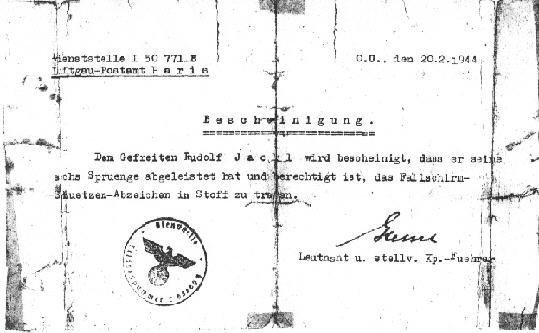
Certificate for the award of the Parachute badge given to Gefreiter
Rudolf Jackl. Originally a Luftwaffe ground crew man he transferred to
the Fallschirmtruppe in 1943 and saw extensive action in Normandy. After
being wounded and evacuated at the end of July 44, he saw further service
in Italy until the end of the war.
Luftwaffe Ground Combat
badge
This badge was instituted in March
1942 to reward Luftwaffe ground forces that took part in combat alongside
other German armed forces. It was to take the place of badges such as the
Infantry Assault badge and General Assault badge if they had been already
been awarded.
It was designed by Professor Von
Weech of Berlin and featured an oval wreath of oak leaves with a Luftwaffe
eagle at the top. Behind the eagle is a cloud, which has a lightening bolt
emanating from it, hitting the ground. At the point of the thunderbolt
are a number of jagged points representing mountains.
The wreath and features are made
from zinc alloy and the Luftwaffe eagle is finished in dull silver. Again
the badge started as 2 pieces and was riveted together.
The prospective recipient had to
be involved in three engagements in three days, been wounded in one of
these actions, been awarded a decoration in one of these actions or killed
in action, where the award would be passed on to the family of the deceased.
All members of the Fallschirmjäger,
Luftwaffe Field Divisions, Luftwaffe Assault Gunners and men of the Herman
Göring Panzer Division were eligible for this award. This award was
also worn on the left breast.
Kreta cuff title
The Kreta cuff title was instituted
on 16th October 1942 to reward all Wehrmacht personnel who had taken part
in the battle of Crete between the 20th May and 27th May 1941.
It consisted of a 33 mm wide, off
white cotton strip with a border of yellow cotton. Between the yellow borders
is the word KRETA in capital letters also in yellow cotton. Either side
of the word is a sprig of acanthus leaves.
The cuff title was worn on all uniforms
and was sewn on the left sleeve at a prescribed distance from the seam
of the cuff, 15 cm on the Fliegerblouse or Tuchrock.
For paratroops to be awarded this
cuff title they must have taken part in a parachute or glider landing between
20th and 27th May 1941.
Afrika cuff title
The Afrika cuff title was instituted
on 15th January 1943 as a campaign award to replace the Afrika Korps and
Luftwaffe Afrika cuff titles which represented units fighting in North
Afrika. The cuff title was a 33mm wide tan coloured band with a silver
border on each edge. In the middle of the cuff title was the word AFRIKA
also in silver cotton. Either side of the word was a stylised palm tree
also in silver. There were several variations of this cuff title but all
were similar in design. This cuff title ceased to be awarded after 29th
August 1944, with the exception of POW's, wounded and missing.
It was worn 15cm above the cuff
of the left arm of the service uniform unless worn with the Kreta cuff
title in which case it was sewn above the Kreta cuff title. It is not unusual
to see photos of Fallschirmjäger wearing both cuff titles on their
left sleeve.
Fallschirm-Jäger
Rgt.1 cuff title
The following 3 cuff titles were
institued in August 1939.
This cuff title was produced for
and worn by members of the pre-war FJR1. It was made from a 33mm wide green
cotton band, the words embroidered in white cotton. Non commisioned officers
had the addition of an upper and lower white braid border. Officers cuff
titles were embroidered in silver lettering and braid. The cuff title was
worn on the right sleeve of the 4 pocket tunic and not worn on the Fliegerblouse,
hence why it is assumed that these cuff titles were ordered to be removed
from all uniforms as many Fallschirmjäger wore the Fliegerblouse in
to combat and not the 4 pocket tunic.
Fallschirm-Jäger
Rgt.2 cuff title
Produced for and worn by members
of the pre-war FJR2, with the same specifications as above.
Fallschirm-Division
cuff title
Produced for and worn by members
of the pre-war Fj division who were not members of FJR1 & 2. For example,
supply & secretariat, drivers, pioneers, cooks, medical personel etc,
would have been eligible to wear this particular cuff title. (I recently
heard from a veteran Sanitäts-Oberjäger from the early Fj.San.Zug.7,
and he told me that he wore a cuff title "Fallschirmjäger"!!!!!!)
Luftwaffe Close Combat
Clasp
The German army close combat clasp
was instituted in 1942 to reward men involved in hand to hand combat. The
Luftwaffe introduced a version to be awarded to their personnel in early
1945. It was awarded in three grades, gold, silver and bronze and the same
criteria as the army version had to be met. For the bronze award the recipient
had to have been involved in close combat for 15 days, 30 days for silver
and 50 days for gold. It featured a circular wreath of oak leaves with
a 9 leaf, oak leaf sprig on either side. Within the wreath is a Luftwaffe
eagle with a crossed bayonet and stick grenade clasped between its talons.
The wreath and sprigs are coloured
in accordance to the grade of the award, the eagle and crossed bayonet/stick
grenade feature was an alloy colour.
It was of 2 piece construction similar
to the above awards and was riveted together. This award was worn above
the left breast pocket.
Luftwaffe Glider Pilots
Badge
This award was designed by Ernst
Peekhaus of Berlin who was responsible for designing many of the German
military awards and decorations. It was then instituted in December 1940
and was awarded to men who had qualified as glider pilots. As mentioned
elsewhere on this site, the Luftwaffe had a number of light assault gliders
at the outbreak of the war, although they were not used until operations
in the low countries.
Gliding had been a very popular
pastime in germany after the 1st world war and it was through gliding that
the foundations of the Luftwaffe were built.
When there became a need for good
glider pilots there were many volunteers, but assault gliding was very
different to sport gliding and the volunteers needed great skill and nerve.
They would be required to land men and equipment safely and more than likely
under fire. The glider pilots used in the first actions in Belgium in 1940
were also infantry and engineer trained so that they could take on the
role of any of the men should they be killed or wounded.
The badge consists of an oval wreath
of oak leaves with a swastika at its base. Just above the center of the
badge with its wings protruding over the wreath is a soaring eagle. Again
this award was of two piece construction with the eagle being riveted to
the wreath.
Narvik Shield
I have decided to add a short section
on the Narvik Shield as it was awarded to many Fallschirmjäger during
the first German airborne operations of the war. It was instituted on 19th
August 1940 in recognition of all the Wehrmacht forces who took part in
the fighting for Narvik between April and June 1940.
2 grades of the award were produced,
silver for Army and Luftwaffe and gold for members of the Kriegsmarine.
The badge was designed by Professor
Richard Klein of München and consists of a shield with a pointed bottom,
9cm by 3.5cm. On top of the shield sits an eagle with folded wings clutching
a
wreath enclosed swastika. Below the eagle is a box with the word Narvik.
Within the main section of shield is a crossed two bladed propellor and
anchor representing the Luftwaffe and Kriegsmarine. Between the tops of
these items is an Edelweiss representing General Eduard Dietl's Gebirgsjäger.
Above the edelweiss is the date,1940. The award came on a piece of backing
cloth attached by means of 4 prongs which fitted onto a backing plate that
was sewn on to the upper left arm of the uniform.
In total, eight and a half thousand
Narvik Shield's were awarded to Wehrmacht forces with men of the Fallschirmtruppe
being awarded 756 of them, making it quite a rare Fallschirmjäger
award.
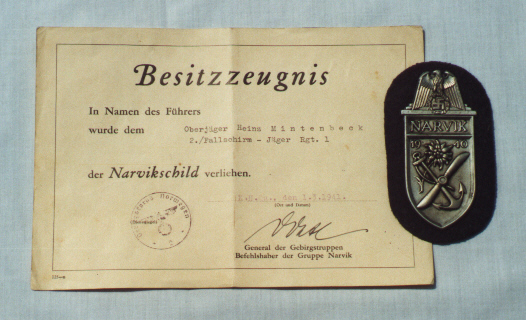
Narvik shield awarded to Oberjäger Heinz Mintenbeck of 2./FJR1
awarded in March 1943. Courtesy of John Turnbull
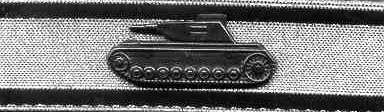
Tank Destruction Badge
Known as the Panzervernichtungsabzeichen,
this award was introduced on 9th March 1942 to award those men who had
single handedly destroyed an armoured vehicle in combat. The award was
back dated to 21st June 1941 to include actions at the beginning of Operation
Barbarossa.
The badge came in 2 grades. Black
for the destruction of one armoured vehicle and on 18th December 1943,
the gold class was introduced to denote the destruction of five armoured
vehicles.
Both grades of this badge consisted
of an 88mm by 33mm ribbon with a 4mm black cotton stripe, 2mm from the
upper and lower edges. In the centre of the ribbon was a 43mm by 18mm metal
MarkIV Panzer (SdKfz161).
The Panzer emblem was secured to
the ribbon with 3 metal pins, which in turn was covered with a cloth patch.
The award was sewn on to the right upper arm of the tunic.
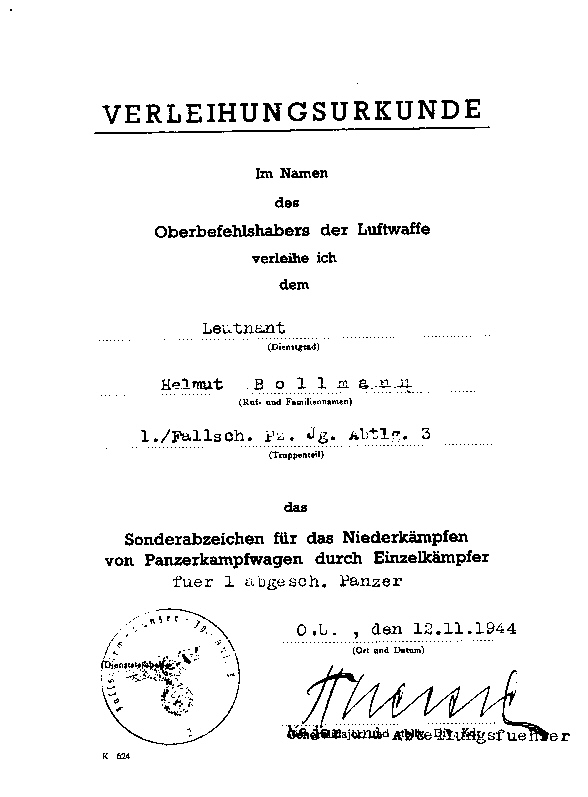
Certificate for the destruction of 1 tank awarded to Helmut Bollmann
in 1944. The action took place in Normandy which resulted in the destruction
of a sherman tank that threatened to overcome their positions. Helmut Bollmann
was a member of 1./Fsch.Pz.Jg.Abt.3.
Return
to Homepage