The disastrous
airdrop in the Ardennes
December 16th 1944
Kampfgruppe Von der Heydte
The Fallschirmjäger saw extensive
action in the Ardennes in late 44, early 45. Two Parachute Divisions were
involved, the 3rd Parachute Division, part of the 1st SS Panzer Corps and
the 5th Parachute Division, part of the German 7th Army, both subordinated
to Army Group B under the command of Feld Marshall Walter Model. Both divisions
although badly mauled in the Normandy campaign and recently reformed, gave
a good account of themselves. The 3rd & 5th Parachute Divisions were
used in an Infantry role during "Operation Herbstnebel" (Autumn Mist),
the Battle of the Bulge, but plans for a small parachute drop in the Ardennes
were underway.
General Kurt Student, one time Commander
of all the German Airborne Forces, now Commander of Army Group H, gave
Oberstleutnant Friedrich August Freiherr Von der Heydte, the job of assembling
a Parachute Battalion for the mission which was to be code named "Operation
Stösser". Von der Heydte was the former commander of I/FJR3, FJR6
and now the Commander of the 1st Parachute Armee weapons school at Aalten.
Student's orders to Von der Heydte
were to form a parachute Kampfgruppe consisting of 100 men from each battalion
within the 1st Parachute Army under the command of Generaleutnant Eugen
Meindl, which was subordinated to Army Group H. He would then organize
these men into 4 Jäger Kompanies, a heavy weapons kompanie, a Pionierzug
and Nachtrichtenzug.
General Student sent orders to all
Regiment commanders within the 1st Parachute Army to send their best men.
Not many commanders responded to this order and only a few good men
were made available.
(however 100 good men were furnished from VDHs'
old FJR6)
Von der Heydte even had to return
150 men to their parent units as unsuitable candidates. He ended up with
very few men who had made previous combat jumps such as Crete, at that
stage in the war only a small percentage of men in the Fallschirmtruppe
were actually jump qualified, an even smaller percentage were actually
veterans of previous airborne operations.
Oberstleutnant Von der Heydte’s
orders came from his superior for this mission who was SS Oberstgruppenfuhrer
Josef Dietrich, commander of the 6th Panzer Army (later SS), which
was to provide the main armoured thrust in the Ardennes offensive. His
orders were clear, the drop zone was approximately 11km north of Malmedy
in the Monte Rigi area of the Eifel mountain region, the objective; a main
road junction that led to Verviers, Eupen and Malmedy. This area would
be the main route for any American reinforcements being rushed into the
area. They were to secure the road junction until met by the point guard
of Dietrich’s 6th Panzer Army, men of the Hitlerjugend Division.
If the mission was delayed by 24
Hrs the secondary objective would be to secure the bridges crossing the
River Ambleve until met by 6th Panzer Army armoured units. Dietrich could
not provide photographs or reconnaissance of the drop zones and all they
were provided with were 300 straw filled dummy parachutists attached to
ancient parachutes, which were to be dropped to make the airdrop look bigger
than it actually was. (when asked if he could provide at least carrier
pigeons, Dietrich retorted, "I am not running a fucking zoo").
The Kampfgruppe was however to be
supported by long range artillery. Obersturmführer Etterich, an Artillery
Observer from the 12th SS Panzer Division was to accompany VDH to call
in fire support.
To VDH, the plan was insane, a night
drop over enemy held terrain in hostile weather with the majority of his
ranks filled with inexperienced men.
The time for the drop was at 0430
on the 16th December but the Kampfgruppe was hampered by transport problems
getting them to the airfields at Lippespringe and Padeborn. The operation
was delayed as only a part of the Kampfgruppe arrived on time.
German radio intercepts confirmed
that American reinforcements were being rushed to the front after the opening
shots of the offensive. Oberstleutnant Von der Heydte's mission, although
delayed was still the main road junction to stop that flow of reinforcements
expected through his area.
The Kampfgruppe finally mustered
at their airfields and the JU-52 transports took off just after midnight
on the 16th/17th December. Over 100 aircraft took off for the start of
Operation Stösser, in terrible weather with strong head winds, which
were not taken into account by the many inexperienced pilots.
Pathfinder aircraft were tasked
to drop indendiary bombs in 2 rows, approximately 1 mile apart to mark
the dropzone for the following transport aircraft. The Pathfinders were
late in joining the formation, which led to some confusion amongst the
inexperienced pilots. Soon after crossing the front line, Allied flak began
to disperse the aircraft formations which threw some of the pilots miles
off course. When it came to the drop many men landed miles from the planned
drop zone, some truppe's made their way back to the German lines, some
were dropped in Holland, many miles from the Ardennes. Only 35 aircraft
made it to the drop area and when it came to jump the Paras were met with
winds up to 36 miles per hour.
As they jumped the Paras became
widely dispersed around the drop zone. During the early hours of December
17th, Von der Heydte only managed to find 125 men, many of whom were injured.
Many men died of exposure overnight in the harsh weather conditions. Most
of their heavy weapons containers had been lost during the drop and
only a small percentage of the men were trained to jump with their weapons,
which made the job of stopping allied reinforcements practically impossible.
The accompanying radio equipment had been damaged in the drop, VDH had
no contact with the outside world, there would be no artillery support
either. Reconnaissance parties were quickly sent out by Von der Heydte
to try and make contact with elements of the 6th Panzer Army, many never
returned. Those who did return were unsuccessful in making contact with
freindly forces
By the morning of December 17th,
the small group reached the road junction. It was not long before they
heard the sound of vehicles approaching. They witnessed a seemingly endless
column of trucks carrying men and supplies being rushed toward the front
line.
With just their small arms and limited
amount of ammunition, the Kampfgruppe was unable to stop this allied reinforcment.
VHD ordered a withdrawal and the 125 men melted back into the forest.
During the afternoon of the 17th,
Von der Heydte made contact with 150 stragglers of his Kampfgruppe, who
were being led by Kriegsberichter Oberleutnant Bruno von Kayser, one of
the Kampfgruppen's Kompanieführer's.
The Allies by this time were aware
of the presence of German Paratroopers in the area but had no idea of the
numbers of men involved. They estimated that a major drop had been undertaken
involving divisional size formations and not just one Kampfgruppe. This
caused panic and confusion at Allied Command as more and more reports of
paratroop sightings came in from isolated units in the surrounding countryside.
Von der Heydte's only success was the redeployment of US troops who became
engaged in the search for German Paratroops or protecting high ranking
officers, instead of heading for the front.
The Luftwaffe tried to re-supply
the Kampfgruppe but to no avail, they only received a few of the containers
and one was allegedly filled with cheap cognac and damp cigarettes.
Oberstleutnant Von der Heydte realised
the situation was critical, he had no contact with 6th Panzer Army, he
had many wounded and all his men were tired and hungry. The Americans were
searching for them and had practically surrounded them. He decided to send
his wounded and unfit back in the direction to where he thought the German
front line was, the fit were organized into an assault group with which
he planned to break through the Allied encirclement. The attack failed
and they took heavy casualties.
On the 21st December he broke the
survivors up into small groups of 2-3 men thinking they would have more
success getting through. He himself set off with his adjutant and orderly
in the direction of the town of Monshau, thinking it was in German hands
as it had been a first day objective of the offensive. This was not the
case, it was occupied by men of a US Engineer Battalion. He was in a bad
way; the pain from a shattered left forearm,
(a previous training injury)
and
a damaged right arm incurred the night of the jump, became unbearable.
On the 23rd December he ordered his companions to leave him. He entered
the outskirts of Monshau alone and rested up in a local house. He stayed
there for a day trying to recover before writing a note of surrender for
the boy of the house to deliver to the americans in the town, who were
headquartered in a local hotel.
He surrendered to them on Christmas
Eve 1944. Oberstleutnant Von der Heydte’s mission had been a failure from
start to finish with no gains, only the loss of many German Paratroopers.
It showed that for an operation of this degree you need good intelligence,
good training and experienced men, Von der Heydte had none of these available
to him.
(Also see the commanders section
for Von der Heytde's biography)
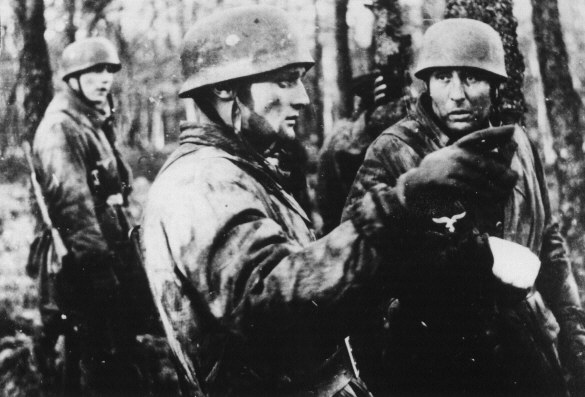
I am very reluctant to add this photograph
to the site as it is one of the gems of my collection, kindly given to
me by FJD7 veteran Otto Merz.
It is I believe, a rare photograph,
taken during the above mentioned Operation Stösser in the Ardennes
in December 1944. I have 2 other photos taken during this operation. One
of US service troop prisoners taken on the afternoon of the 17th December
being guarded by Von der Heydte's men and the other showing a Fallschirmjäger
asleep under the cover of a tree trunk with a flare pistol beside him.
The above photo shows Oberstleutnant
Von der Heydte on the right, Kriegsberichter Oberleutnant von Kayser in
the centre and one of Von Kayser's men on the left. (Both wearing winter
gloves). (The caption written on the reverse of the photo by Herr
Merz says that Von Kayser was a Kompanieführer within the Kampfgruppe.
The German archives could not come up with anything about von Kayser's
military record but I recently heard from a man who knew him after the
war. He was a famous ballroom dancer and had his own dance hall in Germany.
He has a daughter who is still alive.)
I find the photograph very dramatic.
Von Kayser looks as though he is giving VDH a situation report. The strain
can clearly be seen on the face of VDH as he realises that his Kampfgruppe
has been scattered and that most of his weapons containers cannot be found.
He must have thought that the operation was now pointless.
His right arm is in a sling, injured
during the drop. He looks tired and in pain and little did he know that
he would be in captivity several days later.
This operation, although probably
one of the worst planned Airborne operations of the war, was probably one
of the most productive. It tied up thousands of US troops who became engaged
in hunting down Fallschirmjäger in the Eifel Mountains. When the rumour
spread that Fallschirmjäger might attempt to kidnap Eisenhower, he
was guarded by 100's of men. Not just the Supreme Commander but top ranking
Generals were also protected around the clock by men who could have been
used at the front.
I hope that you will appreciate
this photo as much as I do, if you know of any other Stösser phots
then please let me know.
NB: I have just been looking at
the photo in detail and have zoomed in on the helmet of the man at left.
Von Kayser has a white spot on the right side of his helmet and it would
appear that the Melder also has one. It may be some kind of Kompanie identity
marker, I do not know!!!!!!!!!!. What do you think.
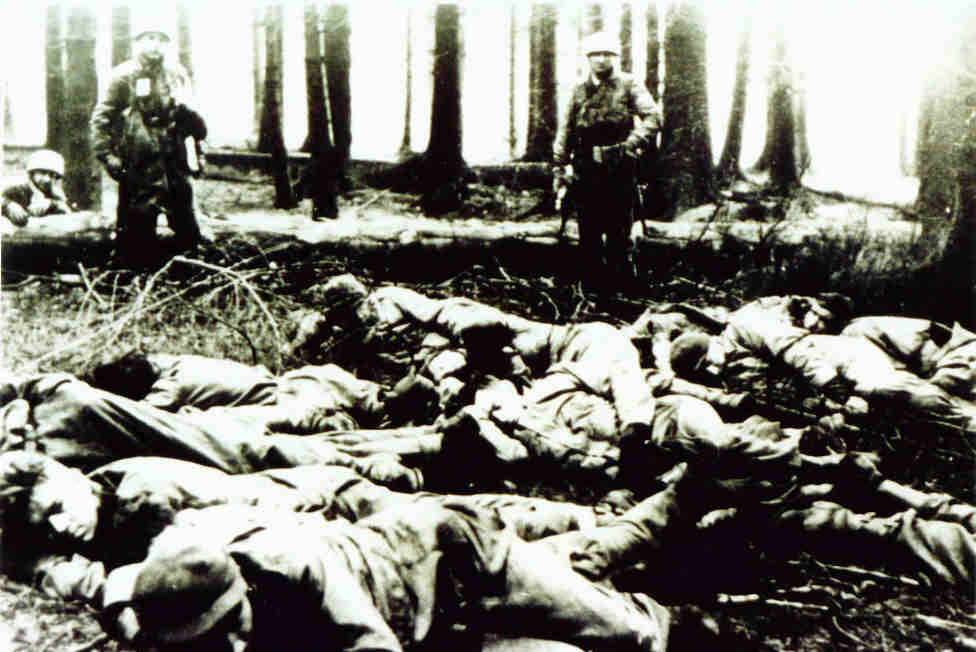 Above - I loathe to add these to the site as they form part of the
photo gems I have in my collection. This photo features men of Kampfgruppe
von der Heydte watching over US prisoners in the Ardennes. From the available
literature on this mission I am assuming that the american prisoners are
supply troops that were captured during the afternoon of 17th December
1944. When Von der Heydte ordered the withdrawal of his men he left behind
his wounded in the care of these prisoners. I am concerned about the lack
of snow. Some reports state that they landed in a blizard, others mention
that the snow did not fall until late evening on the 17th. I would be interested
to hear any comments on this photo.
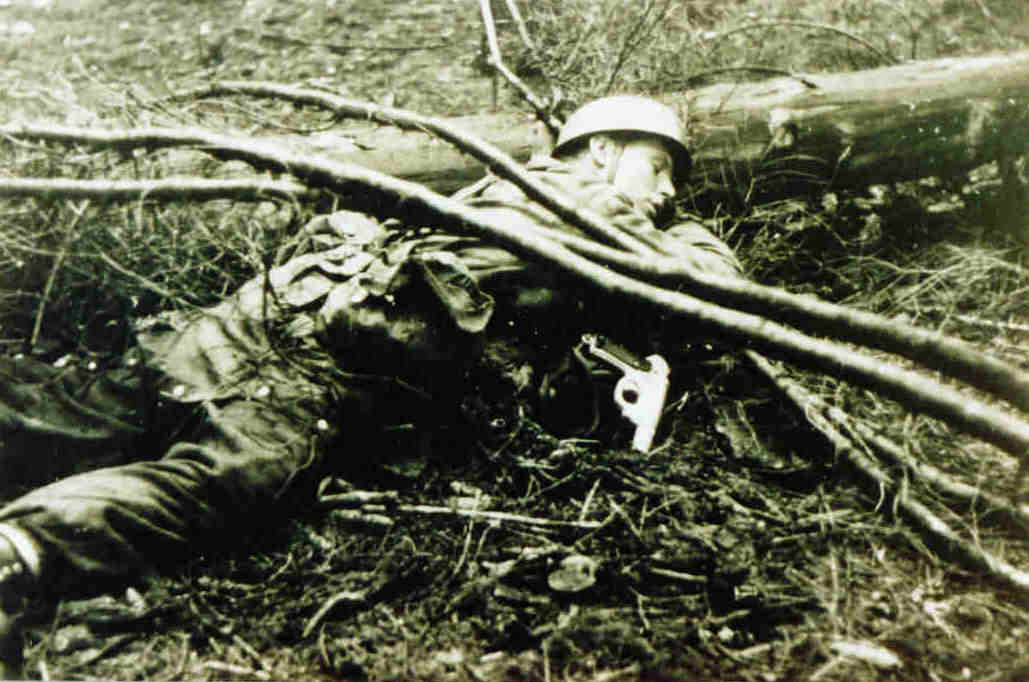 Above - Another part of the Otto Merz Ardennes collection featuring
Kampfgruppe von der Heydte. The caption on the reverse of the photo says,
" a Fallschirmjäger of Kampfgruppe von der Heydte rests in the cover
of a tree. He is probably still alive". Note what appears to be a flare
pistol beside him. Appreciate any comments on this or any of the above
photos.
Return
to Homepage