Air transport
in use by the Fallschirmtruppe during WW2
Junkers JU-52
The JU-52 became the major workhorse
transport aircraft of the Luftwaffe during World War 2. Its roots started
back in 1915 when Junkers flew the worlds first all metal aircraft, not
knowing that three decades later planes using corrugated metal skin would
play such an important role.
The first JU-52 prototype flew in
1930 as a single engine aircraft but after testing with several different
engine types the company decided on a 3 engine variant, which became very
popular with airlines around the world.
The military potential of this aircraft
was secretly being assessed by the Luftwaffe who ordered them as makeshift
bombers. They first saw action during the Spanish Civil War in 1936 where
they were used to ferry nationalist troops from Morocco to Spain. Later
during the conflict they were employed as bombers until replaced by the
log awaited Dorniers and Heinkels.
The JU-52 had proved to be very
reliable and was already blooded for the war ahead.
At the outbreak of the 2nd World
War the Luftwaffe had several hundred JU-52’s in their inventory and it
was used extensively in supply and air assault missions. The Fallschirmjäger
first made use of the JU-52 in the campaign in Norway when the Luftwaffe
had 571 available, then being used again in the Low Countries. They showed
their potential carrying out airdrops, towing gliders and resupplying troops
on the ground. The casualty rate was quite high in the JU-52 because of
its slow speed.
Nearly 500 JU-52’s were used in
the assault on Crete in May 1941 and by the end of the invasion 271 were
destroyed or seriously damaged. They were employed on all fronts and were
involved in most air assault missions.
Production of the JU-52 carried
on until mid 1944 when relentless bombing by the allies eventually ceased
production. The Fallschirmjäger and all other men who had contact
with this aircraft affectionately called it "Auntie Ju" or
"Tante
Ju" and they were always a welcome sight to men were in need of
re-supply or reinforcement.
The plane itself was a low wing
monoplane of all metal construction made from corrugated aluminium panels
over steel tubing, which made it a very well constructed aircraft.
It was considered a very safe aircraft
and could take a lot of punishment; it could even fly with the loss of
one engine, probably a regular occurrence when conducting airdrops at slow
speed. Several photographs taken on Crete show Fallschirmjäger exiting
from burning aircraft.
It was also capable of landing on
uneven or unpaved airstrips and its slow landing speed allowed it to land
on short improvised runways. Its only defences were 1 x 13mm dorsal gun
and two 7.92mm guns mounted in the waist of the aircraft.
The JU-52 was powered by three 725
hp BMW radial piston engines with a top speed of 171 mph and a cruising
speed of 130 mph. It was capable of reducing its speed on landing to 59
mph enabling it to land on short airstrips. The JU-52 weighed 11 tons and
could carry one and a half tons of cargo or accommodate 12 – 18 paratroops
and a dispatcher, who doubled as an observer (absetzer). The dispatchers
job was to get the men ready in their jump line up, make sure their 9 metre
static lines were attached to the wire cable in the ceiling of the aircraft
and open the door ready for the exit and give the signal to jump. Absetzers
were not Luftwaffe personnel but qualified parachutists released by their
units to train as a jump master.
The aircraft was fitted with fixed
gear, although some prototypes were fitted with retractable gear. The cargo
hold was accessible through a door in the left of the aircraft for troops
and a cargo door in the right of the craft for stores. The JU-52 would
normally have been seen towing a single DFS-230 glider but was capable
of towing three if need be.
It proved invaluable throughout
the war in its role of dropping paratroops and supplies and was still in
service with the Swiss Air force until 1983, a true workhorse.
In 1939, the Lufttransportgruppen
consisted of:
Kampfgruppe ZBV.1 based at Burg
under the command of Oberstleutnant Morzig.
Kampfgruppe ZBV.2 based at Stendal
under the command of Oberstleutnant Drewes.
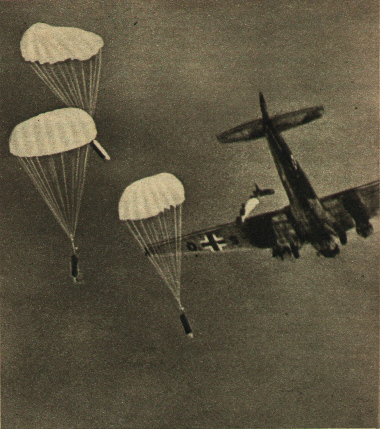
Photo from a copy of "Der Adler" dated 1940. The whole copy is dedicated
to the assault on Belgium and Holland in May of that year. This JU-52 is
dropping cannisters, which contained arms and ammo as well as medical supplies
and other stores for the Fallschirmjäger.
DFS 230 - Light assault
glider
Germany had been forbidden under
the 1918 Treaty of Versailles to reconstruct its Luftwaffe and so in the
early days of the illegal Luftwaffe, pilots started to train in gliders,
which had been a popular pastime in Germany for several years. The country
was full of glider associations so when gliders were being considered in
the combat role there was no shortage of good pilots. It was General Kurt
Student who came up with the idea of using Gliders in combat. Testing and
evaluation was carried out at Darmstadt.
The DFS-230 light assault glider
was successfully demonstrated in 1937 and immediately entered production.
It was manufactured by Gottaer Waggonfabrik AG and by the end of the war
they had produced nearly 1500 gliders. It was inexpensive to produce, easy
to fly and easy to land.
In March 1937, the first Glider
Training Command was set up at Darmstadt-Griesheim under the command of
Leutnant Kieß. On 1st August 1938, the Glider Training Command was
incorporated into Flieger Division 7.
The DFS-230 (Deutsches Forschungsinstitut
Fur Segelflug – German Institute of Gliding Flight), was the only assault
glider in service at the outbreak of World War 2. It was considered a potent
weapon as it could land a small group of men with their weapons and equipment
into a small area, unlike paratroops who were usually scattered upon landing
and had to find their weapons containers before they could become a fighting
unit. A glider could deliver a well trained unit right to the heart of
its objective and maintain stealth till the last minute as the towing aircraft
could release the glider miles from its landing zone. Air superiority was
essential for glider ops; slow moving aircraft towing gliders made easy
prey for enemy planes. On the down side the gliders were prone to being
unstable in the air often resulting in air sick troops and the stress on
the glider during a tow in bad winds had a tendency to sometimes part the
tow cable.
The DFS-230 was a high wing monoplane
made from lightweight metal tubing covered in plywood and linen, the cockpit
was glazed to allow forward observation and was removable to allow the
exit of its two crew. Behind the cockpit was the troop compartment
for up to 10 men sat one behind the other on a centrally fitted wooden
bench.
For takeoff the fuselage was fitted
with two small wheels and for landing it was fitted with a wooden landing
skid which was spring loaded to absorb the shock of landing. When released
from the towing aircraft the glider descended in a spiral dive towards
its objective at speeds of up to 180 mph. Landing was the most dangerous
part of the flight so different methods of braking the glider were employed.
The skid was often wrapped in barbed wire to slow the glider on landing.
Variants were produced, one fitted with a parachute braking system which
released a parachute to slow the rate of descent and reduce velocity in
case of a vertical descent, another variant employed rockets in the nose
of the glider which fired off to reduce the braking effect. (One of
these variants was used to land a Battalion of the 9th Parachute Division
into the city of Breslau in Feb 45)
Variants:
DFS-230A-1 Initial production
variant.
DFS-230A-2
Dual control variant.
DFS-230B-1/2 Incorporated
a braking parachute, which was released from the rear of the external fuselage
(Although all variants used barbed wire wrapped around the skid to further
increase the braking effect.
DFS-230C-1 Had 3 braking
rockets incorporated into the nose structure to increase the braking effect.
DFS-230V-7 Enlarged to accomodate
15 men
DFS-230F-1 Final variant,
which was not produced.
The glider weighed in at just over
a ton and was 36 ft long with a wingspan of 72 ft. Its gliding speed was
around 180 mph and a towing speed of 112 mph. It was christened in combat
on May 10th 1940 when they were employed to land on the Eben Emael fortress
in Belgium and the three bridges over the Albert Canal. They were used
extensively in the battle for Crete in May 1941 but suffered heavy losses
due to unexpected anti-aircraft fire. They were also used to great effect
in the rescue of Mussolini from the Gran Sasso in the Appenine mountains
in central Italy in September 1943. They served on all quarters of the
Ostfront where they were used in re-supply missions as they could carry
over a ton of stores. These Light Assault Gliders changed the face of German
air assaults during WW2 with their many successes.
It was after hearing of the successes
of the German airborne forces that Winston Churchill had the British Army
form its own parachute force and look into the possible design of gliders.
They came up with some very successful models such as the Hotspur, Hamilcar
and the famous Airspeed Horsa.
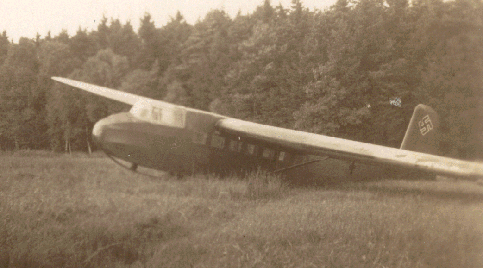
A DFS-230 on the ground after a training flight in Germany, early
1940.
Gotha Go 242 - Medium assault
glider
The Gotha Go-242 medium assault
glider development was approved as it offered three times the capacity
of the DFS-230. It could carry a crew of two and up to 21 fully equipped
troops or the equivalent weight in stores and equipment. The wings were
made of wood with a fabric covering, twin booms extended from the rear
of the wings to carry twin fins and rudders joined by a tail plane. The
fuselage, which was positioned centrally, was made of tubular steel covered
with fabric. Below the fuselage was a twin wheeled dolly, which was jettisoned
on take off and two fixed skids for landing. Troops entered the aircraft
by a door in the left side of the aircraft; cargo was put on board through
the rear hinged fuselage door.
Prototypes were flown in 1941 and
it went into production soon after, entering service in 1942. It saw service
in the Mediterranean and North Africa and only participated in two Fallshirmjäger
operations when men of the 1st Parachute Division used it as a ferry from
southern France to Sicily in July 1943 and again when they were used to
fly in re-inforcements and equipment to a small para force who were dealing
with an FFI uprising in southern France in July 1944. The towing
vehicle was normally a Heinkel 111. One variant employed rockets to assist
in takeoff, which resulted in the tail boom having to be strengthened.
Over 1500 of these gliders were produced during the war, but none of them
took part in any of the well publicized operational paradrops.
The Gotha Go-244 was also produced
which was a powered version of the 242 and came about when French Gnome-Rhone
radial engines became available after the fall of France and the 242 was
modified to a twin engine transport aircraft. They proved to be easy targets
for allied fighters and they were withdrawn form front line service and
used for training airborne troops. Both types a wing span of 80 ft and
they were 51 ft long.
Messerschmitt Me 321 -
Heavy assault glider (Gigant)
The idea for a giant glider was
born during the preparations for the invasion of England when the need
to get men and materials across the Channel in a hurry was paramount. At
the time of its production it was the second largest aircraft in the world
and was capable of transporting over a hundred troops or 19 tons of stores
or equipment. They had a wingspan of 180 ft and were 93 ft long.
A powered version was produced later
in the war. Both variants were easy prey for enemy aircraft and they were
finally reduced to behind the lines flying. The Fallschirmjäger never
used these aircraft.
Return
to Homepage