CAMDEN, NEW JERSEY
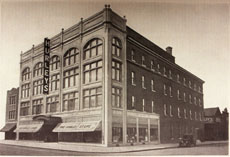
HURLEY'S DEPARTMENT STORE
BROADWAY & PINE STREET
 |
|
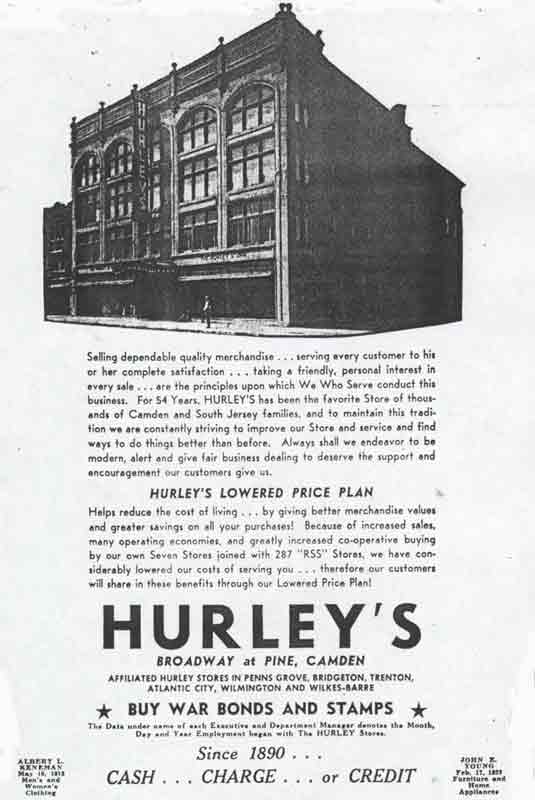
HURLEY'S - 1943 |
|
Hurley's store
brought luxury to Camden
By HAROLD T. NEDD
By Ron Karafin, Courier-Post
Hurley's store stood at Broadway and Pine in the 1940's and
50's. The retail stores that gave
Broadway in downtown Camden City its luster five decades ago can be
found in the pages of the biography of Chuck Doyle's grandfather.
The book on the life of
retail magnate William Leonard Hurley depicts a bustling shopping strip
near a Waterfront that in the 1940s spawned industries that had an
impact on the world.
And the two-story Hurley
department store at Broadway and Pine stood as a once-proud symbol of a
thriving industrial city.
"The store took up half
the block," said Doyle, 71, whose mother, Berenice, was one of
Hurley's four daughters. "It was a full-scale department store with
jewelry, appliances, rugs and beddings. And my grandfather was well
regarded as being a very honest business man."
Pedestrian traffic used to be
shoulder to shoulder along the corridor of shops and various ethnic
restaurants. Two large theaters with live performances from the likes of
Abbott and Costello helped draw shoppers to the strip. And the Hurley's
store was one of seven or eight department stores at the center of the
activity.
"I never saw an empty
store when I used to walk down there after school," said Robert
Doyle, 69, Chuck's younger brother who lives in Haddonfield. "It
was like what downtown Philly is today."
As industries like Campbell
Soup, the manufacturer of condensed canned soup, thrived, so did the
Hurley store, which one former customer described as a smaller version
of the now-defunct Lit Brothers department store in downtown
Philadelphia.
Chuck Doyle believes his
grandfather's success as a retailer in Camden hinged on two things: he
was the first merchant to introduce credit at his stores, sending
salesmen into the country with vanloads of merchandise to sell to women
who didn't have transportation to get to town.
And if there was
"anything wrong with something you bought from his store, you could
always return it and he would take care of it," said Doyle, a
retired salesman from Audubon who worked in the store growing up.
Marie DelRoccili, 66, of
Cherry Hill, remembers the store from the days growing up in the
neighborhood around 4th and Cherry Street, a less than five-minute walk
from the Hurley's store.
•"When we needed
something special...like an Easter outfit...that's where we went,"
said DelRoccili, referring to the many Friday night shopping outings
with her younger sister Rose Giuffre. "They (Hurley's) had a better
quality of merchandise."
•The store remained popular
until it closed in 1956. It succumbed to competition from larger stores
that moved to the suburbs, Doyle said. At the same time, the city's
economy was fizzling: companies like the shipyard shut down, jobs left
by the tens of thousands and despair moved into neighborhoods where
their employees once lived.
•The city's population
would drop from its peak of 125,000 in the 1950s to an estimated 87,000
today, marking an exodus to the suburbs.
• "A combination of
things eventually led to the store's demise," said Chuck Doyle.
"And while there was an attempt to get the store to the suburbs,
provisions weren't made within the family for succession. There was no
leadership left in the family." |