|
ARMY CHOW
The K Ration
Originally designed
for paratrooper, the "K" ration, largely because of its compactness and
light weight, came into general use in the infantry. A meal. Packed in its
brick-sized cardboard box, weighed only a pound. Twelve full rations,
i.e., 36 meal units, were packed in a wooden box, and the total weight was
only 50 pounds. Each meal included approximately four ounces of either
meat, meat and egg products, or cheese, together with biscuits,
confections, chewing gum, beverage, sugar, and cigarettes. Total calories
for the ration (I.e., three meals) was
2,830.
The dinner unit
(which really was less complex than the breakfast and supper units) was
packed by the Patton Company. Its principal component was a four-ounce
can- painted olive drab- containing "processed American cheese" which had
been prepared by one of the plants of the Kraft Cheese Company (general
offices in Chicago)- probably from milk from a middle western farm. On the
can was a small key for opening it, and packed with the can in its light
cardboard wrapping was a khaki-colored book of matches which was made by
the Diamond match Company of New York, A waxed waterproof bag contained
the bread component- two small packages of cellophane wrapped biscuits,
each containing four hard biscuits about an inch wide and three inches
long, one "K-3" Sunshine, and the other "K-14," Nabisco, of the National
Biscuit Company- and confection, beverage, and accessories. There was a
two-ounce box of vanilla caramels manufactured by E.J. Brach & Sons,
Chicago. There was a package of lemon juice powder prepared by Henry
Heide, Inc, New York. Then there was a cardboard box containing 23 grams
of granulated sugar which had been packaged by the Patton Company.; there
was a package of four Chesterfield cigarettes, and one stick of Beech-Nut,
peppermint flavored, chewing gum. All of this was fit snugly into a heavy,
wax-covered cardboard package.
If the final
recipient paused to look at his small packaged dinner before opening it,
he might have read on the outside:
RATION, TYPE
K
DINNER UNIT
Open
inner bag carefully. It may be used as a water-proof container for
matches, cigarettes, etc.
For security, do not discard the empty can,
paper, or refuse where it can be seen from the air. If possible, cover
with dirt, foliage, sand, etc.
Turning the box
over the soldier would have read the
contents:
|
2- Package Biscuits (Energy Crackers).
1- Can cheese. Should be eaten cold.
1- Envelope- Lemonade or orange Powder:
Add contents to 2/3 canteen cup of
cold
Or hot water with sugar to taste, and stir
well.
1- Package of granulated Sugar.
1- Package of 4 Cigarettes.
1- Book of 10 Matches.
1- Package of Candy.
1- Piece of Chewing Gum.
|
 |
|
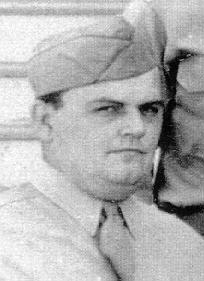
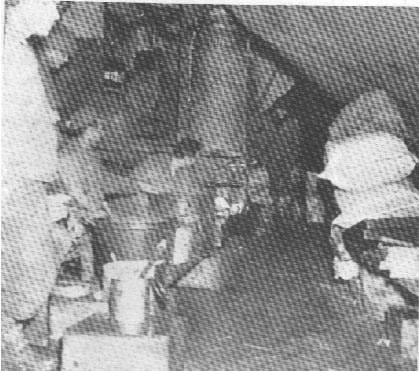
Company A Mess
Sergeant
Sgt.
Cyril Tworek |
|
|
Left to
Right:
Warren Schladenhauffen, Cyril Tworek, John Fetzer, Donnell
Patrick,
unknown entering tent |
C RATIONS
by John H.
Lienhard
Tuesday, 1954, Fort
Monmouth, New Jersey. Four of us set out for a German restaurant in nearby
Long Branch. We called this our Eine Kleine Knockwurst evening. Each
Tuesday the Army served C rations in the mess hall. Each Tuesday we went
off to buy our own supper. For who would be caught dead eating C Rations?
C rations consisted of canned meat and vegetables, packed in
preservatives, along with hard biscuits. Your stomach soon began to seize
up at the sight of those olive drab cans. C rations provided 3800 calories
a day in battle conditions when it wasn't possible to set up a mess hall.
The army had to keep an inventory of the stuff, and its shelf-life was
limited. So at the end of that shelf life, the troops either ate it or let
it cycle into the trash bin while they hitch-hiked into town for real
food.
Barbara Moran tells
how the problem of feeding troops in the field has haunted armies. Civil
War soldiers carried a water-and-flour biscuit called hardtack, and they
constantly suffered scurvy. The Army introduced the C ration, or combat
ration, in 1938. At first, a day's portion added almost six pounds to
soldiers' packs. They took an immediate dislike to its taste.
Then more problems arose:
the cans would rust. Labels would fall off, leaving one to guess what each
can held. The army came out with an improved C ration -- somewhat lighter
-- in 1944, but it still had to fight off a lingering unsavory reputation.
Meanwhile, the Army set out
to create a lighter field ration. What they got was even less appetizing,
but better in combat situations. In 1942 a physiologist named Keys
pioneered the K ration. Whether or not the K reflected Keys's name, we
don't know. But the lemonade powder in the K ration was so acidic that it
was reported to work better as a floor cleaner than as a drink. I don't
recall ever having eaten a K ration myself.
Feeding an Army is a
terrible challenge. Problems of weight and packaging are vastly magnified
on a battlefield. Grocery stores supply food to kitchens: combat rations
have to be ready for use in an open field. Cafeterias feed hundreds:
armies feed thousands. It's no wonder that, when I was a soldier, we would
sing the song,
Oh the coffee in
the Army,
They say it's simply fine.
It's good for cuts and
bruises,
And it tastes like iodine.
Moran, B.,
Dinner Goes to War: The Long Battle for Edible Combat Rations is Finally
Being Won. American Heritage of Invention & Technology, Summer 1998,
Vol. 14, No. 1, pp. 10
   |