|
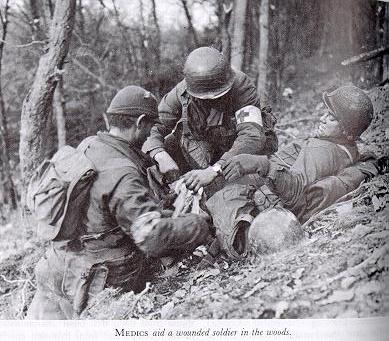
Company A of the 110th Medical
Battalion was the collecting company for the 134th Infantry Regiment, 35th
Infantry Division. Companies B & C serviced the 137th & 320th
regiments, while Company D was the Clearing Company, serving the entire
division. The worst day of the war for Company A may very well have been
July 30, 1944. Known to those who fought there as "BLOODY SUNDAY", two of
Company A lost their lives that day in the line of duty. They were Private
Joseph Toth of Alpha NJ, and PFC Chester Zaleski, of Sayreville NJ. In
addition, several other members of Company A were wounded that day.
The fighting around Torigni-sur-Vire
on
JULY 30, 1944 will forever be known as
BLOODY SUNDAY
excerpted
from BIOGRAPHY OF A BATTALION by James A. Huston
Courier Press, Gering NE 1950
The companies jumped off at 9
o'clock, but the German withdrawal pattern had been altered: there were
immediate bursts of hostile fire all along the line. The enemy added
artillery to his small arms fire. What made the situation immediately
worse was the relative compactness of the Battalion's formation. It had
not even had an opportunity to deploy fully from its compact wagon-wheel
formation which it had taken up for night security. This meant that the
Battalion CP was only about one hedgerow in rear of the frontline, and
the aid station and other headquarters personnel were only the distance of
a small orchard to the left rear- across the road. Nearly the whole
Battalion, therefore, was under fire when any great volume was directed
against it.
An hour and
a half later the situation had not improved. "K" and "L" Companies unable
to advance, Colonel Thomsen sent Company "I" around to attack on the left
of "L"; but there was no flank and "I" was under fire before it even came
abreast. All companies were suffering casualties, and were gaining
nothing. Artillery fire had cut telephone lines, and communications
between Battalion and Regiment broke.
At
the Battalion CP the medics were busy. A litter team was lifting the
battalion clerk from his foxhole onto their litter; he had painful wounds
in his arm and thigh. Someone lit a cigarette for him, and he thanked them
cheerfully as he was carried away. Lieutenant Garner was hit- wounded
seriously. A company runner, eyes closed, sat stiffly in a fox hole where
a shell had killed him. The tank officer who had come up to coordinate was
in a hole nearby, and he got hit; Captain Carroll had gone up to see
Colonel Thomsen, and the S-2 had gone back to regimental headquarters;
Pfc. Johnson was the only one there who did not get hit.
Meanwhile
the companies were trying hard to advance. Company K was still on the
right, and trying to make the next hedgerow. Technical Sergeant Paul
Forney of Nebraska, platoon sergeant, had found himself in command
of his platoon where the lieutenant had been hit. He led the platoon out
across the orchard toward the next hedgerow. Moving through enemy fire,
Forney was wounded; but he kept right on going to throw his hand grenades
over the next hedgerow. He rallied his men to continue the assault, but
the next burst of fire killed
him.
Pfc. Edward
Abraham of Ohio was a little more fortunate. When his platoon was pinned
down by an enemy machine gun, but he leaped over the hedgerow, and
although wounded, crawled down near the German gun and destroyed the crew
with a hand grenade.
Four
automatic riflemen were wounded in quick succession at vital position
protecting the left flank of Company L's 2nd Platoon. Immediately Pfc.
Luverne Stroud of Minnesota, and Robert Hanlon of Washington D.C., ran up
to take over a BAR. They opened fire, and kept the weapon going until a
direct hit from an enemy mortar killed both of them.
Over in Company I one platoon had been able to drive a short gain, but
heavy fire from front and flank forced it to give this up. Technical
Sergeant Leonard Osiek of Ohio, the platoon sergeant, grabbed a light
machine gun to cover the withdrawal of his platoon. He remained in
position until all the members of his platoon had taken cover behind the
hedgerow to the rear. Then, firing the machine gun from his hip, he walked
backwards until he reached the hedgerow. But as he started to climb over,
enemy fire killed him.
Colonel
Thomsen was becoming worried over the battalion's situation. Tanks were
coming up; they were able to cross the railroad over a grade crossing
about a half mile to the west of the knocked out overpass, but the sunken
road which ran parallel to the railroad was too narrow for them in some
places , and there it was necessary for pioneer demolition crews to blast
openings in the hedgerow. All of this was taking time, and in the meantime
the accurate enemy fire was sapping the Battalion's strength. The
battalion commander was hoping that Colonel Miltonberger would commit the
Second Battalion which was being held in regimental reserve. To this
Colonel Miltonberger readily agreed when he saw the gravity of the
situation. However, the commander of the 2nd battalion had been wounded in
the previous night's bombing attack, and now the executive officer was
near nervous exhaustion; it was not until Captain Carroll, after repeated
trips, got hold of the S-3, Captain Frederick Roecker, a young West
Pointer from Washington, that he was able to get any action.
A
long whistle announced the approach of another shell. It burst on a barn.
Splinters of wood, timber fragments, smoke and dust rose high into the
air. Members of the pioneer platoon came running out of the old building;
several were injured- Lieutenant Hall had a gash in his hand. Already
motor personnel, Pioneers, and others, had been pressed into service to
deliver supplies of ammunition to the companies.
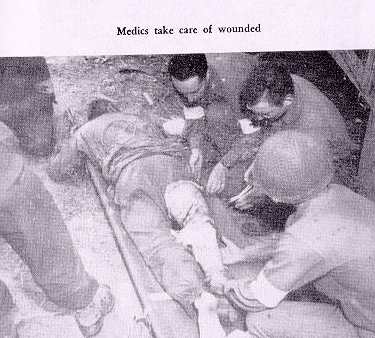
The
battalion medical section was having its busiest day at the aid station
which was in a small building about a hundred yards off the road to the
immediate left. Now a barrage hit the aid station. One man was holding out
his hand having a finger bandaged; a big shell fragment took off the hand.
Wounded men lying helplessly on the floor were wounded a second and a
third time; medics were wounded so that they could not care for them.
Captain Matthew decided he must move the aid station back. The assistant
surgeon gathered up the party and started down the road while Matthew
jumped in his jeep and went on down the road to find another site. A pathetic group it was that
emerged from the damaged building and filed out onto the road. Bloody
bandages fluttering from arms or heads or shoulders ... wounded medics
carrying men on litters ...everyone in a hurry, but no one could run ...
out to the road to join a stream of God-forsaken human beings ... The
walking wounded from the Pioneer platoon, and additional ones coming from
the companies, added their number to the battered column... French
civilians from the little hamlet- the ones who had been so gay the night
before- now added to the general confusion by coming out onto the road
pulling carts stacked high with bedclothes, utensils, what foodstuffs they
might have. They all trudged down the dusty road in the hot sun towards
the railroad. Matthew set up his aid station in an orchard along the
tracks.
It
took some time to get any of 2nd battalion started up, but presently
Captain McDaniel approached the area of the battalion CP with Company E.
But another barrage was on the way. Tree bursts sent leaves and boughs
fluttering to the ground, and sent steel fragments about the men below.
Torn bodies writhes on the ground. A man cried out in a loud voice, "Oh,
Jesus, someone help me!" And then he died. An "M" company mortar crew was
knocked out on the other side of the hedgerow to the right. Other shells
hit on top of the hedgerow and on the ground beside it- they cut down that
column of men.
It
was nearing 5 o'clock now, and Colonel Thomsen was worried about the
situation. He chafed at being unable to advance; he was impatient that
neither the tanks nor the 2nd Battalion had been able to give any
assistance and he was concerned about the loss of men. There had been
nearly a hundred casualties so far during the day. Captain Lassiter of
Company L had been seriously wounded, and so had First Sergeant Benjamin
Miller. Colonel Thomsen was standing behind a tree in the sunken trail. A
barrage burst among the trees to scatter its lethal fragments on the
sunken trail. Nearly everyone in the command group had been hit. Colonel
Thomsen was wounded, Lt. Davis, "K" Company executive, was hit. Captain
Bruce, the adjutant, had been knocked out by a shell farther to the rear.
Captain
Carroll went up to take over. Medics were at work quickly, but they had a
big job on their hands. Colonel Thomsen was unconscious from a wound in
his head; the liaison radio had been destroyed, and all the members of the
liaison group wounded. Drew, the Battalion Sergeant major, had been
killed. The intelligence sergeant was wounded; but when the medics came
for him he refused to be evacuated until all the other wounded men had
been cared for. Then while he was being carried to safety some minutes
later, another shell came into end his life and those of the men carrying
him.
With
the approach of dusk, the regimental commander ordered the 2nd Battalion
to relieve the Third to give the latter an opportunity for reorganization.
Throughout
the day the battalion had been receiving shell fire from time to time from
the rear. The men could hear the report of the gun distinctly and the
shells would come ripping through with deadly effect. Immediately they had accused friendly artillery, but later investigation showed
this not to be the case. They concluded that there was an enemy mobile gun
somewhere in the rear area.
It
was dark before the relieving companies started up, and it was a slow
process. Elements of the Third Battalion's companies had become
intermingled during the heavy fighting, and it was a task to get the
platoons reorganized so they could move out in an orderly fashion. And any
intimation to the enemy that a relief of battalions was going on would
have invited disaster. Lt. Ruby had taken the available members of Company M as well as much of Headquarters Company to act as guides. At
last members of Company I came back to the vicinity of the farm houses,
formed a column, and set off down the muddy sunken trail and turn-ed into
the dry gravel road.
The night was
calm and clear- with a partial moon, and it was cool as always. Carroll
and the S-2 waited another hour- "sweating out" "Bed-check Charlie";
fortunately, they received word that there would be friendly
night-fighters up, and "Charlie" missed a call. Presently the
sticking, slippery sound of feet upon mud told them that Company L was
coming out. It was well after 5 A.M. before all the Battalion was
back in the assembly area.
Lieutenant Colonel
Sheppard, regimental executive officer, was sitting by a lamp in a dugout;
he was to remain with the battalion until its new commander arrived.
Members of the earlier companies were already asleep when the later ones
started digging their foxholes. Some men had to be sent up to outpost the
gap between the First and Second Battalions. Everyone was physically and
mentally exhausted. Men had seen about 115 casualties leave the Battalion
during the day; they were wondering when their turn would be- percentages
looked well enough when the figures were dealing with the whole Army, for
most of the Army does not fight, but in the fighting elements of an
infantry battalion they began to see that they had no odds in their favor.
It was becoming a question not if they were going to get hit, but when,
and how badly. Would he be one of the lucky ones, or would he be killed or
permanently maimed? During these two weeks of combat the Battalion had
suffered 574 casualties- 86 were wounded fatally.
Colonel Thomsen later
died of wounds received in this
action. |