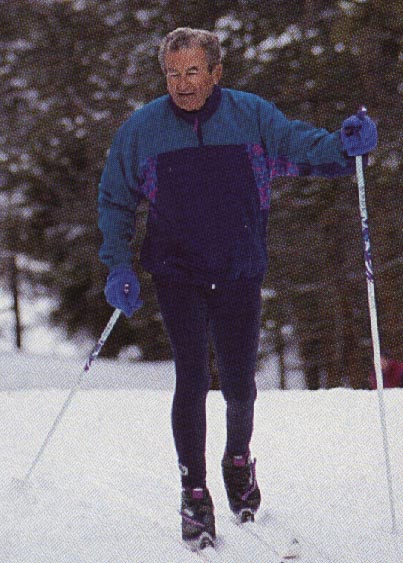
Originally a 4.91 megabyte file, in MP3 format, of Dr. Frederick Webster,
recounting some his more interesting experiences while commanding Company A of
the 110th Medical Battalion, I have broken this up into 9 smaller files, to
speed up downloading time.
Dr. Frederick Webster commanded Company A from June 11, 1944 until March of
1945, when he was seriously wounded. These recordings total approximately
30 minutes in length. Please excuse the sound quality on the recordings. You
can click to download and then listen to these stories. They are for the most
part in MP3
format.
To download the entire full length file, click here: CAPTAIN WEBSTER'S
STORIES
Shortly
after landing in France, it was determined by 110th Medical Battalion commander
Col. Millard Hall that the Collecting Companies should be commanded by men who
were younger and physically active.
Known to his men as "Fearless Freddie", Dr. Webster was extremely
active to say the least, spending a great amount of time on the lines and in
harms way. Although medical personnel were officially non-combatants, they took
a great amount of casualties, as has been mentioned elsewhere.
Cpl. Bert Pratt, Company A, 100th Medical
Battalion:
"This
is the article I wrote about our C.O. Captain Webster in
1944.
"‘Just
a word about our C.O. Words can't describe his ability to cope with any situation. His medical talents are being wasted. In war, his chief
contribution is his reconnaissance work. He belongs with a reckon group or
the infantry. He spends his time on the front lines... Sometimes looking
for aid station locations or for buildings for his men. He brings back
wines, champagne, etc. He looks around for comfortable places... not too
dangerous, yet in the right spot. He once dressed as a Frenchman to look
over a bridge. He saw Germans nearby and saw a mortar crew in action. When
our outfit was cut off with sixty casualties, he led the men in and
supervised the rescue of the wounded. For the rescue of those sixty three
men, Capt. Webster was awarded the Bronze Star. He is young and is a C.O.
that could fit into any unit. He once gave a good set of O.D.'s to a man
who had gotten soaked. He takes his turn on night duty when ever he
happens to be in the area. How he stands it is a question. He has already
worn out several drivers. We hope he doesn't get yanked out by some higher
up
command.'"
On March 7th, 1945, Captain Webster and Captain Everett Hornberger were severely
wounded by German artillery. Both men were evacuated and saw no further action.
Captain Webster lost a foot, and spent considerable time in military hospitals
rehabilitating. Dr. Webster has not let this interfere with his post-war
activities. He went on to a long and distinguished career as an orthopedic
surgeon. Currently retired and living in Colorado, Dr. Webster up until very
recently was involved in competitive cross country and alpine skiing, and in 2001
took first prize at the National Senior Games Archery Tournament in his age
group, setting a record while doing it. He has won many medals
during his involvement in competitive sports. He continues to
enjoy hunting, fishing, and the outdoors.
retired and living in Colorado, Dr. Webster up until very
recently was involved in competitive cross country and alpine skiing, and in 2001
took first prize at the National Senior Games Archery Tournament in his age
group, setting a record while doing it. He has won many medals
during his involvement in competitive sports. He continues to
enjoy hunting, fishing, and the outdoors.
When Dr. Webster was transferred to Company A, it's previous leader, Dr. Everett
Brillhart was transferred to the Clearing Company, where he served admirably. Master Sgt. Ferdinand Brodfuehrer,
the ranking NCO in the 110th Medical Battalion often commented to his son
Richard about Dr. Brillhart's service:
"Although I don't recall any specific stories, my dad often
mentioned the marvelous work done by doctors like Everett Brillhart under
impossible conditions. He said 'Those GPs did things in a tent to save
boy's lives that civilian specialists wouldn't have tried in a hospital.'
"
- Richard
Brodfuehrer
 |
|
FRED WEBSTER DECEMBER 2001 |