
`The Log of a Sea-Waif`, written in 1899, describes life aboard a merchant vessel in the 1870s
Many boys clamour for a sea life, will not settle down to anything ashore, in spite of the pleadings of parents, the warnings of wisdom, or the doleful experiences of friends. Occasionally at schools there breaks out a sort of `epidemic` of going to sea for which there is no proximate cause, but which rages fiercly for a time, carrying off such high-spirited youths as can prevail upon those responsible for them to to agree to their making a trial of a seafaring life. Many a parent, whose affectionate projects for the future of his offspring are thus rudely shattered, bitterly resents what he considers unaccountable folly.
In my own cas matters were quite otherwise. I belonged to the ignoble company of the unwanted. In spite of hard usage, scanty food and overwork, I ridiculously persisted in living, until, at the approach of my twelfth year, an eligible opening presented itself for me to go to sea. Being under no illusions whatever as to the prospect that awaited me, since I had known intimately those who had experienced all the vicissitudes of a sailor`s life, I was not unduly elated at the idea. Nevertheless, food and shelter were objects peculiarly hard to find ashore, while I felt satisfied that at sea these necessaries would always be provided, even if their quality was none of the best.
The vessel in which I obtained a berth as cabin-boy was commanded by my uncle: a stubborn, surly, but thoroughly capable, old seaman. Soured by misfortune and cross-grained by nature, it was small wonder that he had no friends, not even the sterling honesty of his character, or his high ability being sufficient to counter-balance the drawback of his atrocious temper. His latest command was not calculated to improve him, for she was a survival of a bygone day, clumsy as a Dutch galliot, impoverished by her owner, who was heartily sick of seeing her afloat, and would have rejoiced to hear that she was missing; and withal as leaky as a basket.
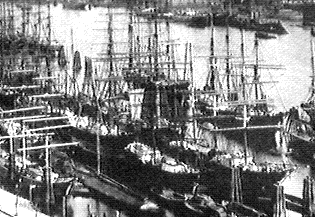
When I saw her huddled into a more than usually dirty corner of the West India Docks, I was filled with wonder to see that her cutwater was sunken between two swelling bows like the cheeks of a conventional cherub. Although I could be no critic of marine construction, this appeared to be an anomaly for which there appeared to be no excuse. Her bowsprit and jibboom soured into the air exactly like those of the galleons of old and her three skimpy masts stood like broomsticks at different angles - the foremast especially, which looked over the bows.
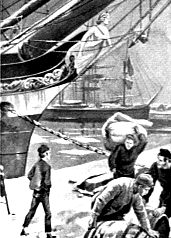
It was a bleak, gloomy day in January when I first beheld her. The snow, which had fallen heavily for some days previously, was, wherever it could be, churned into filthy slush, and where undisturbed, was begrimed more into the similitude of soot-heaps than anything else.
Climbing on deck, I found such a state of confusion and dirt reigning as I could hardly have believed possible. Owing to the parsimony of the owner, not even a watchman had been kept on board, and, in consequence, the decks had not smelt a broom for a month. The cargo and stores were littered about so that progress was gymnastic, while in every corner and hollow lay the snow. Several discontented- looking men were engaged aloft in bending sails, others were gradually coaxing the cargo on deck into the hold, but no one seemed to have any energy left. Seated upon an upturned beef-cask was a truculent looking individual whom I instinctively regarded as the boss. Him, therfore, I timidly approached. Upon hearing my message he rolled off his throne and led the way aft, uttering all the time some, to me, perfectly unintelligible sounds. I made no pretence of answering so I suppose he took me for a poor idiot hardly worthy of his attention. When, after some effort, he disappeared down the cabin companion, I was close behind him, and, understanding his gestures better than his speech, made out that here was to be the scene of my future labours.
The place was so gloomy that I could distinguish none of its features by sight; but the atmosphere, a rank compound of the reek of bilgewater, mouldering stores, and unventilated sleeping spaces, caught me by the throat, making my head swim and a lump rise in my chest. A small locker by the ladder`s foot, reminding me curiously of a rabbit-hutch, was pointed out to me as my berth, but I naturally supposed it to be a place for my bag. How could I have dreamed that it was also to be my chamber? But everything began to reel with me, so, blindly clutching the ladder, I struggled on deck again, where the bitter wind soon revived me.
Henceforth no one noticed me so I roamed around the deck, pryoing int holes and corners, until the stevedores knocked off for dinner. Presently the mate came towards where I sat, shivering and solitary, on the windlass end, and made me understand that I was to come ashore with him. He conducted me through a labyrinth of mean streets to a spacious building in a wide thoroughfare, around which were congregated many little groups of seamen of all nations. We entered the place at once, and soon reached a large bare room crowded with seamen. Here I was told to wait while the mate, Mr Svenson, went to seek the captain. While I stood bewildered by the bustle of the crowded place, I heard occasional hoarse demands for "Three A.B.s an` one ordinary for Pernambuck!" "Cook and stooard for Kingston, Jamaica!" "All the croo of the Star o` Peace!" and similar calls, each followed by a general rush towards the speaker, accompanied by a rustling of discharges in the air as their owners sought to attract attention.
After about an hour`s wait I heard the cry "Croo of the Arabella here!" which was followed by the usual rush; but to the disappointment of the watchers the whole of the crew had already been selected. One by one they squeezed through the crowd into the office beyond, wither I managed to follow. I was too much amazed by the hurly-burly to notice who were to be my fellow shipmates, but I paid a sort of awestruck attention to the reading of the "articles". Doubtless much excuse must be made for the officials who have to gabble the same old rigmarole over so many times each working day; but I certainly think that the essential part of the agreement should be made clear to men who were about to bind themselves for a long period to abide by it. In our case the only words clearly accented, heard, and understood by all, were the last three, "no spirits allowed". Each man signed or made his mark, ending with my self, when I found that I was entitled to receive five shillings a month, without any half pay or advance. Each of the men received a month`s advance in the form of a promissory note, payable three days after the ship left the Downs at the entrance to the English Channel, "providing said seaman sails in said ship". None of them lost any time in getting away to seek some accomodating(?) shark to cash their notes at an average discount of about 40%, most of the proceeds being in kind.
This important preliminary over, I was free till net morning, when all hands were ordered on board by 10 o`clock. Not feeling at all desirous of returning to the ship, yet being peniless, and in a strange part of London, I made my way westward to the Strand, where I soon managed to pick up enough for a meal. I spent the night in Hyde Park in a snug corner, unknown to the police, which had often served me as a refuge before. At daybreak I started east, arriving on board about half past nine. The mate eyed me suspiciously, saying something which I guessed to be uncomplimentary. As before he did not interfere with me or set me a task.
The litter of cases, bales, etc. about the deck was fast disappearing while the raffle of gear aloft was reduced to as near as a approach to orderly arrangement as it could ever be expected to assume. Presently a grimy little paddle-steamer came alongside, through the clustering swarm of barges, and was made fast, ahead and astern. An individual with a stentorian voice, a pilot suit, mangy fur cap, and a brick-red face mounted the forecastle, bellowing out orders apparently addressed to no one in particular. Their effect was at once evident, however, because we began to move deliberately away from the warf, splitting the crowd of barges assunder amid the sulphurous remarks of their attendants. Once out ito the clear centre of the dock we made good progress until the last lock was reached; there we came to a full stop. As yet none of the crew had arrived, the vessel being handled by the shore-gang so far. After a quarter of an hour`s delay during which time the captain and the pilot exhausted their vocabulary, the crew hove in sight, convoyed by a motley crowd of tailor`s "runners", boarding-house masters and frowsy looking women.
They made a funny little group. The sailors were in that happy state when nothing matters - least of all the discounter of and advance-note; hence the bodyguard of interested watchers, who would leave no stone unturned to see that their debtors went in the ship, although, being under the vigilant eye of the police, they dare not resort to violent means. The ladies, possessing but a fast-fading interest in the outward bounders, were probably in evidence more from slackness of business than any more sentimental cause. Having cajoled or coerced Jack to the pierhead, he seemed unpersuadable to the final step of getting aboard. Again and again a sailor would break loose and canter waveringly shorward, only to be surrounded by his escort and hauled back again. At last the skipper sprang ashore followed by the pilot and seizing the maudlin mariners, hurled them on board as if they were made of rubber. Their "dunnage" was flung after them, the warps were laet go and the ship began to move ahead.
Outside the dock-gate a larger tug was waiting in readiness to hook on as soon as we emerged, and tow us down the river. With a final shove, accompanied by a stifling belch of gresy smoke, our sooty satelite shook herself free of us, retreating hastily within the basin again. The shore-gang worked hard to get the decks clear for sea , but their efforts were greatly hindered by the crew who, not being sufficiently drunk to lie still in the forecastle, persisted in tumbling about the decks, offering assistance while getting in everone`s way. I grew weary of standing about and was grateful when Chips, the carpenter who was also second mate, ordered me to fetch him a marlinspike. I had not the faintest idea what he wanted but ran forward and asked a labourer. He told me it was a pointed bar of iron with a hole in one end, adding that I would find some in the fo`lk`sle, "right forrard in the eyes of her". Away I went into the thick darkness of the men`s dirty cave, groping my way into its innermost recesses among the bags, chests and beds with which the deck was bestrown. Reaching the farthest corner I felt a great bundle of something on what I took for a shelf. Tugging at it I suddenly felt it move! I did not wait but floundered back on deck and reported my discovery to Chips. He brought a light and sure enough there was a sea-bag about six feet long, stuffed full - the drawstring tightly closing the mouth. As soon as it was touched there was a movement within. Its contents were obviously alive. They dragged the bag on deck and turned it bottom upwards. Out there tumbled, head formost, a lanky black lad, who had been missing since the previous morning and given up as having deserted. He humbly explained that, despairing of ever getting warm again, he had put on his entire wardrobe, lain down in his bunk and crept into his bag, managing somehow to draw the string tight over his head. He had been there ever since and was likely to have died there, since he could not get his arms up again to let himself out.
Upon arrival at Gravesend we anchored; the tremendous racket made by the cable rushing over the windlass giving me a great fright. I thought that the bottom of the ship had fallen out. Here the pilot and the shore-gang left us in a wherry. Although I had not a single soul ashore to regret me, there was sufficient sadness in the thought of leaving the land of my birth to bring to my eyes a few unaccustomed tears.
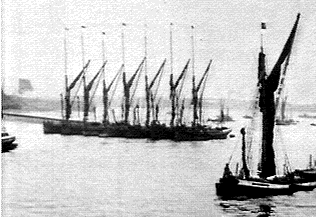
Fortunately the cook, a worn-out seaman, was now sober enough to get supper ready. My regular duties now began; the captain, my uncle, giving me the first lesson in laying the table sea-fashion. The atmosphere below had appreciably improved , but still there was a prismatic halo round the swinging lamp. The captain and his two officers took no notice of it though I got a racking headache. Supper over I was ordered to "Clear away the wreck", and get my own supper in the pantry, a sort of little ease in a corner of the cuddy. Hungry as I was I could not eat there and as soon as the skipper had retired I fled forward to the galley with the cook. His domain consisted of an erection about six foot square, with sliding doors on either side, which was lashed firmly down to ring-bolts in the deck. A coal locker ran across it at the back, its lid forming a seat. Between it and the stove there was just room to turn. Here by the dim flicker of a lamp like a handleless teapot I spent a pleasant hour with the ancient mariner eating a hearty supper of biscuit and tea. At last, feeling I might be wanted, I returned to the cabin where I found the captain and Chips making melody with their snores. Mr Svensen was on deck keeping watch, for which none of the crew were yet available. I made such a lair as a dog might in the hutch that held my scanty stock of clothing and was soon in the land of perfect peace.
continued................