
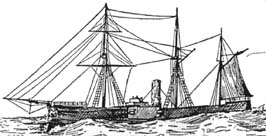
| HMS. SERPENT was a twin-screw third-class cruiser, laid down at Devonport in November 1885 and launched on 10 March 1887.
|
In 1888 and 1889 SERPENT had only been commissioned for the annual manoeuvers before returning to the Reserve, but on 24 June 1890 she was commissioned by Cdr. Harry L. Ross for service on the Cape of Good Hope and West Coast of Africa Station. His officers were:- Lieuts. Guy Greville (navigating), Peter Richards and Torquill Macleod. She sailed from Plymouth on Saturday 8 November.During the night of Monday 9th three seamen from SERPENT, were cast up on a rocky shore, exhausted, bruised and bleeding. They must have walked several miles because the morning was well advanced before they reached a remote and impoverished Spanish town where they were treated with great kindness. The whole town was roused and hundreds hurried along the coast to where wreckage was coming ashore. No trace could be found of other survivors and by the following morning nothing could be seen of SERPENT. On Wednesday 12 November a despatch reached Madrid that a British man-of-war SERPENT had been wrecked on the previous Monday night near the small coast town of Camarinas in the old Spanish province of Galicia with the loss of 147 of the officers and crew. By 7 o`clock on Thursday morning rumours of the loss had reached Plymouth and Admiralty House and Devonport Dockyard gates were besieged by relatives and friends anxious to learn if any news had been received by the Admiralty. Early in the afternoon a special edition of the local newspaper, The Western Morning News, gave some details of the wreck but no confirmation came from the Admiralty, leading the poor people waiting at the gates to hope that their men might have been saved.
Officials who had started out for Camarinas along mountainous roads and mule tracks on Wednesday, returned to Corunna on Saturday afternoon and the steam gun vessel HMS LAPWING which had arrived at Corunna on the Friday morning sailed with the first and second officers of HMS TYNE to recover bodies and look after salvage. She returned on Sunday evening with the three survivors and the news that thirty bodies had already been recovered by the Spaniards and buried in the graveyard near the remains of the crew of a British steamer wrecked in the bay two years previously. The bodies of Cdr. Ross and two unidentified officers were found on Friday and by the evening 50 bodies had been found and interred.
Telegrams arrived in Plymouth throughout the weekend giving more details based on the survivor`s stories and large crowds read them as they were posted outside the newspaper offices. The weather had been thick off Camarinas on Monday night and although no actual gale was raging there was a heavy sea. SERPENT was steering a course which should have taken her well clear of Cape Villano but, partly due to compass defects, she was more than ten miles off course and was virtually doomed by the time she entered Punta Bay north of Cape Villano, a place littered with rocks, some submerged, others as much as 100ft above low water. The officers were on the bridge and six men were on watch when she struck Boy Rock going at a speed of eight or nine knots, ripping the hull as far back as the first coal bunkers. She remained impaled on the rock for a short time as the waves drove her forward foot by foot and swept over the deck. The men who had not been drowned in their bunks rushed for the deck and a large boat was launched but it was almost immediately smashed to pieces and all the people in it perished. It was impossible to launch any other boats so the remaining men were ordered into the rigging where, for the time being, they were comparitively safe. But, within a short time SERPENT was beaten off, slid into deeper water and foundered.
The three survivors owed their lives to the fact that they had been told off as a boat`s crew and had donned life jackets. They were:-
Onesipherous Luxton, who was known to his shipmates as `Oney`. He came from Topsham near Exeter. With other men he was swept away by the swell and succeeded in gaining the rock, but he was the only one who could hold out against the force of the seas and reached the shore in an almost lifeless condition, badly wounded in the legs, having had a large piece of flesh torn out.
Benjamin Burton from Birmingham, was an able seaman who had been drafted from the Naval Barracks. A wave threw him ashore close to Luxton and together they looked back on a shapless mass of men struggling for life and being hurled against each other and the rocks by the great seas.
Frederick Joseph Gould, 26, from Plymouth, had been drafted as a leading seaman gunner but, on joining SERPENT, had been promoted to second-class petty officer. He had been in the service for twelve years and had two brothers in the navy. He was in the water longer than the other two, but he was a powerful swimmer and fought the waves until he was eventually flung, nearly naked on the beach.
The following morning the bodies of sailors with cork jackets were seen floating on the water. All were badly disfigured and some were headless trunks. The three men met at a coastguard hut where they found some men who were looking after the cargo of the British steamer TUNBRIDGE which had been wrecked a few month`s earlier. Luxton was given shelter by the parish priest of the village of Janina and some labourers gave him bread. Only one boat was cast ashore in a fairly sound condition, the rest were smashed to pieces.
Most of the crew came from the Plymouth area. A fortunate few had been drafted to the SERPENT but circumstances prevented their sailing. A marine named Crispin deserted in July and a 2nd class stoker named Witburn broke his leave. Both were still at large when the ship sailed.
John Butters, able seaman, and Thomas Viant, stoker, had been sentenced to eighty-eight and thirty-one days respectively in Bodmin Jail on 7 November.
Several men, John Dwyer, Boatswain, 2nd class stoker Leah, and stoker Freathy among them, were invalided and their places taken by others.
Other men were not so lucky. A stoker named Niles had been brought before the Devonport Magistrates the previous week on a charge of resisting the police who had taken his sister into custody for disorderly conduct. He was fined 10 shillings and desired to go to prison rather than pay the fine. This was not allowed and he embarked in the SERPENT.
Mr Pengelly, an engine room artificer from Devonport, was trying to purchase his discharge from the Navy and the money was actually in the hands of the proper officials when he sailed.
A Stoker named John Thomson finished his 30 day`s jail sentence at the end of October, just in time to rejoin his ship.No time was lost in setting up appeals to provide funds for the immediate relief of the distress caused by the large number of fatalities. The Duke of Edinburgh was informed by the Admiralty that parents and relatives who were dependant on their allotments from pay would get relief from the public funds and widows would receive the usual pensions from the Greenwich Hospital Funds. The Soldier`s and Sailor`s Family Association, which had been in existence for some years, said that they had sufficient funds to relieve immediate poverty and that they could administer any money raised by public subscription.
The verdict of the Court of Enquiry was that SERPENT had been lost through an error in navigation.
© 1999 Michael Phillips.
Go to Maritime History