
The Six Long Years
Extracts from "The Six Long Years", which is the naval autobiography of
George John Sallet. Past Commander of The Pearl Harbor Attack
Veterans and Chairman of Operation Return 1961, the 20th anniversary
of the attack. George now lives in Clearwater, FL. with his wife who
comes from Plymouth, England.
George Sallet served aboard the destroyer USS Bagley, DD386, between
June 1941 and June 1946 in the Pacific. I found his first-hand
account of these years completely absorbing and I am only sorry that
no publisher has seen fit to print it. In compiling these extracts I
have done a little editing just to condense the text. At the time of this
first extract he was 19 years old.
Part 1. 1941 - The Attack on Pearl Harbor
Nov.28 We are screening the battleships Arizona, Oklahoma and Nevada, taking station ahead of them in column.
Nov.29 For some reason Nevada needs to return to Pearl, we joke that her power cord is not long enough as we are selected to screen her back to the harbor entrance. It is about midnight when we return to the group, now activly shooting at each other with searchlights.
Dec.1 The group is off the Island of Molokai this morning as aircraft towing sleeve targets continue overhead all day. We on the guns must track the sleeve simulating gun-fire. Our gun crews go to the loading machine while this is going on.
Dec.2 Seas are getting rough. Today we fire 50cal machine guns at drone aircraft. Destroyers and cruisers in column all fire their machine guns as it flies off the island at about 500 feet. It passes between Bagley and Patterson ahead, from port to starboard. The guns on the starboard side open up and still it is flying. We razz the pants off our machine gun crews during meal breaks. The storm worsens.
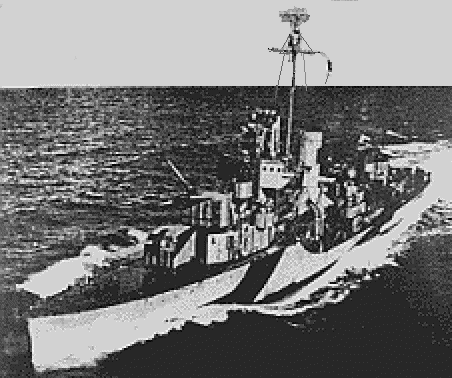
USS BAGLEY DD-386
Dec.3 Bagley pulls out of formation with a flapping section of bilge keel. The group continues maneuvering and we limp along at reduced speed towards Pearl Harbor.
Dec.4 We tie up with sister destroyer at Buoy X-7. Underwater team find a good 15 feet of keel torn loose.
Dec.5 All morning long task force #3, a Carrier, Destroyer and Cruiser group, is heading out of harbor.
Dec.6 At 0800 we shifted berth to Navy Yard B-22. Our stern is to cruisers Honolulu and St. Louis. I take a late liberty and walk over to the Botanical Gardens. Tomorrow afternoon I plan to go to the Submarine Base Commissary Store and buy a camera and take some 35mm color shots of the fantastic floral displays.
Dec.7 I got my morning call about 6am, went up to early chow, picked
up my whites and went below for my shaving kit. I went back to the
washroom, shaved and went back down to my locker. Suddenly there was
a terrific rumbling sound being transmitted through the water that
vibrated my feet a bit. I thought there must be some underwater
demolitions going on in the Yard.
Our 50cal machine guns aft opened fire. I ran to the port ladder
and looked out the hatchway to see what was going on. As the shell
cases were pinging down on the deck I saw a plane with a distinctive
red circle on its side flying slowly past and dropping a torpedo. The
bullets from our guns stitched across the pilot and his rear gunner as
our General Alarm went off. I tobogganed down the ladder running aft
yelling to mates in their bunks "Wake up, we are under attack by the
Japanese Navy". Some responded, others just lay there although the
Alarm was burping away. I even got a shoe tossed at me.
I scrambled up Gun #4 handling room on to the deck which was covered
with awnings then ran up towards the quarter deck with empties raining
down on me. I stared at a shipmate on sentry duty with a loaded rifle
and a bandolier of ammunition. Our 50`s were shooting at an
approaching plane and I said "Shoot you jerk, What the hell are you
waiting for". The quartermaster turned and calmly said "Sal, man your
gun". I nearly broke my neck running across empty shells to Gun #4.
The sky was alive with enemy planes, diving, low level strafing over
Ford Island Naval Air Station. Another torpedo plane came down the
channel and our 50cal were hitting him as he pulled up dropping his
torpedo somewhere in the Naval Yard and rolling over. Someone said
"Look, the rear gunner has fallen out". I missed seeing it.
We were frantically clearing the awnings and stanchions. Some one
brought a pair of cutters to make a quick job of the turnbuckles but
the Chief took the away and said "UNBUCKLE". Gun cleared I climbed
into my Pointers seat and the Gun Captain said "Sal, we`ve got a ready
box full of powder. You were magazine boss, see what`s happening down
there. We need AA common shells". I found the entire door thrown and
everything as black as night. I was about to switch on the light when
someone struck a match. I screamed "What are you doing. This place
could go up in a flash and half the Navy Yard with it". I showed them
how to use the hoist and told them to pass up shells painted white.
After 15 shells to alternate shell - powder.
Returning to my seat I found the Gun Captain yelling ACTION PORT.
The plane is ours I thought as I pulled the trigger, but nothing
happened. I switched to local battery and then percussion cap with no
more luck. Reaching into the breech block I found there was no firing
pin so I raced down to the Ward Room where Ensign H was pacing up and
down mumbling "We have no permission to fire". I grabbed a pin
mechanism from the open locker and took off.
While I was fitting it a torpedo plane was coming in from Battleship
Row. Our 50cal were hitting him and bits were flying off. His
torpedo front mounting broke and the torpedo hit the water, ran
crazily towards us then off to the right and exploded on a mudbank
ahead of Bagley. The plane crashed in the Yard.
Our next target was a single bomber flying over Aiea. Again the gun
would not fire in all three positions. The Gun Captain, going by the
book, said we must wait the prescribed number of minutes before
removing the primed powder case. Hearing this the sight setter pulled
the lever and case flew out past everyone, banged on the deck and hung
itself on the life rail netting. Someone tossed it into the water. I
fired a shot at a large bomber over Aiea but the burst was lost in the
jungle. The fuses had not been set so I put the setter to a 2 sec.
burst and all the ready use shells were cranked to that setting.
Two dive bombers are diving on Arizona at the end of Battleship Row.
One lets go a large bomb that does not explode. A dud we say then
suddenly Ka-Boom, the entire front end of Arizona erupts, tossing the
forward turret into the air. Shells explode sending bodies and
equipment flying though the air. Great clouds of smoke and flame
cover her as she settles into the mud.
We fire two rounds that burst behind an observation plane and fire
several rounds into the dive bombers concentrating on the Nevada as
she made her way down channel but they explode short.
Someone yelled and pointed at the Oklahoma which had apparently lost
her 18 inch armor belt and was rolling over on her sister Maryland.
We saw the brown bottom of this goliath rolling over with sailors in
white uniforms swarming over her hull from the other side. Emotion
took over as I stood frozen watching what I believed to be the
unsinkable, sink.
My eaphones came alive, we are now under director control. ACTION
STARBOARD. We train around to the stops. AIR TARGET. I shift into
automatic and lock my key. Looking down the barrel I see two dive
bombers coming in on the cruisers Honolulu and St. Louis. We open
fire with four guns, putting bursts ahead of them. Our 50cal are
firing lines of tracer into them. One, two and three rounds we fire
and they pull out afire, dropping their bombs, which I watch like in a
movie. The clusters of bombs penetrate the dock just 100 yards ahead
of where I`m sitting, just missing a line of freight cars. They are
armor piecing and go through the dock, exploding in the mud under the
Honolulu. I learn later that the freigh cars were loaded with 8 inch
shells and powder that the cruisers were going to load the next day
Six destroyers without power were ahead of the cruisers so many of
their crew members came over to Bagley to get into the battle. On #4
gun we normally had 4 or 5 guys holding powder and 3 shell handlers,
now we had about 12. God love em, they all wanted in on the action.
Bagley`s fire room crew were hastily bring up steam. Because someone
forgot a spreader the black smoke coming out of our stack was covering
the cruisers and the Navy Yard.
Because Navy Yard assistance was not available to shut off dock
power, one of our electricians loosened the connections and pulled the
cables out of the power box. The flashing high voltage when they
touched gave him several bad flash burns as he tossed them on the
dock. I now had a qualified fuse setter sitting at his station. Most
of the senior ratings were ashore as well as our officers.
ACTION STATIONS. AIR TARGET. Our gun director is tracking a line
of enemy bombers east to west, could be as many as 50 flying in "V"
formations of 3 each. STANDBY. A powder is put in the tray, shell
loader has his foot poised to pop up the first shell. My sights are
following just ahead of the line. COMMENCE FIRING. At normal rate we
put out one shell every 5 seconds. My gun was going off so fast it
was hard to keep count.
Air bursts were in, under and ahead of the line, the enemy climbing all the time. Now and then one or two of them would pull out of formations and turn to the south. A couple came down in flames, gun #4 following. Someone said that bombs were on their way and looking skyward I could see the silver flashing of the bombs falling in a long line as though they were going to stich bomb a line across the Navy Yard. They land in a line across Ford Island, missing the overturned Oklahoma and Maryland. We cease fire when the planes get to high.
The empties on the fantail are quickly picked up and cleared away. Guys from the Honolulu who had no ammunition for their AA guns cheered and gave us the thumbs up as our lines were being singled up. Our smoke screen ended as I felt the screws turn over, then we cast off aft and as the bow was pulled in, Bagley backs out to cheers from Honolulu, St.Louis, San Francisco and other ships at the dockends. Still going astern we pass along Battleship Row. Oklahoma`s hull is covered with sailors, small craft are darting in and out of the burning mass of oil drifting from the Arizona down wind to around West Virginia and Tennessee. Cheers and whistles abound as Bagley backs towards Aiea. Over the battle phones we hear that a cruiser is following us. I notice that #2 turret on Arizona has fallen in the fire forward and her tripod mast has bent forward in the intense heat. I am heart sick at this sight. No one has anything to say, we just stand and stare as as small boats pick up men from the burning oil
Bagley makes Aiea Bay and goes forward around Ford Island. The Detroit looks OK but the Raleigh is listing, could have taken a torpedo hit. The old target battleship Utah is over on her side. We pick up speed and see Nevada firmly aground opposite Hospital Point. Her crew are fighting bomb hit fires and are moving about the decks under damage control orders over their PA system.
Great billows of smoke from the burning destroyer Shaw wafts across the landscape. Someone on the gun director said that the forward section of her bow was lying in the mud alongside the railway. I had a flashback remembering those in #4 magazine striking matches looking for the light switch.
We head for the group of ships gathering off the harbor entrance. The S.O.P.A. (Sr. Officer Present Afloat) directs us to patrol for submarines. Two more cruisers came out to make up a battle group and they made off to the west.
Back and forth we patrolled. It was now 1500 hours and, still sitting in my pointer`s seat, I hung my arms over my sights and pondered the events of the day.
I could see the oil-soaked sailors struggling to climb aboard the rescue boats; the belching flame of the burning oil; the many armor piercing bombs crashing though the dock; the lone torpedo plane coming right at us. I began to shake, feeling alone and forgotten. Then - HOT SOUP, COME AND GET IT. There stood the two new ensigns with a group from the galley with a ten gallon pot, cups and Salteen crackers. Hardly anyone talked, I downed the soup, hot as it was, like water and dipped in for another.
To beat all, a shipmate came out from the handling room in his undershorts and said "WHAT THE HELL IS GOING ON"? He had tied one on the last night ashore and had slept all through the attack. Someone said "We are at war with the Japanese". He turned as white as a sheet and, head bowed, went below speechless.
------ to be continued.
© George Sallet 1996
Go to Part 2 of George Sallet`s autobiography
Go to Maritime History Page