
On Monday the 14 October 1805 a large crowd of people gathered on
the beach below Walmer Castle near Deal in Kent. They were watching
the DORETHEA, a Danish brig of about 200 tons moored half a mile off
shore, and the small boats that were working around her. In spite of
rumours nothing exciting happened and the crowd dispersed in the
evening.
The following afternoon the beach was almost deserted when Lady
Hester Stanhope, niece and housekeeper to prime minister Pitt who
lived in the castle, strolled down to chat with a man standing by the
water's edge. After a short conversation he tied a handkerchief to
his walking stick and waved it at the brig, remarking to her as he
looked at his watch, "Fifteen minutes is her time." Two boats then
rowed past the brig and something was thrown into the water from each
of them.
A quarter of an hour later there was an explosion which lifted the
brig out of the water and broke her in two. Although the noise was
little more than that made by a 4-pounder gun she was a complete wreck
within a few seconds, the ends sinking immediately and leaving the sea
covered with splintered planks.

The man on the beach was Robert Fulton, a 40 year old American who
was known in England under the pseudonym 'Mr Francis'. Urgent business
had called Mr Pitt away to London, but Admiral Holloway and many commanding
officers of the fleet in the Downs were present. Twenty minutes before the
explosion one of them, Capt. Kingston, had declared that if one of the
devices had benn placed under his cabin when he was at dinner, he should
feel no concern for the consequence.
Unfortunately for Fulton the successful demonstration of his explosive
devices, variously known as 'carcasses' or 'coffers' and by him as
`torpedoes`, came too late because three months later, on 26 January 1806, his sponsor
William Pitt was dead and the new administration, a coalition of Pitt`s
enemies, paid him off in September 1806 with 1653 pounds 18 shillings
and 8 pence. (Pitt had promised him 100,000 pounds not to divulge his
plans to the enemy)
They were influenced by Lord St. Vincent who remarked to Fulton that
"Pitt was the greatest fool that ever existed to encourage a mode of war
which they who command the sea do not want, and which, if
succeesful, would deprive them of it." He was not the last man to
believe that something could be uninvented.
A year earlier things had looked more hopeful. On 1 October 1804,
with the weather favourable,
Admiral Lord Keith, responsible for defending Britain against
Napoleon's invasion attempts, resolved to attack the flotilla of 150
vessels moored off Boulogne with the devices Fulton had been preparing
at New Romney during the first two weeks of September. The largest of
these, five of which were built, was an oblong vessel, 21 feet long,
with wedge shaped ends. It was caulked, run with pitch and covered in
canvas. The charge consisted of 40 barrels of gunpowder covered with
flint chippings and tightly packed. Pulling out a pin allowed a
clockwork mechanism, made by Cutler & Co. (who later received 1533
pounds 13 shillings and 7 pence for their work) to rotate for a
predetermined time and fire an ordinary gunlock with a two inch barrel
containing a musket charge of powder. The total weight was about
2 tons and the ballast was arranged so that the top floated level with
the surface of the water.
A line with a buoyed grappling hook was trailed astern. He also
prepared five smaller ones and ten using hogshead barrels.
The French were naturally alarmed when the 74-gun MONARCH,
with frigates, sloops and numerous other small vessels arrived off
their coast on the evening of Tuesday the 2 October and they mustered
troops and field guns along the shore and stationed gunboats around
their flotilla.
At a quarter past nine the boats and explosion
vessels from the British squadron carrying Fulton's devices, and
other boats, known as catamarans, which floated low in the water towing the
larger carcasses, rowed down on the French vessels. The men pulled
out the pins and released their charges to drift on the tide and
entangle with the enemy's anchor cables. The attack finished at four
o'clock the following morning by which time all the charges had been
exploded. In spite of a continuous heavy fire of round shot and
musketry there were no British casualties and, in the confusion of the
night, hopes were high that a great deal of damage had been done to
the enemy. In fact no great damage was done. The explosions
alongside the enemy vessels merely gave them a violent shock and
canted them sideways.
The opposition newspapers immediately attacked the use of the new devices,
but Lord Melville wrote to Keith that anything which could be used against
the enemy should be embraced.
An attack with small carcasses on Fort Rouge, a pile fort off Calais,
on the 8 December using the Susannah explosion vessel and two carcasses,
was more successful and part of the breastwork was knocked down.
Fulton was not the only inventor with ideas to attack the French invasion forces. On 11 November 1803 a Charles Rogier had written to Lord Keith with plans for a gas balloon, 32 feet in diameter, which would carry nearly 900 lb of `spiked rockets`, shells, etc., and use a clockwork mechanism to drop them on the enemy, particularly at night. Nothing more was heard of this early idea for aerial bombardment.In October 1805 Congreve`s rockets were used to bombard Boulogne from the sea.
Fulton returned to America where, on the third attempt, he blew up
a brig in New York Harbour in August 1807. This explosion was
witnessed by more than 1000 onlookers. He also proposed an anchored
torpedo, in effect a moored mine, which would float at a predetermined
depth and be detonated by a ship striking a lever on the top. He
considered that 200 or more, moored in a channel, would protect a port
and be unsweepable by enemy boats.
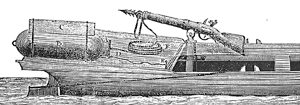
Another of his proposals, if adopted, would have been a big improvement
on the spar torpedo so popular later in the century. He used a harpoon gun
to fire a line attached to the cable linking two of the Dorethea
type torpedoes at a ship. According to his experiments the harpoon point
would drive through three inches of wood at a range of thirty to fifty feet
and, firing at a target six feet square twenty or thirty times he never missed.
The next occasion the Royal Navy became involved with "infernal
machines" was on the 9 June 1855 when two submarine explosions occured
under the paddle vessel MERLIN off Cronstadt in the Gulf of Finland
during the war with Russia. They were closely followed by another
under her companion the gunboat FIREFLY. On the 2O June one
exploded under the paddle frigate VULTURE. No damage was caused
and the following day boats from the squadron fished up thirty-three of
the mines.
Those that were brought on board the ships were treated very
carelessly. The first one brought on board the Duke of Wellington
was deprived of its fuse, swung at a boom and fired at with a rifle to see
whether it would explode by mere concussion, but without result. It was
then taken down to the poop for dissection. Meanwhile Admiral Seymour on
board Exmouth was manipulating an intact machine which exploded,
injuring his eyes and face, as well as some of the onlookers. This was
followed by a loud report from Admiral Dundas`s cabin in the Duke,
but this was only the bursting of a fuse and no harm was done.
The mines consisted of cones of zinc 2O inches long with a diameter of 14
inches. With about 8 lb of gunpowder in the apex, an air chamber
ensured that it floated at anchor, base up, a foot or two under the
surface. The fuse used a glass tube of sulphuric acid resting on a
pad saturated with potassium chlorate. If any of a number of wire
rods around the base was moved it struck a copper tube which broke the
glass causing a flame which ignited the powder.
The mines had been designed by Professor Jacobi of St. Petersburg
and as used were capable of doing little more than break glass and
crockery. It is not known why more powerful versions were not
deployed. The same fuses were used in Russian Anarchist bombs at the end
of the century.
Torpedoes were also used, particularly by the Confederate States, for
defensive purposes during the American Civil War.
In 1863 the narrow river channel leading past the forts into Mobile Bay was
lined with torpedoes, some made out of beer kegs filled with powder, the
sides studded with little tubes containing fulminate which exploded on
contact, the rest were metal cones with detonating caps.
Torpedoes detonated electrically from the shore were used by the
Confederates in the James river in 1863. The gunboat Commodore Jones
was blown up by one on 6 May. The banks of the river were searched and the
torpedo operators captured. One of the prisoners was placed in a gunboat
sweeping the river and gave a great deal of information about the location
of the torpedoes.
Commander William Cushing, USN, used a spar torpedo invented by Engineer
Lay of the navy to destroy the Confederate States ironclad
Albemarle
at Plymouth on the Roanoke River in October 1864. An earlier attempt to use
a torpedo carried in the Miami during a battle on 5 May failed. Follow
the link on the line above.
© 1996 Michael Phillips