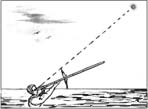
The Cross Staff
Since latitude could be determined with practical accuracy a ship`s master making the Atlantic crossing would attempt to reach the latitude of a known feature on the other side and then sail along that line of latitude. until he made a landfall. The only method he had for determining his position along the line was by `dead reckoning` . In other words, trying to guess how far his ship had travelled by making assumptions about the speed of the vessel, and the effect of the tide, current and wind.
Speed was measured using a `Log-line` which is unreeled over the stern, the rate at which it is runout being measured by a sand-glass. The line is marked with knots at specific intervals, namely the length between knots had to be the same fraction of a nautical mile (then 6080 feet) as the sand-glass was of an hour. Then counting the number of knots during the time it takes the hour-glass to run out gives the speed in knots or nautical miles per hour.
 Return to Part 1