
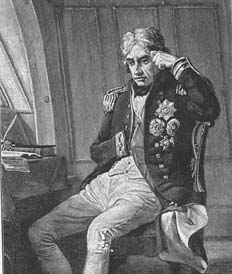
 Contemplation on the eve of Trafalgar. |
|
In over-all command of the expedition would be Captain, the Honorable, Constantine Phipps, later to take the title of Lord Mulgave. He would personally command the vessel RACEHORSE.. Besides being an officer of the Royal Navy, Capt. Phipps`s other assets were memberships in both the Royal Society and the Society of Antiquaries.. He had served his country in the Seven Years war and had been at the capture of Havana. Phipps`s ability to form a friendly comradeship with his men would stand him in good stead on the voyage..In command of the second vessel, carrying the grisly name of CARCASS would be Captain Skeffington Lutwidge. And here lies the tale of how he began a lifelong friendship with the future naval hero of England.
In the year 1773 one Horatio Nelson, midshipmen on the frigate HMS TRIUMPH had about three years of naval life under his belt. He had joined the Royal Navy in late November of 1770 when war between England and Spain seemed certain.. Once more a dispute had broken out over ownership of a lonely group of islands to the far south called the Falklands.. Once more a call to arms had been issued to the merry people of England. Once more her navy was brought out of ordinary to handle the job. One of young Horatio's uncles, on his mother side, was given command of a captured French frigate the RAISONNABLE.. The uncle, Maurice Suckling, made a name for himself in the Seven Years war.. While in command of the 60 gun DREADNOUGHT, Suckling along with two other British vessels, the AUGUSTA, 60 gun, and the EDINBURGH of 64 guns had attacked a French squadron of seven vessels and proved that, indeed, England, ruled the waves.. This battle took place near Cape Francois on a date that his nephew would make famous 48 yrs later.. October 21. Suckling had his doubts about the wisdom of letting his nephew enter the navy.. After all young Horatio had a very sickly beginning in life.. Barely surviving his birth. He was the least likely of his dead sister's children to survive the rough life at sea. But young Horatio had enlisted the aid of his older brother William and their father to press his case.. Suckling gave in and took the lad on board his vessel.. But as things turned out he need not had been so over concerned.. England and Spain came to an agreement.. Spain realized it could not afford a war with Great Britain at this time.. It had more pressing worries to attend to..
Capt. Suckling`s next command would be the guard ship TRIUMPH stationed at the Nore. He took his nephew with him as one of his followers..Now, being a sensible man and knowing of his nephew's innocence, being a backward country boy, he thought it best to send Horace, as his family was fond of calling him, to sea... Not only would this get the 13 yr old boy away from the evils of port life, it would enable him to get some much needed sea experience. This was very important for Horatio`s advancement in the service.. And sea duty was one thing he would not be able to do while on the guard ship.. Here Capt. Suckling enlisted the help of his former master`s mate on the DREADNOUGHT. For some years now John Rathbone had commanded a West Indiaman for the firm of Hibbert, Purrier and Horton. It took little for Suckling to talk Rathbone into take Horace on board his vessel.
However, on Horace's return to the fleet one year later, Capt. Suckling, felt doubts to his wisdom of letting his nephew sail in a civilian vessel.. In that year Rathbone's crew had turned the young lad's mind against the Royal Navy by instructing him in the evils of the service.. The floggings, bad food, bad officers, long service at sea with a very slim chance of leave. The brutal pressing of men into the service. Kidnapping is what members of Rathbone's crew called it. Especially taking men off of returning merchant ships.. In their home waters!!! Within sight of England and their loved ones.. Never to go ashore.. Straight from their ship and into a man of war..How criminal!!! They, in general, brainwashed the lad with the evils of the service.
Yes. It took the uncle of the future hero to England some time to set the lad back on the right path.. Part of Suckling's reconditioning of Horace came in the form of giving him more and more independence in the form of commanding the TRIUMPH's boats, and launches around the Nore. Then, the Thames and Medway estuaries and finally up to London to the Whitehall Stairs. It is at this time in his life during the winter of 1772-3 that Horace learned the lessons of a pilot that would stand him in good stead later in life.. It is here that his uncle and some of areas commanders saw the makings of a natural leader begin to bloom as Horace was now given the duties of a coxswain..When not in use by the ship, its cutter and long decked boat were given over to Horace. And so it was that during a dinner given by Maurice Suckling to his dear friend Constantine Phipps, Phipps showed his interested in recruiting the TRIUMPH's coxswain for service on the expedition to the Arctic.. Phipps was taken aback to see the coxswain who commanded the boats around in such an expert manner turned out to be a 14 year old boy. The leaders of the Arctic expedition had decided not to allow boys to go since they had no room for them.. But, an exception was made for Horace and at the end of May Horatio Nelson left the TRIUMPH for duty onboard the CARCASS.. Here the boy would be given lessons in astronomy by a renowned astronomer of that date, Israel Lyons. He would use the trip north as a chance to study the Polar sky in more detail. New equipment for distilling fresh water from sea water and a new log for measuring the ship's speed would be tested. Even the great Joseph Banks showed his interest in the voyage by requesting Captain Phipps to make notes on any animals and plant life he came across.
And so on June 4, 1773 amidst the usual celebrations for this day, it being his Majesty King George The third's birthday, the two former bomb ketches, now polar exploration vessels, with much fanfare, left Deptford, where they had been fitted out and manned. The RACEHORSE had ninety and the CARCASS, eighty men, on board. Down the mighty Thames. Past the Nore and out to sea. Bands played to mark their passing. People gathered at the water's edge waving flags and cheering the vessels onward. Even the First Lord of the Admiralty came to bid the adventurers a hearty farewell. The ships turned northward, with the shores of the county of Norfolk being the last English soil they saw... What were the thoughts of Horatio Nelson? Now age 14. He had sailed to the West Indies. Discovered a lifetime illness. Seasickness...Many people had told him he would either outgrow it, become use to it, or leave the sea for some sort of career on shore... His options on shore were very limited. Although he did have relatives who could get him employment in a government office. If nothing else he could attend farther schooling and become a minster of the cloth.. No, the sea called to this boy and to sea he much go...
The cruise started out under fine summer weather but on passing through the waters off the Shetlands the two ships ran into a very heavy fog bank. So heavy that it was hard to see from bow to stern let alone the other vessel.. In an age the knew no such modern conveniences as radar, sonar, and satellite navigation, the vessels had to feel their way through this fog using, drums, horns, and signal guns to keep track of one another.. On top of this the wind failed them and they drifted more than sailed their way north. In an eerie mist they sailed on.. The average day sounds of ship life and sea had taken on a ominous threatening tone.. Dampness prevailed the ships. Even the hammocks and blankets became moist from the clouds the ships sailed through making it uncomfortable to sleep Then, ever so slowly, as the fog disappeared, they discovered a new world ...
Sailing ever northward the vessels began encountering icebergs as well as some of the larger life forms of the of the polar region, in other words whales.. By the end of June the voyagers had made their way past Norway to the island of Spitzbergen, known in later history as Svalbard, owned by Norway. Here the voyagers found a land with hills covered with ice...This produced mirages much like the sands of a desert, deceiving the ship's companies with images of building, trees churches, ruins, ships, and many other things that filled their everyday lives. So wrote the surgeon of Horatio's ship, William Wallis.
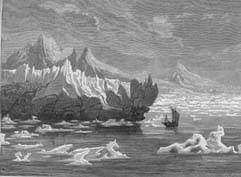
RACEHORSE and CARCASS had entered the world of the midnight sun. It was an unearthly world.. Where fire danced in the skies above them. The air seemed almost crystalline. Their companies breathed clean pure air. It revitalized them immensely.. Uplifted their spirits.. And amazingly, this close to the North Pole, for they were to come within ten degrees of it, they had not needed their cold weather clothing. The vessels now moved gingerly through the ice field working their way ever north, ever east. The off-duty men spent most of their time on deck watching creatures that they had only heard about in the inns back home.. Creatures they did not really think real , until now. It is here that danger first entered their lives. The ice moved in and imprisoned the ships.. But while the captains of both vessels worried about this the men took to the ice like children. Playing games they had not played since they were boys...
And again a fog came over the vessels. What seemed to unnerve the voyagers was the sound of ice grinding on ice and worst on wood. By July 30th the explorers found themselves becalmed in a bay with three islands around it.. On going on deck the next morning to their horror they saw themselves encased by ice... Now, they were truly trapped. Captain Lutwidge led a party to the nearest island and on climbing a hill and found they were indeed ice-bound to the horizon... As Captain Phipps wrote:-
"Beautiful and picturesque, the two ships becalmed in a large bay, with three apparent openings between the islands that formed it, but everywhere surrounded by ice as far as we could see, with some streams of water; not a breath of air; the water perfectly smooth; the ice covered with snow, low and even, except a few broken pieces near the edges; the pools of water in the middle of the pieces were frozen over with young ice."
The following day, as pressure forced some pieces higher than the main-yards of the vessels, the hard work of forcing a passage through the ice began as ice anchors were got out and along with the ship's boats the vessels were hauled through the ice towards the east and what appeared to be a slight break in the ice. Here began the legend of the courage of Horatio Nelson.. When a young boy he had become lost near his home; when he was found his grandmother asked him if he had been afraid. Looking at her with a puzzled expression the boy answered with the question - " What is fear?" Now in the high Arctic the boy showed his fellow crew members that while he lacked fear he may also lack good judgement.. This showed itself a few days after in Waigatz Strait, when some of the men of the RACEHORSE decided to supplement their food with some walrus steaks.. They left the RACEHORSE in one of its boats and, choosing their victim, fired shots at it. The injured animal dove and the men rowed to where he was last seen. In the meantime the animal's companions took exception to this attack on one of their own and launch one of their own.. They charged into the sides of the boats..One of the beasts even went so far as to grab a oar from one of the men. Things began to go from bad to worst for the men of the boat when, as the animals were on the point of overturning it, in charged the CARCASS's launch with reinforcements under the command of Horace Nelson. The walruses were beaten off and the two boats safely returned to their own ships..
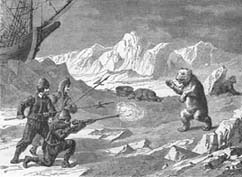
Then early one morning Capt. Lutwidge discovered just how foolish his coxswain could be.. Something woke him around 3:30 am. Going on deck and walking over to the side to gaze out at the ice he was shocked and horrified to see two members of his crew out on the ice and stalking a large polar bear.. In a moment he saw that these two were in danger of being attacked by the beast..Lutwidge issued orders to signal their return.. This brought members of both ships topside. One man had realized the folly of this venture and turned to head back to the vessel. The other, however pressed on... As the remaining hunter prepared to fire his musket at the bear the captain ordered one of the ship's guns to be fired. The musket had failed to go off and the bear turned to attack.. However, the loud explosion of the ship's gun and the sound of a cannon ball landing near the bear caused it to choose the better part of valor and run.. On returning to the ship it was discovered that Horace Nelson was the one who came up with the ideal of going after the bear.. In a well deserve fit of rage Lutwidge asked the boy what he thought he was doing.. With lower lip stuck out and downward shameful look Horace explained that he wanted the skin of the bear as a rug for his father.. In later life Admiral Lutwidge often told this tale about Lord Nelson.. Lutwidge would go on to outlived this daring bear hunter and attend the funeral of the Victor of Cape Trafalgar.
A few days later a east wind came up and caused the pack ice to break up.. Not wanting to spend a winter trapped in the Arctic the men set sails and with the aid of the ships boats hauled the RACEHORSE and CARCASS into clear water.. The ships paused at Smeerenberg Harbour, New Friesland long enough to make much needed repairs and on September 25th dropped anchored at Orfordness. The ships were paid of on October 15th..
So ended the first real adventure of Horatio Nelson. He had tasted the thrill and dangers of sea life in a strange land. Rather than being satisfied with this he hungered for more.. His next cruise would take him to far off India where he would face the first real trial of his young adult life.. But that is another story for another time...
© 1997 Jane Buchmann
 ver since the Europeans discovered a roadblock in
the form of the
American continents between them and the far East, they looked to the north
for a route around.. For years a way to the west was searched for.. Then, some
turned their eyes to the east for a northeast passage to the lands, of gold,
silver, spices and riches beyond imagination..