and the Editor, Christopher T. George, I am pleased to be able
to reprint this important paper from the Winter 1999 issue of the:-


One of the famous small warships of the US Navy was the schooner Enterprize. Two Revolutionary War warships were so named---sometimes spelled "Enterprise" --- and the schooner built in 1799 was the third US warship to hold the name, She served admirably in the Quasi War with France, the Wars with the Barbary Powers, and the War of 1812. In our century, the name Enterprise continued in service with the World War II aircraft carrier and the name and noble tradition is currently in carried by the first nuclear-powered aircraft carrier. What sparked this tradition of victory and professionalism, such that it has captured the imagination of our nation for two centuries, reaching into the realms of science fiction, with Gene Roddenberry`s Enterprise of Star Trek fame?© 1999 Michael L. Bosworth . Reprinted from The Journal of the War of 1812, Vol.IV, No 1.In 1794, the US Congress (having been unable to afford anything larger than a revenue cutter for a decade) authorized the construction of six large, powerful and fast frigates. This was done despite continuing fiscal difficulties in the new nation, in order to counter continuing depravations on American merchant ships from the seagoing corsairs of the Barbary Powers of North Africa. Tribute payments and diplomacy eased tensions for a time and only three of the six frigates were completed by 1797; the famous Constitution (rated at 44 guns), United States (44), and Constellation (38). The ship construction campaign and resurrection of the national navy after a hiatus of a decade was timely. In 1796, revolutionary France commenced a privateering campaign that captured hundreds of American merchant vessels in a year. A "new Act Providing for a Naval Armament" empowered the President to man and employ the new frigates. However, the big frigates were not enough for the myriad small French privateers. The creation of a Navy Department separate from the War Department, and additional warship construction and conversion occurred for the Quasi Naval War with France.[1] Two schooners were authorized under an Act of Congress dated April 27, 1798. They would soon be named Experiment and Enterprize.
Secretary of the Navy Benjamin Stoddert, knew he needed some small, fast vessels quickly. He instructed Jeremiah Yellot, the naval agent in Baltimore, to build two swift schooners, and left to him the design details. Yellot chose the design of the new Baltimore schooners, or "schooner, pilot boat built", as their design was derived from the smaller pilot boats that raced skilled harbor and bay piloting officers to incoming ocean-going ships.[2] Enterprize was built in St. Michaels, Maryland at the Spencer yard in 1799. She outfitted at Fells Point in Baltimore at Yellot`s own docks. The new double topsail schooner of 135 tons berthen and armed with 12 six- pounder cannons was commissioned in December 1799. She left on December 17 for the West Indies on her first convoy escort mission commanded by Lt. John Shaw.
It was the middle of the Quasi War with France, and Enterprize was actively employed. She returned to Philadelphia with dispatches from Capt. Thomas Truxtun of the frigate Constellation. The big frigate had fought a hard won battle with the French national frigate Vengeance a year after capturing another frigate, L`Insurgent. Enterprize immediately returned to the West Indies center of action. In rapid succession, the little schooner captured several French privateers, including L`Aigle of 10 guns and Le Flambeau of 12 guns. The latter engagement lasted for nearly two glasses (nearly an hour) and was rated one of the hottest actions of the Quasi War. Lt. Shaw, due to ill health, was relieved by Lt. Andrew Sterett, recently of Constellation, who finished out the Quasi War by repairing a sprung foremast and capturing or recapturing additional prizes.[3] At the end of the Quasi War, the rapidly expanded Navy was reduced to just 13 frigates, with no smaller vessels. However, Enterprize was famous even then, and public furor caused the schooner to be the fourteenth ship (and only small cruiser) retained in service.
In 1801, the maritime threat shifted from the French to, once again, the Barbary pirates. After resupplying in Baltimore, Enterprize sailed with a new subordinate officer (Lt. David Porter) for the Mediterranean Sea. In August 1801, Lt. Sterett reported to his commodore on a sharp action.
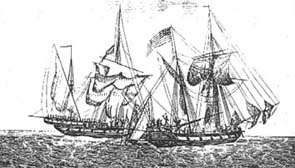
Capt. STERRETT in the Sch. ENTERPRIZE paying tribute to TRIPOLI. August 1801
"SIR, I have the honor to inform you, that on the 1 of August, I fell in with a Tripolitan ship of war, called the Tripoli, mounting 14 guns, commanded by Rais Mahomet Rous. an action immediately commenced within pistol shot, which continued three hours incessantly. She then struck her colors, the carnage on board was dreadful; she having 30 men killed and 30 wounded, among the latter was the Captain and first Lieut. Her sails, masts and rigging were cut to pieces with 18 shot between wind and water. Shortly after taking possession, her mizenmast went over the side. agreeably to your orders, I dismantled her of every thing but an old sail and spar. - with heartfelt pleasure I add, that the officers and men throughout the vessel, behaved in the most spirited and determined manner, obeying every command with promptitude and alertness, we have not had a man wounded, and we have sustained no material damage in our hull or rigging."[4]
Lt. Sterett was sent back to Baltimore with dispatches but was back at Tripoli by November 1802. In April 1803, Lt. Sterett turned over command of the schooner Enterprize to Lt. Isaac Hull. In June, Hull and Enterprize, on blockade duty off Tripoli, encountered the larger enemy polacre-rigged corvette Meshouda (22 guns). Hull, well known in the service for his seamanship, outmanuevered the larger ship and forced her to moor in a narrow bay. Joined by the frigate John Adams, the two American warships engaged the corvette and a troop of supporting cavalry, eventually blowing up the Tripolitan corvette. A few months later in November 1803, the more senior Hull swapped ship commands with Lt. Stephen Decatur for the larger Argus (16 guns). [5]
Disaster had struck the U.S. Mediterranean squadron. Just as Commo. Preble arrived to take command, the frigate Philadelphia ran aground off Tripoli and was captured, to be moored under the guns of the numerous fortifications and surrounded by the gunboats and small cruisers of that Barbary port. In February 1804, Lt. Decatur took a volunteer crew (largely from Enterprize) aboard a captured local craft the American renamed Intrepid to successfully burn Philadelphia and thus deny this powerfiul ship to the enemy. Admiral Lord Nelson was reported to have called the action the boldest act of the age. Soon thereafter, Decatur and Enterprize participated in hot shore bombardment and gunboat actions, ably led by Commo. Preble in his flagship Constitution. Decatur was promoted to hill captain, and Lt. James Lawrence (whose story turns tragic in Chesapeake in 1813) took command of Enterprize for most of the rest of 1804.
In late 1804, Master Commandant Thomas Robinson took command of Enterprize with orders to give her a well deserved major refit. In Trieste, Italy, he discovered the wonderous capabilities of the nearby Arsenal of Venice. Worn and nearly rotted out Enterprize was totally rebuilt with the fine naval stores, Adriatic oak and superb engineering capabilities of supervisor Austrian Major Andrea Salvini and the shipyard, then perhaps the premier such facility of the world. Robinson succumbed to lengthening his ship by approximately six feet, rebuilt the stem, enlarged the guudeck by reducing tumblehome (inward side hull sloping), and strengthened the deck for a large center-mounted cannon for future shore bombardment duties. Robinson didn`t immediately inform his superiors how much he planned to improve Enterprize (while maintaining her quite extraordinary underwater lines).
"Oh! how I wish I had got permission to give her a few more feet Keel and opened her a little what a sweet Brig I would have made her, and with no apparent expence, but Sir it is dangerous for Officers young in rank to take libertys...." [4],[6]
Master Commandant Robinson and Maj. Salvini eventually took those liberties, as we will later briefly discuss in the technical section, and Robinson was neither praised nor censured. In July 1805, Enterprize rejoined the squadron oft Tripoli for the final events of the Barbary Wars, and a year later at the successful conclusion of the Mediterranean wars returned home to lie in ordinary (reserve status) at the Washington Navy Yard. But the naval calm was short-lived; the infamous Chesapeake-Leopard impressment affair of 1807 caused a new crew to be recruited in Alexandria, Virginia, and other Potomac ports. Manned by a largely Maryland and Virginia derived crew, Enterprize was in Norfolk for 1808, and served in New York the following year. After normal peacetime patrols, as the Chesapeake furor died down, Enterprize arrived at Washington Navy Yard in 1811 for a second major refit. This included conversion to brig sailing rig (more square sails) and a main battery of fourteen 18-pounder cannonades (powerful, short range but lighter weight cannon) and two long nine chasers to replace her original twelve 6-pounder long guns.
The outbreak of the War of 1812 found Enterprize the only ocean capable cruiser amidst coastal gunboats on the New Orleans station, and yellow fever struck. She was sent back to the East Coast, and Lt. William Burrows took command of the veteran brig. Now fifteen years old, Enterprize was smaller and less powerful than most warships serving similar roles, despite the recent revisions which more than tripled her weight of broadside but significantly degraded her formerly stellar sailing qualities. However, in September 1813, Enterprize fought a dramatic duel with HM Brig Boxer, in which both ships` captains were killed, and Enterprize captured the British ship Enterprize finished the war as the station ship for Charleston, South Carolina.[5]
After the end of the War of 1812, Enterprize continued to serve important roles. The Barbary pirates once again needed chastising, easily done in 1815 with the now powerful American Navy. From 1817 to 1823, Enterprize served in an anti-piracy role in the West Indies. However, in July 1823, the Enterprize`s good fortune ran out as she foundered on Little Caracao Island, but without injury to crew.
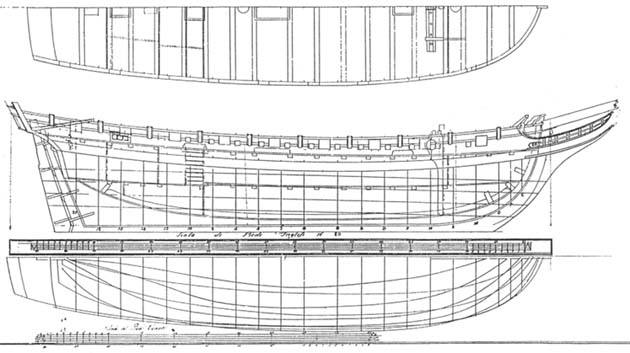
Enterprize, in her original schooner rig, had a reputation of being fast, and she was remarkably lucky in her assignments, her timely refits and her officers and crew. In 1803, when additional schooners were to be built, the Secretary of the Navy wanted Enterprize`s design to be duplicated. However, no plans were to be found, and the schooner Vixen was built to similar scale but new Baltimore schooner lines, Howard Chappell, in his studies of American sailing ship design, states that no Enterprize lines have ever been found.[8],[9] In 1994, with knowledge of the 1805 refit at the Arsenal of Venice, a search of the Trieste archives by Mario Marzari at the request of this author located an interesting set of ships� lines.[10] These are quite possibly those of Enterprize as lengthened during the 1805 refit at the Arsenal of Venice, or alternatively might be those lines used as a starting point for a design excursion. Particularly indicative of the first postulate are the line drawing`s pair of midships indicators (labeled as an encircled cross). Most ship plans have but one, but Enterprize was lengthened; the easiest way then as now to increase an existing ship`s length is to insert a section amidships. Also, comparison with the earliest preserved lines of a Baltimore schooner, those of Superiere provides confidence. Superiere was a Baltimore schooner built in Talbot County as Superior. She was purchased by the French Navy and named La Superieure, but captured by the British in 1803 and her lines taken off and archived in the National Maritime Museum, Greenwich - England.[2] Comparison of this earliest known Baltimore schooner plan with the Venice plan shows a remarkable similarity. Mario Marzari, a historian who has studied Salvini and the Arsenal of Venice, indicates that the lines are unusual for the region. Comparison of the Arsenal provided ship lines with the next known survey dimensions (that of 1808 conducted at the Washington Navy Yard) also indicates remarkable matching.
These are possibly the plans of Enterprize as lengthened during
the 1805 refit at the Arsenal of Venice or, alternatively the lines used
as a starting point for a design excursion
                Comparison of:
        1808 Survey        Venice Plan
Length between perpendiculars (feet)
            80.5               80.5
Length of gundeck (feet)
            92.7               93.0
Moulded beam (feet)
            22.9               24.4
Depth in hold (feet)
            10.8               10.8
Gunports per side (exclusive of bridleport)
             9                  8 (9 feasible)
Gunport to gun port (feet)
             8.8                8.8
Fwd. perpend. To centre of foremast (feet)
            16.1               16.1
However, there are a couple of issues that dictate caution. The beakhead on the Arsenal provided plan is atypical of Baltimore schooners, and two excellent artist renditions of Enterprize in 1806, within a couple years of the refit, show no beakhead. Also, the number of gunports shown on the Venice plan, the Roux engraving, the Baugean engraving, and the 1808 audit varies (the audit being dominant).[10],[11] More detailed analysis is needed prior to declaring the identification of the Venice plans as certainly those of Enterprize. However, the discrepancies have possible explanations, and the verifications are so numerous, so as to warrant optimism of the identification. If these are indeed the long lost lines of Enterprize, they can be used to extrapolate better all three configurations, i.e., the 1799 original shorter schooner, the 1805 longer schooner after refit at the Arsenal, and the 1811 brig after refit at the Washington Navy Yard.
The technical story of the remarkable Baltimore schooner, the emergence of the United States Navy and merchant marine, and the specific story of Enterprize have yet to be fully explored. There is currently a nascent project seeking to build a replica vessel of this configuration, perhaps even Enterprize herself, and perhaps that will encourage future research. But whether we glean the tale from dusty plans and documents, or tell the story more visually to a wider audience with the eventual building of a full scale replica, the story of the brave ship and her various crews and their services is worthy of our nation`s admiration.
The author acknowledges the assistance of the late Bill Dunn, as well as Geoffrey M. Footner of Fells Point and Mario Marzari of Trieste, Italy. This paper is an overdue report of a work-in-progress.
SOURCES
- Michael L. Bosworth. Stoddert, Truxtun, and Prebie:
Three Key Figures in the Creation of the U.S. Navy
and Its Professional Tradition. Journal of the War of
1812 2(Fall)1997:20-23.
- Geoffrey M. Footner, Enterprize - A Hallowed
Name, unpublished monograph, an excerpt from the
author`s With Canvas Wings Abroad to Fly - The
Evolution of the Chesapeake Pilot Schooner, ca.1993.
- Dudley W. Knox, Naval Documents Related to the
Quasi-War Between the United States and France.
7 vols. Washington, D.C.: U.S. Government Printing
Office, 1935-1938.
- Dudley W. Knox, Naval Documents Related to the
United States Wars with the Barbary Powers. 7
volumes. Washington, D.C.: U.S. Government
Printing Office, 1939.
- Fletcher Pratt, Preble`s Boys: Commodore Preble
and the Birth of American Sea Power. New York:
William Sloane Associates, 1950.
- W. M. P. Dunn, Resource Data File; Enterprize 1798 -
1823. Unpublished computer data file, a
compendium of various primary sources, dated June
6,1993.
- Leonard F. Gultridge and Jay D. Smith, The
Commodores: The U.S. Navy in the Age of Sail.
New York: Harper & Row, 1969.Howard I. Chapelle, The History of the American
Sailing Navy: The Ships and Their Development.
New York: Bonanza Books, 1949.
- Howard I. Chapelle, The Baltimore Clipper: Its
Origin and Development. New York: Dover
Publications, New York, 1988. (Republication of
Marine Research Society of Salem, Massachusetts
Publication #22,1930).
- Private correspondence between II Conservatore
(Amm. Div Lorenzo Sferra) of the Museo Storico
Navale in Venice, Italy and Prof Mario Marzari of
Trieste, Italy and Cdr. Michael Rosworth of Vienna,
Virginia, Dec. 1993--Jan. 1995. The key letter with
two plans, one the plan (design "b") discussed in this
paper, is Mario Marzari`s of July 9, 1994.
- Fox Collection, Phillips Library, Peabody Essex
Museum, Salem, Massachusetts. Loc: MH, Box
#16, Fldr #3. "No. 800 - Page 1, Dementions (sic) of
Schooner Enterprise."
Michael Bosworth is a retired naval officer, naval architect and part-time doctoral student. He pursues his historical interests as a member of Ship`s Company, a naval living history group based in Baltimore and Washington DC. He also sings sea shanties with the Ship Company chanteymen, who host an open pub sing each first Tuesday of the month at the Royal Mile Pub on Price Street in Wheaton Maryland, and third Tuesdays at the Hard Times Cafe in Alexandria, Virginia. He is an Advisor to Journal of the War of 1812 and the Era 1800 to 1840.
Mike can be contacted at [email protected]
Go to The Journal of the War of 1812 for more information. on the publication and how to subscribe