CHESAPEAKE MILL
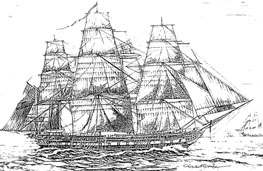
Early in morning of the first of June 1813 the United States frigate
CHESAPEAKE left her moorings in President Roads, Boston, Mass.
and sailed on a cruise. At a quarter to six that same evening she commenced
an action with the British frigate SHANNON, which had been watching
the port. The American commander, Captain James Lawrence, was mortally
wounded and his ship surrendered to a British boarding party after a great
loss of life.
CHESAPEAKE was taken into the Royal Navy under the same name and
Captain Francis Newcombe commanded her at Plymouth during 1815.
On 18 August 1819 she was sold to Mr J. Holmes for breaking up and the
timber from her gun-deck was bought by John Prior in 1820 for �3,450 to build a
water mill alongside the River Meon in the village of Whickham in
Hampshire.
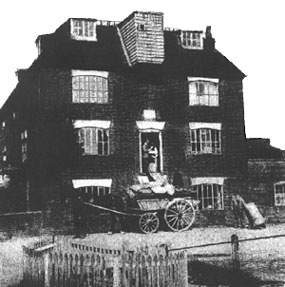
It is now known as the CHESAPEAKE MILL.
Over the past two years the communities of the Meon Valley have been
discussing ways of marking the Millenium and the most popular idea was the
creation of an environment and heritage centre.
The already historically important Chesapeake Mill, now semi-derelict
after being empty for ten years, tied in completely with their aspirations.
The Chesapeake Mill Group is a Building Preservation Trust and registered as a charity under the title "The Meon Valley Environmental and Heritage Visitor and Study Centre." The planning group see the centre as a natural focus for visitors which will concentrate, not only on the ecology and history of the local area, already a rich tapestry on which to draw , but also on the story of the Chesapeake and its significance for American naval history.
By using modern technology with computers and CD-ROM, which can store large amounts of information, the centre will prove invaluable in the education of the young. It is proposed to identify the individual timbers in the building on a computer display or a cut-away model of the Chesapeake. One major theme will be water and the intention is to restore the channels and the mill race and provide a new wheel which will supply electricity for the centre.
Brian Lavery, the Curator of Ship Technology at the National Maritime
Museum, and a well know author of books on the subject, considers that there is sufficient evidence to convince him that many of the pinewood timbers in the building do come from the Chesapeake and, as such, are of great historical importance.
The American Ambassador to Great Britain has expressed his interest in the project and sent his best wishes for its success.
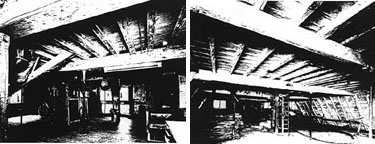
Internal photographs highlighting gun-deck timbers
The total funding for the project will be �714,000 to acquire, restore and refurbish the mill. The Group has been registered as a company limited by guarantee (Company No. 3281807) and the project is registered with the Heritage Lottery Fund (EM-96-01688) which, if it gives approval, can grant up to 75% of the cost. This still leaves �178,500 to be raised. If this cannot be raised, the Heritage Lottery Fund grant will not be offered, and the dream will quickly fade.
For IMPORTANT NEWS go to the next page.
For further information about the project or to obtain details about how to pledge funding, please contact:-
Mark Phillimore FAX +44-(0)1329-832543 or
Email [email protected]
Chesapeake - Shannon Here you will find official letters on the action between the two ships.
This page is maintained by Michael Phillips, mike @cronab.demon.co.uk on behalf of the Chesapeake Mill Project Comittee.