

In 1823 the British goverment decided to mount another attempt to find the North West Passage between the Atlantic and Pacific Oceans and appointed Captain Sir W.E. Parry to command it. Capttain John Franklin submitted a plan for a land expedition to go the mouth of the Mackenzie River to survey the coast westwards from there as part of the whole operation. His proposal was accepted and he was appointed leader. Lieutenant Back returned home from the West Indies while the expedition was being prepared and, when Lieut. Bushnan, the assistant surveyor, died prematurely, he was offered the appointment.
Before the expedition sailed on 25 February 1825, Lieut. Back attended a public dinner in his honour at Stockport. Captain Salusbury Price R.N. was in the chair and the local newspaper expressed the general high degree of pleasure felt at seeing his health and vigour after the suffering and privation which had reduced his frame to the extremity of weakness.
Lieut. Back was promoted to commander on 30 December 1825 for his services on the first overland expedition.
The story of the second expedition has already been told in the biography of Franklin. While Capt. Franklin returned via New York, Cdr. Back waited at Fort Franklin until the ice broke and then took the remaining officers and men, the boats and the specimen collections and data to York Factory, wher he embarked them on a Hudson`s Bay Company ship. They arrived at Portsmouth on 10 October 1827, only a fortnight after Captain Franklin and his party landed at Liverpool. The following July an order was issued that the year a commander must serve before being promoted to captain must be served on board a vessel in commission. Because of this his promotion was refused, although he had spent more than two years on very active service, and he was not offered another appointment. It did not go unnoticed at the time that Franklin apparently lacked the influence posessed by Parry, since, although his expedition was unsuccessful, several of his officers were promoted.
Commmander Back spent the next few years kicking his heels on half pay. In April 1828 he submitted a plan for exploring the country between Repulse Bay and Point Turnagain, but the Admiralty had lost interest in the northern polar regions. Early the following year he made an unsuccessful application to join Captain Hoppner on a voyage to the South Pole.
By the end of 1832 worries began to grow about Captain John Ross, who had sailed in the summer of 1829 to seek the North-west passage, and had not been heard from since. His friends held a meeting at the Royal Geographical Society and it was agreed that he could still be alive since he had supplies for three years and there were stores in the wreck of Fury, abandoned by Parry in Prince Regent Inlet in 1825. A private subscription raised �5000 towards a relief expedition and the Government offered �2000. When Commande Back was appointed as leader the Hudson`s Bay Company not only agreed to provide boats free of charge but granted Back a commission which gave him full powers throughout their territories and authority over all their servants below the governor.
Com. Back, Mr King, who joined him in the capacity of surgeon and naturalist, and three former companions, sailed from Liverpool on 16 February 1833. They arrived in New York to an enthusiastic welcome. On Government instructions, they were passed straight through customs The Hudson River Steamboat Association provided a vessel to take them to Albany to meet the Governor and they received numerous letters from all over the country expressing an interest in the expedition. They Left for Montreal after attending a luncheon on 29 March given by the British Consul in New York to introduce them to important people from that city.
They arrived in Canada on 6 April and were joined by four volunteers from the brigade of artillery stationed there. They left Montreal on 25 April and during the summer reached within 100 miles of Bathurst Inlet. Yhe party spent what Back described as a "distressing" winter at Fort Reliance on the Great Slave Lake. Food was short and his party spent much of the time searching for the animals and fish that seemed to have deserted them.
From a letter to the Royal Geographical Society, 20 April 1834.On 25 April news reached him of the safe return of Captain Ross and he was directed to devote his time to a scientific exploration of the territory. Sufficient supplies to last through the 1834-35 winter were forwarded to him by the Hudson`s Bay Company."During the whole season scarcely a living creature has been seen, except on one occassion a raven, which, in wheeling over the house, startled me with his croak, so uniform was the silence around us. I ran out, but when it saw me it screamed, and again made off to the western mountains, in the dark shade of which it was speedily lost. Mr M`Cloud, (an agent of the Hudson`s Bay Company) and his young family are at this moment somewhere on the lake fishing; and you may imagine what it costs me to see them also exposed to the rigours of this severest of all winters, for the mean of three thermometers has been far below the lowest we ever registered in our former expeditions. After this narrative you may believe that, in spite of all my care and economy, some part of the provision laid up for our voyage has been necessarily consumed. Another misfortune is, that pinched as we are for provisions, we must drag our boats and luggage almost 100 miles over rock and ice before we can reach open water. But I have perfect confidence in my men, and they, good fellows, think I cannot err."
On his return to England he was appointed to lead a new survey expedition from either Repule or Wager Bay to the eastern shore of Prince Regent Inlet, and to examine the coast as far as Point Turnabout.
The party sailed from England in the Terror on 14 June 1836 and, six weeks later, encountered a massive iceberg in the Davis Strait. Soon afterwards they became trapped in an ice field and remained best for nine months. Four months of the time were spent, to quote Back, "on an icy cradle," lifted out of the water. On 5 September there was a calm and the whole party landed on the ice to try and release the ship by breaking up the floes and moving them to the only clear water near by. This was only partly successful.
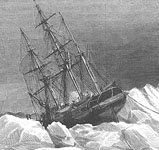
"September 20 -- Shortly after 9 AM a floe piece split in two, and the extreme violence of the pressure curled and crumbled up the windward ice in an awful manner, forcing it against the beam fully eighteen feet high. The ship creaked as it were in agony, and strong as she wasmust have been stove and crushed had not some of the smaller masses been forced under her bottom, and so diminished the strain by actually lifting her bow nearly two feet out of the water. In this perilous crisis, steps were taken to have everything in readiness for hoisting out the barge."They were about to start cutting a dock around the ship when the ice was again in motion, breaking up into pieces which were piled upon one another and pressing against Terror. For several days her stern was raised seven and a half feet above normal by the pressure of the ice, while her bow was depressed, making the deck slippery and dangerous. The ship gradually righted herself on 1 October and the men were kept busy building snow walls round the ship and erecting an observatory on the ice floe."At noon the weather and our prospects remained the same. The barometer was falling and the temperature was 26 below with unceasing snow. Much ice had been sunk under her bottom, and a doubt existed whether it was not finding its way below the ice pack also; for the uplifted ruins, within 50 paces of the weather beam, were slowly advancing towards us like an immanse wave fraught with destruction. The butt-ends began to start, and the copper in which the galley apparatus was fixed became creased, sliding doors refused to shut, and leaks found access through the bolt-heads and bull`s-eyes. To guard against the worst I ordered the provisions and preserved meats, together with various other necessaries, to be got up from below and stowed on deck, so as to be ready at a moment to be thrown on the large flow alongside. Suddenly, from some unknown cause, the floe which threatened instant destruction turned so as in a degree to protect us against an increase of pressure, though for several hours the same creaking and grinding sounds continued to annoy our ears. Yet the gale was broken, and by midnight it had abated considerably."
"September 21 -- There was a lateral motion in some pieces of the surrounding ice, and, after several astounding thumps under water against the bottom, the ship, which had been lifted high beyond the line of flotation, and thrown somewhat over to port, suddenly started up and almost righted. It was not until one mass of ponderous dimensions burst from its imprisonment below that she altogether regained her upright position. Her mould was stamped as perfectly as in a die in the walls of ice on either side. On sounding the well she was found not to leak, though ther carpenter had employment enough in caulking the seams on deck."
Back, and particularly his first lieutenant, William Smyth, had to work hard to bring the crew together as mess-mates. There were a few men-of-war-men on board who "were worth the whole put together". The rest were out of colliers, although a few had served in Greenland vessels. Their want of discipline and lack of attention to personal comfort was most conspicuous and it was only by Smyth insisting on rigorous obedience to the regulations for hygiene and behaviour in the Royal Navy that they were able to live together in harmony. On 22 October a general masquerade was held and this was followed by regular theatrical entertainments.
They had many alarms during the long winter. On 20 February the ice opened and shut for three hours, threatening to crack the vessel like a walnut. The men were mustered on deck and some extra warm clothing was doled out. Spars were rigged over the quarters ready to hoist out the bales of provisions and stores that had been brought up on deck. At noon the ice began to drift slowly northward taking them within five to eight miles of the nearest land. At five o`clock in the afternoon the ice opened sufficiently for the ship to resume her upright position but then closed again, causing every plank to complain, a creaking which only ceased when she was lifted bodily about eighteen inches. The same sort of behaviour continued through until the middle of March
Early in the afternoon of 15 March, when the movement of the ice was carrying them past a broken and rocky coast, with cliffs some one or two hundred feet high, Terror was suddenly thrown on her starboard quarter. A loud crack was heard from below the main-mast as though her keel had been broken or carried away. Simultaneously a three foot split opened up in the outer sternpost from the ten-feet mark down to to an unknown point. The stern itself was thrown up to the seven and a half feet mark and the leakage increased to 3 feet an hour. Extra pumps were worked and an inspection made by Mr Smyth; the master, Mr Saunders, and the carpenter, showed nothing amiss inside. To be on the safe side the cutters and the two whale boats were lowered, and hauled with their stores to a more secure place, a task which took two and a half hours. Meanwhile the ship was still setting fast along the shore, much too close to the fixed land ice for comfort. At about 8 o`clock in the evening a rushing noise was heard which developed into a heavy roar towards the port quarter about a quarter to eleven caused by a immense wall of ice rolling towards the ship. Although the hands were called immediately, they only just managed to hoist in three of the boats before the solid wave, now 25 feet high, reached the quarter. Suddenly the motion ceased as the ice reached the rudder slung athwart the stern, and the wave toppled over. The only effect was a leak from somewhere near the sternpost which stopped after about half an hour.
"March 16 -- Our intervals of repose were now very short, for at 12.50 am another rush drove irresistibly on the larboard quarter and stern, and, forcing the ship ahead, raised her upon the ice. A chaotic ruin followed; our poor and cherished courtyard, its walls and arched doors, gallery, and well-trodden paths, were trent, and in some parts ploughed up like dust. The ship was carreened fully four streaks and sprang a leak as before. Scarcely were ten minutes left us for the expression of our astonishment that anything of human build could outlive such assaults, when, at 1 am, another equally violent rush succeeded; and, in its way towards the starboard quarter, threw up a rolling wave thirty feet high, crowned by a blue square mass of many tons, resembling the entire side of a house, which. after hanging for some time in doubtful poise on the ridge, at length fell with a crash into the hollow, in which, as in a cavern, the after-part of the ship seemed imbedded. It was indeed an awful crisis rendered more frightful from the mistiness of the night and dimness of the moon. The poor ship cracked and and trembled violently; and no one could say that the next minute would not be her last, and, indeed, is own too, for with her our means of safety would probably perish."After spending three-quarters of the year in the ice, during which she had drifted several hundred miles, the day of release finaly came in July."Until 4 am the rushes continued from different directions, fortunately with diminished force. We certainly were not more than three miles from the barren and irregular land abeam, which received the name of Point Terror."
"July 11 -- The crew had resumed their customary labour, (cutting away at the ice) and, as they drew near to the stern-post, various noises and crackings beneath them plainly hinted that something more than usual was in progress. Scarcely had I taken a few turns on deck and descended to my cabin when a loud rumbling notified that the ship had broken her icy bonds and was sliding gently down into her own element. I ran instantly on deck, and joined in the cheers of the officers and men, who, dispersed on different pieces of ice, took this significant method of expressing their feelings. It was a sight not to be forgotten. Standing on the taffrail, I saw the dark bubbling water below, and enormous masses of ice gently vibrating and springing to the surface."
On 14 July the ship finally righted and in a short time they
had patched her up and made her seaworthy. She had survived to take Sir John Franklin on his last voyage.
The officers of the Terror
Captain.     George Back
Lieutenants. William Smyth
             Owen Stanley
             Arch. McMurdo
Master.      James Saunders
Surgeon.     James Donavan MD
Ass. Surg.   John A. Mould
George Back`s health began to fail after his return and he lived a quiet life on half-pay; He was knighted in 1839 and died, an admiral, on 28 June 1878.
Go to the first part of George Back R.N.
© 1997 Michael Phillips.