THE ARISTOCRAT LUGGER
The Story Behind a Print
During the short summer night of Tuesday 15 July 1795 a lugger
crept in close to the French coast near St. Malo and at 5 o'clock in
the morning her boat brought nine men off the beach. They were agents
who had been on secret missions for the French royalist forces which
three weeks before had captured the fort at Penthievre on the Quiberon
peninsular with the help of Breton peasants and 300 Royal Marines.
The lugger, the ARISTOCRAT, was chartered by the Admiralty and
was commanded by Capt. Wilkins who, although he was not in the Royal
Navy, had been employed for some time as master of his own vessel in
running supplies to insurgents in the department of La Vendee on the
Biscay coast. As a result he was well aware that a price of 2000 pounds
had been put on his head by the French Government. His little vessel was
armed with four 6-pounders and eight 4-pounders.
With the tide against him Capt. Wilkins tacked towards the Isles of
Chausey but found a large cutter running down the wind towards him
so he turned south to avoid her but, on his next tack northward,
reached the islands where he anchored to wait for the tide to turn.
The cutter he had seen in the morning then came up and he engaged her
for a short time before she took refuge under a shore battery.
ARISTOCRAT then stood to the northward but saw a flotilla of eight
vessels, including a ship and five brigs all heavily armed, had
followed the schooner and that there was no way of avoiding action
with the whole French force.
By now his French agents were in a state of panic, faced as they
were with imminent capture followed by torture and execution. It is
difficult to tell whether they were relieved by Capt. Wilkins'
assurance that "they might rest extremely easy that they should not be
made prisoners." If there was any danger of the lugger being boarded,
he intended to fire the powder-room which contained 125 barrels of
gunpowder due to be landed in France.
ARISTOCRAT soon found herself at the very centre of the enemy
squadron with heavy fire from from every vessel drowning the shouts
of 'Vive la Republique' and the ribald replies of the British sailors.
The French Commodore carried a distinguishing pendant on his ship
the SOCIETE POPULAIRE which mounted eighteen 18-pounders. Regarding
the outcome as a foregone conclusion he had already hoisted out his
boats to be ready to bring his prisoners aboard when Capt. Wilkins
closed within a pistol-shot and fired his tiny broadside causing so
much damage that the French vessel showed no more interest. Later
intelligence showed that five of her guns had been dismounted and many
of her crew killed.
The action then developed into a running fight to the southward
until they came within range of a fort at the entrance to St. Malo.
Past a coast lined with spectators, Capt. Wilkins tacked every two
hours alternately to the northward and southward until he had worked
well up to windward off Cape Frehel and exchanged broadsides with the
leading French brig DILIGENCE which was armed with twelve
18-pounders. By this time he had the weather gage of the whole
flotilla and with the night coming on he was able to lose them and
stand on to the Minquiers rocks were he anchored, his people
completely exhausted after being in action for eighteen hours during
which their double broadside of 56lb had been pitted against a total
of 1066lb from the nine vessels.
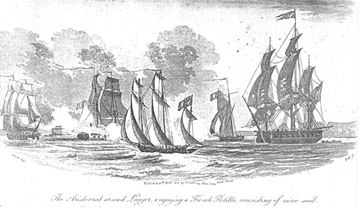
The print shows ARISTOCRAT engaging DILIGENCE, which lost five men killed, and RONDELL after disabling SOCIETE POPULAIRE. The artist is John Thomas Serres (1759-1825), the eldest son of a Frenchman Dominique Serres who had come to England as a court painter. It was published on 30 April 1806 by J.Gold of 203 Shoe Lane, Fleet Street, London.
The Royalist effort had been in vain for, during a terrible storm
on the night of the 20th July, treachery by a number of sentries allowed
republican troops to enter the fort. Some of the royalists were
massacred by their former companions while others escaped to the shore
where they were picked up by British frigates. Those who stood and
resisted finally negotiated terms for surrender but this did not
prevent the more distinguished from being executed. Supplies for
40,000 men were left behind in addition to six transports laden with
rum, brandy and other provisions, which had arrived the night before.
While ARISTOCRAT was being repaired Capt. Wilkins had her
converted to a brig at the request of the government and promptly lost
command to a succession of naval lieutenants. These included Abraham
Gossett who helped in the destruction of eight French vessels at Erqui
on the 18 March 1796 and Corbet James D'Auvergne, who captured a
French gun-vessel off Cape Frehel on 19 February 1800.
Capt. Wilkins received no recognition for his cloak-and-dagger work
and was unemployed until his patron, Sir Sidney Smith, got him appointed
to a small schooner, the PRINCESS CHARLOTTE mounting six carronades,
during 1805 - 06. After that I can find no trace of him.
Sir Sidney commanded the Dungerness squadron and was incidently, also
responsible for designing the first purpose-built
landing craft for running artillery ashore, but that is another story.