Luigi Rizzo was an ex-Merchant Service captain who did not believe that the Austro-Hungarian warships were safe in their strongly defended bases. He had spent all his wartime service in the small motor torpedo boats known as M.A.S. and in early 1917 he had been commanding a flotilla based at Grado in support of the army. Later in the year he moved to Venice to concentrate on attacking Trieste. His frequent reconnaissances off the harbour on moonless nights showed him that the gaps between the moles offered the best access if they could manage to break through the steel hawsers which were stretched across them. To accomplish this powerful cutters had to be designed and fitted to the bows of his boat M.A.S. No.9.
During the afternoon of 9 December 1917 torpedo boats left Venice towing Rizzo`s M.A.S. and another commanded by Chief Quartermaster Ferrarini. The M.A.S. were slipped at a quarter to eleven when they were ten miles off Trieste and crept silently towards the land. Rizzo climbed on to one of the moles and listened to the watchmen chattering in a lookout post before slipping back on to his boat and tackling the cables. The main four-inch hawser was cut through fairly easily but the cutters were not designed to deal with 3 inch cables, six of which were strung across at different depths, and these took more than two hours to cut.
As they passed through a searchlight swept around the harbour and they sheltered under the shadow of the mole. When it was switched off they started out on a twenty minute trip towards the two ships known to be in the anchorage. After inspecting the targets to make sure there were no anti-torpedo nets, Rixxo decided to attack the nearest while the other boat was ordered to fire at the one farthest away. As soon as he released his two side mounted torpedoes his little boat was illuminated by a searchlight from the maintop of the Austrian ship. But not for long. There were two loud explosions and the light went out. A little later there were two more explosions and they hoped that Farrarini`s torpedoes had found their mark. Instead they had missed and exploded on the beach. The two boats headed for the harbout entrance at full throttle to meet their torpedo boats outside. By dawn they were back in Venice and the following day the Austrian bulletin admitted the loss of the old coastal defence battleship Wien. Most of her crew were saved.
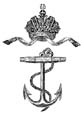
Note on crest.
The official emblem of the Austro-Hungarian Navy shows the Habsburg crown
decorated with two cap ribbons and a naval anchor.