It began at 8 o`clock on the evening of 14 May 1917 -
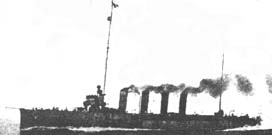
The cruiser NOVARA, Captain Nikolaus Horthy, and the cruisers SAIDA
and HELGOLAND left Cattaro and steamed southward. Destroyers from
Durazzo sailed independently and encountered an Italian convoy of three
merchant ships escorted by the destroyer BOREA. One of the ships
and the BOREA were sunk and another ship damaged.
The cruisers separated and passed through the barrage, 49 drifters, organised
in seven groups of seven, being mistaken for allied ships by those that saw
them. An eighth group had hauled in their nets and were returning home.
Lieut. Baunton R.N.R., who was in charge of the drifters, heard the attack
on the convoy and went to investigate, so was absent at 3.15 A.M. when a
cruiser appeared and opened fire on the drifters, and particularly the one
carrying radio, near the centre of the line. The drifters slipped their
nets and scattered and only one was sunk. The next group heard the firing
and started to retire westward, only to be met by a cruiser which called
on them to abandon ship. The GOWAN LEA, ADMIRABLE, JEAN and
SELBY; MORNING STAR, FLOANDI and CORAL HAVEN were made of strong
stuff and, instead of surrendering, fought back. Some repelled the enemy -
Skipper Nicholls of
At Brindisi the British cruisers BRISTOL (half an hour`s notice for
steam), DARTMOUTH (three hours) and LIVERPOOL (five hours),
were under the command of the Italian Rear Admiral Acton. By chance he had
sent out a destroyer patrol the previous evening to work up the east coast
towards Cattaro but they did not make contact with the enemy and first
reports of the attack came from British and Italian signal stations.
BRISTOL and two Italian destroyers sailed at 3 minutes past 5 on the
morning of the 15th, followed by Admiral Acton in DARTMOUTH with
two more destroyers and the Italian AQUILA.
AQUILA and the destroyers were detached to attack some Austrian destroyers
which fled into Durazzo after imobilising AQUILA by cutting her main
steam pipe. By 9.30 DARTMOUTH and BRISTOL were in action with
three cruisers which had been sailing towards AQUILA. The leading
Austrian ship was hit and the second set on fire before they turned away
under a smoke screen. They proved to be faster than BRISTOL and
DARTMOUTH found it dificult to keep up. When she came under fire
from the three Austrians she extended the range from 10,000 yards to
16,000 yards so that her 6 inch guns would be more effective than the
enemy 4.1 inch. NOVARA was hit repeatedly and as she slowed
Admiral Acton crossed her stern and poured in a murderous fire. But
they were within 30 miles of an enemy base and when two heavy cruisers
were sighted coming up he decided to retire to Brindisi. DARTMOUTH
was hit by a torpedo from a submarine and only just managed to make it
into harbour. This was probably the only time an Italian Admiral had
commanded a squadron from the bridge of a British cruiser.
NOVARA had to be towed into harbour. The 49 year old Horthy was
wounded, but the success of the raid brought him fame and he went on
to lead the `white` forces against the communist government of Hungary
in 1919-20. He became regent in 1920 until dismissed by Hitler in 1944.
The attempt to accuse him at the postwar Nurenberg Trials failed and he
died in 1957 in exile in Portugal. His coffin was brought back to Hungary in
1995 and is now in the family grave at Kenderes.
NOTE.
Written with assistance from Erwin Sieche who supplied the copy of
the painting
Douglas Morris Harris, the young wireless operator in Floandi, was killed by
gunfire at his post, still copying messages in the log. His memorial is in
St. Peters Church, Wolverhampton, and can be seen on
Wolverhampton Remembers
© 1997 Michael Phillips
Note on crest.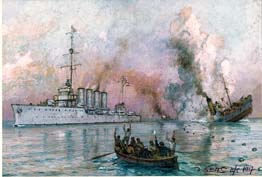
Sinking of a British trawler at the Otranto barrage by S.M.S. SAIDA
by official war artist Johann Seits, on board HELGOLAND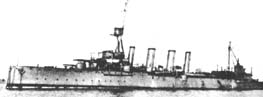
DARTMOUTH
Following the Austrian victory at Caporetto on 24 October 1917 the Italian
army fell back, losing 200,000 prisoners and and even greater number of
deserters. The Austrians reached within 20 miles of Venice before they were
finally halted by British, French and Italian troops on 18 June 1918. They
were driven back to the Isonzo with heavy losses in October 1918.
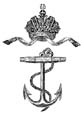
The official emblem of the Austro-Hungarian Navy shows the Habsburg crown
decorated with two cap ribbons and a naval anchor.
Return to Maritime History Index Page