The 35 cm guns of the 'improved TEGETTHOFF-class battleships'
The 35 cm guns of the 'improved TEGETTHOFF-class battleships'
by Erwin F. Sieche, Vienna, Austria.
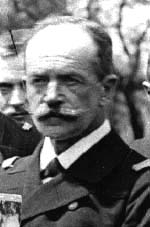
The 'improved TEGETTHOFF'-class battleships were to be built during the
period of navy commander admiral Anton Haus. This is one of the few
photographs showing Haus bareheaded, it was taken in 1900 when Haus held the
rank of a Linienschiffskapitaen (Captain).
First there was only an idea and a slogan
On 2 March 1911 the mutual financial delegations of Austria-Hungary approved
a big naval budget allowing the construction of the four dreadnoughts of the
TEGETTHOFF-class, 3 scout cruisers and 6 modern turbine destroyers. Very soon after this approval first ideas for the next class of battleships came up. Since long the Austrian Naval League (Oesterreichischer Flottenverein) had advertised in his monthly magazine "Die Flagge": "The MONARCH-class must be replaced". Therefore this next class of battleships often is called the 'Ersatz MONARCH-class'. In the official files, anyway, this design was first given project numbers (project I, II, III and so on) or tonnage designations (22.000 ton battleship, 23.400 ton battleship and the final variant 24.500 t battleship), finally they were referred to as the 'improved TEGETTHOFF-Class', which might be the historical correct label.
It is remarkably that the desire of building a new group of dreadnoughts
first came from the Skoda Werke AG and not from the Austro-Hungarian Navy.
While completing the 30,5 cm triple turrets of the TEGETTHOFF-class Skoda
was asking for follow up business arguing with the necessity of securing
high skilled jobs and ensuring development continuity. So 18 April 1911
Skoda submitted to the Naval Section detailed plans for 34,5 cm twin and
triple turrets. They had thought in advance for the Austro-Hungarian naval
architects and proposed triple turrets and superimposed twins in the
centreline. This design had a remarkably resemblance to contemporary
British turrets.
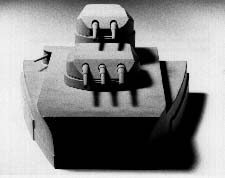
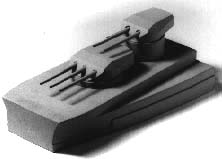
Demonstration model of the forward turret group of a 'improved TEGETTHOFF'
type battleship showing superimposed twin.
The Naval Section rejected this design for some technical reasons and
to counter predomination by Skoda, Austro-Hungarian naval authorities
ordered on 3 June 1911 the preparatory designs for the next Austro-Hungarian
dreadnought generation to the following alternative particulars:
A) 23.000 t metric, 10 x 30,5 cm cal 45, 18 x 15 cm, 24 x 7,5 cm
B) 24.600 t metric, 10 x 34,5 cm cal 45, 18 x 15 cm, 24 x 7,5 cm
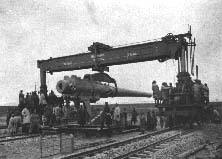
One of the manufactured 35 cm barrels. The particular spur-gear typical for
a turret mounted naval gun is clearly visible. Most probably this photograph
has been taken at an artillery proving ground.
The displacement limit was caused by the need to fit the future ship
(with half consumption supplies and full ammunition load) into the floating
drydock No 1, which had a lifting power of 23.800 metric tons.
It was believed, nevertheless, that such a design could match contemporary
opponents by cutting down the cruising radius, e.g. saving fuel weight,
regarding the geo-strategic situation of the Adriatic Sea. The most
remarkable fact was the desire for an alternative design for both Diesel
and turbine propulsion. But soon Diesel was rejected against conventional
mixed coal/oil burning boilers.
December 1911 the Austro-Hungarian Naval Technical Committee (MTK =
Marinetechnisches Komitee) presented its desing for both variants A and B
(see table). The demand for more secondary armament - 15 cm - was solved by
using twin casemates. The surmounting of the strict tonnage limit which
turned out after exact displacement calculations led to a series of
sub-variants with reduced poop-deck and other measures to save weight
dating from February to May 1912 (see table).
Competitive designs
Also in December 1911 the private owned yard industry tried to demonstrate
once again their predominance in design questions and the firms Ganz �z
t�rsa -Danubius, Stabilimento Tecnico Triestino, Cantiere Navale Triestino
and the naval architect Silvius Morin presented no less than 26 alternative
designs. But Poppers successor, Oberster Schiffbauingenieur (supreme naval
architect) Franz Pitzinger did not want to be overruled a second time like
in the TEGETTHOFF-class and all other designs were rejected.
In the mean time Skoda was asked to to work out new desings for the 34,5 cm
turrets. A board held 12 May 1912 increased the final calibre to 35 cm to
match the loss of penetration power given by the new standard shell to be
developed. A secon reason might have been the compatibility with German
ammunition: compare the German battlecruisers of the MACKENSEN class.
January 1913 the Naval Technical Committee presented its next design
(see table).
The dreadnoughts that were never built
Caused by the strict weight limit the designers had to save every ton
possible and therefore reduced the secondary artillery, ommitted the aft
conning tower and the mainmast and designed the heavy guns in triple
turrets superimposed over the twins to better follow the curve of the hull.
As this obviously inflicted stability the ammunition load was reduced and
in July exactly the same ship was presented with superimposed twins.
Apparently the Austro-Hungarian naval architects felt that such a stripped
down design would not be well balanced and presented two enlarged
alternative designs in January 1914, showing that more displacement was
necessary to make up a well balanced dreadnought with the benefit of a
speed increasement of two knots.
Pre-project I 29.600 t/23 kts, 12 x 35 cm, 18 x 15 cm
Pre-project II 32.000 ts/23 kts, 13 x 35 cm, 18 x 15 cm
But the tonnage limit was kept upright so in July 1914 the last design
variant was presented. For weight reasons the number of secondary guns
was reduced to 14 x 15 cm. This is the last existing design variant tho
which the 'improved TEGETTHOFFs' obviously would have been constructed.
A secret schedule dated 12.1.1914 proposed the following building dates
Name/Number     Builder envisaged    laying down    Completion
No VIII               STT            1.7.1914        30.6.1917
No IX              Danubius          1.1.1915        31.12.1917
No X                  STT            1.6.1916        31.5.1919
No XI              Danubius          1.6.1916        31.5.1919
This is only a first draft, but it shows the estimated building times and
the intended distributuion between the Hungarian and the Austrian yards.
Fundraising and politics
From the political point of view the history of the 'improved TEGETTHOFFs'
was not a repeat of the story of the TEGETTHOFFs although the industry
wanted for a second time to start construction on credit. In March 1913 the
Heir of the throne, archduke Franz Ferdinand, urged the new head of the
Austro-Hungarian navy, admiral Anton Haus, to order the new dreadnoughts
because the last of the STT built TEGETTHOFFs, the PRINZ EUGEN, had been
launched since four months and the yard needed urgently a follow up
contract. But the Hungarian authorities headed by primeminister Wekerle
refused to start building on credit, arguing that the only legal way would
be providing funds in the 1914/15 budget. Even the Emperor himself tried
without result to convince the Hungarian minister of finance, Dr. Teleszky,
to start construction before the budget was approved. But Weckerle refused.
And not before 28 May 1914 the 1914/15 budget was approved by the mutual
delegations. This included a special credit of 426,8 million Crowns, enough to built the new battleships VIII - XI. End of June STT was ordered
to build No VIII and Ganz �z t�rsa - Danubius to build No IX. As we all
know just in the same time the fatal murder of Sarajevo set an abrupt
end to all ship construction because of the outbreak of World War I. On
3 February 1915 the Austro-Hungarian navy administration definitely
declared in a meeting of the ministers for mutual affairs (Ministerrat
f�r gemeinsame Angelegenheiten) to 'freeze' this money and present a new
fleet program to the mutual delegations after the end of the war.
TABLE
List of all different MTK-Projects of the 'improved TEGETTHOFF'-type
Date            Displacement constr.         Armament

December 1911   22.000 t                only triple turrets
Dimensions	161 x 27,6 x 8,4 m	12 x 30,5 cm cal 45
		22 x 15 cm cal 50
		24 x 7,5 cm cal 50
		4 twin-casemates fore
		2 twin-casemates aft

December 1911   23.400 t               twins superimposed over triple turrets
Dimensions	165 x 27,8 x 8,4 m	10 x 34,5 cm cal 45
		22 x 15 cm cal 50
		24 x 7,5 cm cal 45
		4 twin-casemates fore
		2 twin-casemates aft

December 1911   24.500 t               twins superimposed over triple turrets
Dimensions	165 x 27,8 x 84 m	10 x 34,5 cm cal..
		22 x 15 cm cal 50
		24 x 7,5 cm cal..
		4 twin-casemates fore
		2 twin-casemates aft

December 1911   23.400 t               twins superimposed over triple turrets
Dimensions	165 x 27,8 x 8,4 m	10 x 34,5 cm cal 45
		22 x 15 cm cal 50
		24 x 7,5 cm cal 45

February 1912   22.000 t               only triple turrets
Dimensions	161 x 27,6 x 8,4 m	12 x 30,5 cm cal 45
		22 x 15 cm cal 50
		24 x 7,5 cm cal 50
		4 twin-casemates fore
		2 twin-casemates aft
		partially reduced poop deck

May 1912        25.200 t               1 triple, 4 twin turrets
Dimensions	175 x 28,5 x 8,5 m	11 x 34,5 cm cal 45
		16 x 15 cm cal 50
		18 x 7,5 cm cal 50
		one double story casemate fore
		focsle extending until fore funnel

May 1912        25.200 t               only triple turrets
Dimensions	175 x 28,5 x 8,5 m	12 x 34,5 cm cal 45
		16 x 15 cm cal 50
		18 x 7,5 cm cal 50
		one double story casemate fore
		focsle extending until fore funnel

May 1912        25.200 t               3 triple, 2 twin turrets
Dimensions	175 x 28,5 x 8,5 m	13 x 34,5 cm cal 45
		16 x 15 cm cal 50
		18 x 7,5 cm cal 50
		one double story casemate fore
		focsle extending until fore funnel

May 1912        25.200 t               2 triple, 3 twin turrets
Dimensions	175 x 28,5 x 8,5 m	12 x 34,5 cm cal 45
		14 x 15 cm cal 50
		18 x 7,5 cm cal 50
		one double story casemate fore
		focsle extending until fore funnel

January 1913    24.500 t               triple superimposed over twin turrets
Dimansions	172 x 28,5 x 8,4 m	10 x 35 cm cal 45
		18 x 15 cm cal 50
		22 x 9 cm cal 45, including 6 AA guns
		double story casemates fore

April 1913      24.500 t               twins superimposed over triple turrets
Dimensions	172 x 28,5 x 8,4 m	10 x 35 cm cal 45
		18 x 15 cm cal 50
		20 x 9 cm cal 45, including 4 AA guns
		double story casemates fore

January 1914    29.600 t               only 4 triple turrets
Preproject	194 x 29 x 8,5 m	12 x 35 cm cal 45
		18 x 15 cm cal 50
		18 x 9 cm cal 45, including 10 AA guns
		double story casemates fore

January 1914    32.000 t               twins superimposed over triples,
Preproject                             3 triples, 2 twins
Dimensions	196,5 x 29,5 x 8,4 m	13 x 35 cm cal 45
		18 x 15 cm cal 50
		18 x 9 cm cal 45, including 10 AA guns
		double story casemates fore

January 1914    24.500 t               triple superimposed over twin turrets
Dimensions	172 x 28,5 x 8,4 m	10 x 35 cm cal 45
		14 x 15 cm cal 50
		22 x 9 cm cal 45, including 12 AA guns
		double story casemates fore

July 1914       24.500 t               twins superimposed over triple turrets
Dimensions	172 x 28,5 x 8,4 m	10 x 35 cm cal 45
		14 x 15 cm cal 50
		20 x 9 cm cal 45, including 12 AA guns
The last approved design of the improved TEGETTHOFF-class dated July 1914
The 35 cm gun cal 45
The 'Waffenfabrik der Skodawerke AG' received the contract for the first
batch of guns for the 'improved TEGETTHOFFs' 24 July 1914: 10 guns plus
one spare barrel for the first unit. 22 November 1914 a 35 cm trials barrel
was tested at the Skoda gunnery proving ground at Bolewetz. On 28 May 1915
Skoda reported that gun No 1 plus cradle is ready for delivery. On 9 March
1916 gun No 2 was tested at the Skoda gunnery ground at Bolewetz. In April
1916 gun No 1 was tested at the Hungarian gunnery proving ground at
Hajmask�r and achieved a range of 35 kms. The same month the gun is going
to the Italian front to form a mixed battery together with a 38 cm cal 15
howitzer. It has often been published that this gun was named 'Georg', but
there is no proof in the official files, maybe it was an inofficial name
given by the field troops. 10 April 1916 the Heir of the throne, archduke
Karl, the later Emperor Karl I., inspected the battery. 16 to 22nd of May
1916 gun No 1 fired against targets near Asiago, Fondi, Gallioand Camporovere. A total of 122 shots was fired at ranges of 25 kms until
the aiming error became so significant that the gun had to be returned to
Skoda for refurbishing. 30 May 1916 gun No 1 returned to Skoda to be
changed against gun No 2, but this never happened because No 2 had been
sent to the Bulgarian front. It's goal was to destroy Romanian
fortifications on the Danube when Marshal Mackensen's Army crossed
that river attempting to encircle the retreating and defeated Romanian
army near Bucharest. So on 23 and 24 November 1916 gun No 2 was in
action near Svistov, but only a few rounds were fired.
18 May 1917 gun No 3 was tested at the Skoda proving ground Bolewetz.
A status report by Skoda dated May 1917 reads as follows:
Gun No 1 returned from the front.
Gun No 2 delivered as B.K. L 45/No 2. (B.L. means Belagerungskanone, e.g.
siege gun).
Gun No 3 is completed at Skoda.
Gun No 4 is in the final stage of completion.
Guns No 5-11 are in different stages of completion.
Gun No 2 was later sent to the Italian front and installed end of August
1917 at Santa Croce near Opcina/Opicina above the city of Trieste. 23
September 1917 it was ready to fire against the long range Italian coastal
batteries situated between Grado and the Isonzo estuary. 18 October gun
No 2 fired the first shot over the gulf of Trieste against Grado.
The final fate of these guns is not really clear. It is said that gun
No 2 returned from the Italian front to Skoda while No 3 was sent from
Plzen via the Vienna Artillery Arsenal to the front. According to one
source it reached the front and was in action up to the Austrian collapse
end of October 1918 when it was captured by the Italians. According to
another source it was left in Yugoslavia just behind the new Italo-Yugoslav
frontier. According to a third source the gun left in Yugoslavia was not
No 3 but No 4 which had been delivered to the Vienna Artillery Arsenal
just before end of World War I. At any rate, the Yugoslavs possessed one
35 cm cal Skoda gun in the interwar period. Another 35 cm gun fell into
French hands, and it was most likely gun No 4 which they had sized in
Austria.
Historical problems
The table shows that 15 different designs studies were submitted by the
Naval Technical Committee during the three year design process. As all
these were presented with a full set of plans, researchers and naval
historians asking for those plans at the Oesterreichisches
Staatsarchiv/Kriegsarchiv, Vienna, Austria, were often supplied with one
of the different versions by pure chance. Since the twenties we find
different drawings in the reference books, each one claiming to be the
'real' one. This lead to great confusion about the final appearance of
the 'improved TEGETTHOFFs'. Especially the question of superimposed
twin or superimposed triple turrets was never really clear for a long
time. But the date of issue clearly shows that the design of July 1914
with superimposed twins would have been the final choice.
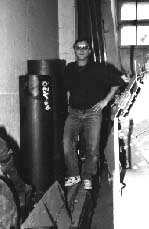
The collection of the future Museo della Guerra per la Pace at Padriciano
near Trieste, Italy, holds two cartridges of Austro-Hangarian naval guns.
The greater one has the dimensions 1440 mm, diameter 360 mm, inscription on
the base reads 'Berndorf 1916 / 342'. Berndorf is the manufacturer. Most
probably it comes from gun No 2 which was posted at Santa Croce near
Opicina/Opcina in fall of 1917.
The second cartridge has the dimensions 1280 mm, diameter 310 mm,
inscription on the base reads 'Berndorf 1906 / I 58'. Most probably it comes
from a battleship of the RADETZKY-class.
The author is in the picture for size comparison.
Technical particulars of the gun 35 cm cal 45
Caliber:	350 mm
Powderload:	193 kg
Projective's weight:	700 kg
Vo:	770 m/sec
Normal pressure:	2.800 atmospheres
max:	2.900 atmospheres
1 kg powder brings:	112,9 mt
Official files and plans
Oesterreichisches Staatsarchiv/Kriegsarchiv, Vienna
Files II GG 1911 4D/4 2/7, 2/21, 7/9; I GG 1913 I-4/11; II GG 1914 47 C
6/4-9/5, II GG 1914 IV B 1/7
Collection of ship's plans
Sch IV/1-2 to Sch IV/1-6
Reference books
Gray Randal (Editor), Conway's all the World's Fighting Ships 1906-1921,
London 1985, page 335
Prasil, Michal, Skoda Heavy Guns, Atglen, PA/USA, 1997
Schirmer, Hermann, Das Geraet der schweren Artillerie vor, in und nach
dem Weltkrieg, Berlin 1937, page 374
Periodicals
Die Flagge, Vienna, August 1913, pages 294, 295
HADITECHNIKA, Budapest, 3/1972, page 54
MARINE - Gestern, Heute, Vienna, 4/1977, page 118
Marine Rundschau, Germany, October 1938, page 752f
Warship International, Toledo USA, 2/1971, page 186, 1/1972, page 85,
4/1972, page 443, 2/1974, page 173ff, 3/1980, page 281, 1/1984, page 120f,
3/1985 page 320f
© 1997 Erwin F. Sieche, Vienna, Austria
Note on crest.
The official emblem of the Austro-Hungarian Navy shows the Habsburg crown
decorated with two cap ribbons and a naval anchor.
Return to Maritime History Index Page