In 1827 Captain John Ross R.N. proposed to his Majesty`s Government, to fit out an expedition to discover the North West Passage. When they declined the undertaking, his wealthy friend Mr Felix Booth, finding that the Act providing a financial reward for the discovery had been repealed, and that therefore there could be no suspicion of interested motives, agreed to finance him to the tune of £ 17 - 18,000. A paddle steam-ship, The Victory, was purchased, and, with a crew of 19 men, he sailed from England in May 1829.Copy of a Letter from Captain Ross to Captain the Honourable the George Elliot, C.B. [Secretary to the Board of Admiralty] dated on board the Isabella of Hull, Baffin`s Bay, September 1833.
SIR, Knowing how deeply my Lord`s Commissioners of the Admiralty are interested in the advancement of natural knowledge, and particularly in the improvement of geography, I have to acquaint you, for the information of their Lordships, that the expedition, the main object of which to solve if possible the question of a North-west Passage from the Atlantic to the Pacific Ocean, particularly by Prince Regent`s Inlet, and which sailed from England in May 1829, notwithstanding the loss of the fore-mast, and other untoward circumstances, which obliged the vessel to refit in Greenland, reached the beach on which His Majesty`s late ship Fury`s stores were landed, on 13th August.
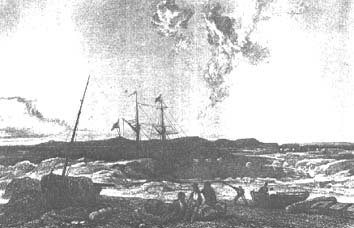
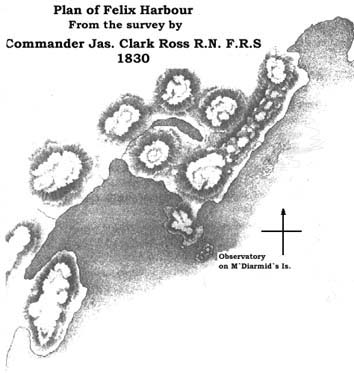
We found the boats, provisions, &c. in excellent condition, but no vestige of the wreck. After completing in fuel and other necessaries, we sailed on the 14th, and on the following morning rounded Cape Garry, where our new discoveries commenced, and keeping the western shore close on board, ran down the coast in a S.W. by W. course, in from ten to twenty fathoms, until we had passed the latitude of 72° north in longitude 94° west; here we found a considerable inlet leading to the westward, the examination of which occupied two days; at this place we were first seriously obstructed by ice, which was now sure to extend from the South Cape of the inlet, in a solid mass, round by south nd east into E.N.E. Owing to this circumstance, the shallowness of the water, the rapidity of the tides, the tempestuous weather the irregularity of the coast, and the numerous inlets and bays, for which it is remariable, our progress was no less dangerous than tedious, yet we succeeded in penetrating below this latitude of 70° north in longitude 92° west, where the land, after having carried us as far east as 90° took a decided westerly direction, while land at the distance of forty miles to southward, was seen trending east and west. At this extreme point our progress was arrested on 1st October by an impenetrable barrier of ice. We, however, found an excellent wintering port which we named "Felix Harbour."
FELIX HARBOUR. Lat.60° 58` 42" 5 N 92° 1` 6" 6 W
Early in January 1830, we had the good fortune to establish a friendly intercourse with a most interesting association of natives, whom being insulated by nature, had never before comunicated with strangers; from them we gradually obtained the important information that we had already seen the Continent of America, that, about forty miles to the south-west there were two great seas, one to the west, which was divided from that to the east by a narrow strait or neck of land. The verification of this intelligence either way, on which our future operations so materially depended, devolved on Commander Ross who volunteered this service early in April, accompanied by one of the mates, and guided by two of the natives, proceeded to the spot, and found that the north land was connected to the south, by two ridges of high land, 15 miles in breadth; but taking into account a chain of fresh water lakes, which occupied the valleys between, the dry land, which actually separates the two oceans, is only five miles. This extraordinary isthmus was subsequently visited by myself, when Commander Ross proceeded minutely to survey the sea coast to the southward of the isthmus leading to the westward, which he succeeded in tracing to the 99th degree, or to 220 miles of Cape Turnagain of Franklin, to which point the land, after leading him into the 70th degree of north latitude, trended directly; during the same journey he also surveyed 30 miles of the adjacent coast, or that to the north of the isthmus which, by also taking a westerly direction, formed the termination of the western sea into a gulf. The rest of this season was employed in tracing the sea coast south of the isthmus, leading to the eastward, which was done so as to leave no doubt that it joined, as the natives had previously informed us, to Ackullee, and the land forming Repulse Bay. It was also determined that there was no passage to the westward for 30 miles to the northward of our position.
This summer, like that of 1818, was beautifully fine, but extremely unfavourable for navigation, tion, and our object being now to try a more northern latitude, we waited with anxiety for the disruption of the ice, but in vain, and our utmost endeavours did not succeed in retracing our steps more than four miles, and it was not until the middle �of November, that we succeeded in cutting the vessel into a place of security, which we named "Sheriff`s Harbour." I may here mention, that we named the newly discovered continent, to the southward, "Boothia," as also the isthmus, the peninsula to the north, and the eastern sea, after my worthy friend, Felix Booth, Esq., the truly patriotic citizen of London, who, in the most disinterested manner enabled me to equip this expedition in a superior style. The last winter was in temperature nearly equal to the means of what had been experienced on the four preceding voyages, but the winters of 1830 and 1831 set in with a degree of violence hitherto beyond record, the thermometer sank to 92 below the freezing point, and the average of the year was 100 below the preceding; but notwitstanding the severity of the summer, we travelled across the country to the West Sea, by a chain of lakes, 30 miles north of the isthmus, when Commander Ross succeeded in surveying 50 miles more of the coast leading to the N.W. and, by tracing the shore to the northward of our position, it was also fully proved that there could be no passage below the 71st degree.
This autumn we succeeded in getting the vessel only 14 miles to the northward, and as bad not doubled the Eastern Cape, all hopes of saving the ship was at an ends and put quite beyond possibility by another very severe winter, and having only provisioms to last us to June 1, 1832, dispositions were accordingly made to leave the ship. in her present port, which (after her) was named "Victory Harbour." (This has since been named "Victoria Harbour," by permission of their Royal Highnesses the Duchess of Kent and Princess Victoria.) Provisions and fuel being carried foward in the spring, we left the ship on May 29, 1832, for Fury Beach, being the only chance left of saving our lives. Owing to the very rugged nature of the ice, we were obliged to keep either upon or close to the land, making the circuit of every bay, thus increasing our distance of 200 miles nearly one half, and it was not until July 1 that we reached the beach, completely exhausted by hunger and fatigue.
A hut was speedily constructed, and the boats, three of which had been washed off the beach, but providentially driven on shore again, were repaired during this month; but the unusual heavy appearance of the ice afforded us no cheering prospect until August 1, when in three boats we reached the ill-fated spot where the Fury was first driven on shore, and it was not until September 1 we reached Leopold South Island, now established to be the N.E. point of America, in lat. 73° 56`, and long. 90° west. From the summit of the lofty mountain on the promontory we could see Prince Regent`s Inlet, Barrow`s Strait, and Lancaster Sound, which presented one impenetrable mass of ice just as I had seen it in 1818, here we remained in a state of anxiety and suspense, which may be easier imagined than described. All our attempts to push through were vain; at length being forced by want of provisions and the approach of a most severe winter to return to Fury Beach, where alone there remained wherewith to sustain life; there we arrived on October 7, after a most fatiguing and laborious march, having been obliged to leave our boats at Batty Bay. Our habitation, which consisted in a frame of spars, 32 feet by 16, covered with canvas, was during the month of November enclosed, and the roof covered with snow from four to seven feet thick, which being saturated with water when the temperature was 15deg. below zero, immediately took the consistency of ice, and thus we actually became the inhabitants of an iceberg during one of the most severe winters. hitherto recorded: our sufferings, aggravated by want of bedding, clothing, and animal food, need not be dwelt upon. Mr. C. Thomas, the carpenter, was the only man who perished at this beach, but three others, besides one who had lost his foot, were reduced to the last stage of debility, and only thirteen of our number were able to carry provisions ia seven journeys of sixty-two miles each to Batty Bay. We left Fury Beach on July 8, carrying with us three sick men which were unable to walk, and in six days we reached the boats, where the sick daily recovered. Although the spring was mild it was not until August 15 that we had any cheering prospect, a gale from the westward having suddenly opened a lane of water along shore: in two days we reached our former position, and from the mountain we had the satisfaction of seeing clear water almost directly across Prince Regent`s Inlet, which we crossed on the 17th, and took shelter from a storm twelve miles to the eastward of Cape York. Next day, when the gale abated, we crossed Admiralty Inlet, and were detained six days on the coast by a strong north-east wind. On the 25th we crossed Navy Board Inlet, and on the following morning, to our inexpressible joy, we descried a ship in the offing becalmed, which proved to be the Isabella, of Hull, the same ship which I commanded in 1818; at noon we reached her, when her enterprising commander, who had in vain searched for us in Prince Regent`s Inlet, after giving us three cheers, received us with every demonstration of kindness and hospita1ity which humanity could dictate. I ought to mention, also, that Mr. Humphreys, by landing me at Possession Bay, and subsequently on the west coast of Baffin`s Bay, afforded me an excellent opportunity of concluding my survey, end of verifying my former chart of that coast.
I now have the pleasing duty of calling the attention of their lordships to the merits of Commander Ross, who was second in the direction of this expedition. The labours of this officer, who had the departments of Astronomy, Natural History, and Surveying, will speak for themselves in Ianguage beyond the ability of my pen, but they will duly be appreciated their Lordships, and the Iearned bodies of which he is a member, and who are already - well acquainted with his acquirements.
My steady and faithful friend, Mr William Thorn, of the Royal Navy. who was formerly wtth me in the Isabella, besides his duty as third in command, took charge of the Meteorological Journal; the distribution and economy of provisions, and to his judicious plans and suggestions must be attributed the uncommon degree of health which our crew enjoyed; and as two out of the three who died the four and a half years, were cut off early in the voyage by diseases not peculiar to the climate, only one man can be said to have perished. Mr. M`Diarmid, the surgeon, who had been several voyages to these regions, did justice to the high recommendaticm I received of him: he was successful in every amputation and operation which he performed, and wonderfully so in his treatment of the sick; and I have no hesitation in adding, that he would be an ornament to His Majesty`s service. Commander Ross, Mr. Thorn, and myself, have, indeed, been serving without pay, but, in common with the crew, have lost our all; which I regret the more, because it puts it. totally out of my power adequately to remunerate my fellow-sufferers, whose ease I cannot but recommend for their Lordship`s consideration. We have, however, the consolation, that the results of this expedition have been conclusive and to science highly important; and may be briefly comprehended in the following words The discovery of the Gulf of Boothia, the Continent and Isthmus of Boothia Felix, and vast number of islands, rivers, and lakes; the undeniable establishment, that the N.E.point of America extends to the 74th degree of north latitude. Valuable observations of every kind, with water when the temperature was 15deg. below zero, immediately took the consistency of ice, and thus we actually became the inhabitants of an iceberg during one of the most severe winters. hitherto recorded: our sufferings, aggravated by want of bedding, clothing, and animal food, need not be dwelt upon. Mr. C. Thomas, the carpenter, was the only man who perished at this beach, but three others, besides one who had lost his foot, were reduced to the last stage of debility, and only thirteen of our number were able to carry provisions ia seven journeys of sixty-two miles each to Batty Bay. We left Fury Beach on July 8, carrying with us three sick men which were unable to walk, and in six days we reached the boats, where the sick daily recovered. Although the spring was mild it was not until August 15 that we had any cheering prospect, a gale from the westward having suddenly opened a lane of water along shore: in two days we reached our former position, and from the mountain we had the satisfaction of seeing clear water almost directly across Prince Regent�s Inlet, which we crossed on the 17th, and took shelter from a storm twelve miles to the eastward of Cape York. Next day, when the gale abated, we crossed Admiralty Inlet, and were detained six days on the coast by a strong north-east wind. On the 25th we crossed Navy Board Inlet, and on the following morning, to our inexpressible joy, we descried a ship in the offing becalmed, which proved to be the Isabella, of Hull, the same ship which I commanded in 1818; at noon we reached her, when her enterprising commander, who had in vain searched for us in Prince Regent`s Inlet, after giving us three cheers, received us with every demonstration of kindness and hospita1ity which humanity could dictate. I ought to mention, also, that Mr. Humphreys, by landing me at Possession Bay, and subsequently on the west coast of Baffin`s Bay, afforded me an excellent opportunity of concluding my survey, end of verifying my former chart of that coast I now have the pleasing duty of calling the attention of their lordships to the merits of Commander Ross, who was second in the direction of this expedition. The labours of this officer, who had the departments of Astronomy, Natural History, and Surveying, will speak for themselves in Ianguage beyond the ability of my pen, but they will duly be appreciated their Lordships, and the Iearned bodies of which he is a member, and who are already - well acquainted with his acquirements. My steady and faithful friend, Mr William Thorn, of the Royal Navy. who was formerly wtth me in the Isabella, besides his duty as third in command, took charge of the Meteorological Journal; the distribution and economy of provisions, and to his judicious plans and suggestions must be attributed the uncommon degree of health which our crew enjoyed; and as two out of the three who died the four and a half years, were cut oft early in the voyage by diseases not peculiar to the climate, only one man can be said to have perished. Mr. M`Diarmid, the surgeon, who had been several voyages to these regions, did justice to the high recommendaticm I received of him: he was successful in every amputation and operation which he performed, and wonderfully so in his treatment of the sick; and I have no hesitation in adding, that he would be an ornament to His Majesty`s service.
Commander Ross, Mr. Thorn, and myself, have, indeed, been serving without pay, but, in common with the crew, have lost our all; which I regret the more, because it puts it. totally out of my power adequately to remunerate my fellow-sufferers, whose ease I cannot but recommend for their Lordship`s consideration.
We have, however, the consolation, that the results of this expedition have been conclusive and to science highly important; and may be briefly comprehended in the following words The discovery of the Gulf of Boothia, the Continent and Isthmus of Boothia Felix, and vast number of islands, rivers, and lakes; the undeniable establishment, that the N.E.point of America extends to the 74th degree of north latitude. Valuable observations of every kind, but particularly on the magnet; and to crown all, we have had the honour of placing the illustrious name of our most gracious Sovereign, William the Fourth, on the true position of the Magnetic Pole.
I cannot conclude this letter, Sir, without acknowledging the important advantages obtained, from the valuable publications of Sir Edward Parry and Sir John Franklin, and the communication kindly made to us by these distinguished officers before our departure from England.
But the glory of this enterprise is entirely due to Him whose divine favour has been most especially manifested towards us, who guided and directed all our steps, who mercifully provided effectual means for our preservation, and who, even after the devices and inventions of man had utterly failed, crowned our humble endeavours with complete success.
I have the honour to be, &c.
JOHN ROSS, Capt RN.