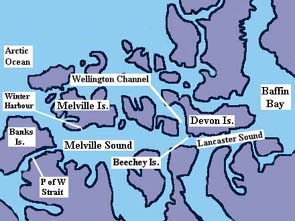
On 12 December 1856, as the result of a generous gesture by the American Congress, HMS RESOLUTE, a Royal Navy arctic discovery vessel, arrived off Portsmouth, England, with an American crew and under the command of Commander Hartstein of the U.S. Navy. The story of the ship, and the events which led up to this unique occasion will be told in this section. In May 1845 the distinguished British Arctic explorer Sir John Franklin sailed with the two ships EREBUS and TERROR in search of the North-West Passage across the north of Canada between the Atlantic and Pacific Oceans. They were never seen again after they spoke to a whaling ship on 26 July. Between 1848 and 1859 no less than 32 vessels were sent out from England, and three from the United States, to try and find out what had happened to them. In February 1852 the British Admiralty commissioned four ships RESOLUTE, INTREPID, ASSISTANCE and PIONEER for an expedition into the Arctic to search for clues to Franklin`s fate. The first pair were to go to Melville Island and the second to go up Wellington Passage. A fifth ship, the NORTH STAR, commanded by Captain Pullen, was to be stationed as a depot at Beechey Island, where it was already known that Franklin`s party had spent their first winter.
The overall command was given to the 53 year old Captain Sir Edward Belcher, who had been employed since the mid 1820`s on survey work in the Far East and on the coasts of South and North America. The appointment was unfortunate. When men are confined together in the close quarters of a ship for years at a time, tact and good temper are essential for harmonious living. Belcher possess neither quality and inspired an immediate dislike in all who met him. Captain Henry Kellett commanded HMS RESOLUTE. He was 7 years younger than Belcher and had served under him during the war in China in the early 1840`s where Kellett, as a young lieutenant, had been highly praised for his courage under fire. He was an amiable man who got on well with his subordinates. INTREPID was commanded by Commander M`Clintock and Belcher in ASSISTANCE was accompanied by the experienced Commander Osborn in PIONEER. Belcher treated Osborn shamefully and eventually superseded him in his command. HMS RESOLUTE
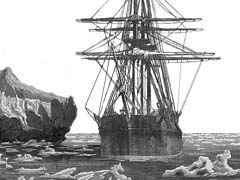
HMS RESOLUTE was built as PTARMIGAN and purchased by the Admiralty on 21 February 1850. She was first named REFUGE, but this was changed the following month. She was 424 tons burthen with a length of 115 feet and a beam of 28.5 feet. She was massively built, with her bows and sides built up with three thicknesses of wood to withstand the pressure of the ice. All the decks were double planked. A steam pipe, fed from a furnace which was also used for cooking , passed under every berth and through every cabin, and pipes three feet in diameter ran between decks to keep the vessel warm, even when the outside temperature was down to 70 deg. below zero.
COMMANDER McCURE AND HMS INVESTIGATOR
We must now leave Captain Belcher` expedition preparing to sail and backtrack in time to 1850 when Commander Robert McClure in HMS INVESTIGATOR entered the Arctic from the Pacific Ocean by way of the Bering Straits. On 5 August he rounded Point Barrow, the northernmost point of what was then Russian America and at the end of the month reached Cape Bathurst where he gave a letter addressed to the Hudson`s Bay Company to a party of Inuit. To the north they sighted land which was not shown on their charts and they named it Baring`s Land, not knowing that it was the southern end of the already known Banks Island. More land to the east they named after Prince Albert and the water between them, in the hope that it was a strait and not a bay, Prince of Wales Strait. They sailed up this Strait for three weeks in clear water until the weather worstened and ice began to form. By the end of September, when their observations showed that they were only 60 miles from Melville Sound, INVESTIGATOR was beset. On the 26 October McClure and six men left the ship with a sledge and travelled over the ice up Prince of Wales Sound for five days; a hard journey, since they had to rely on lighting fires to melt snow for dinking and soften their pemmican. On the 20th. they ascended 600 feet up a hill on the coast of Banks Island before dawn and by the light of the rising sun they could see Prince Albert Land to the east as far as what was later known as Peel Point, and beyond that the ice of Melville Sound. They realised that they were seeing places which had already been reached from the eastern side, so the North West Passage had at last been discovered. The INVESTIGATOR got out of the ice in July 1851 but was unable to push her way north up Prince of Wales Strait. MaClure then attempted to work up the western side of Banks Island with a clear sea for the first 300 miles but by the end of Sepember the ice closed in and forced him to go into winter quarters at a place he called Mercy Bay on the north coast of the island. In the spring of 1852 he sent out a number of exploratory parties and he himself crossed the ice to Melville Island where, at a place called Winter Harbour, he found a message left the previous year by a Captain Austin saying that a boat with provisions had been left at Beechey Island. He also added a record of INVESTIGATOR`s exploits to the sandstone on which the explorer William Parry had carved the story of the winter he spent there in 1820. The ice did not melt in the summer but they were well supplied with game - reindeer and musk oxen - but when these migrated with the onset of winter the position became serious. The winter of 1852-3 was a severe one with temperatures as low as 65 deg. below zero and by the spring, with provisions running short, a quarter of the crew on the sick list and signs of scurvey. Maclure had decided to send the weakest overland to safety in the trading posts on the Mackenzie River. CAPTAIN BELCHER`S EXPEDITION
Meanwhile in the summer of 1852 ASSISTANCE and PIONEER entered Wellington Sound, reached as far as 77 deg. North. and found winter quarters in Northumberland Inlet on the north-eastern point of Devon Island.
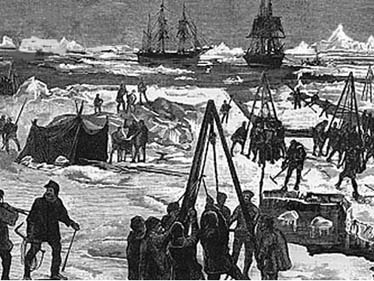
The ice in Melville Sound was unusually clear and RESOLUTE and INTREPID were able to reach as far as Melville Island and visited Winter Harbour, but they failed to notice McClure`s message. They then fell back eastwards along the coast and found good , sheltered winter quarters at Dealy Island. One of the exploratory parties which Captain Kellett sent out just before the arrival of winter revisited Winter Harbour and there Lieutenant Mecham did discover the sandstone. As soon as travelling was possible in the spring a party was sent across Melville Sound to see if INVESTIGATOR was still there. They found her just as the final preparations for sending the party to the mainland were being made. MaClure describes their meeting thus. "While walking near the ship with the First Lieutenant we perceived a figure walking rapidly towards us from the rough ice at the entrance to the bay. From his pace and gestures we both naturally assumed that he was being pursued by a bear. The stranger came on and then called out - `I am Lieutenant Pim, late of the HERALD, and now in RESOLUTE. Captain Kellett is in her at Dealy Island.!` To rush and seize him by the hand was the first impulse, for the heart was too full for the heart to speak." MaClure visited Capt. Kellett and at first there was some hope that INVESTIGATOR could be saved, but the health of the crew would not permit it. They were transferred to RESOLUTE and INTREPID and INVESTIGATOR`s remaining stores were landed and placed under a cairn of stones. Then her colors were hoisted and she was left in the ice. As soon as the ice melted in the summer of 1853 Capt. Kellet sent a Lieut. Cresswell in a boat to Beechey Island. Here he was picked up by HMS PHOENIX and taken to England with his despatches. RESOLUTE and INTREPID followed but got caught in pack ice in Melville Sound and were forced to spend the following winter beset south of Bathurst Island to the east of Melville Island. When travelling was again possible in the spring of 1854 Capt. Kellett sent an officer to Capt. Belcher with a report of his plans for next summer`s work. However Capt. Becher had had enough. His first two winters in a ship embedded in the ice had proved too much for a man of his temperament, and he resolved that he would rather sacrifice his ships than go through another. He sent back orders to Capt. Kellett to abandon his two ships and bring all his people to Beechey Island where he would join him after abandoning ASSISTANCE and PIONEER. They would then all return to England in the NORTH STAR. Capt.Kellett replied that he had plenty of provisions, his two ships were in no danger, and they were in a good position to be free of the ice the following summer. Capt. Belcher then sent him written, peremptory orders to abandon his ships and he had no option but to obey. They left them on 15 June and arrived at Beechey Island after a two week journey across the ice to find that the PHOENIX and the TALBOT had arrived there to join NORTH STAR. They returned to England in September. In England the captains had to face courts martial to answer for the loss of their ships. Kellett was acquitted of blame, complimented by the court and immediately promoted to be Commodore in Jamaica. He finished up a Rear Admiral, Commander-in-Chief in China. and died in 1875. Belcher was acquitted without comment, the court deciding that legally he was acting within the discretionary powers given to him, but he was never employed again and died in 1877. McClure and his crew, the first men to pass between the Pacific and the Atlantic Oceans in the polar regions, were also honorably acquitted. He died an Admiral in 1873. THE RETURN OF HMS RESOLUTE
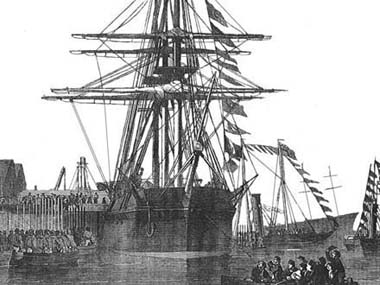
But what of RESOLUTE? Left to her own devices she freed herself from the ice pack the following summer, just as Capt. Kellett had foretold, and made her way, uninjured, through Lancaster Sound and out into Baffin Bay. On 16 September 1855 she was found by Capt. James Buddington of the American whaler GEORGE HENRY still in ice in the Davis Strait off Baffin Island at lat. 6deg. 30 sec. North, long. 64 deg. West. after travelling some 1200 miles. When he and some of his crew took up their quarters on board her they found "A deathlike silence and a dread repose. For a year and four months no human foot had trod the deck of that deserted ship." When the thaw set in he took her to his home port of New London, Connecticut, where, after the British Goverment waived all claim to her, the American Government bought her from the fortunate walers for for $40,000. She was refitted at the American Government`s expense in the Brooklyn Navy Yard with the intention of presenting her to the British Government "on behalf of the people of the United States as a token of the friendly feelings by which our country is actuated." She was repainted from stem to stern, her sails and most of her rigging replaced with new and new flags were made in the Navy Yard to replace those which had rotted away. The books in the captain`s library, the pictures in his cabin and the musical box and the organ belonging to the other officers were all preserved. At noon on 13 November she sailed for England under the command of Commander H.J.Hartstein of the US Navy, with his officers, Lieuts. C.H. Wells, E.E. Stone and Hunter Davidson. The passage was a succession of gales and the night previous to her arrival was described as very wild - heavy rain and hail with vivid lightning.
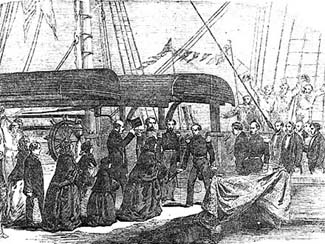
On 12 December she anchored at Spithead, off Portsmouth Harbour in England. The following morning at 11 o`clock the wooden steam frigate HMS SHANNON saluted the American ensign with 21 guns, after which RESOLUTE changed her colors to English and the Portsmouth garrison battery (on the flagstaff of which was hoisted the Stars and Stripes) fired another 21 gun salute. Later in the day Commander Hartstein embarked in the steam tender SPRIGHTLY to be welcomed ashore by Commander-in-Chief of the port. On the 15th RESOLUTE was towed to Cowes Harbour on the Isle of Wight where she was visited by Queen Victoria.
The last official engagement of Commander Haltstein and his officers was a municipal banquet given by the Mayor of Portsmouth. A great many speeches were made and a great many toasts were drunk. The last one being "May the natural link beween The United States and Great Britain never be broken." In 1879, when RESOLUTE was finally broken up, a desk was made from her timbers which was presented by Queen Victoria to President Rutherford S. Hayes. Apart from short spells, the desk has been in daily use in the Oval Office of the White House by every President of the United States since then. On 15 February 1965 the British Prime Minister, Harold Wilson, presented President Lyndon B. Johnson with the bell from RESOLUTE. Captain Buddington never saw a dollar of the money promised by Congress, although he did manage to arrange for some money to be paid to his crew.
******************* Elizabeth Loeppert, an American writer, probably knows more about the history of HMS Resolute, and the complicated political background which threatened war between Great Britain and the USA, than anyone else. She gave a lecture on Resolute at the Plymouth Naval Museum during the 1998 Plymouth American Thanksgiving celebrations.
© 1998 Michael Phillips
Go to Maitime History Index