An Island in the Sun.
Some of you will have heard of Surtsey, the volcanic island that erupted out of the ocean floor some ten miles off the south coast of Iceland in 1963, or little Surtsey which appeared in 1966, its birth being watched and photographed by the crew of a British Shackleton aircaft. Few, however, will have heard of Graham Island which appeared in a similar fashion, not in a remote area of the Atlantic Ocean, but in a major shipping lane.
On the afternoon of 11 July 1831 HMS RAPID was about nine miles off the port of Marsala on the western point of Sicily. A 10-gun brig sloop of the Cherokee class she was two years old and the first command of her captain, Cdr. Charles Henry Swinburne. Swinburne was no stranger to the Mediterranean having served there as a lieutenant in the frigate GLASGOW in 1824.
At about 4 o`clock Swinburne noticed a high column of white smoke to the south-east so he altered course towards it, making about seven knots through the Sicilian Channel. As he drew near at a little after eight o`clock in the evening the column, still clearly visible in the moonlight, was suddenly lit by brilliant flashes as forked lightning darted about within the smoke. Red hot cinders were being flung into the air so Swinburne judged it wiser to shorten sail and he hove to until morning.
At daylight RAPID moved in closer until a small hillock could be seen rising a few feet above the sea. Although cinders and stones, some of them six inches in diameter, were still being flung into the air, Swinburne ordered a boat to be lowered and he was rowed to within a few yards of the island taking soundings as he went. The brig, lying a mile off due north, was in 130 fathoms and the lead and line in the boat could find no bottom until they were only 20 yards off when a depth of 18 fathoms was measured. He found that the island was in the form of a crater about eighty yards in diameter and rising to a maximum height of about twenty feet. During the eruptions the crater was filled with a mass of hot cinders which was thrown some hundred feet into the air with a loud rumbling noise before falling back into the sea with an even louder noise due to the immense amount of steam produced. Details of the island could only be seen during the brief periods of inactivity.
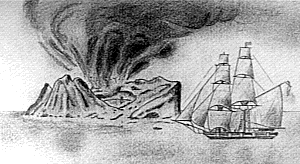
Graham Island in August 1833
RAPID remained in the vicinity for eight days watching the island grow larger with every burst of activity. Sights taken on the forenoon of 19 July determined the position of the new island as 27 miles from Sciacca in Sicily. It was about a third of the way between that port and the island of Pantelleria, in latitude 37deg 7min 30sec North and longitude 12min 41deg East. Swinburne then returned to Malta, 130 miles to the east, to report to Vice-Ad. Sir Henry Hotham.
The following month the commander in chief sailed in the ST. VINCENT,120, to see for himself. As far as Britain was concerned the island was now named after Sir James Robert George Graham of the Admiralty. Nobody considered asking the Sicilians. He was accompanied by the GANGES,84, Capt. George Burdett, and the flagship`s tender, the cutter HIND.
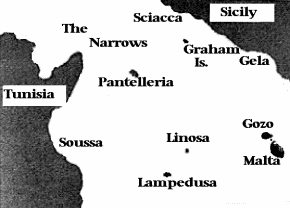
Map showing the position of Graham Is.
Mr Alick Osborne, the surgeon of the GANGES, was one of the many officers who landed in a little bay on the N.E. side on the morning of 20 August and he recorded his impressions.
By now Graham Island was about a mile in circumference, nearly round, with two hills connected by low lying land. On the highest point, named after Lt. Thomas Coleman of HIND, the Union flag had been hoisted and it was to here that all the visitors climbed (scampered, if one believes the surgeon) through clouds of evil smelling gas in the heat of a scorching sirocco sun.
Osborne was pleased to note that his pulse was still 86 when he reached the top and remarked that the vapour produced nausea rather than suffocation. In the centre of the island they could see a basin about 90 feet in diameter, shaped like a funnel and filled with bubbling red water. Osborne astonished his companions when, anxious to recover some memento, he flung off his jacket, climbed down 20 feet and plunged his hand ino the water. He withdrew it very quickly when he dicovered that the water was only a few degrees below boiling point and satisfied himself with a two pound lump of limestone for a souvenir.
Over the next few months the island started to crumble away under the action of the waves. At the beginning of December it was only a few feet above the surface and the captain of a Sicilian gunboat who had hoisted a flag there on the 1st could find nothing when he returned nine days later. The American brig FLORA on 19 December and the yacht LADY EMILY on 9 January 1832 found only an extensive reef with waves breaking over it. Lt. Andrew Kennedy of the steam packet HERMES saw only a change in the smoothness of the water when he passed through the area at the beginning of February.
RAPID was ordered back in June 1832 for a survey. Swinburne found a dangerous shoal of sand, stones and rock some 42 yards in diameter lying between one and a half and two fathoms below the surface with five or six fathoms at 100 yards distance. To the south-west there was a large area of discoloured water whch could easily be mistaken for the reef which was almost invisible. Navigation near the shoal was dangerous since, due to the steep sides, soundings could not be trusted. He moored two casks each surmounted by a pole off the N.E. and S.W. sides as warning buoys.
This had all been forecast in Alick Osborne`s fine purple prose.
"The insatiable ocean will encroach upon its base; the winds of heaven will scatter the dusty surface to the four cardinal points of the compass; the rain will disolve the saline bond of the union and the crumbling ruin will gradually sink. Its loss will not be deplored for the screaming sea-birds instinctively avoid the dark and desolate spot".
So passed Graham Island, only eighteen months from birth to death and now, as far as I can determine from a small scale chart, no longer any threat to navigation.
Cdr. Swinburne paid off RAPID at Portsmouth in July 1833 and was promoted the following year to join the long list of unemployed post-captains. Although he later retired on half pay this was no bar to his advancement in the mid-victorian navy and he progressed through the Flag ranks to finish up a full-blown Admiral in 1867, the brig being his only command. RAPID returned to the Mediterranean under the command of Lt. Graham Hay St. Vincent de Ross Kinnaird who lost his life when she was wrecked off Crete in April 1838.
© Michael Phillips. 1988.
Winter 1999/2000. The submerged volcano is again showing signs of activity, and, with the tip only 8 meters below the surface, is once more proving a hazard to shipping. If the island does reappear it could well cause a diplomatic dispute between Britain and Italy.
Go to Maritime History Page