We were lying in Falmouth Harbour, very near the Town; when, by neglect of the watch, four men jumped into the cutter and made for the shore. I was in my cabin; and hearing the rattling of oars looked out of the windows. Upon my coming on deck, with the Master, our muskets loaded, we called to them to return; which they not complying, I fired, and killed one man. The rest got to land and were received by some hundreds of the inhabitants. On the next day the Select Men, as Magistrates, wrote, desiring to know what should be done with the body of John Latty? I offered to bury him according to the custom of the Navy; this they refused. We were lying a cable`s length from the shore and the Master represented that he thought they were going to mount some guns in an old fort, so I thought it necessary to move the Brig a mile lower down. I then wrote to the Admiral, but my letters were intercepted and published. I now ventured to leave my station without order and ran for Nantasket Road, where I wrote to the Admiral apologising for the liberty I had taken and requesting a Court Martial. The Court, having tried the Master and Myself, we were honourably acquitted. When the Admiral delivered his order to resume the Command of the Gaspee. he at the same time gave me instructions to write to the Select Men and inform them that if they did not deliver up the deserters, I was empowered to impress every Man I found on the Water. This gave the inhabitants great uneasiness, as they were unable to produce the men, they having all sailed in a new Vessel for England. - I continued on this disagreeable Service until 1 March 1775, when, to the joy of all hands, I was ordered to resume my old station, superintending the Fisheries in the Gulf of St. Lawrence. When our provisions ran short we sailed for Quebec, and on my arrival the Governor, Sir Guy Carleton, informed me of his having received intelligence, that the Rebels were coming across Lake Champlain to attack the Settlement; that he had ordered two Vessels to be built at St. John`s, and armed for the protection of the Colony; and therefore wished me to go and examine them. I immediately sailed up to Montreal, left the Gaspee, crossed to Lepriere, and then to St. John`s where I found the Vessels in Timbers; with no prospect of their being ready in time, with the Rebels about 20 or 25 miles distant. We made every exertion, and got one launched on 3 Sept. 1775 - she was called the Royal Savage. Another, intended for a Row Galley, was so badly formed that one of the Thames Ballast Lighters would have rowed as fast. The enemy were at Ile aux Noix where they had a strong post. On the 11th we remained all night at Quarters. On the 17th their fleet appeared and anchored at Point Daniel; two Gundolas came down and fired at us, which we returned from our South Redoubt, with shot and shells, forcing their retreat. the next day the Gundolas mounted a heavy 12-pounder, we returned it with ten or twelve field pieces we had on board. It was difficult to bring our guns to a horizontal line because the Royal Savage had curved decks like a Merchant Vessel. On 18 Sept. the enemy had cut our communication with Montreal and were busy building gun and mortar batteries. The South Redoubt fired several shot and shells in the wood, where we thought they were at work. On the 21st two Batteau drifted down from Point Daniel, which we picked up. One had a sleeping man with two casks of pork, some muskets and paddles. We cut her down for a Floating Battery, putting a field 6-pounder in her.
On the 25th the Rebels unmasked a battery of two 12-pounders from a distance of 800 yards, which we returned, but our shot fell short. The battery wounded our main-mast, shot away much of our rigging and once hit us twixt wind and water. As soon as it was dark we hauled the vessel on shore, repaired the leak, and got her out again before daybreak. On the 30th a shot came through the bows of the Row Galley and broke a Shipwright`s arm which occasioned his death. October 11th the Enemy opened a Battery on the other side, the east, of the River reducing St. John`s and sinking the Royal Savage. On 1 November a flag of truce came from the enemy to summon us to surrender; hostilities ceased on the night of the 3rd, and we surrendered, agreeable to capitulation. As soon as the Batteries were ready to take the Garrison on board, we proceeded up River to their camp where we remained for some time before moving up to Isle aux Noix. The following day we crossed Lake Champlain. Then Ticondaroga, Fort George, Fort Edward, Serra Toga and Half Moon until we arrived in Albany, where we continued until Congress had fixed upon our destination. The Artillery and thirteen Seamen were ordered to pass the River and proceed to the Government of Connecticut. We were kept for several weeks in a village called Canaan, but the place could not supply us with the necessaries we stood in need of so Governor Trumball of that Colony was so obliging to remove myself and the other officers to Withersfield, a beautiful village on the side of the Connecticut River. We remained here 15 months when we were exchanged and sent to New York. My men were put on board the ships appointed by Admiral Lord Howe; not one of them deserted, though often tempted. I am sorry to say that this was not the case with the soldiers, many of whom were left behind. I took passage to England in a Transport and on my arrival in town I informed the Admiralty of my return from captivity; at the same time claiming, as I thought, my right, promotion; but receiving no answer, I waited on Lord Sandwich, and presented him with a NEMORIAL OF MY SERVICE. When his Lordship had looked it over, he merely said, You may send one into the Board! I did so, but without any effect. But being still fond of a Profession I had for such a number of years been employed in, I, at length, waited again on Lord Sandwich, and tendered my Services, wherever he might think proper. He looked at the list, remarked that I was an old Officer; and then replied, We will employ you still. Flattering myself, from some hints, that I might expect Promotion, I the next morning received a note from the Admiralty, informing me that there was a commission waiting at the Office. To my astonishment and surprise, it was only as Second Lieutenant of the Cumberland, Capt. Joseph Peyton. Having passed between 23 and 24 years in actual Service as an Officer I conceived this to be both degrading and unjust; however as I was always zealous of the welfare of my Country I took up my Commission and repaired to the Ship. I must acknowledge that I never sailed with a more zealous Commander, he was not a pleasant officer to serve under; his temper being always petulant and warm; yet at the same time he was the most upright, honourable man I knew. We served on the Channel Service under Admiral Keppel, and later Sir Charles Hardy. On our return to Portsmouth I received a letter informing me of my Father`s death. I wrote to be superseded, and quitted a ship as well conditioned as any in the Navy. I then went into the North and after a few months returned to London, bringing with me credentials and recommendations from the Lord Provost and Magistrates of Edinburgh, requesting their Member, Sir Lawrence Dundas, to use his influence with the First Lord of the Admiralty; but these did me no kind of service. Through the interest of my friend Mr James Dyson, Solicitor of the Admiralty, I accepted an appointment to the Impress Service, and on this duty continued for the war, viz. two years and a month. Thus finishes my professional career. I returned to Scotland for thirteen months, with two children on my half pay of 54 pounds per annum. When the gallant veteran Lord Howe was placed at the head of The Board, my younger brother, Capt. John Hunter, of the Royal Navy, late Governor of New South Wales, applied to him to appoint me Lieutenant of the Royal Hospital of Greenwich, in the room of Lieut. Larcock, deceased. His Lordship willingly complied and I accordingly succeeded to Lieut. Larcock`s berth on 15 October 1787, satisfied and happy after plowing that turbulent and inconstant element the Ocean for forty-four years. Ambition once flattered me that I should have risen higher, and there have been times that I felt my Services merited promotion. When I have heard, as, thank God! I have lately often done, the shout of Victory, I rode uneasy at my moorings, and experienced a pang, that after so many years of Service, I should in my old age be unknown and unnoticed. But the squall never lasted long; Amidst all my Fortunes I have preserved that Sheet Anchor which no Man taketh from me - A firm belief in an over-ruling Providence, and a constant reliance upon Him Who Stilled the Waves.

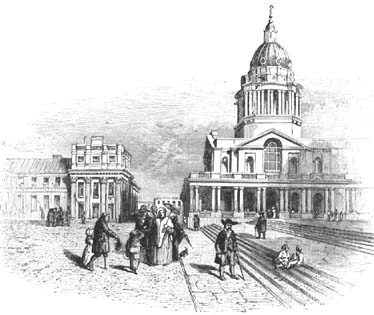
Royal Naval Hospital, Greenwich
Transcribed by Michael Phillips from the original of 1805.
Return to the beginning of Lieut. Hunter`s story
Go to Maritime History Index.