I pray Heaven to bestow the best of Blessings on this House and all that shall hereafter inhabit it. May none but honest and wise men ever rule under this roof.
Letter from President John Adams
to First Lady Abigail Adams,
November 2, 1800.
|
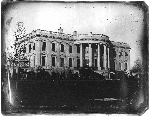
The cornerstone of the White House was laid on October 13, 1792. President John Adams and his wife Abigail moved into the unfinished structure on November 1, 1800, keeping to the scheduled relocation of the capital from Philadelphia. Congress declared the city of Washington in the District of Columbia the permanent capital of the United States on July 16, 1790. President George Washington and Charles L'Enfant, the French planner of the federal city, chose the site for the residence. Congress selected a design by James Hoban, an Irish emigrant architect living in Charleston, South Carolina for the structure. Modeled after Leister House in Dublin, Ireland, Hoban's plan featured the Palladian style popular in Europe. It was chosen over several other proposals including one submitted by Thomas Jefferson.
Constructed of white-grey sandstone that contrasted sharply with the red brick used in nearby buildings, the presidential mansion was called the White House as early as 1809. President Theodore Roosevelt officially adopted the term in 1902.
 A View of the President's House in the City of Washington after the Conflagration of the 24th August 1814, circa 1814. Portraits of the Presidents and First Ladies, 1789-Present |
Invading British troops burned the White House during the closing months of the War of 1812. Rebuilt and enlarged under the direction of Hoban, it was reoccupied by James Monroe in 1817.
The next major expansion of the executive mansion took place during
Theodore Roosevelt's presidency when second-floor rooms were converted from
offices into living quarters for the president's family. The
West Wing was also built during this period to house the expanding
presidential staff. For over six months in 1927, President and Mrs.
Calvin Coolidge
lived in nearby
Dupont Circle while the White House was renovated and the roof raised
and replaced. During the Truman years, the structure of the building was
reinforced with steel beams.
1775 The First American Naval Force
The Continental Congress authorizes construction and administration of the
first American naval force. From the outbreak of open hostilities with the
British in April, little consideration was given to protection by sea until
Congress received news that a British naval fleet was on its way. In
November, the Continental Navy is formally organized, and in December Esek
Hopkins is appointed the first commander-in-chief of the Continental Navy.
His first fleet consists of seven ships: two twenty-four-gun frigates, the
Alfred and the Columbus; two fourteen-gun brigs, the Andrea Doria and the
Cabot; and three schooners, the the Hornet, the Wasp, and the Fly.
1812 Sir Isaac Brock Saves Canada
During the War of 1812, British and Indian forces under Sir Isaac Brock
defeat Americans under General Stephen Van Rensselaer at the Battle of
Queenstown Heights, on the Niagara frontier in Ontario, Canada. The British
victory, in which over 1,000 U.S. troops are killed or wounded, effectively
ends any further U.S. invasion of Canada. Sir Isaac Brock, who captured the
city of Detroit two months earlier, is also killed during the battle.
1943 Italy Declares War on Germany
Just one month after the unconditional surrender of the Italian army to
invading Allied forces, Italy declares war on its former Axis partner
Germany. Since the beginning of the war, the Italian Resistance visibly
opposed Italy's Fascist regime and its cooperation with Nazi Germany,
organizing mountain guerilla units, workers' strikes, and industrial
sabotages. The Resistance gained momentum after a government coup toppled
Fascist leader Benito Mussolini, and during the Allied liberation, soldiers
of the Resistance provided invaluable aid to Allied troops.
1960 - The World Series ended on a home run for the first time. Bill Mazeroski's homerun allowed the Pirates to beat the Yankees
1977 Palestinians Hijack German Airliner
Four Palestinians hijack a Lufthansa airliner to Somalia, where they demand
the release of eleven imprisoned members of Germany's Baader-Meinhof
terrorist group, also known as the Red Army Faction. The Red Army Faction
was a group of ultra-left revolutionaries who terrorized Germany for three
decades, assassinating at least thirty corporate, military, and government
leaders in an effort to topple capitalism in their homeland. On October 17,
after the Palestinian terrorists kill the plane's pilot, a German special
forces team storms the aircraft, releasing the captives and killing the
hijackers. The RAF's imprisoned leaders respond to the news by committing
suicide in their jail cell in Stammheim, Germany.
1989 - U.S. President George Bush called for an overthrow of the Panamanian ruler Manuel Antonio Noriega.
BIRTHDAYS
1902 - Wilbur Shaw (Indianapolis Speedway Hall of Famer: Indianapolis 500 winner {1937, 1939, 1940): 1st to win twice in a row; became president & general manager of Speedway)
1925 - Margaret Thatcher (Roberts) ('The Iron Lady': British leader: Prime Minister of Great Britain)
1931 - Eddie Matthews (Baseball Hall of Famer: third baseman & home run hitter: Boston/Milwaukee/Atlanta Braves: World Series [1957, 1958]; Houston Astros, Detroit Tigers; Braves coach & mgr.; on cover of 1st Sports Illustrated)
1941 - Paul Simon (singer, composer: group: Simon and Garfunkel: Bridge Over Troubled Water, Homeward Bound, I Am a Rock, Mrs. Robinson, Scarborough Fair, The Sounds of Silence, Graceland, The Obvious Child; Rock and Roll Hall of Famer)
1944 - Robert Lamm (singer, musician: keyboards: group: The Big Thing: Chicago Transit Authority: Chicago: Beginnings, Feelin' Stronger Every Day, Saturday in the Park, (I've Been) Searchin' So Long, If You Leave Me Now, Just You 'n' Me, Hard to Say I'm Sorry; songwriter: Critic's Choice; solo: LP: Skinny Boy)
1959 - Marie (Olive) Osmond (singer: Paper Roses, Who's Sorry Now, This is the Way that I Feel; TV host: Donny and Marie, Ripley's Believe It or Not)
1962 - Jerry Rice (football: San Francisco '49er wide receiver: Super Bowl XXIII, XXIV, XXIX; NFL individual record: touchdown receptions: career [131], season [22]; Super Bowl records: career: yards gained [215], points scored: [42], touchdowns scored [7], TDs in one game [3])
1969 - Nancy Kerrigan (Olympic ice skating medalist: [silver, 1994])