Pushing the 4000 ton deck out into space
The deck of what is going to be the world’s highest bridge is being launched over the Tarn valley, in the South of France, with hydraulic technology from Enerpac, a US multinational that specializes in Hydraulic System Integration for large-scale construction projects. The hydraulic system was designed and built by Enerpac's Construction Centre of Excellence in Madrid, Spain.
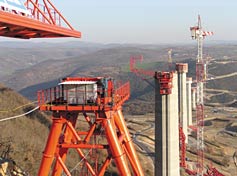
Pier P7 to pier P1.
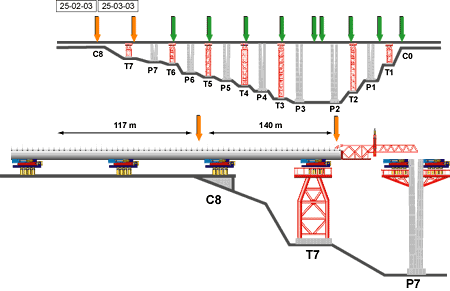
Current status of launching process.
The enormous yet at the same time “light” deck is pushed by means of hydraulic launching devices on each pier, which first lift and then push the deck. An adjustable nose structure at the end of the deck, allows the deck to land on each pier as it approaches it.
Basically, each system consists of a lifting cylinder, with a capacity of
250 ton, lifting the deck off the supporting structure of the pier, and two
or four skates, each equipped with two 60 tons cylinders, which retract to
launch the deck a maximum of 600 mm. All of this rests on a system of
single-acting lock nut cylinders supporting both the launching device and
the deck.
The launching process was started on the western slope (C8) with two
launching devices, each with two 120 ton cylinders. In total, in the last
phase of the launch, there will be 5280 tons pushing capacity from the
southern slope (1752m of deck) and 2400 tons from the northern one (708m of
deck, making up a total length of 2460m). Each push-cycle moves the deck 600
mm and takes 4 minutes, which means that there will be 3280 pushes from the
west and 1540 from the east.
Illustrations on the next page shows the launching process.
As you can see, each launching system rests on a system of cylinders
which allows the load of the skates to be balanced right and left on each
pier, to compensate for the rotation of the deck during the launch phase,
and correct or modify the height of the skate and thus of the deck where
necessary.
Manufactured by Enerpac, these cylinders are of different capacities
according to the needs of the deck. The most demanding system having an
absolute capacity of 14.400 tons, supporting four skates and 24 support
cylinders of 600 tons each, with a stroke of 500 mm. Other piers use
cylinders of 280 tons with a stroke of 300 mm. Valves are used to make the
different groups of cylinders independent of each other and so control the
height and angle of the deck, each system having an independent control
centre for the skates and the jacking cylinders.
The nose of the deck
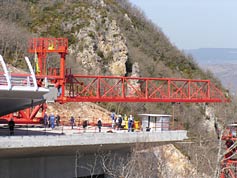 The weight of the
deck means that, as it is pushed along and gets further from its support, it
curves downwards, so that it approaches the next pier below the proper
level. In order to compensate for this deviation, a nose recovery system is
constructed at the end of the deck. This independent system, consisting of a
hydraulic group of four 270 tons cylinders, pulls the nose upwards to the
level of the skate. Another hydraulic system allows the nose-end to pivot.
The weight of the
deck means that, as it is pushed along and gets further from its support, it
curves downwards, so that it approaches the next pier below the proper
level. In order to compensate for this deviation, a nose recovery system is
constructed at the end of the deck. This independent system, consisting of a
hydraulic group of four 270 tons cylinders, pulls the nose upwards to the
level of the skate. Another hydraulic system allows the nose-end to pivot.
Illustrations on the next page show the nose recovery process.
PLC-Control system
All hydraulic systems for pushing the deck are operated from the Control
Centre on the bridgehead. This control centre receives data via a PROFI-BUS
cable, where it is automatically handled so that the system can follow the
parameters established when programming the cycle. Although all hydraulic
systems installed on each pier are controlled from this centre, each single
hydraulic system has a local control panel, which allows local movement of
the skates to be made from that pier independently, as long as this is
allowed by the Control Centre, which in turn must receive the approval of
each local control centre in order to make synchronised pushing movements
from all the pushing cylinders of all the piers. The outer cylinders on each
pier have a positional transducer that indicates the amount of travel, and
each hydraulic system has its independent hydraulic control centre. Movement
of the deck can be made in three modes: manual, semi-automatic and
automatic. The manual mode is used for adjusting the system and, if
necessary, to make instant corrections. In semi-automatic mode, each
movement is made step by step: raise, push, lower, withdraw cylinders.
Automatic mode completes the entire cycle.
Hydraulic system integration, of high force hydraulics and advanced
control technology, nowadays play and important role in the controlled
movement of large-scale civil engineering projects, like the launching of
the Millau Viaduct.