The Bedfordshire Regiment in The Great War

5th Battalion Officer photo's and bio's (1)

Home
Researching an Ancestor?
Pte 4400 Herbert Charles Kendall
The Compass
History of the 16th Foot
The 1st Battalion
The 2nd Battalion
The 4th Battalion
The 5th Battalion
The 6th Battalion
The 7th Battalion
The 8th Battalion
Hertfordshire Rgt
Photos and Bios
Graves and Memorials
War Memorials
Links and useful sites

Links to other 5th battalion photo's and bio's:
 
2/Lt Leonard Leader Brereton's personal diary.
2/Lt Brereton's personal photo album.
 
Back to 5th battalion main page.

Lt-Colonel FN Butler, 5th Btn CO pre war
webbutlerfnltcol.jpg

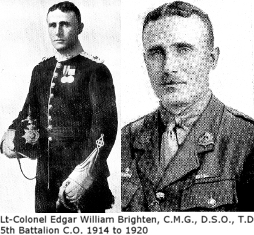
Lt-Colonel Edgar William Brighten, 5th Btn CO
ltcolbrighten.jpg
Survived

Captain Andreini, Transport Officer
webcptandreini.jpg
Survived

Lt-Colonel CH Miskin M.C.
webmiskinchltcol.jpg
5th Btn CO 1928 onwards

Above, in order are:
 
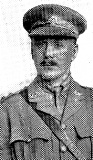
Lieutenant-Colonel F.N. Butler
Lt-Colonel Butler commanded the battalion between the 20th January 1912 and 25th January 1915. Afterwards, his experience were required in the field so he was posted to France following the British armies losses in 1914. He was also in temporary command of the 1st battalion on the Western Front between December 1916 and March 1917.
 
Lieutenant-Colonel Edgar William Brighten, C.M.G., D.S.O., T.D.
Lt-Colonel Brighten had served with the battalion from 1898, including in the South African Wars and was the 5th battalion's commanding officer from the turn of 1915, all the way through Gallipoli, Egypt and Palestine, until the 15th February 1920. After some years in the Indian training schools, Edgar commanded the 2nd battalion between June 1929 and June 1933, after which he retired. A full story of his service can be seen here.
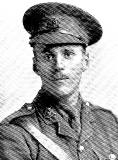
Captain Ernest V. Andreini
Whilst the battalion were still in England, Ernest was their Transport Officer who was seemingly capable of procuring absolutely anything, despite how unusual or bizarre! This even involved "requisitioning" a coal lorry and fitting it onto their transport train despite the dimensions insisting it could not be achieved. The "rather short gentleman with the twinkling eyes" officer relinquished his transport duties on his own request to the young 2/Lt Miskin (see below) whilst still in England. On the the 15th August 1915 battle Ernest was posted missing but turned up several days later suffering from severe sunstroke, having been out in no-man's land for several days. He survived the war but not much information seems to be available on him, despite him being such an obvious character. He is also shown in the 1915 photographs here.
 
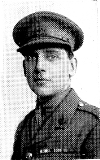
Captain Christopher Harold Miskin M.C. and BAR
Captain Miskin spent time in England in 1915 as one of the two "most capable transport officers a battalion could wish for" before joining the battalion in Egypt with a large draft as they rebuilt following their trials on Gallipoli. He is shown in the group photographs here and his Military Cross and a fuller biography can be seen here. He was also in command of the 5th battalion between 20th March 1928 to March 1933.

Major John Edgar Hill

John Edgar Hill was born in 1886 and left Oxford with a 2nd Class M.A. Honours degree in Modern History. After his schooling had finished, he enlisted into the 1st Battalion of the Oxfordshire Volunteer Brigade (The Oxfordshire Light Infantry) on the 19th October 1905. On the 17th May 1909 he was commissioned as a 2/Lt and posted to the 5th Battalion of the Bedfordshire Regiment, where he served until the end of the Great War.


On April Fool’s Day 1911 John was promoted to a Lieutenant and the 2nd May 1913 saw him rise to the rank of Captain. From the 25th May 1915 he served as a temporary Major until it was finally substantiated on the 27th October 1921.


When the battalion sailed for Gallipoli in July 1915, John was the second in command and landed with them on Gallipoli early on the 11th August. During their first battle on the 15th August 1915, he “performed prodigies of valour” by running between the spread out groups of Bedford’s left after their assault to keep the unit coherent . Ever watchful and never still for a moment, he noted the plight of Lt Shoosmith’s Machine Gun section who were attracting the Turkish artillery to the point that only Shoosmith and one other were left.  He dashed across the shrapnel swept ground and found Shoosmith “merrily hammering away at the Turks” for all he was worth, despite the attentions of their artillery. Major Hill slid to a halt next to the focused Shoosmith and asked “Who is to fight the gun if you get knocked out? No one else knows enough about it up here; your section is gone and you had better show me how to do it”. “Oh, you just pull this and press that! It’s quite simple” came Shoosmith’s breezy reply as he continued “pumping hell into the Turks”.


That night, Major Hill took charge of the forward remnants of the Battalion as they grimly held onto the position they had just won at such a dreadful cost and continuously moved between the posts ensuring his men were in good spirits.


His handling of the battalion impressed his superiors in the next two months, so much so that on the 23rd October 1915 he was posted to the post of Staff Captain in the 162nd Brigade. A year later he moved to D.A.A.G. in the Delta Force, Egypt where he served between the 28th October 1916 and the 20th February 1919. During his service in the Delta Force, Major Hill was awarded the O.B.E. (Military Division) for services rendered in the war and was mentioned in General Sir E.H.H. Allenby’s dispatches on the 23rd October 1917 and the 23rd October 1918.


On the 29th January 1921, Major Hill left the Middle Eastern theatre and headed home, arriving Valentines Day, 14th February 1921. On the 19th February 1921, he requested to resign his commission on the grounds of being unfit due to Nephritus resulting from the Dysentery he had suffered whilst on active service. His resignation was finalized on the 11th July 1921 although he retained the rank of Major.


On the 28th September 1921 John lived at 9 Regents Court in London NW1, having spent the previous six months in New York on business.


Major John Hill can be seen here in the 1915 Officers group photograph, sitting fourth from the end of the third row.



.......................................................................
Site built by Steve Fuller
Copyright 2005,2006
Contact me on [email protected]
 
Fasthosts powered