Second
Lieutenant Percy James HOLT.
Percy
James Holt was born on the 14th January 1896
at Cradley, near Malvern to Phlilip and Eliza Holt. His
father died suddenly in 1907 and James went on to be educated
at Tewkbury
Grammar School
between 1910 and 1912. He was a Drapers assistant at Rendale
and Co. in Malvern when he enlisted into the army at Hereford
on the 7th September 1914. Percy became Private
2210 in the 1st/1st Herefordshire
regiment (later renumbered to 235660) and specialised as
a Signaller. After initial training he embarked for Gallipoli
on the TSS Euripides, 16th July 1915.
At
7am on the 9th August the battalion landed at
Suvla
Bay,
Gallipoli, and Percy survived what can only be called the
difficult landings and assaults of that week. Whilst they
were in reserve at Karakol Dagh he was admitted to the 26th
C.C.S. on Gallipoli with shrapnel in his right foot on the
26th September 1915. He was moved to the 17th
General Hospital
in Alexandria,
arriving there on the 1st October, and onto No.6
Convalescent Hospital 3 days later. By the 6th
November Percy was back at the Base Depot and returned to
Gallipoli for the final phase of the campaign, but was off
of the Peninsular again on the 4th December.
The next year was spent in Egypt
and on the 9th April Percy was made up to a Corporal
and in September to a Sergeant while his battalion defended
the Suez Canal.
Sergeant
Holt applied for a commission in Egypt
on the 30th December 1916 and was shipped back
to England
for his Officer training on the H.T. Arcadia, embarking
on the 31st January 1916. He started his training
at the 14th Officer Cadet Battalion at Berkhampstead
on the 7th April 1917 and was granted a temporary
commission in the 6th battalion of the Bedfordshire
Regiment September 1917.
On
the 20th April 1918 2/Lt P.J. Holt arrived with
the 6th battalion in the field along with a large
replacement Officer draft and served with the battalion
until they were disbanded in May. His first summer in France
was, on the whole, uneventful. The 10th August
onwards saw the battalion advancing as a part of the massive
allied offensives that would lead directly to the end of
the war that November and the 23rd August saw
him involved in attacking and taking Achiet-le-Grand, for
the cost of almost 200 casualties. On the 27th
August he wrote to his mother on German notepaper he must
have taken from the battlefield at Achiet-le-Grand. He remarks
that he was very well, that he had “been busy as you
may have seen in the papers” and how he expects to
not be able to write very often after that note. Sadly,
this was to be the last letter he wrote as he lost his life
a week later.
The
Hertfords assaulted German positions north east of Bapaume
on the 4th September and suffered badly from
machine gun fire and gas. The next day was spent consolidating
their new positions under fire so Percy was wounded on one
of these days. Sadly he died of wounds at 4.50am on the
6th September 1918, whilst on board the 14th
Ambulance Train bound for Rouen.
Included in his personal effects were a German pistol and
case (perhaps taken at the same time the notebook was),
his personal correspondence and ten buttons from his old
Bedfordshire Regiment tunic he had kept as souvenirs. He
is buried in the St. Sever cemetery in Rouen
After
his death his mother entered into what can only be described
as heartbroken correspondence with the War Office, desperate
to understand more of her obviously much loved son’s
death.
The
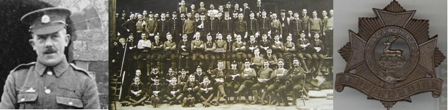
first photograph of Percy by himself (above) was taken in
1914/1915 just after he enlisted into the army at the age
of 19. The second one as well as the one taken with his
younger sister Kathleen (below) shows him sporting a long
service stripe, 2 oversees chevrons from Gallipoli, a wound
stripe also from Gallipoli and the Signallers flags showing
his specialisation. These two must have been taken in 1917
whilst in England
for his Officer training.
(My
thanks to Geoff Alford, Percy's relative, for allowing this
biography)