|

Those
who gave their lives in the 1918-1918 War:
Second
Lieutenant Noel Legard Alexander
9th
Battalion, the Kings Own Yorkshire
Light Infantry
Noel
was Killed in Action on the infamous 1st July
1916 in France,
aged 22. He was the son of Edward Disney Alexander, M.Inst.
M.E., of Milton House, Northamptonshire and is buried in
Grave II. M. 10., Gordon Dump
Cemetery,
Ovillers-La-Boisselle.
Private
17200 John Thomas Faulkner
B Company, 7th
Battalion, the Northamptonshire Regiment
John
was born in Holcot and enlisted from Kettering
early in February 1915. After his initial training he was
sent to France
with the 7th Battalion who were to become one
of the first “New Army” battalions to find themselves
in the thick of the fighting in France.
The eager recruits, inexperienced but keen to ‘do
their duty’, were sent headlong into the Battle of
Loos which had started in the 15th September.
John reached the front line with his colleagues –
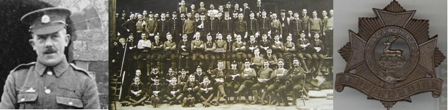
including William Houghton shown below – on the 25th
and occupied the newly won trenches just captured by the
Scottish Brigade. Facing veteran Prussian troops, they found
themselves involved in fierce fighting in their baptism
of fire, suffering almost 350 casualties in the first few
days.
John
was killed in action on the 27th September 1915,
around Loos, age unknown, along with his friend William
Houghton (shown below). He has no known grave but is remembered
on panels 91 to 93 of the Loos Memorial. His picture and
obituary are shown in the ‘Northampton Independent’
newspaper.
Private
17612 Bernard Houghton
6th
Battalion, the Northamptonshire Regiment
Bernard
was born in Holcot and enlisted from Wellingborough in March
1915. He was killed in action 3rd June 1917 in
France,
age unknown, whilst wrestling with the Germans for control
of a strongly contested trench system on the Somme.
Bernard was the son of Mrs. Ann W. Houghton, of 18, Newcomen
Rd., Wellingborough and is buried
in Grave C8 of the Rookery
British Cemetery,
Heninel.
The
Battalion War Diary for the period of Bernard’s death
records:
“2.6.1917.
8.45pm. Battalion marched to trenches via HENINEL and SUSSEX
AVENUE.
10.0pm At 10.0pm the battalion relieved the 7th West
Kents.
Relief carried out with the exception of HORSESHOE TR at
the east end of WREN LANE Point O.31.b.74. The enemy had
taken possession of this trench and a post 70 yards west
of the HORSE-SHOE in WREN
LANE and were holding it strongly.
The West Kents organised
a bombing party composed of their own men and ours, 2nd
Lt G H Warner, 6th N N heading this party. They bombed up
WREN LANE
and drove the enemy completely out of that trench and established
a double bombing block at the junction of WREN
LANE and HORSESHOE. Here 2nd
Lt Warner was killed. Simultaneously with this operation
a platoon of the Royal West Kents, supported by a platoon
of the 6th N N under 2nd Lt A J Frost attacked HORSESHOE
TR from the end of LARK
LANE. They were very strongly
resisted with pineapples, rifle-grenades and machine gun
fire and were unable to get a footing in the trench.
3.6.1917. The entire defence of the front line system was
entirely taken over by the 6th N N Regiment at 4am on the
morning of the 3rd with the enemy still strongly holding
the HORSE-SHOE.
Consolidation of the trenches and the making of fire steps
was proceeded with. Copy of commanding officers scheme to
obtain possession of the HORSE-SHOE submitted to the 54th
I. B. The GOC approved of the alternative scheme.
11pm – In the trenches west of CHERISY. Zero hour
11pm. The Operation carried out per Operation Order with
3 platoons, one platoon attacking from the end of LARK LANE
under 2nd Lt R J SUCHLICK supported by a wiring and consolidating
party; another platoon attacking from the north under 2nd
Lt H BECKINGHAM. The success of the operation was largely
due to Stokes mortars and the volume of rifle-grenades fired.
The trench was taken, 11 of the enemy dead were accounted
for and about 40 rifles of the 1916 pattern captured. Consolidation
was carried out under extreme difficulty, the HORSESHOE
TRENCH being heavily shelled – the shelling continuing
during the following day.”
Private
57623 Thomas Alderman Houghton
2nd
Battalion, the Lancashire Fusiliers, formerly 14773 East
Surrey Regiment.
Thomas
was born in Holcot and enlisted from Northampton.
He was killed in action on the 2nd September
1918 in France,
during the Battle of Drocourt-Queant, age unknown. He has
no known grave but is remembered in panels 5 and 6 of the
Vis-en-Artois Memorial.
Private
15986 Wilfred Houghton
C Company, 7th
Battalion, the Northamptonshire Regiment
Wilfred
was born in and a resident of Holcot, and enlisted from
Creaton, Northamptonshire in December 1914. When he enlisted,
he lived in Main
Street, Holcot and is shown as
a member of C Company when the Battalion went to France
in August 1915.
He
was killed in action 27th September 1915, aged
24 during the Battle of Loos along with his friend Thomas
Faulkner, also from Holcot. See above for details on Thomas
and more information on their first - and last - battle.
He was the son of Stephen and Sarah Ann Houghton of Main
St., Holcot, Northampton.
Wilfred has no known grave but is remembered on panels 91
to 93 of the Loos Memorial and his photo and obituary are
shown in the ‘Northampton Independent’ newspaper.
Private
75901 Bert Mabbutt
9th
Battalion, the Royal Fusiliers, formerly 10/27439 31st
T.R. Battalion (Training Reserve)
Bert
was born in and a resident of Holcot, Northamptonshire,
and enlisted from ‘Northants’. He was killed
in action 21st September 1918 in France,
during the final phases of the Allied advance against crumbling
German opposition, aged 19. He was the son of Mr. and Mrs.
W. Mabbutt, of Overstone Grange Cottages, Northampton.
Bert is buried in grave III. L. 15 in the Epehy Wood Farm
Cemtery, Epehy.
Lance
Corporal 18150 Frederick William Mobbs
32nd
Battalion, the Royal Fusiliers
Frederick
was born in and a resident of Holcot, and enlisted from
Northampton.
He was killed in action 7th June 1917 in France,
aged 21 on the first day of the Flanders Offensives that
would continue until the mud all but broke the British Army
in December that year. Frederick
was the son of Mr. and Mrs. C. Mobbs, of Main
St., Holcot, Northampton.
He has no known grave but is remembered on panels 6 and
8 of the Ypres (Menin Gate) Memorial.
Private
4695 Edward Sabin
10th
(Prince of Wales’ Own) Hussars.
Edward was born in, a resident
of and enlisted from Northampton.
He was an “Old Contemptible” who served in the
regular British Army before the war and was wounded twice
during his service. The first time on the 12th
November 1914, whilst his unit was holding the trenches at
Zillebeke and Klein Zillebeke as part of the 6th Brigade,
who were in support of the 4th Guards Brigade. The second
time was in one of the very rare and perhaps the last cavalry
charge of the war, during the infamous carnage at Monchy-Le-Preux
on the 11th April 1917, one of the phases of the
Battle of Arras.
The
8th Cavalry Brigade, including Edward, charged
German positions as a part of a combined attack in the driving
snow to take several fortified positions east of Arras.
A squadron of the Essex Yeomanry made a probing advance
to Lone Copse, North West of the village, while a detachment
of 10th Hussars galloped towards the village
itself and were met by machine-gun fire and high-explosive
artillery fire. The artillery fire also hit the rest of
the 8th Cavalry Brigade on the slopes of Orange
Hill, but a snowstorm allowed them to escape.
From "Stalemate" by J.H. Johnson, attributed from “And
All for What” by D.W.J. Cuddeford, 1933:
"During a lull in the snowstorm an excited shout was
raised that our cavalry were coming up! Sure enough, away
behind us, moving quickly in extended order down the slope
of Orange Hill, was line upon line of mounted men covering
the whole extent of the hillside as far as we could see.
It was a thrilling moment for us infantrymen, who had never
dreamt that we should see a real cavalry charge, which was
evidently what was intended.
In their advance the lines of horsemen passed over us rapidly,
although from our holes in the ground it was a rather 'worm's
eye' view we got of the splendid spectacle of so many mounted
men in action.
It might have been a fine sight, but it was a wicked waste
of men and horses, for the enemy immediately opened on them
a hurricane of every missile they had"
A
passage in Gibbs’ “From Bapaume to Passchendaele”
1917, includes part of a journalist’s battle report,
which adds:
”It is a small
place that village, but yesterday, perched high beyond Orange
Hill, it was the was the storm-centre of all the world conflict,
and the Battle of Arras paused till it was taken. The story
of the fight for it should live in history, and is full
of strange and tragic drama. Our cavalry- the 10th Hussars,
the Essex Yeomanry, and
the Blues- helped in the capture of this high village, behaving
with the greatest acts of sacrifice to the ideals of duty.
I saw them going up over Observation Ridge and before they
reached that point; the dash of the splendid bodies of men
riding at the gallop in a snow-storm which had covered them
with white mantles and crowned their steel hats. Afterwards
I saw some of these men being carried back wounded over
the battlefield, and the dead body of their general, on
a stretcher, taken by a small party of troopers through
the ruins of another village to his resting place.
Many gallant horses lay dead, and those which came back
were caked in mud, and walked with drooping heads, exhausted
in every limb. The bodies of dead boys lay all over these
fields. But the cavalry rode into Monchy and captured the
north side of the village, and the enemy fled from them.
Meanwhile
English troops of the 37th Division – Warwicks and
Bedfords, East and West Lancashire battalions, and the Yorks
& Lancs- were advancing on the right and linking up
for the attack on Monchy in conjunction with the Jocks(15th
Division). On the left bodies of cavalry assembled for a
combined attack with Hotchkiss and machine guns; and at
about five o’clock yesterday morning (reported on
the 12th April 1917) they swept upon the village.”
Although the early phases of the Arras offensives
went well, by this action, the weather conspired to slow
the advance down and British casualty figures started to
take on their familiarly high look. Lance Corporal Harold
Mugford of the Essex Yeomanry won a Victoria Cross for his
actions helping to hold the village that day, as Edward
lay in the snow, wounded, and waiting to be evacuated.
Edward
was evacuated back through the medical system, eventually
finding himself in the sprawling Administrative areas around
Etaples. He died from his wounds on the 21st
April 1917 in France,
aged 28 having been wounded some ten days earlier at the
Battle of Arras. He was the son of Thomas and Ann Sabin,
of Holcot, and is buried in grave XIX. E. 12A. in the Etaples
Military Cemetery.
Signaller
(Private) 7012 Frederick Tarry
1st
Battalion, the Royal Fusiliers
Frederick
was born in, a resident of and enlisted from Northampton.
He was killed in action 11th October 1918 in
France,
aged 27, during the “Pursuit to the Selle” in
the final phases of the war. He was the son of Mr. D. Tarry,
of ‘Halcott’ (this should read Holcot) Northampton
and is buried in Grave V. B. 13. of the St. Aubert British
Cemetery.
Lance
Corporal 73722 Gordon Clark Drage Winder
28th
(Saskatchewen Regiment) Canadian Infantry
Gordon
was killed in action 15th September 1915 in France,
aged 24. The son of the late William John Winder and Fanny
Garratt Winder, he has no known grave but is remembered
on the Vimy Memorial
Those
who gave their lives in the 1939 to 1945 War:
A.B.
Horace John Walker
Royal
Navy. No further information available so far.
In
honour and rememberance of the men of Holcot who laid their
lives down so that we may enjoy the freedom their sacrifice
provided for us.
Site
built by and © Steve Fuller 2005-2008
|