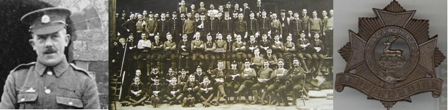
Second
Lieutenant Chester Bishop KYDD
Chester
Bishop Kydd, a native of Leavenworth,
Kansas, USA,
born on 31st May 1897, was the only son of John G A Kydd
and his wife Jessie de Mott Bishop. The family settled in
Coleraine, Co Londonderry.
Chester B Kydd was gazetted 2nd Lieutenant
in the Bedfordshire Regiment on 18th June 1915 and he was
on the Western Front from July 1916. He was killed in action
when leading B Company in the attack at Cherisey on 3rd
May 1917. The Company was trapped around Fontaine trench
in a deep belt of uncut wire and were being badly mauled
by MG & sniper fire. Of the company officers who started
out that day, only two came out of the action unwounded.
His batman, Private H.H. Gladwish, was with him when Kydd
was shot in the chest. He tried to carry his wounded charge
to the British line, but he was forced to shelter in a shell-hole,
and it was there that C B Kydd died. Private Gladwish, alone
and trapped by the shelling, spent almost seventy-two hours
in No Man’s Land. During all that time he was without
food and water. When he ultimately got back to his own lines,
he was too exhausted with hunger and grief to tell a coherent
story.
In December of 1917 the Mayor of Margate
presented Private H H Gladwish with the DCM he won in France
in May. Mr and Mrs Kydd had been honoured guests at this
ceremony in Margate.
The tale is closely supported by the medal citation, London
gazette, 26th July 1917: “40533 H H Gladwish,
Bedf. Regt.
For conspicuous gallantry &
devotion to duty. Having shown great gallantry in attempting
unsuccessfully to rescue a fatally wounded officer, whose
servant he was, he remained out three days and nights, collecting
valuable information concerning the enemy, during which
time he was continuously under fire and without food or
water".
"A
DCM was more than earned by Pte Gladwish, servant to 2/Lt
Kydd, of 'B' Coy, who was killed near Fontaine Trench. For
three days and nights he tried to find his way back, though
he could have easily given himself up to the Bosche. In
spite of terrible thirst and hunger, he hid by day in shell
holes and reconnoitered by night. Finally after three nights
out, he found himself challenged by a British sentry, and
was safe, though exhausted and looking like a hunted creature."
(Source;
The 54th Infantry Brigade 1914-1918. Gale and Polden 1922
(for private circulation)
Private Henry H. Gladwish had previously served as 29034
Essex Rgt and later served as 897242 in the 34th (County
of London)Battalion,
London Rgt, He survived the war.
C B Kydd features as a name on the war memorial in Larne Grammar
School, as well as on the memorial
in Coleraine Academical Institution (CAI); he's also listed
on the town memorial in Coleraine. He featured in a recent
local book, 'Coleraine Heroes' by Robert Thompson, wich
is where the photo comes from. There is also a plaque to
Kydd in Coleraine Congregational Church. The plaque wording:
“In Loving Memory of Chester Bishop Kydd, 2nd Lieutenant
Bedfordshire Regiment, only and dearly beloved son of Dr
J.G. A. Kydd and Jessie Bishop Kydd, Dunreeva, Coleraine,
killed in action while leading the attack on Cherisy,
France
on 3rd May 1917 in the twentieth year of his age.”
C B Kydd's only sister, Elizabeth
May Kydd, died on 20th November, 1925.
His father was a dentist in Coleraine. He had been educated
at Coleraine Academical Institution and at Erasmus
Smith Grammar School,
Galway. He later went to
America
where he studied Dentistry at Kansas
City Dental
College.
In 1892 he married Jessie Bishop of Leavenworth
and in 1898 returned to Coleraine. He died on 19th October
1939, just after the start of the Second World War (aged
79) and is buried in Agherton
Cemetery,
Portstewart. His wife Jessie Bishop died many years later
on 27th July 1957 and is interred with her husband in Agherton.
C B Kydd's grandfather, John Kydd, was a former minister
of the Congregational Church and during his ministry the
present church in New Row, Coleraine was erected.
Private
and Sergeant 15483, later Lieutenant Lionel HAMBLING, M.C.
Lionel
Hambling was born on the 18th May 1889 in Thrapston,
Northamptonshire. His parents were Alfred John William (a
retired financier) and Eliza Fanny Hambling who moved to
Plough Cottage, South Mimms
by the time Lionel enlisted into the army.
Private
15483 L.L. Hambling enlisted on the 7th September
1914 at St. Albans, aged
24 years and 3 months. Trade was shown as a Caterer, who
also taught pianoforte harmony. He was postd to the newly
raised 7th Battalion and was promoted to Lance
Corporal on the 22nd September 1914, to Corporal
on the 1st October, finally becoming a Sergeant
on the 25th November 1914.
After
training, Lionel sailed with the 7th Battalion
to France
in July 1915 and served in the trenches until, on the 18th
October 1915, he reported to Battalion HQ complaining of
severe abdominal pains, but returned to the trenches the
same day. They didn’t go away and on the 1st
November 1915 he was transferred to the 55th
field Ambulance with Appendicitus and Pyrexia, then straight
to 5 CCS, arriving at Rouen
on the 3rd. Lionel left France on the 15th
on board the Hospital Ship “St. Patrick” and
spent until the following summer recovering.
Once
he had recovered and retrained, Lionel was posted back to
the 7th Battalion as a Sergeant on the 29th
September 1916. By now, he was a qualified Machine Gunner.
He joined them just in time to join the assault on the impregnable
Schwaben Redoubt near Theipval, which the 54th
Brigade took at considerable cost. After the battle, around
400 of the Battalion were left and they took no further
part in offensive operations until after Lionel’s
departure that December. Lionel impressed his CO with his
leadership, resulting in him being recommended for a Commission.
He
was posted to the Regimental Depot as a Sergeant, arriving
in England
on the 20th December 1916 and he was posted to
No. 3 Officer Cadet Battalion at 70
Woodland Road in Bristol
on the 20th March 1917. Once he was trained,
Lionel was discharged to the “Special Reserve of Officers”
on the 26th June 1917, having been granted a
Temporary Commission in the 3rd Battalion. By
this time, he had served a total of 2 years and 293 days
in the ranks of the Bedfordshire regiment.
2/Lt
Lionel Hambling arrived in the 4th Battalion on the 9th
September 1917 and was involved in the final big phase of
the Third Battle at Ypres
(“Passchendaele”) when the Division attacked
a mile west of the infamous Passchendaele Ridge but were
held up by a combination of the mud, enemy artillery and
machine gun fire. Almost 200 of the 4th Battalion
became casualties on the 30th October and the
Canadians eventually took the ridge a week later.
After
several quiet months holding the lines, the massive German
Spring Offensive was launched on the 21st March
1918, which saw the 4th Battalion in the thick
of the incredible fighting withdrawal that only just held
the onslaught. After a week of fighting and retiring, the
Battalion was becoming extremely weak but still refused
to be overrun. On the 27th March, during a superbly
led stand against a massive German attack, Lionel was among
the many Officers who became casualties. Included in the
casualty list were the Battalion CO, Lt-Colonel
John Stanhope Collings-Wells who
was posthumously awarded the Victoria Cross as a result,
the second in command Major Nunnelly and a further seven
of the handful of Officers left by the 27th.
Lionel
was the Machine gun Officer and was often the last to withdraw
from the fighting once the other men had already retired.
His guns accounted for unthinkable numbers of Germans during
the week long fight, and he was awarded the Military Cross
for his bravery. The Citation hints at his involvement during
the defensive actions:
“SUPPLEMENT
to THE LONDON
GAZETTE, 22nd JUNE, 1918. 7411
2nd Lt. Lionel Hambling, Bedf. R.,
Spec. Res.
For conspicuous gallantry and devotion
to duty. He showed great skill and courage in keeping his
Lewis guns in action to cover a withdrawal, .and inflicted
heavy losses on the enemy. Later, during an enemy attack,
he established two Lewis guns in a forward position and
put two enemy machine guns out of action.”
Lionel
received a gunshot wound to the forehead and left the 4th
Battalion on the 27th March 1918, once they had
been relieved. He arrived back in Dover
on the 5th April to start another phase of recuperation.
On
the 11th September 1918, Lionel was deemed fit
again and ordered back to the 3rd (Reserve) Battalion
to restart training in readiness for his return to the front
but by the time he was fit again, the war was thankfully
over. On the 27th December 1918 Lionel was promoted
to the rank of Lieutenant and on the 25th March
1919, he was disembodied from the Special reserve of Officers.
The
12th February 1920 saw him finally relinquished
his commission but retained the rank of Lieutenant and he
returned to his life, having served the entire war in the
Regiment and rising from a civilian Private soldier to a
decorated Lieutenant in the process