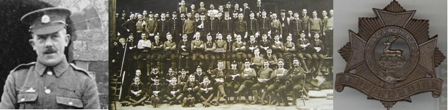
The Bedfordshire Regiment in The Great War

5th Battalion Individual Gallantry Medals


According to page 343 of the Regimental History, soldiers of the 5th Battalion earned the following gallantry medals during the war:


1 Victoria Cross

1 CMG

2 Distinguished Service Order’s

13 Military Crosses

2 Bars to Military Crosses

10 Distinguished Conduct Medals

47 Military Medals (see seperate page)

3 Foreign Decorations

36 Officers and men were mentioned in despatches


It is true that other Battalions in the Regiment earned more medals, but the theatre of operations the 5th Battalion were to operate in resulted in few major engagements, many of which were predominately cavalry actions. Hence, the hard done by infantry were too often consigned to building roads and the like. Nevertheless, the 5th Bedfords still excelled at every opportunity and were rewarded accordingly.


Below, I have complied a list of the individuals and any information available on their decorations.


Individual Gallantry Medals


VICTORIA CROSS


203329 Private Samuel Needham VC

 
  samuelneedhamvcpic.jpg  

Samuel was originally RTS/5023 in the Army Service Corps and went to France on the 13th January 1915. Having been wounded and recovered in England, he was posted to the 1/5th Bedfords in Palestine and was to become the Battalion’s only winner of this most coveted bravery award. His complete disregard for personal safety and “berserk fury” when faced with overwhelming odds saved his patrol from certain destruction.

An extract from The London Gazette, No. 30982, dated 29th Oct 1918, records the following;

"For most conspicuous bravery and initiative when with a strong patrol which was heavily attacked by the enemy and forced back in confusion. At this critical moment Private Needham ran back and fired rapidly at a body of the enemy at point-blank range. His action checked the enemy and enabled the patrol commander to reorganise his men. The patrol had many casualties, but successfully got back all their wounded, and it was due to the action of individuals, of which this is the most outstanding, that the entire patrol was not cut off. Pte. Needham's example was of the greatest value at a critical moment, and the bold and determined stand made by him did more than anything to inspire confidence, and undoubtedly saved a critical situation."

Page 232 of Captain FAM Webster’s book “The History of the Fifth Battalion Bedfordshire and Hertfordshire Regiment (TA)” says:

'At one stage of operations on the Bureid Ridge, one of Captain Yarde’s patrols suddenly bumped into a very much stronger Turkish patrol and, when our men were getting demoralised by our casualties, Private S Needham, who was a miner from Hull, saved the situation and won the Victoria Cross. He charged the enemy single handed and, fighting like one possessed, accounted for many Turks. His berserk fury created such a diversion in the darkness and confusion that, for the moment, the enemy was checked and themselves gave way before him. His comrades were unanimous in thinking that Private Needham’s action enabled them to get away, otherwise they would have all been surrounded and cut off. Had this happened the valuable information that Captain Yarde brought back would not have been available for further operations. It should be noted that Captain Yarde himself won a bar to his MC on this occasion.' (See below for information on Captain Yarde, MM and Bar)


With an irony that so often befalls the tallest of hero's, Samuel survived all the war could throw at him but died within a week of it’s ending. According to a privately printed pamphlet detailing the life of Samuel, he was born in Brocklesby near Grimsby and died on 4th November 1918 from a gunshot wound to his head received whilst at No. 1 Base Depot in Kantara. Samuel’s CWGC entry reads:


Name:

NEEDHAM, SAMUEL

Initials:

S

Nationality:

United Kingdom

Rank:

Private

Regiment:

Bedfordshire Regiment

Unit Text:

1st/5th Bn.

Age:

33

Date of Death:

04/11/1918

Service No:

203329

Awards:

VC

Additional information:

Son of Septimus and Mary Needham, of Grimsby.

Casualty Type:

Commonwealth War Dead

Grave/Memorial Reference:

E. 181.

Cemetery:

KANTARA WAR MEMORIAL CEMETERY        


1 C.M.G. ("The Most Distinguished Order of St. Michael and St. George")


Lt-Colonel Edgar William Brighten, C.M.G., D.S.O., T.D.

Edgar William Brighten was born 18th May 1880 and served in the Volunteers (the predecessor of the Territorials) from 1898. By 1900, the newly promoted Lieutenant Brighten volunteered for active service abroad and was in charge of the 4th draft of Volunteers to serve in the South African War in 1902. By 1904 he was a Captain in the Volunteers as well as being a partner in Messrs Brown and Brighten, a solicitors firm from Luton. After the Great War, he continued to serve in the Regiment for many years afterwards.


Lt-Colonel Brighten of Luton was a serving Officer in the 5th Battalion for the entire 1914-1919 war, having been granted his commissioned to Major on the 20th January 1912. He took over command of the Battalion from Lt-Colonel F.N. Butler (who took over command of the 1st Battalion in France) before they left English shores and led them throughout their trials on the Gallipoli peninsular, the boredom of Egypt and to the end of the war in Palestine. After the war he served as a Training Officer in India (13th February 1924 to 30th January 1928) and went on to command the 2nd Battalion between 1929 and 1933.


His C.M.G. was awarded for the way he handled his Battalion during the Dardenelles campaign and gazetted in the London Gazette on the 2nd February 1916.


His “Distinguished Service Order" was awarded for the Battalions raids on Umbrella Hill in July 1917, as well as for their continual conduct throughout the 1916 and 1917 campaigns.


The "Territorial Decoration" was shown in the London Gazette on the 28th August 1918.


In addition, Edgar Brighten was "Mentioned in Despatches" several times for distinguished services, including 28-1-1916, 13-7-1916, in Sir Ian Hamilton's final Gallipoli despatches on 1-12-1916 and on 12-1-1918 as well as on 22-1-1919.


He can be seen by himself as well as in many of the group photographs here.


3 DISTINGUISHED SERVICE ORDERS


In addition to Lt-Colonel Brighten shown above, the following Officers were granted the D.S.O.:


Major C.H.F. Metcalfe, D.S.O., T.D.

His promotion to Captain in the Territorials was granted on the 25th January 1909 and was present when the Battalion embodied in August 1914. Having served with the Battalion throughout Gallipoli his D.S.O. was gazetted on 1-1-1917.


His Territorial decoration was granted in the London Gazette 6-5-1920 and he was also Mentioned in Despatches on 4-1-1917 and again on 14-6-1918


Major Harold Younghusband, D.S.O.

Harold Younghusband was appointed the Battalions Captain and Adjutant on 12th February 1914.


His D.S.O. was included in the London Gazette dated 2-2-1916 for his gallantry on Gallipoli whilst serving as the Battalion Adjutant, after which he was promoted to the rank of Major. He is mentioned in the Regimental History for “performing prodigies of valour” in keeping the isolated groups of the Battalion together during the attack on 15th August 1915 (see here for the battle story).


Harold was wounded in the knee on 30th August 1915 and shipped home to recover. After his recovery he was promoted to Lt-Colonel and posted to command the 7th Battalion of The Gloucestershire Battalion in Mesopotamia but was sadly killed in action on the 21st April 1916 - shortly after arriving with them - aged 39


He was also Mentioned in Despatches on the 28th January 1916 in connection with his gallantry on Gallipoli, within Sir Ian Hamilton’s final Gallipoli despatch.


Harold Younghusband can be seen here in the 1915 Officers group photograph, sitting next to Lt-Colonel Brighten.


13 MILITARY CROSSES & 2 BAR’S


Captain Harold Simon Armstrong, MC.

Captain Armstrong , formerly of the 4th Battalion, was posted to the 5th on the 17th March 1916. He trained the men for, and led the first “Umbrella Hill” raiding party on 20th July 1917 (see here for details on the raid). He is mentioned several times in the War Dairy by name including on 30th September 1916 and 10th July 1917 during the practice for the coming raids on Umbrella Hill. In 1918, he went on to become 2nd in command of one of the Norfolk Battalions and survived the war.


Harold won his Military Cross for his cool and gallant leadership during the Umbrella Hill raids in July 1917. The raid was such a success that it became the “text book” practice in the theatre, and 16 of the 19 medals awarded as a result went to men of the 5th Battalion.


The Battalion War Diary recorded; “3 Aug 1917 - Deir el Belah Notification received of award of Military Cross to Capt. H.S. ARMSTRONG, Capt. C.H. MISKIN &Capt. A.T. CUNNINGHAM for gallantry in connexion with 1st raid on UMBRELLA HILL”.


His MC was gazetted 10th August 1917 and The London Gazette on 18th October 1917 recorded:

”2nd Lt. (T./Capt.) Harold Simon Armstrong, Bedf. R., Spec. Res.” and the MC citation in the London Gazette 7-3-1918 reads: ”For conspicuous gallantry and devotion to duty when in command of a raiding party. Owing to the dense smoke from the bombardment some confusion was caused when the party entered the enemy's lines, but with great coolness he got all his parties to their allotted objectives. The withdrawal was rendered extremely difficult owing to an enemy barrage, but he personally reconnoitred the best way through it, and got his party back successfully. His coolness, courage and presence of mind in very difficult circumstances saved a number of casualties and contributed largely to the success of the operations.”


He is also mentioned in The London Gazette as follows:

No. 30002, published 27/03/1917, p15 of 70. “2/Lt (Temp. Lt) HS Armstrong to be Temp. Cpt whilst attached to the Battalion. 18/12/1917”
No. 30737, published 7/06/1918, p15 of 18. “Temp. Cpt HS Armstrong, MC, Bedf. R., to be Acting Major (in the Norfolk Regiment) whilst employed as 2nd in command. 9/02/1918”.


Captain William Stuart Chirnside, MC and Bar.

William was commissioned as a 2nd Lieutenant in the 5th Battalion on the 28th March 1914 and was in the Orderly Room at the Bedford H.Q. with Captain Younghusband when the surprise order to mobilise came through at 6.17pm on 4th August 1914. Having discussed the validity of the order, they called the 4th Northamptons who confirmed it was accurate, which resulted in the two bemused Officers starting the process of mobilisation. He trained and served with the Battalion from the start and sailed out with them in July 1915. William survived the wounds he received on Gallipoli and was awarded his first Military Cross for bravery shown during that most trying of times. After a period of convalescence at home, he was posted to France to become a Major in the 1st Battalion, where he won his second M.C.


During the Battalions baptism of fire from 15th to 19th August 1915, around half of their number became casualties, yet the Bedfords tenaciously held the ground they had gained against a series of vicious bomb and bayonet attacks. During the ferocious engagements several medals were earned, including the then Lt Chirnside. He ignored his wounds and stayed at his post for 2 days, until senior officers insisted he retire to the first aid station on the beach. For his gallantry during the period, he was awarded an MC and promoted to Captain.


Page 308 of the Battalion history and London Gazette number 29394, issued 7th December 1915 both read;

“For conspicuous courage on the Gallipoli peninsular 15th to 17th August 1915. He led his men with gallantry and spite of being wounded, he remained 2 days at his post until relieved and taken to hospital. By his fine example and courage he assisted in keeping up the morale and spirits of his men.”


His promotion didn’t stop there, as he went on to reach the heights of Acting Lt –Colonel, even temporarily commanded the 1st Battalion whilst the CO was away at the end of 1918.


He is mentioned several times in The London Gazette, as follows:

No. 29666, published 11/07/1916, p8 of 10. “Lt WS Chirnside to be Captain. 16/08/1915”

No. 29976, published 9/03/1917, p33 of 84. “Cpt R Forrest to be Adjutant, vice Cpt WS Chirnside, MC. 01/02/1917”

No. 30541, published 22/02/1918, p8 of 18. “Cpt WS Chirnside to be acting Major whilst serving as Major on Hd Qtrs of Battalion. 12/11/1917”

No. 30680, published 10/05/1918, p6 of 14. “Cpt WS Chirnside, MC, TF relinquished rank of Acting Major. 7/02/1918”

No. 30972, published 22/10/1918, p5 of 16. “Cpt (Act. Major) WS Chirnside, MC, TF, to be acting Lt – Col. whilst commanding a Battalion. 7/09/1918”

No. 31311, published 25/04/1919, p5 of 20. “Cpt WS Chirnside MC, TF, to be Acting Major whilst serving on Hd Qtrs of a Battalion from 16/10/1918 to 5/01/1919 inclusive”


William Chirnside can be seen in the second row of the 1915 Officers group photographs here. 

Captain Andrew Tocher Cunningham, MC

Captain Cunningham was the RAMC Medical Officer who was attached to the 5th Battalion and earned his MC whilst raiding the Turkish lines on Umbrella Hill on 20th July 1917. Although not technically a member of the 5th Battalion, he was responsible for saving many lives during his assignment, so is well worth the mention amongst those men whom he helped to save.


The Battalion War Diary records:

“3 Aug 1917 - Deir el Belah Notification received of award of Military Cross to Capt. H.S. ARMSTRONG, Capt. C.H. MISKIN & Capt. A.T. CUNNINGHAM for gallantry in connexion with 1st raid on UMBRELLA HILL”


Andrew’s MC Gazette, dated 18-10-17 reads:

“T./Capt. Andrew Tocher Cunningham, M.B., R.A.M.C.”

The citation in the London Gazette, dated 7-3-1918 states;

“For conspicuous gallantry and devotion to duty during a raid on the enemy's lines. He worked continually throughout an intense bombardment attending to the wounded at the aid post until they had all been attended to and evacuated. He showed great courage and devotion to duty.”


Captain Thomas Alderman Franklin, M.C.

Information on Thomas Franklin can be found here and his photograph is here.


2/Lt Frank Gooderham, MC

Frank Gooderham started the war as a Sgt in the 1/5th Suffolks, gained promotion to become a commissioned Officer in the Bedfords and survived the war.


On 30th May 1918, 2nd Lieutenant Gooderham took nine men out on a patrol along the Wadi Dhaheb, close to the River Auja at Transfluvia East. On hearing movement in the darkness, the patrol crawled to within 150 yards of the noises and identified a strong Turkish party. They moved forwards, intent on ambushing them and stumbled into a sleeping picket, whom they bayoneted. The screams of the dying enemy alerted several other groups hiding in the long grass and the small party found themselves heavily outnumbered and almost surrounded. After killing ten of them and losing only one of their own, they slipped away and made it back to their own lines unmolested.


The Battalion War Diary records:

“9 Jun 1918. Notification of awards of M.C.'s to 2nd Lieuts Gooderham and Mayers for good patrol work.“

11 Jun 1918. 1800 Presentation of Military Cross ribbons to 2nd Lieuts Gooderham and Mayers”


His MC citation in the London Gazette, No. 30997, published 5/11/1918, p24 of 54, reads:

“2/Lt Frank Gooderham, Bedf. R. He took out a small patrol and rushed an enemy piquet. On more enemy coming up he and his patrol successfully fought their way out, accounting for 10 of the enemy with only one casualty to themselves. He showed conspicuous gallantry and good leadership and bayoneted three of the enemy himself”.


Capt.F.B.Hobbs, MC.

Captain Hobbs was commissioned into the 5th Battalion as a 2nd Lieutenant on the 1st July 1914 and served with them throughout the entire war. By their departure for Gallipoli, he was a full Lieutenant , and was promoted to Captain in May 1916. Despite being wounded in 1917, he survived the war.


Captain Hobbs earned his MC during the desperate defensive actions around Zeify Hill on the 28th and 29th November 1917, when in command of D Company. A large band of Turkish soldiers raided the Bedford’s positions overnight and almost succeeded in punching through their thin, overstretched line. Most of the Army were engaged in events many miles away, leaving the 54th Division to man an unusually long portion of the line of advance, which the Turks tried in vain to break through.


One of D Company’s machine gun posts was overrun unexpectedly, which spurred Captain Hobbs into action. Gathering a small force, he assaulted the position and bombed the larger group of Turks from their newly won position. Captain Hobbs and many others were awarded medals for their gallantry that night as allowing the Turks to break through would have left them with a clear, unmolested line all the way back to the British Command areas in Ludd as no other troops were in the area.


The Battalion War Diary states:

“16 Mar 1918 Heavy Rain in the early morning. Major C.R.James, Capt.F.B.Hobbs & Lieut.W.A. Shaw (awarded the) MC. R.S.M.Milton MC, (awarded the) DCM. C.S.M.Chandler Sgts Sapsford, Sharpe, Cpl.Ball (awarded the) D.C.M. Sgt.Marlow, Ptes Halfpenny, Andrews (awarded the) M.M (and) proceeding to YAZUR for presentation of decorations by the Duke of Connaught”


He is mentioned by name several times in the War Dairy, including being wounded by shrapnel on 14th August 1917 and a secret mission on 29 September 1916. A mixed party was to sail to Jedda to assist King Hussein of Hedjaz, but the King changed his mind and would not allow the British force to land once they arrived. The Battalion history remarks that none of them were “the worse for a very nice little trip up and down the Red Sea” when they returned.


He is also mentioned in The London Gazette several times, as follows:

No. 29643, published 27/06/1916. “Lt (Temp. Cpt) FB Hobbs relinquishes temporary rank on alteration of posting, from 30/01/1915. 19/05/1916”

No. 29843, published 3/11/1916, p9 of 10. “Lt FB Hobbs to be Temp. Cpt 17/05/1916”

No. 30238, published 17/08/1917, p15 of 18. “Lt (Temp. Cpt) FB Hobbs to be Captain from 01/06/1916”

No. 30218, published 3/08/1917, p 4 of 20. “Temp. Lt FB Hobbs to be Acting Captain. 19/03/1917”

No. 30473, published 11/01/1918, p11 of 14. “Captains, in order of precedence; JT Yarde, FB Hobbs, HH Sperling, OS Chaunder (seconded)”

No. 31508, published 15/08/1919, p2 of 12. “Temp. Lt FB Hobbs relinquishes rank of Acting Captain 27/07/1919”


Captain Hobbs is also shown leading a raiding party later on 6 Oct 1917. The diary recorded:

“A.C.D coys relieved in Merioneth Redoubt and front line of HEREFORD RIDGE SECTION, between 0900 and 1100. Strong Patrol consisting of three officers, 3 Warrant Officers, 3 Lewis Guns and 46 men left SUBKET POST at about 1800 for the purpose of locating position of enemy in FISHER'S ORCHARD, engaging them and then withdrawing sending back a code word to Brigade via Coy and Battalion H.Q. on receipt of this zero hour was fixed by Brigade and on zero hour 4.2" howitzers and Stokes guns opened up on Echelon Trench followed 10 minutes later by 18pr and machine gun barrage, this lasted for another 10 minutes, shortly after this the patrol pushed out again but met with such strong opposition just outside our wire that Capt F.B.Hobbs who was commanding patrol, thought it advisable to withdraw to our own lines and to call on the Artillery and Stokes Guns to put an other [sic] barrage down closer to our own trenches thus inflicting many casualties on the enemy. Our casualties were one killed six wounded.”


Major C.R.James, MC.

A full biography of Major James, including his photograph can be seen here. He is also in the Officers group photograph here.


Captain Emil Theodore MAIER, MC

Captain Maier's photograph and interesting biography can be seen here.


2/Lt William Henry Mayers, MC

William was commissioned as an Officer in the 5th Battalion on the 14th August 1917 and survived the war.


He was awarded his Military Cross for his part in the patrol on the 30th May 1918 (see Lieutenant Gooderham), and is recorded in the Battalion War Diary:

“9 Jun 1918. Notification of awards of M.C.'s to 2nd Lieuts Gooderham and Mayers for good patrol work.“

11 Jun 1918 The C.O. leaves battn. for tour of inspection of Schools of Instruction. Major CR James MC assumes command. 1800 Presentation of Military Cross ribbons to 2nd Lieuts Gooderham and Mayers”


Williams MC citation in The London Gazette, No 30997, published 5/11/1918, page 32 of 54 reads;

“2/Lt William Henry Mayers, Bedf R. For conspicuous gallantry leading a patrol some 3,500 yards towards enemy’s lines and cutting off and capturing an enemy piquet some 8 strong, whom he brought back without casualties to his own party. He showed leadership and enterprise of a high order”


Captain S.D. Mills, MC

Captain Mills served in the 5th Battalion until seconded to the Indian Army in September 1918. Although unconfirmed, he probably earned his MC during the July raids on Umbrella Hill, or at the 3rd Battle at Gaza. He has no CWGC entry, so probably survived the war.


Captain Mills is mentioned in The London Gazette as follows:

No. 29705, published 11/08/1916, p3 of 12. “Lt (Temp. Cpt) SD Mills to be Captain. 16/07/1916”

No. 30007, published 30/03/1917, p6 of 18. “Cpt. SD Mills to be Acting Major whilst employed as Major on Hd Qtrs. 20/01/1917

No. 30106, published 11/06/1917, p8 of 20. “Cpt. SD Mills relinquishing rank of Acting Major. 9/03/1917”

No. 30949, published 11/10/1918, p5 of 16. “Cpt. SD Mills, MC, Bedf. R., is seconded for service with Indian Army (on probation). 19/09/1918 with seniority from 14/02/1916”.


In addition, the Battalion Diary records:

“24 Aug 1918. Major CR James MC going on leave, Battn taken over by Capt SD Mills MC.”


200007 Regimental Sergeant Major Aleck Milton, M.C., D.C.M

Having already won a Distinguished Conduct Medal, Aleck Milton was awarded his M.C. whilst the Battalion’s R.S.M. He helped to repel the Turks in the Zeify Hill skirmish in November 1917 (see Captain Mills’ entry above for details).


His MC was gazetted 28-1-1918 and the ribbon was presented along with Captain Mill’s. More information on Aleck Milton can be seen in his entry under the DCM.


Captain Christopher Harold Miskin, MC
Christopher Miskin was commissioned as a 2nd Lieutenant on 4th February 1914 and took over as the Transport Officer from the wily and able Lieutenant Andreini in the spring of 1915. He is recorded as being one of the most able Transport Officers ever to have blessed the Battalion but was forced to stay with the Transport in England until after the evacuation of Gallipoli; he arrived in Egypt with the 5th Battalion’s Transport on the 12th January 1916. Whilst stationed in Egypt he was one of only two men in the Brigade to scale the second largest pyramid at Giza - the other being Lt-Colonel Brighten! After the war he became the 10th Commanding Officer of the 5th Battalion (from 1928). His photograph can be seen here.


He won his MC during the raids against Turkish positions on Umbrella Hill 29th July 1917. (See Captain Armstrong for further information on the raids, and the full story can be read here.)


His MC Gazette dated 18-10-17 reads:

“Capt. Christopher Harold Miskin, Bedf. R.”

The London Gazette entry of 7-3-1918 records;

”For conspicuous gallantry and devotion to duty during a raid on the enemy's lines. He was in charge of a party of reserves concentrated in rear of our front line, which came under an intense barrage after the raid had started. He moved about in this barrage in the most fearless manner, and succeeded in stopping the raiding party on their return and diverting them round the barrage. But for his courage and presence of mind under very heavy fire many casualties would undoubtedly have occurred.”

He is mentioned a number of times in the Battalion War Diary, including:

“3 Aug 1917 - Deir el Belah Notification received of award of Military Cross to Capt. H.S. ARMSTRONG, Capt. C.H. MISKIN & Capt. A.T. CUNNINGHAM for gallantry in connexion with 1st raid on UMBRELLA HILL.” See the War Diary on 20th and 27th July 1917 for some detail” and  “12 Feb 1916 Draft of 1 Officer CAPT MISKIN & 420 O.Rs arrived from ENGLAND”


Christopher Miskin is also mentioned in The London Gazette as follows:

No. 29607, published 2/06/1916, p23 of 100. “Appointments; Lt (Temp. Cpt) CH Miskin to be Captain 13/09/1915”.

No. 29666, published 11/07/1916, p8 of 10. “Cpt CH Miskin to have precedence from 16/08/1915”

No. 30337, published 16/10/1917, p17 of 22. “Cpt CH Miskin to Acting Major whilst employed as Major on Hd Qtrs from 26/06/1917 to 21/07/1914”


Lt. William Arthur Shaw, MC.

William was commissioned into the 5th Battalion on the 23rd March 1916 and served with them throughout the Egypt and Palestine campaigns, surviving the war.

Lieutenant Shaw won his MC for leading the middle section of raiders during the Umbrella Hill raids of July 1917 (see here for story) and led D Company during the third battle at Gaza in November 1917. After the battle, he motivated his Company so well during the salvage operations that they collected hundreds of shells from the field, earning themselves the nickname the “Salvage Corps”.


His MC Gazette of 18-10-17 reads:

“Lt. William Arthur Shaw, Bedf. R.”


The London Gazette citation of 7-3-1918 states:

“For conspicuous gallantry and devotion to duty during a raid on the enemy's lines. On reaching the enemy's front trench he was confronted with a machine gun mounted on the parapet which threatened to hold up the whole party. Without hesitation he dashed at it with his party, killed the gunners, and captured the gun. He then led his men along the trench in face of rifle fire and bombing, and forced the enemy to give way. He showed remarkable dash and leadership.”

The Battalion War Diary recorded:

“16 Mar 1918 Heavy Rain in the early morning. Major C.R.James, Capt.F.B.Hobbs & Lieut. W.A. Shaw (awarded the) MC. R.S.M.Milton MC, (awarded the) DCM. C.S.M.Chandler Sgts Sapsford, Sharpe, Cpl.Ball (awarded the) D.C.M. Sgt.Marlow, Ptes Halfpenny, Andrews (awarded the) M.M (and) proceeding to YAZUR for presentation of decorations by the Duke of Connaught”


He is also mentioned several times in The London Gazette:

No. 30017, published 13/11/1917, p18 of 62. “2/Lt WA Shaw to be Acting Lt 17/02/1917”

No. 30550, published 26/02/1918 p15 of 16. “Lt WA SHAW, MC to be Acting Cpt 8/12/1917”

No. 31163, published 4/02/1919, p11 of 14. “Lt WA Shaw, MC to be Acting Cpt whilst commanding a Company. 15/11/1918.”

No. 31326, published 2/05/1919 p12 of 16. “Lt (Acting Cpt) WA Shaw, MC relinquishes rank on alteration os posting. 24/12/1918”.


In addition, the diary recorded:

“13 Oct 1917 Attack Practice over prepared position. Lieut W.A.Shaw rejoined from El Arish Snipers Course.”


Lieutenant B.W. Smythe, M.C.

Lieutenant Smythe was commissioned into the 5th Battalion 21st September 1915, arriving with the Battalion in Gallipoli the same month, only to find his elder brother, Captain R.M. Smythe had been killed on the 14th September 1915. Whilst on the peninsular, he led several raids against Turkish positions on Bulgar Bluff and was eventually taken from the line on 17th November due to illness.


Having recovered and rejoined the Battalion in Egypt, he served with them for the rest of the war. During the Umbrella Hill raids of July 1917, he commanded the 12 strong screen, for which he was awarded the Military Cross. The screen cleared the remnants of the Turkish wire away from in front of the position, allowing the raiders behind to rush the trenches. Having completed that, his party rushed a machine gun post across open ground and remained in position for the duration of the raid.


He was gazetted the MC 11-2-1918.


After the war, Lieutenant Smythe rejoined the Battalion and continued to serve well into the 1930’s.


Captain H Wilkin, MC

2nd Lieutenant Wilkin was commissioned 19th October 1915 and seconded from the Royal West Kent Regiment into the 5th Bedfords late in 1916. He stayed with the Battalion and survived the war.


On the 19th April 1917, he was wounded during the 2nd Battle at Gaza but rejoined the Battalion in time to lead one of the assaulting parties during the 1st Umbrella Hill raid in July 1917. It was for his leadership in the raid that his MC was awarded.


By the 3rd battle at Gaza, he had been promoted to Captain and was the Battalions acting Adjutant, serving in the Headquarters section alongside Lt-Colonel Brighten.


He is mentioned several times in the War Diary, including him assuming the role of Adjutant on 27th May 1918, and leaving the Battalion for duty with XXI Corps on 9th June 1918 but returning the following month.


He is also mentioned several times in The London Gazette:

No. 30017, published 13/04/1917, p18 of 62. “2/Lt H Wilkin (RWK Regt.) to be Acting Lt whilst attached to Battalion 5/11/1916.

No. 30429, published 14/12/1917, p15 of 16. “2/Lt H Wilkin (RWK Regt.) to be Adjutant and Acting Capt 6/10/1917”

No. 30537, published 19/12/1918, p18 of 22. “2/Lt (Acting Captain) H Wilkin (RWK Regt.) relinquishes rank of Acting Capt upon ceasing to command a Company. 6/1/0/1917”

No. 31004, published 8/11/1918, p2 of 12. “RWK Regt; Promotion of 2/Lt H Wilkin, MC, antedated to 20/02/1918.”

No. 31175, published 11/02/1919, p5 of 14. “Memorandum; Lt H Wilkin, MC, RWK Regt, attached 5th Bedf, to be Temp Capt whilst acting as Staff Capt. 14/10/1918”


Captain John Tristram Yarde, MC and bar.

John Yarde was the Head Boy at Bedford School, the Captain of Boats and rowed for Christ’s College, Cambridge before war broke out. After the war his intention was to join the church - a vocation he sadly never got to fulfil. He can be seen in the 1915 group photograph of Officers here.


This highly respected officer joined the 5th Battalion when war broke out, trained with them in 1914 and 1915, sailed for Gallipoli with them in July 1915 and made it all the way through the Gallipoli and Palestine campaigns earning 2 MC’s along the way. In one of the wars many sad ironies he was killed during the final battle against the Turkish Army at Megiddo, less than 6 weeks before the end of the war.


During the Battalions baptism of fire 15th August 1915, Lieutenant Yarde was badly wounded yet refused to leave the Battalion until they were relieved two days later.


Lieutenant Yarde recovered and is mentioned by name several times in the War Dairy, including a secret mission on 29 September 1916. A mixed party was to sail to Jedda to assist King Hussein of Hedjaz, but the King changed his mind and would not allow the British force to land once they arrived. The Battalion history remarks that none of them were “the worse for a very nice little trip up and down the Red Sea” when they returned.


At the 3rd battle at Gaza Captain Yarde led B Company in the successful attack against the fortified city.


On the 21st December 1917, he led B Company in a midnight bayonet charge against Yafa Hill without artillery support. Although the defenders fought well, his leadership and the determination of his Company caused the enemy to bolt. For this assault and his outstanding leadership, John was awarded the Military cross, which was gazetted in the London Gazette 26-3-1918.


Towards the end of the war, in September 1918, Captain Yarde was the commander of 3 fighting patrols including Private Samuel Needham’s unit when he won the Victoria Cross in September 1918. He himself won a bar to his Military cross (a second MC) during the engagement that saw them badly outnumbered yet fight their way out of encirclement. More details can be seen under Samuel Needham’s V.C. entry at the top of this page. Captain Yarde’s second MC was shown in the London Gazette 15-2-1919.


The London Gazette also mentions him several times:

No. 29605, published 30/05/1916 p 11 of 12. “2/Lt (Temp. Capt) JT Yarde reverts to Temp. Lt on alteration of position from 16/08/1915. 19/04/1916”

No. 29769, published 29/09/1916 p15 of 58. “2/Lt (Temp Lt) JT Yarde to be Lt 16/08/1915” (The day after the Bedfords “baptism of fire when they lost all of their Company commanders)

No. 29813, published 3/11/1916, p9 of 10. “Lt JT Yarde to be Temp. Capt 30/12/1915”

No. 30238, published 17/08/1917 p15 of 18. “Lt (Temp. Capt) JT Yarde to be Captain from 1/06/1916 and remain Adjutant. 19/08/1917”


At the Battle of Megiddo, the final battle of the war for the Bedfords, he was seriously wounded during intense shelling on 19th September 1918, and died at Casualty Clearing Station 76 in Ludd 2 days later, aged just 24. John was the son of John Edward and Bessie Beresford Yarde of 7, Kimbolton Avenue, Bedford.


He was described on page 342 of the Battalion history as “a gallant officer who was a great loss to the Battalion, as he had gone out with them from England”. The following month, Turkey capitulated and the war in that part of the world ended. His CWGC entry reads:


Name:

YARDE, JOHN TRISTRAM

Initials:

J T

Nationality:

United Kingdom

Rank:

Captain

Regiment:

Bedfordshire Regiment

Unit Text:

1st/5th Bn.

Age:

24

Date of Death:

21/09/1918

Awards:

MC and Bar

Additional information:

Son of John Edward and Bessie Beresford Yarde, of 7, Kimbolton Avenue, Bedford. J.T. Yarde was Head of Bedford School and Captain of Boats; he also rowed for Christ's College, Cambridge.

Casualty Type:

Commonwealth War Dead

Grave/Memorial Reference:

CC. 48.

Cemetery:

RAMLEH WAR CEMETERY  


 11 DISTINGUISHED CONDUCT MEDALS 


201118 Private Horace Baldwin, D.C.M., M.M.

Horace Baldwin was from Tring and enlisted into the British army in October 1914 as Private 16974. He initially served in the 1st Battalion of the Bedfordshire regiment in France, from 27-4-1915 until he was wounded that summer, after which he spent time in England convalescing. When he had recovered, he was sent to the 5th Battalion in Egypt, arriving early in 1916.


His DCM was awarded for his bravery in the action that Samuel Needham won his VC, Captain Yarde his second MC and several other gallantry medals shown on this page. The DCM was gazetted 7-11-1918 and his citation dated 25th February 1920 reads:

“On the night of 10/11th September 1918 near Kefr Kasim, one of our fighting patrols was surrounded by greatly superior numbers of enemy. Pte. Baldwin as No.1 of a Lewis gun team pushed out 10 yards in front of our line, covering them, at 25 yards from the advancing enemy. He held the enemy back, and then withdrew his Lewis gun in one hand, covering himself with his revolver. Had it not been for his courage and determination, this Lewis gun would undoubtedly have been lost.”


Horace survived the war, eventually being discharged “Class Z” on 3rd April 1919.


13080 Corporal A.H. Ball, D.C.M. 

Corporal Ball hailed from Sandy in Bedfordshire and enlisted into the army late August 1914. He served in the 1st Battalion in France from March 1915 until wounds returned him to England to recover, after which he was transferred to the 5th Battalion in Egypt early in 1916.


He won his DCM during the third battle at Gaza. His citation, dated 1st May 1918, reads: 

“For conspicuous gallantry and devotion to duty. When in command of a machine-gun section he showed considerable initiative and gallantry, and when under heavy shell fire and before the position had been consolidated he pushed forward to an advanced position and opened fire on the enemy assembling for a counterattack.”


Corporal Ball was one of the group of Bedfords who were decorated at Yazur and is mentioned in the Battalion War diary:

 “16 Mar 1918 Heavy Rain in the early morning. Major C.R.James, Capt.F.B.Hobbs & Lieut.W.A.Shaw (awarded the) MC. R.S.M.Milton MC, (awarded the) DCM. C.S.M.Chandler Sgts Sapsford, Sharpe, Cpl.Ball (awarded the) D.C.M. Sgt.Marlow, Ptes Halfpenny, Andrews (awarded the) M.M (and) proceeding to YAZUR for presentation of decorations by the Duke of Connaught”


He survived the war and was disembodied from service in 1919.


3992 Private, later Acting C.Q.M.S. 240084 Reginald Bell, D.C.M.

Reginald Bell enlisted into the army as a Private late in August 1914 and trained with them until their departure for Gallipoli in July 1915.


During their baptism of fire on 15th August 1915 Private Bell took the initiative and led the remnants of his platoon after all the Officers and NCO’s were killed or wounded. The following day Lieutenant E.L. Rawlins crawled out from their newly won positions to try and rescue a wounded Bedford but was himself hit in the process. Private Bell immediately rushed out to rescue the Officer and the other wounded man and finally brought them in after dark, having cared for them as Turkish bullets and shells tried to find him. On the 17th August, he went out alone to learn about Turkish positions and the chances of yet another counter attack being delivered, which included lying up only yards from their positions for hours at night, listening to their movements.


Private Ball was promoted to Corporal and awarded the DCM, second only to the VC, for his bravery. The DCM gazette is dated 6th November 1915 and the citation, dated 22-1-1916 reads:

“For conspicuous gallantry and determination during operations at Suvla Bay, Gallipoli Peninsula, on many occasions, notably the following: On 15th August 1915, he organised and led a party of men when their officers had become casualties. On 16th August he went out under a very heavy fire, dressed and brought in a wounded officer. On 17th August he made a valuable reconnaissance of a Turkish position.”


During his service, he was promoted through the ranks, ending up as an Acting CQMS in the 5th Battalion at the end of the war. I can find no trace of his death during the war so hope he survived. Hopefully I will be able to confirm this in the future.


3785 Private Harry Bryant, D.C.M.

Harry Bryant enlisted into the 5th Battalion mid August 1914 and served within their ranks until they left for Gallipoli in July 1915.


During the attack on Kidney Hill, 15th August 1915, his Company had become leaderless and separated into small groups. Although he had been wounded during the advance towards the position, he collected a small platoon together and they charged the hill, regardless of whether any other men were going forward. Other groups of sheltering Bedfords saw and heard the attack and joined in, thus establishing a foothold on the southern slopes of Kidney Hill.


Private Bryant’s DCM was listed in the London Gazette 3-6-1916, and his citation appeared on the 21st June. It reads:

“For conspicuous gallantry. When wounded, he got together a party of about 30 men for an attack n a hill and continued at his post until wounded a second time”


Harry served throughout the Gallipoli, Egypt and Palestine campaigns in the 5th Battalion and finished the war as a Sergeant. He was renumbered to 200342 in March 1917 when the Territorials were issued with a new batch of service number, in line with the changes within the entire system. Harry seems to have survived the war as I have found no trace of his death or a Silver War Badge to date.


201450 Colour Sgt. Major J.J. Chandler, DCM 

CSM Chandler of Bedford was an old Contemptible who started the war as Lance Corporal 8038 in the 1st Battalion of the Bedfordshire Regiment, having enlisted in 1905. He landed in France with the Battalion 16th August 1914 and was with the superb British Army that fought the Germans to a standstill around Mons, Le Cateau and The Marne. He was one of the 90% casualties sustained in the first few months of the war and, having recovered, was posted to the 2nd/5th Battalion early in 1916.


During his long and distinguished service, he was also known as Sergeant 201450, CSM 6100, Warrant Officer Class II 44105 ands finally CSM 5942654 in the Bedfordshire and Hertfordshire Regiment after the war.


He received his well earned D.C.M. following his involvement in, and recovery of the wounded from the Umbrella Hill raids in July 1917, and subsequent aggressive patrols before the 3rd battle at Gaza. His DCM was gazetted 22-10-1917 and the citation dated 26th January 1918 reads:

“For conspicuous gallantry and devotion to duty. He has carried out some exceedingly fine patrol work, bringing in valuable information of the enemy’s position. He has also done splendid service in bringing in wounded and recovering quantities of arms, ammunition and equipment, and his energetic example and personal gallantry have greatly influenced others to do the same.”


The Battalion War Diary records : “16 Mar 1918 Heavy Rain in the early morning. Major C.R.James, Capt.F.B.Hobbs & Lieut.W.A.Shaw (awarded the) MC. R.S.M.Milton MC, (awarded the) DCM. C.S.M.Chandler Sgts Sapsford, Sharpe, Cpl.Ball (awarded the) D.C.M. Sgt.Marlow, Ptes Halfpenny, Andrews (awarded the) M.M (and) proceeding to YAZUR for presentation of decorations by the Duke of Connaught”


This inspirational NCO survived the war and continued as a professional soldier into the 1920’s.


200382 Colour Sergeant Major Arthur John Day, D.C.M.

Arthur Day of Luton enlisted into the 5th Battalion as Private 3902 late August 1914 and served with distinction throughout the war. By 1919 he had been promoted through the NCO ranks and was a Warrant Officer Class II.


His DCM was awarded in recognition of his continuing reliability and bravery over the four years of the war. It was gazetted 3-6-1919 and the citation dated 11th March 1920 reads:

“For conspicuous gallantry and continuous good service. Since August 1915, he has served continuously throughout the Gallipoli and Palestine campaigns. His work has been of the highest order, and on many occasions he has borne himself particularly gallant under fire, showing dash and able leadership.”


200290 Lance Sergeant Herbert J. Emerton, D.C.M.

Herbert Emerton enlisted into the 5th Battalion in June 1914 as Private 3657 and served with them through Gallipoli, Egypt and Palestine. At the end of hostilities he was transferred into the Waterways and railways section of the Royal Engineers as Corporal WR/19570. He was discharged in May 1919, when he retirned to his home in Inkerman Street in St. Albans.


His DCM was awarded for bravery at the 3rd Battle at Gaza in November 1917. His citation dated 1-5-1918 reads:

“For conspicuous gallantry and devotion to duty during an attack. Under rifle fire at point-blank range he cleared the enemy from a line of rifle-pits which would have enfiladed the main attack. Later, when his platoon commander became a casualty, he took command of the platoon as a critical moment. His gallantry and resource contributed largely to the success of the operation.”


2092, later 200007 Regimental Sgt. Major Aleck Milton MC, DCM.

Aleck Milton was a Territorial soldier from before 1910 and a well known, inspirational NCO. He held several posts during and after the war, including CSM 2092, RSM 200007 and RQMS 633840, RQMS 5944210, eventually to become a commissioned Officer in the Beds and Herts regiment after the war. He can be seen in the photograph here of the Officers in 1929, standing fifth from the left and looking very comfortable amongst Generals, Colonels and Majors! Aleck’s MC entry can be seen above.


Aleck won his DCM for his outstanding heroism during the Bedfords baptism of fire 15th to 16th August 1915 and was instrumental in the rebuilding of the battalion after Gallipoli. As the battalion were broken up by the galling Turkish fire and difficult terrain during their attack on the 15th August 1915, Aleck gathered a group of men together and led them to attack the final objective on Kidney Hill. In the 48 hours that followed, he organised the remnants of the Company into a fighting formation who held the position against counter attacks, inflicting heavy losses on the enemy in the process.


His gazette is dated 3-3-1916 and the citation dated 21st June 1916 reads:

“For consistent gallantry and devotion to duty. He has set a fine example to the NCO’s and men of the battalion.”


He turns up regularly in the Battalion history and was always in the thick of things. During the Umbrella Hill raids of July 1917, he worked ceaselessly to move stores to the assembly areas, despite being under regular shelling from Turkish guns, thus ensuring the raid was supplied and supported correctly.


At the 3rd Battle at Gaza he narrowly escaped death when a lethal 5.9 shell landed almost on top of him. The heavy sand blanketed much of the force and his equipment was ripped clean from his body, yet he escaped with a nasty wound to his forearm. Despite the wound, he refused to become a casualty and, arm wrapped in a makeshift sling, continued working and fighting until the battle had finished and the Turks were evacuating the city. His example of fortitude once again set a benchmark for the men under him.


When Zeify Hill was almost overrun late November 1917, he and Lieutenant RH Smith led a scratch detail of Headquarters staff in an uphill bayonet charge, believing the Turks had taken a Machine gun post and were in a position to break through their thin, overstreched lines. Although they were disappointed due to Captain Hobbs (see above) having beaten them to it and retaken the post, their act was one of incredible bravery as they could not have known who or what was facing them when they started their advance. The language of RSM Milton, Sergeant-Cook Thurley and his men was “most picturesquely expressed” when they discovered their comrades had beaten them to it!


Aleck Milton did not receive the medals he had so bravely won until 1918 when both medal ribbons were pinned to his tunic, as the Battalion War Diary records:

“16 Mar 1918 Heavy Rain in the early morning. Major C.R.James, Capt.F.B.Hobbs & Lieut.W.A.Shaw (awarded the) MC. R.S.M.Milton MC, (awarded the) DCM. C.S.M.Chandler Sgts Sapsford, Sharpe, Cpl.Ball (awarded the) D.C.M. Sgt.Marlow, Ptes Halfpenny, Andrews (awarded the) M.M (and) proceeding to YAZUR for presentation of decorations by the Duke of Connaught”


Aleck Milton was also one o the handful of men who provided the Colour Guard in 1926 when the Prince of Wales visited Luton to present the famous Battalion with their Colours and went on to become a commissioned Officer later that decade.


203148 Sergeant Stanley Sapsford 

Stanley Sapsford of Bishop’s Stortford served as Private 9143 in the Bedfordshire regiment from 1907, and rejoined on the outbreak of war as Sergeant 13642. After being wounded in France, he recovered and was transferred into the 5th Battalion in Egypt, where he served for the remainder of the war. After the end of hostilities, he transferred to the Suffolk Regiment who remained to police Palestine during 1919, becoming Lance Corporal 67682.


Sergeant Sapsford won his DCM for his involvement in the third battle at Gaza. Despite the casualties his platoon had taken and being wounded himself, he led the remnants of his platoon with unwavering coolness and gallantry to take Turkish positions along Tomb Spur. This allowed for the rest of the Company to move up to him and consolidate their newly won positions.


His DCM was gazetted 28-1-1918 and the citation dated 1st May 1918 reads:

“For conspicuous gallantry and devotion to duty. In the attack he commanded a platoon, displaying marked gallantry and coolness at a critical moment after the assault when casualties had caused a slight confusion. Though wounded himself, he reorganised his platoon, pushed forward, and thus enabled the remainder of his company to consolidate. His initiative contributed largely to the success of the operations.”


His DCM ribbon was pinned to his tunic in March 1918, as the Battalion War Diary records:

“16 Mar 1918 Heavy Rain in the early morning. Major C.R.James, Capt.F.B.Hobbs & Lieut.W.A.Shaw (awarded the) MC. R.S.M.Milton MC, (awarded the) DCM. C.S.M.Chandler Sgts Sapsford, Sharpe, Cpl.Ball (awarded the) D.C.M. Sgt.Marlow, Ptes Halfpenny, Andrews (awarded the) M.M (and) proceeding to YAZUR for presentation of decorations by the Duke of Connaught”


203146 Sgt Arthur T. Sharpe, D.C.M. 

Arthur Sharpe of Dunstable served as Private 9475 in the Bedfordshire regiment from 1910 and re-enlisted as Private 4408 in the 5th Battalion early in September 1914. He served in Gallipoli, Egypt and Palestine with the 5th Battalion, eventually working his way up to Acting Warrant Officer Class II 44108 in the Hertfordshire regiment after the war had finished.


Sergeant Sharpe won his well earned DCM for his part in the 1st raids against Umbrella Hill on 20th July 1917.


His initiative and fearlessness led the way into the Turkish positions and, despite being wounded in the opening brawls, he helped his Officer to organise and direct the attack amongst the confusion in the Turkish trenches. On their return to the British lines he helped the men caught in the Turkish barrage by returning many times to get the wounded back into the British trenches. On one of his returning runs, he noticed the badly wounded Major Miskin (see above) who had been hit when a 5.9 shell exploded outside the HQ dugout as he returned to report on the raid. Sergeant Sharpe saw what had happened and remained with the Major to tend his wounds. Soon afterwards another shell landed within feet of him, finishing the dugout off and badly wounding Sharpe in the process. A shell fragment wounded him in the jaw and knocked out several of his front teeth, leaving him bleeding badly from yet another point in his body. Quite unperturbed, he mumbled to himself “that will save a dentist” and continued dressing the Major’s wounds. As all of the stretcher bearers were already casualties themselves Sergeant Sharpe got the Major back to an Aid Post on a stretcher, having commandeered help from a fellow Bedford before turning his attention to his own wounds.


His well earned DCM was gazetted 10-8-1917 and the citation dated 26th January 1918 reads:

“For conspicuous gallantry and devotion to duty during a raid on the enemy’s lines. On reaching the enemy’s trench he showed admirable dash and fine organisation in overcoming confusion caused by the smoke of the bombardment, and in helping his officer to get his party to their objective. On returning to the front line, under an intense enemy bombardment, he gave valuable assistance in attending to the wounded, although wounded himself. He showed great fearlessness and initiative.”


By March 1918 he had recovered and was sent to Yazur to receive the vaunted medal ribbon in person, as the Battalion War Diary records:

“16 Mar 1918 Heavy Rain in the early morning. Major C.R.James, Capt.F.B.Hobbs & Lieut.W.A.Shaw (awarded the) MC. R.S.M.Milton MC, (awarded the) DCM. C.S.M.Chandler Sgts Sapsford, Sharpe, Cpl.Ball (awarded the) D.C.M. Sgt.Marlow, Ptes Halfpenny, Andrews (awarded the) M.M (and) proceeding to YAZUR for presentation of decorations by the Duke of Connaught”


200024 Private, later C.S.M. W. Young, D.C.M.

CSM Young of Luton was a territorial soldier well before the war broke out, serving from some time before 1909 with a service number between 2495 and 2666. He was renumbered in 1917 to 200024 and appears to have survived the war, although I have been unable to find out much about him to date.


His DCM was awarded for his part in the action during which Samuel Needham won his VC, Captain Yarde his second MC and many others. The medal was gazetted 7-11-1918 and the citation dated 25th February 1920 reads:

“On the night of 10th-11th September 1918, near Kefr Kasim, one of our fighting patrols was heavily engaged, and, finally being surrounded, had to fight its way back to our lines. CSM Young, who was in charge of two Lewis guns, used his guns in such a way that he practically saved the situation. One of his guns was blown up by a bomb; nevertheless, he successfully evacuated it. When the main party had withdrawn he organised and led, at dawn, a search party, to make sure no wounded had been left behind.”


Go to:

Military Medal winners of the 5th Battalion


Site built by Steve Fuller

Copyright 2005,2006, 2007
Contact me on [email protected]