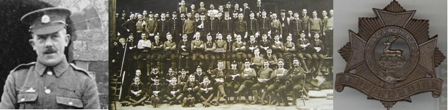
Lieutenant / Acting Captain Robert Bowness
GIBSON
Robert
Gibson was born 8th January 1895 at 139 Downshire Hill in Hampstead,
the son of the Reverend Thomas William Gibson of Cranham Rectory,
Upminster. His mother was Frances eorgina Gibson, nee Currey.
Robert was baptised at St Sepulchre's, Holborn, March 25th 1895
and confirmed at St Giles, Oxford,
April 15th 1908 by the Bishop of Oxford.
Robert’s education started at the Oxford Preparatory School (Lynam's) between 1904 and 1908,
after which he attended the Winchester College
from September 17th 1908. In 1913 he won a scholarship at New College Oxford. Whilst at Oxford,
Robert had double pneumonia, which was when the photograph of him in bed was taken.
On the outbreak of war, he originally enlisted
into the Territorial 28th London’s (the “Artists
Rifles”) as Private 2605 on the 8th September 1914 and was discharged to Commission on the 26th October, into the 3rd
South Staffs, aged 19 yrs 9 months. On the 3rd November 1914 Robert was posted to B Company of the 2nd
Battalion of the Bedfordshire’s, arriving with them in France
on the 20th May 1915.
2/Lt Gibson was mentioned in dispatches on the
16th June 1915 for his role in operations around Givenchy, when he was the only Officer to come out of the fight
unscathed, and again by Sir John French on the 1st January 1916. He was evacuated sick to Merville Hospital between the 12th
and 18th July 1915 as well as being admitted to CCS1 on the 29th August 1915 with appendicitis. He was discharged
again on the 3rd September 1915.
As a result of the attack near Vermelles 25th September
1915, he took command of B Company, being the most senior Officer left after the attack and was the Captain I/C of B Company by November. His Captaincy reverted to 2/Lt the following month, along with Lt de Burriatte
of the famous Xmas truce 1914 fame & was granted leave between the 11th December 1915 and 15th February 1916. Having returned
from leave on the 26th February, he took command of A Company, then C Co a month later. In April, he was moved to Officer
Commanding B Company but the next day was off to hospital sick again. After a short respite, he was back in charge of B Company
again & had another spell of leave towards the end of May 1916.
The brave and much loved Robert was twice recommended
for a Military cross (at Givenchy and Vermelles in 1915) but was sadly killed in action on the 11th July 1916 at
Trones Wood on the Somme. A letter held in his record dated 14th August 1916 said he was
buried at Maricourt Cemetery, near the Napiers Redoubt t 2.30am on Sunday 16th July 1916 after three men from his
platoon volunteered to go and find his body.
The Battalion War Diary for 11th July 1916 reads:
"11
Jul 1916 - Trones Wood The Battalion were in position by 1.30 a.m. formed up in lines of 1/2 Companies with an interval of
five paces between the men, and a distance of 150 yards between platoons, in the following order: - "A" Company commanded
by Captain C.G.TYLER "B" Company commanded by Lieutenant H.A.CHAMEN "C" Company commanded by Captain L.F.BEAL "D" Company
commanded by Captain R.O.WYNNE."
Orders had been received that the Battalion was to enter the wood at 3.27
a.m., so the leading line commenced to advance at 3.10 a.m. towards the South eastern edge of TRONES WOOD. It being almost
dark, the advance was not observed until the leading line was 400 yards from the wood, when enemy Machine Guns opened fire
from Points Z and R marked on Sketch (Appendix "B").
The enemy quickly got their artillery to work and the Battalion
suffered many casualties entering the WOOD, but by 3.45 a.m. the whole Battalion had gained the inside of the WOOD, but owing
to Machine Gun and shell fire, had entered rather too much at the SOUTHERN END. Owing to the denseness of the undergrowth,
it was not possible to see more than 4 yards in front of you, so the Companies had great difficulty in keeping touch. Lieut.R.B.GIBSON was killed entering the wood and 2nd Lieut.F.E.PLUMMER wounded and it was found that the WOOD
was strongly held and full of Trenches and Dug-outs.”
Robert Gibson fell in the area shown on the trench
map, just as his platoon entered the wood. Most of his men were killed or wounded in the burst of machine gun fire that claimed
his life, with very few of tem making it into the wood itself.
Robert’s obituary in the Times, dated Friday
August 4th 1916, reads:
”Lt Robert Bowness Gibson, killed on July 11th, was the 5th son of the Rev. T W Gibson,
rector of Cranham. He was educated at the Oxford Preparatory
School, Winchester and New College Oxford.
He was gazetted second lieutenant in the South Staffordshire Regiment in November, 1914, being attached and later transferred
to the Bedfordshire Regiment, with which he had served at the front since May 1915. His name was noted for conspicuous gallantry
in the field on June 16 1915 and was mentioned in Lord French's dispatch on January 1 last. His colonel writes of him:- "I
cannot tell you how much he was loved by his brother officers and men. He was a most splendid officer, quite the best subaltern
I had".”
A fellow Bedford Regiment enthusiast, John Wainwright,
has a collection of letters and photographs detailing the life of the obviously brilliant and very popular Robert Gibson,
a well as some of the pressed flowers taken from his grave in 1923. Below are a selection, including the circumstances surrounding
his death at Trones Wood on the Somme, 11th July 1916.
Extracts from letters to Miss Clementson,
written by Robert before he went out to the front.
"Pray for me .....that I may prepose myself physically and spiritually
for the work, and may be ready to kill and if need be to be killed in the service of God and our country"
"Of course our
actual fate lies in God's hands and he will give us what he thinks best"
"I can with absolute sincerity wish you a Happy
New Year and a Happy Birthday, feeling that though the war may bring us sorrow, may even bring death among us, it will in
the end bring greater faith and greater peace in God"
"I like to think we are all united in worship, the Lord be with you
and me and with all those whom we love, and all who are coming to England's help today. And may he overrule this war to the
good of the world".
Letter from Lt Col HS Poynty. Commanding 2nd Battn Bedfordshire Rgt,
BEF, 15-7-16
"It is with the deepest regret I am writing to you how your gallant son was killed. A braver and better
fellow never stepped (sic) and I can't tell you how much he was loved by his brother officers and men. He was a most splendid
officer and quite the best subaltern I had. On July 11th at 3.27 am we were ordered to attack Trones Wood, where very heavy
fighting has been going on. It had been taken by us and re taken by the Germans, so we were ordered to re take it again. The
distance from us to the wood was about 1000 yards. D Coy in which your son was, was the third company to go over, and unfortunately
your son's platoon was heavily fired into by a body of Germans hidden in the wood, with the result that the whole platoon
was knocked out. Your son was shot through the head and I am thankful to say could not have suffered as death must have been
instantaneous.
Yesterday at 10.00 am the whole of the wood was captured, we only secured the southern end of it, as it
was too strongly held. Your son's body lay on the edge of the wood about half way up on the western side, and several attempts
were made to get him in, but each time we were driven back.
We have sent a party out to try to recover it and I am anxiously
awaiting the news that it has been recovered. We are going to have him buried in Maricourt Cemetary and I will write and let
you know exactly.
I can't tell you how much we miss him, and how very popular he was with everyone. We had terrific fighting
in the wood and the regiment did magnificently in establishing a footing in the southern end of it. We lost 5 officers and
240 men in the attack. Please accept the sincerest condolences of the officers and all ranks of the battalion, a nicer and
braver fellow never lived"
From Capt Beal 2nd Bedfordshire Rgt. 17-7-16
“By
now you will have heard of the sad death of your son, nothing I can say can in any way express the deep sorrow of not only
myself, but of every officer and man in this Regt.
I have served longer with this Regt out here than any other officer
and can safely say that your son’s death in action has been felt more keenly than any other of the many this Regt has
suffered.
I can hardly realise yet what has happened, your son being my oldest ad best friend in the Regt. Many and many
a time have we shared the same blanket and coat in trying to keep each other warm. If anything can help you bear your great
loss, I am sure it will be the knowledge that his death was instantaneous and that he died at the head of his men, with whom
he was so well liked.
His body has been recovered and buried and buried in the British
Cemetery near where he fell. With sincere sympathy to you and your family”
From
Major Bidder, 21st Brigade Machine Gun Coy.28-7-16
“I have just got our address from Capt Wynne and wish to write
to you about your son.
I commanded the 2nd Brigade (sic?) from the last day at Loos (when they were holding Breslau Avenue)
for a couple of months, I got to know your son well in that time , for he was one of my company commanders; and I got to think
a great deal of him, he was so able and so dependable. One knew that anything he was given to do would be done and well done.
He
was brave as a lion and such a clever and interesting man as well.
I liked him very much indeed and it was a real blow
to me when I heard that he too had been called upon for the great sacrifice. I should like if I may to express my very real
sympathy with you.
I remember him so well under such varied circumstances. Cheerful and muddy in the trenches, toiling
at almost impossible tasks in getting out ready made barbed wire obstacles; consolidating craters in the little attack we
made in November; enjoying the comparative cleanliness of billets and (I don’t know why one should be shy about it)
kneeling to receive the communion on the meadow grass of a sunlit orchard. His is one of the many faces that will always stay
by me, of my friends who have gone before. Your son and Capt Wynne lunched with me just before July 1st he was in the best
of spirits”
From Lieut B Primrose Wells, 2nd Bedfordshire
Regt, BEF, 16-7-16
”RIP.
I must just write you a line and send you my sincerest sympathy in your great loss
and in ours also.
We all had a great affection for your son and considered him the bravest, most gallant officer in the
Regt. He was extremely nice to me when I joined the battalion and the affection had continued all the time.
We had a very
hard job set us in attacking Trones Wood and received a good deal of opposition at first. We estimate there were quite 300
Huns in the wood when we attacked. Your son was on my left and he and his platoon were supposed to enter the wood a little
way up on the W side. He was in his exact position, with his men round him when he got near the wood. The Germans had a trench
all down the W side of the wood which we did not know about, and just where your son wanted to enter was one of their strong
points. He quite saw what was up against him, and his platoon opened fire and he fired several shots himself with his revolver,
but the Huns had the advantage from the trenches, besides being excellent shots. Your son was shot apparently through the
head absolutely instantaneously not making a sound. I had to advance over the same ground and tried twice to get his body
in, but lost men both times, so left it until we could finally get the whole wood. We were relieved after 48 hours of very
hard fighting hand to hand - and very nerve racking. Two days after, when the wood was finally taken by the British, I asked
the Colonel if I might go up again to get our son’s body out and bury it in the Maricourt
Cemetery, but he refused to let me go, and our Chaplain with 4 volunteers went up
and found the body and buried him in Maricourt Cemetery.
We are making and inscribing a cross down here as we are back a few miles
having a well earned rest, and when we get it up I will try and get a photograph taken of the grave and send it to you. He
died as he would like to die, in action and having done his duty to the fullest and with nearly all his platoon round him,
two sergeants and two men surviving, the remainder killed or wounded. I have heard from Mr Turnbull, our chaplain that he
is writing you.
I take over your son’s platoon or the remainder with reinforcements. I shall try and see you when
I am in England, but don’t expect
any leave for sometime. Once again my sincerest sympathy. We miss the vacant place as he was always such a cheery fellow.
Capt Beal, our company commander was quite cut up as “Jaspey” as we called your son, was to use the familiar phrase,
was his :- “mucking in pal in dug outs etc”, and were always seen together”
From Mr Turnbull, Chaplain attached 2nd
Bedfordshire Regt. 4th Sunday after Trinity 1916
“I am writing to tell you that we have succeeded in recovering
the body of your son and he was buried last night at 2.30 am, behind the line in a French village. When it was known that
the wood where he lost his life was in our hands, we determined to try to recover him and so three of the remnants of his
platoon came up with me to do so.
I can only say that after a short search we found him where we expected, and brought
him back to the cemetery. I should like to mention the magnificent spirit shown by those three men, who gave up a night of
their much needed rest to do the last honour to a man that in their simple soldier’s way, they loved. No greater tribute
to your son’s life and influence out here could be paid to him.
The names of the men who brought him down are Sergeant
[comment; 9544 E.] Pepper, Private [comment; 50626 Harry Otto] Riddell and Private [comment; unknown] Piggott, all of the
14th Platoon, 2nd Bedfordshire Regt. I am sure you will like to know who it was that came forward so readily. It has been
a great comfort to us to have been able to do this and I feel sure it will help you in a small measure in your great sorrow.
I hope you will allow me to say that his loss has been a great one to me personally. Though I have only been with the battalion
since April I have learned to value his unselfishness and his wonderful cheerfulness, and I miss him sorely. But for you the
sadness must be infinitely greater, and the only comfort I can assure you of is, that his example will not be forgotten by
the men he led. He was a true soldier, and the men told me with pride that he never asked hem to do what he would not do himself,
and he was always in the front to inspire them by his own personal example. You will forgive me not writing further, as I
believe the Colonel will have sent you the particulars gathered from those who were near him when at the time.
His grave
will be photographed as soon as possible and the results sent to you. May I ask as a favour that if you can spare some small
memento of him, I should be grateful, but knowing the small claim I have to such an honour, I hope you will not let those
who knew him best be without them. He was present at the last celebration that we had on the Saturday before he went into
action again.”
Robert’s Officer’s Long Service Number
is 906 & his record is filed under WO339/446 at the National Archives.
Captain Harold de
Burriatte (of the famous 1914 Christmas truce)
Harold
de Buriatte enlisted into the Territorial 28th London Regiment (the “Artist’s Rifles”) on the
28th November 1911 as Private 1033 and was embodied with the Battalion on the 5th August 1914. His leadership
capabilities were quickly recognised and he was given a temporary commission, arriving with the 2nd Battalion in
France on the 15th December
91914.
Less
than two weeks later, Harold became one of the “famous” Bedfordshire Regiment Officers for his involvement in
the1914 Christmas Truce. The Battalion War Diary records:
"On
evening of 24th Dec.1914 at about 8 p.m. the Germans were singing in their trenches. There were numerous lights on their parapets
apparently on Christmas trees. A voice shouted from their trenches & could be distinctly heard "I want to arrange to bury
the dead. Will someone come out & meet me". 2/Lt.de Buriatte went out with 3 men & met 5 Germans the leader
of whom spoke excellent English but was not an officer. He said he had lived in Brighton & Canada. This German said they
wished to bury about 24 of their dead but would not do so at night as they were afraid of their artillery might open fire
and they could not stop them and this would not be fair to us. No arrangement was made at the time. During the conversation
the German said he belonged to the 15th Regt. & gave Lt.de Buriatte a postcard with the following information.
The addressee was in the 12th Company 3rd Battalion 15 Infantry Regiment 26 Infantry Bde. 7th Army Corps. The men also had
15 on their shoulder straps. The red band round their Caps was covered with grey cloth. This morning 25th inst. at 10 A.M.
a German officer and 2 men unarmed came out of their trenches with a white flag and were met by Captain H.C.Jackson and asked to be permitted to bury their dead so we said we would not fire till 11.30 A.M.
to give them time & this was done. My men had already buried some on night of 24/25. It was noticed that the German trenches
were strongly held their being a large number of men sitting on the parapet during the time the bodies were being buried.
The men were a young lot from 19-25 years well turned out & clean. I had given strict orders that none of my men were
to go towards the enemy's lines without definite orders & that no one except those on duty were to be looking over the
parapet. No Germans were allowed to come near our trenches. The German wire was closely inspected & is as previously reported.
During the period that no firing was taking place one of my Company Sergeant Majors was speaking to a German when an elderly
officer passed. The German said he was the "Divisioner". This German also said they were very comfortable in a nice village
behind but did not give the name! He seemed surprised that our troops were not an elderly Reserve class. The general impression
was that the Germans had had enough and were anxious for the War to come to an end.”
As
the dreadful winter ground on, Harold became one of the numerous men to suffer badly from sickness and spent several spells
away from the lines suffering from dysentery and paratyphoid A (salmonella). Having been away from the lines sick between
January and June 1915, he was promoted to Lieutenant and became the O.C. of A Company in August 1915. Unfortunately, paratyphoid
A took him back to England again on the
2nd January 1916 and kept him away from the front line until October 1916.
Having
returned to the 2nd Battalion, Harold led A Company in their assault at the Battle of Arras on the 12th
April 1917 and continued serving in the Battalion as a Lieutenant. He survived the Third Ypres battles (“Passchendaele”)
in 1917 and Operation Michael battles of March and April 1918 and spent between the 23rd June and 31st
July 1918 training the newly arrived American units.
On
the 15th August 1918, during a relief, Harold was shot twice in the right arm and was withdrawn from the war for
what would be the last time. One bullet fractured his ulnar below the elbow, with the other fracturing the radius above his
wrist, leaving him unable to move his right wrist. Harold spent the rest of the war in and out of London hospitals until he was finally released from his commission on the 8th
May 1919, after which he returned to normal life. He later married Doris Murray and had a family, of which two sons still
live today.
(My thanks to Tim de Buriatte for his kind permission to summarise Harold’s
service here)