"This is an unfortunate region, and consist entirely of mud, a form of matter which has, however, been unfairly despised. I am prepared to take my oath that mud is warm and a friend to man. Mud is affectionate and clinging; mud has no pride; mud is soft to fall on; mud is not unpleasant to the taste, and does not greatly interfere with the hearing; and, finally, mud is warm."
2/Lt. Bernard Pitt, Christmas day 1915
Below: The
'BBC Trench'
Flesquières, France,
November 25th, 2001
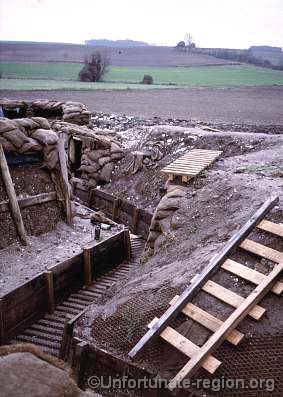 |
inverted 'A' frame covering the walkway.
This allows water to drain away underneath
(in theory...)
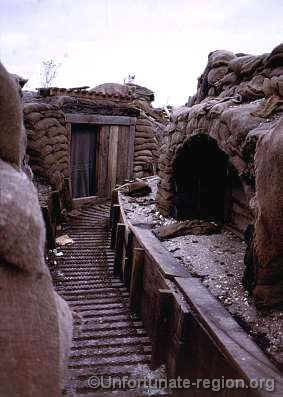 |
The frontline trench showing
a 'funkhole' on the rightand a deep dugout further on, on the left. The deep
dugout has a gas blanket covering the entrance.
Not only in life was Bernard Pitt a remarkable men, but even in death. It is fair to say that probably in most cases the true way a soldier died was hidden from his relatives by the soldier's friends and officers. A 'quick and painless death' with minimal mutilation (a sniper's bullet is therefore often mentioned) was often reported although this was not always the case.
Not so with Bernard Pitt, though. His wife Florence received a letter telling her that he had become the victim of an explosion and that witnesses were unable to find even the slightest bit of him. Basically she was told he was blown to bits.
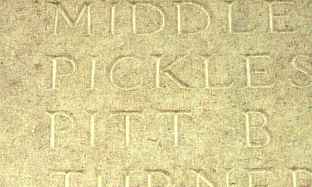 |
Bernard Pitt's
name on the Arras Memorial to the
'Missing'
at
Faubourg d'Amiens Cemetery.
| Casualty: | Second Lieutenant BERNARD PITT. | |
| Served With: | 10th Bn. attd. 47th Trench Mortar Battery, Border Regiment. | |
| Died: | 30th April 1916. | |
| Commemorated: | ARRAS MEMORIAL, Pas de Calais France, Bay 6. | |
| Additional Information: | Age 34. Son of Abraham Robert and Annie Pitt; husband of Florence Mary Pitt, of 11, Murray Avenue, Hounslow, Middx. | |
| The Arras Memorial is in the Faubourg-d'Amiens Cemetery, which is in the Boulevard du General de Gaulle in the western part of the town of Arras. The cemetery is near the Citadel, approximately 2 kilometres due west of the railway station. The Memorial commemorates almost 35,000 casualties of the British, New Zealand and South African Forces who died between Spring 1916 and 7th August 1918, with the exception of casualties of the Battle of Cambrai in 1917, and who have no known grave. The design, by Sir Edward Lutyens, consists of a cloister, 25 feet high and 380 feet long, built up on Doric columns and faces west. In the broader part of the site the colonnade returns to form a recessed and open court, terminated by an apse. The names of the casualties are carved on stone panels fixed to the cloister walls (information taken from the Commonwealth War Graves Commission website). | ||
|