Trumbull began his painting career in 1777. He went
to England to study briefly with Benjamin West in 1780, returning
in 1784 for a longer period. The critical era of his life, and
that of his finest work, was from 1784 to 1794. In March 1785
he wrote to his father, Jonathan Trumbull, Sr., that "the
great object of my wishes...is to take up the History of Our
Country, and paint the principal Events particularly of the late
War." (Connecticut Historical Society, quoted in Cooper
1982, 7) Influenced by the work of West and Copley, he completed
his first history painting, The Death of General Warren at the
Battle of Bunker's Hill (Yale University
Art Gallery), in March 1786. He began the composition of The
Declaration of Independence (Yale University
Art Gallery) while visiting Thomas Jefferson
in Paris that July. There he also visited private paintings collections
and met Jacques-Louis David and Jean-Antoine Houdon, travelling
to Germany and the Low Countries before going back to London.
Trumbull returned to the United States in the fall
of 1789. For the next four years he traveled along the East coast,
painting the portraits he needed for his history paintings. His
small oil portraits, his oil sketches for these history paintings,
and his life portraits, especially the full-lengths of the 1790's,
were influenced by his work with West and his knowledge of French
painting. His friendships with Jefferson, John
Adams and other political leaders gave him distinct advantages.
In 1794, after the death of his cousin Harriet Wadsworth
(1769- 1793), whom he wished to marry, he accepted an offer from
John Jay to serve as secretary with the Jay Treaty Commission
in London. He resumed his painting career in England in 1800,
the year he married Sarah Hope Harvey. He returned to the United
States in 1804, planning to settle in Boston. When he learned
that Gilbert Stuart intended to move there from Washington, he
went instead to New York, thinking that "Boston...did by
no means offer an adequate field of success for two rival artists"
(Autobiography, 1841, quoted in Cooper 1982, 13). His portraits
from this period were influential on the work of younger American
artists. He was elected to the board of directors of the New
York Academy of the Fine Arts (later the American Academy of
the Fine Arts). However the economic consequences of the Embargo
Act of 1807, restricting foreign trade, cut short his success.
He left in 1808 for Connecticut, and then for a sketching trip
through New York State and eastern Canada. He had been blinded
in one eye in a childhood accident, and returned to England with
is wife in 1809 for treatment of his failing eyesight. Some observers,
including contemporaries, attribute Trumbull's particular success
with small-scale paintings to this lack of full eyesight.
Trumbull and his wife returned to America at the end
of the War of 1812. In 1817 he received a commission for four
large history paintings for the rotunda of the United States
Capitol in Washington. That same year he was elected President
of the American Academy of the Fine Arts, which under his strict
guidance came in the 1820's to represent an older, more traditional
group of artists. He completed the Capitol pictures in 1824.
When he failed to receive further federal commissions, he turned
again to portraiture. In difficult financial straits, he offered
his painting collection to Yale College in return for an annuity.
The offer was accepted in 1831 and the Trumbull Gallery opened
the following year. His autobiography, written after he retired
from the presidency of the academy in 1836, recalls his long
career. He died in New York at the age of eighty-seven in 1843.
(This is an edited
version of the artist's biography published, or to be published,
in the
National Gallery of Art Systematic Catalogue) |

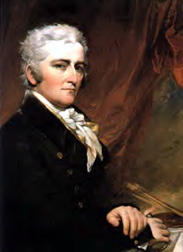

 John Trumbull